


Ahlia University, the first private university licensed in the Kingdom of Bahrain, housed in the Gosi Complex in Manama, has, as a body, systematically set and publicly stated completion targets for students who fall into the bottom 20% of household income group in the country. The Student Financial Inclusion and Access Policy (University Council Paper UC/P 613/2023 of 25 January 2023) fixes a completion rate for these students of at least 82% in 2022/23, the base year, 83% in 2023/24 and 85% in 2024/25, and requires that by 2024/25 the rate be within 3 percentage points of the rate for all students. The University Council confirmed both targets when it reviewed the policy by University Council Paper UC/P 757/2025 of 26 February 2025.
Completion here means that a student enrolled at the start of the academic year either graduated or was retained to the next academic year in good standing. In 2024/25 the University had 110 students from the bottom quintile on its own headcount base of 1,430, and 93 of them (85%) completed, against 88% for all students. Over the three academic years 2022/23 to 2024/25 the group numbered 293 student-years, of whom 245 (84%) completed, and 46 graduated (12, 15 and 19). The gap to all students fell from 4 points in 2022/23 to 3 points in 2023/24 and 2024/25, which meets the policy.
At a glance
Element of the question
| Completion target | Standing activity or document: At least 82%, 83% and 85% of the group complete the year; gap to all students of 3 points by 2024/25 Owner: Dean of Student Affairs; University Council Latest dated instance in 2025: Review, UC/P 757/2025 of 26 February 2025 Three-year figure: 245 of 293 completed |
|---|---|
| Graduation | Standing activity or document: Graduates from the bottom quintile counted every year Owner: Centre for Measurement and Evaluation Latest dated instance in 2025: Annual extract, Wednesday 18 June 2025 Three-year figure: 46 graduates |
| Measurement | Standing activity or document: Rates drawn from the student information system and compared with all students Owner: Centre for Measurement and Evaluation Latest dated instance in 2025: Annual extract, Wednesday 18 June 2025 Three-year figure: 3 annual extracts |
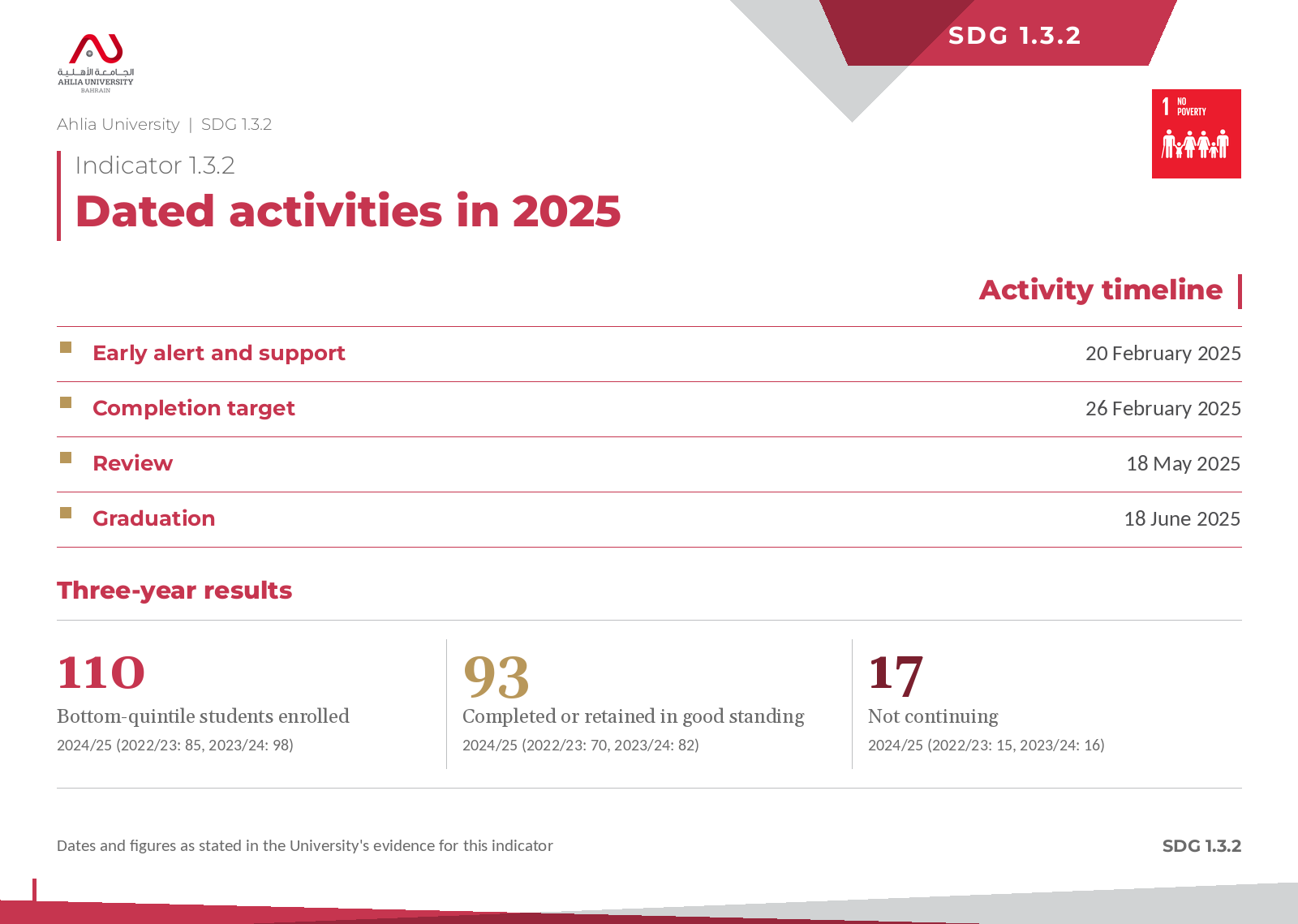
| Early alert and support | Standing activity or document: Risk list at week 6 of each semester, adviser and aid interview Owner: Student Counselling and Advising; Financial Aid and Scholarships office Latest dated instance in 2025: Spring risk list, Thursday 20 February 2025 Three-year figure: 48 students not continuing |
| Review | Standing activity or document: Committee review of results against targets Owner: Student Financial Assistance Committee Latest dated instance in 2025: Meeting, Sunday 18 May 2025 Three-year figure: 4 meetings in 2025 |
▪ Evidence for each element is cited in its own section below.
1. The completion and graduation targets
The Student Financial Inclusion and Access Policy sets two kinds of target for the students identified as bottom quintile under indicator 1.3.1. The first is a completion rate: 82% for 2022/23, 83% for 2023/24 and 85% for 2024/25. The second is a gap: the completion rate of the group should be no more than 3 percentage points below the rate for all students by 2024/25. The results were 82%, 84% and 85%, so the completion target was met in each year, and the gap was 4, 3 and 3 points against rates for all students of 86%, 87% and 88% (1,127 of 1,310, 1,196 of 1,375 and 1,258 of 1,430). The Dean of Student Affairs owns the targets, and the University Council reviews them each year with the access results, most recently on 24 December 2025 in University Council Paper UC/P 828/2025.
Graduation is reported beside completion. Students from the bottom quintile who graduated numbered 12 of 295 graduates in 2022/23, 15 of 310 in 2023/24 and 19 of 325 in 2024/25, which is 4%, 5% and 6% of all graduates and follows the rise in the number of students identified in the group. The Centre for Measurement and Evaluation, which already tracks the share of women who graduate compared with men, extends the same tracking to this group.
▪ Evidence: Student Financial Inclusion and Access Policy, UC/P 613/2023 of 25 January 2023, and its review, UC/P 757/2025 of 26 February 2025 [1]; annual access and completion report to the University Council, UC/P 828/2025 of 24 December 2025 [2].
2. How completion is measured
At the close of each academic year the Centre for Measurement and Evaluation extracts from the student information system the students flagged as bottom quintile by the Financial Aid and Scholarships office, using the consented income evidence described under indicator 1.3.1, and counts how many graduated or re-enrolled in good standing for the next semester. It compares the result with the same count for all students and sends aggregate figures only to the Dean of Student Affairs and the Student Financial Assistance Committee. The extract of 2025 was made on Wednesday 18 June 2025 and covered 110 students, of whom 93 completed and 17 did not continue. The extracts of 2023 and 2024 covered 85 and 98 students, with 15 and 16 not continuing.
The Centre records the reason when a student leaves, from the exit form or a call from the student's adviser: financial reasons, transfer to another university, employment, family reasons or academic dismissal. The reasons feed the review of the support described below. Individual cases are never reported.
▪ Evidence: annual extracts of the Centre for Measurement and Evaluation, 2022/23 to 2024/25, with the exit-reason register [3].
3. Early alert and support to complete
Each semester academic advisers list students with low attendance or low marks at week 6, and Student Counselling and Advising, which offers confidential, open-door guidance on academic, personal, social and psychological concerns, contacts those on the list. When a student in the group is on the list, the Financial Aid and Scholarships office offers an interview within five working days to look at instalment payment of fees, an emergency or hardship grant under the Student Hardship and Food Support Scheme (University Council Paper UC/P 586/2022 of 22 June 2022, reviewed by UC/P 762/2025 of 26 February 2025) and a place in the free AU Mentorship Programme, which pairs students with alumni, industry, academic or entrepreneur mentors in group sessions, with at least three sessions for each mentor and mentee. The Statistical Support Unit, open to all students and staff, helps with data work for coursework and graduation projects. The spring risk list of 2025 was issued on Thursday 20 February 2025 and 31 students from the group were offered an interview, of whom 24 took it up.
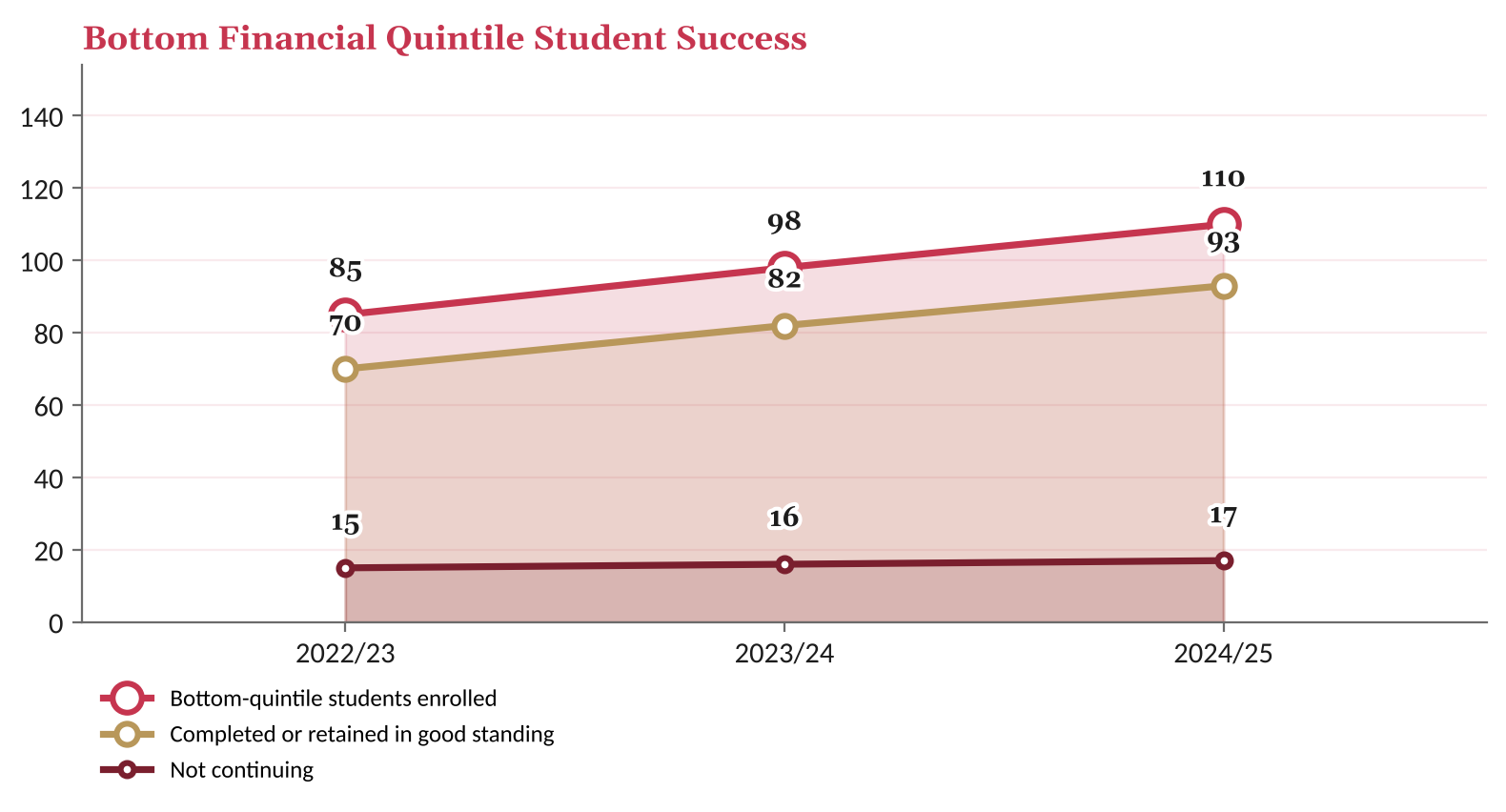
The measures work together as one targeted approach and are reported in detail under indicator 1.3.4. The retention results above are their combined effect: 70, 82 and 93 students completed in the three years.
▪ Evidence: risk lists and interview log, Student Counselling and Advising and the Financial Aid and Scholarships office, 2022/23 to 2024/25 [4]; Health and Wellbeing Services page, counselling services; AU Mentorship Programme page.
4. Review by the Committee and the University Council
The Student Financial Assistance Committee, formed by President's Decision No. 720/2022 of 4 September 2022 and re-formed by No. 720/2023 of 3 September 2023, No. 720/2024 of 1 September 2024 and No. 740/2025 of 7 September 2025, reviews the results against both targets at its May meeting and sets any corrective action. It met on Sunday 19 January, Sunday 18 May, Sunday 21 September and Sunday 7 December 2025, and the meeting of 18 May 2025 reviewed the extract of the Centre for Measurement and Evaluation and agreed to widen the week 6 risk list to include students who miss an instalment payment. The Dean of Student Affairs then reports to the University Council once a year, in the combined access and completion report received by UC/P 828/2025 of 24 December 2025.
▪ Evidence: minutes of the Student Financial Assistance Committee, 2025 [7].
Policy basis
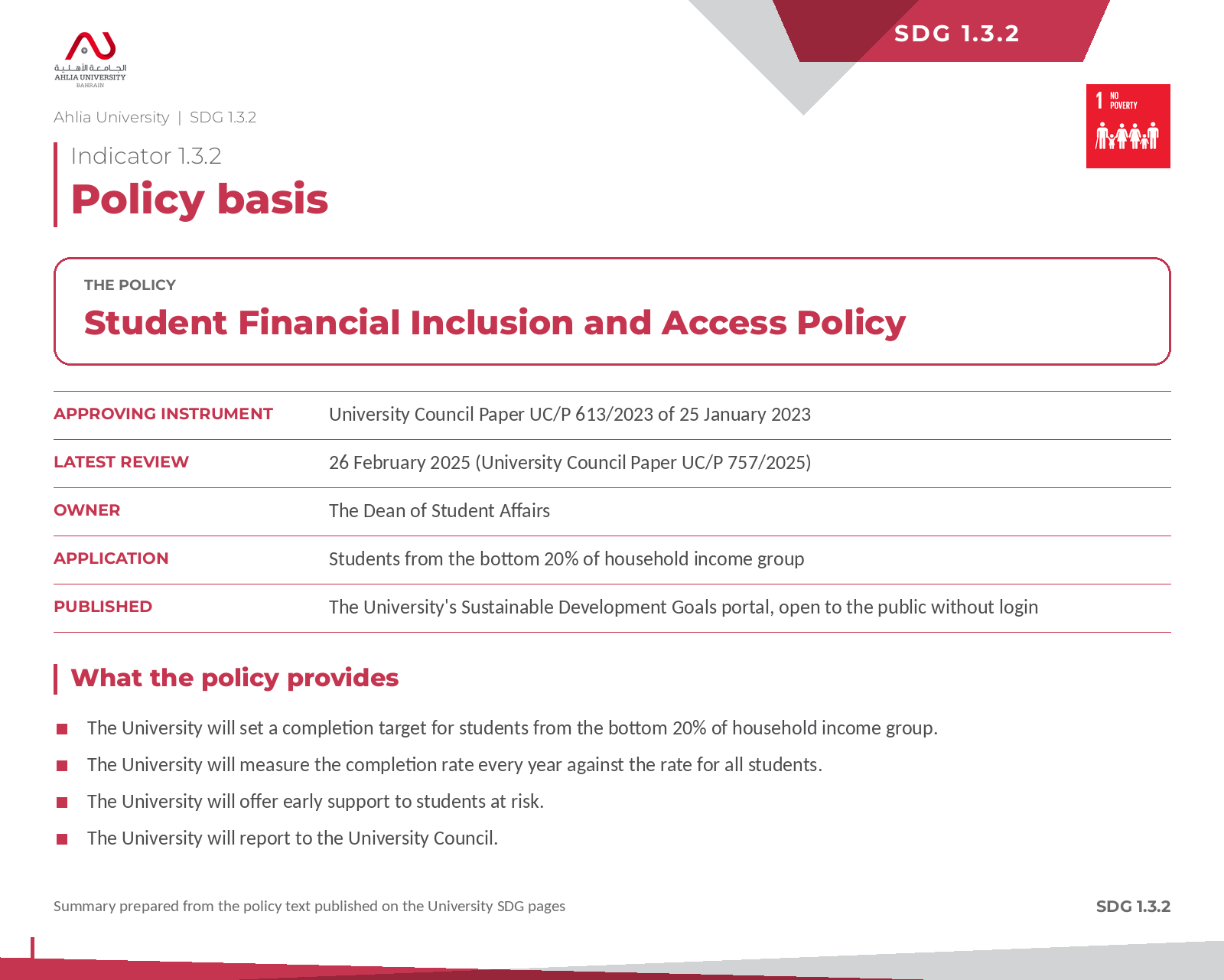
Title: Student Financial Inclusion and Access Policy. Approving instrument: University Council Paper UC/P 613/2023 of 25 January 2023; latest review: University Council Paper UC/P 757/2025 of 26 February 2025. Owner: the Dean of Student Affairs. The clauses that answer the question say that the University will set a completion target for students from the bottom 20% of household income group, will measure it every year against the rate for all students, will offer early support to students at risk and will report to the University Council. Application in 2024/25: target 85%, result 85% (93 of 110), gap to all students 3 points, 17 students not continuing. The policy is published on the University's Sustainable Development Goals portal.
Results by academic year
Students from the bottom 20% enrolled are counted on the student register at the start of each academic year: 85, 98 and 110, which is 293 student-years. Completed means graduated or retained to the next academic year in good standing: 70 + 82 + 93 = 245. Not continuing: 15 + 16 + 17 = 48. Each year the completed and not continuing lines add up to the enrolled line (70 + 15 = 85; 82 + 16 = 98; 93 + 17 = 110). The completion rate is completed divided by enrolled, rounded to a whole number. Graduates from the group are included in the completed line. All figures use the University's own headcount base.
| Indicator | 2022/23 | 2023/24 | 2024/25 |
|---|---|---|---|
| Bottom-quintile students enrolled | 85 | 98 | 110 |
| Completed or retained in good standing | 70 | 82 | 93 |
| Not continuing | 15 | 16 | 17 |
| Graduates from the bottom quintile | 12 | 15 | 19 |
| Completion rate, bottom 20% | 82% | 84% | 85% |
| Target for the bottom 20% | 82% | 83% | 85% |
Publication and verification
The evidence for this indicator was approved by University Council Paper UC/P 830/2026 of 14 January 2026 together with the 2025 edition of the SDG reports (University Council Paper UC/P 829/2026 of the same day, published 21 January 2026) and was published on the University's Sustainable Development Goals portal on 28 January 2026, open to the public without login. The underlying registers, which are the student information system extracts, the risk list and interview log, the exit-reason register and the minutes of the Student Financial Assistance Committee, are held by the Dean of Student Affairs and the Centre for Measurement and Evaluation and are quoted in the text above.
Evidence and references
- Student Financial Inclusion and Access Policy, University Council Paper UC/P 613/2023 of 25 January 2023, reviewed by UC/P 757/2025 of 26 February 2025, Dean of Student Affairs
- Annual access and completion report to the University Council, UC/P 828/2025 of 24 December 2025, Dean of Student Affairs
- Annual extracts and exit-reason register, Centre for Measurement and Evaluation, 2022/23 to 2024/25
- Risk lists and interview log, Student Counselling and Advising and Financial Aid and Scholarships office, 2022/23 to 2024/25
- Ahlia University: Health and Wellbeing Services page, Student Counselling and Guidance https://www.ahlia.edu.bh/health-and-wellbeing-services/
- Ahlia University: The AU Mentorship Programme, page of 10 October 2024 https://www.ahlia.edu.bh/the-au-mentorship-programme/
- Minutes of the Student Financial Assistance Committee, 19 January, 18 May, 21 September and 7 December 2025, Dean of Student Affairs