Ahlia University, the first private university licensed in the Kingdom of Bahrain, housed in the Gosi Complex in Manama, has, as a body, policies around use minimisation of plastic. The Waste, Hazardous Waste and Single-Use Plastics Policy (University Council Paper UC/P 627/2023 of 22 March 2023, reviewed by University Council Paper UC/P 757/2025 of 26 February 2025) sets the rules on single-use plastics: no single-use plastic bags, cutlery, plates, straws or stirrers are bought for the University or by its catering operator, free drinking water is provided so that bottled water is not bought, and plastic that cannot be avoided is collected for recycling. The University Policy on Healthy Environment, published on the Climate Action Policy page, adds that every member of the University is to re-think, reduce, re-use and recycle. Since the memorandum of understanding signed in April 2023 with the Bahraini Association for Parents and Friends of the Disabled, the plastic collected in all University facilities is given to the Association for recycling, to help pay for wheelchairs.
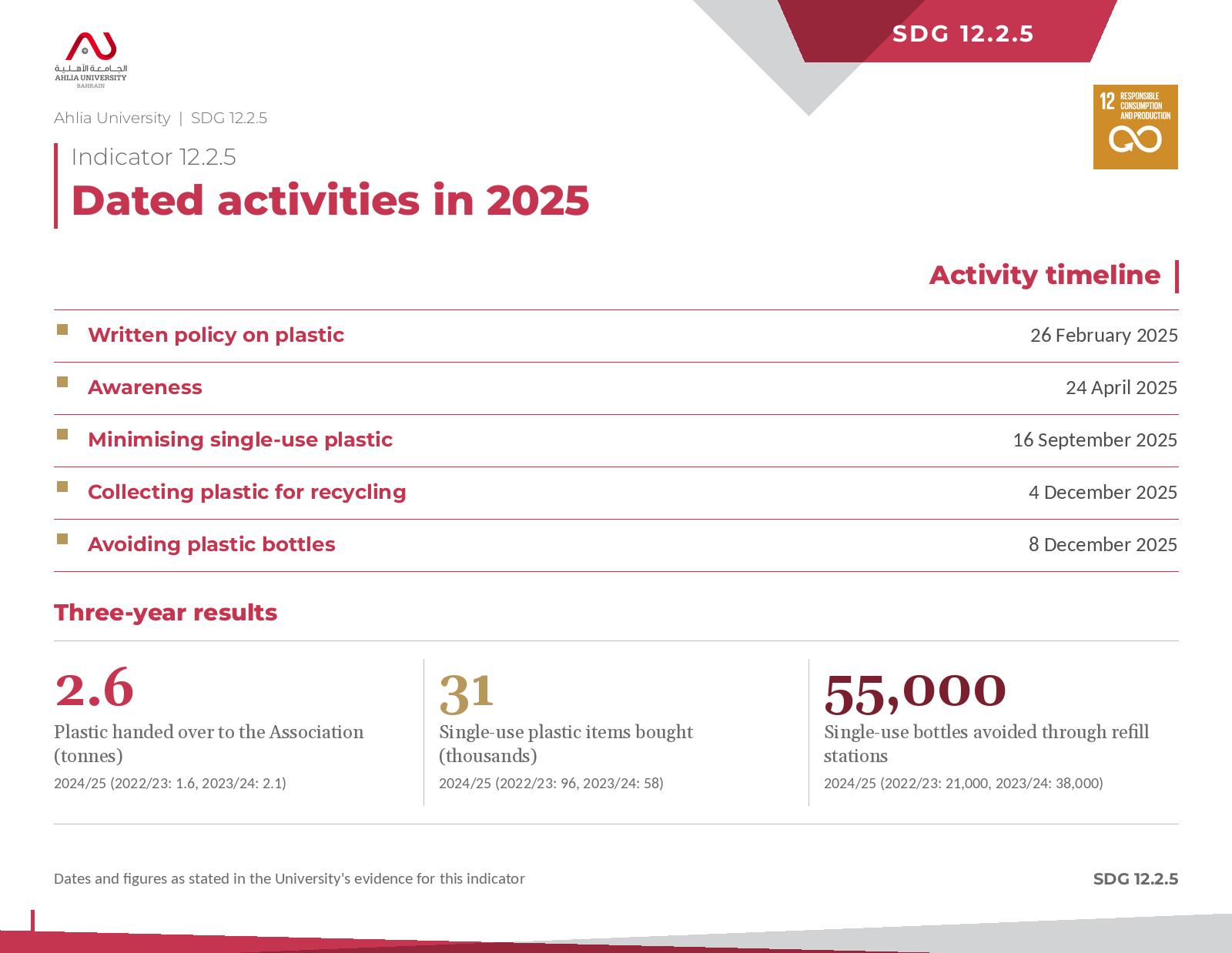
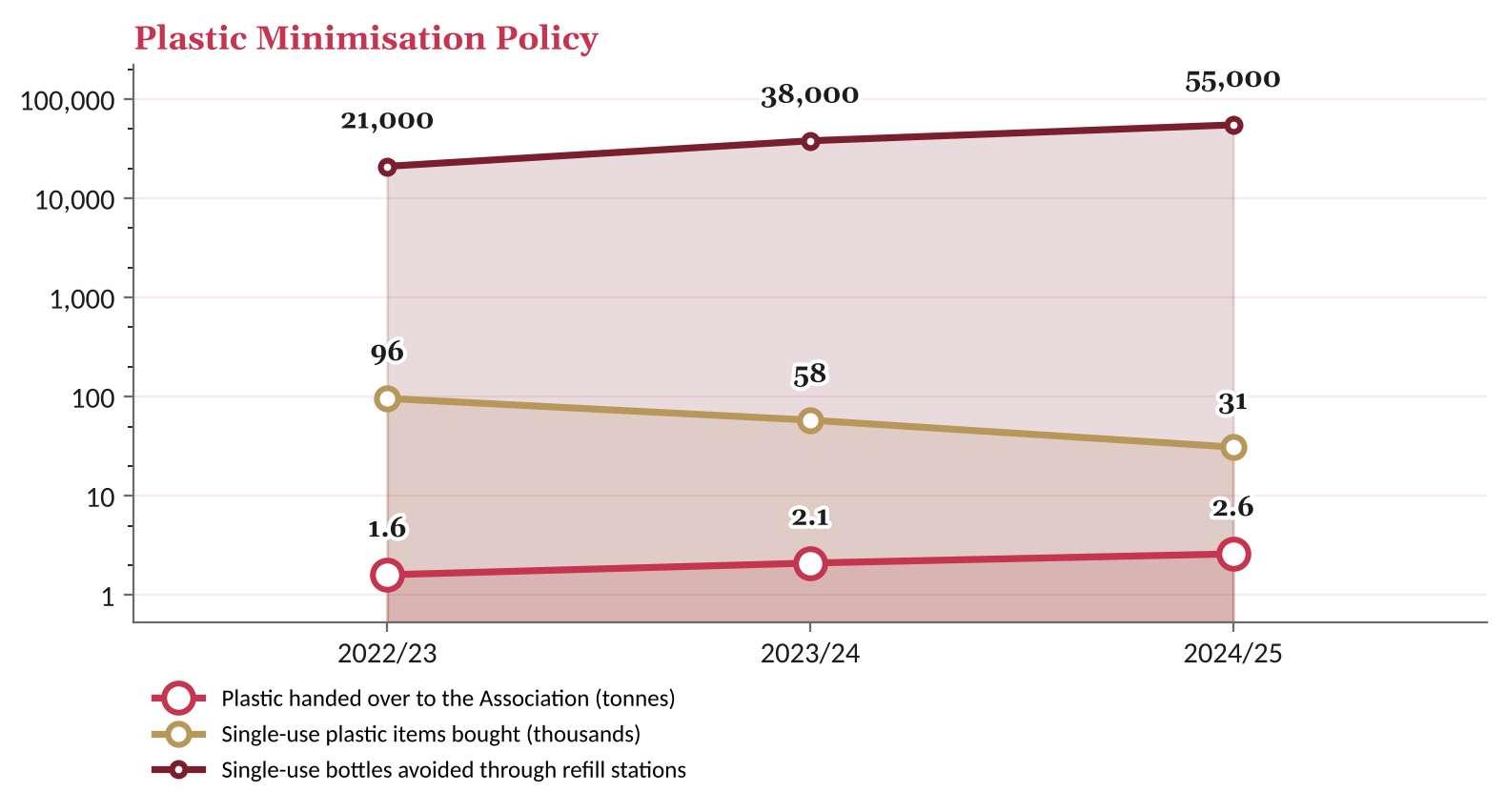
In 2025 the University and its catering operator bought 31,000 single-use plastic items, 68% fewer than the 96,000 of 2023, collected 2.6 tonnes of plastic for the Association and avoided 55,000 single-use bottles through its refill stations. Over the three academic years 2022/23 to 2024/25 the Association received 6.3 tonnes of plastic (1.6, 2.1 and 2.6).
At a glance
Element of the question
| Written policy on plastic | Standing document or practice: Waste, Hazardous Waste and Single-Use Plastics Policy; University Policy on Healthy Environment Owner: University Council; Facilities and Maintenance Latest dated instance in 2025: Review, UC/P 757/2025 of 26 February 2025 Three-year figure: 2 policies |
|---|---|
| Minimising single-use plastic | Standing document or practice: Ban on buying single-use plastic bags, cutlery, plates, straws and stirrers Owner: Procurement; Facilities and Maintenance Latest dated instance in 2025: Purchase review, Tuesday 16 September 2025 Three-year figure: 68% fewer items than in 2023 |
| Collecting plastic for recycling | Standing document or practice: Memorandum of understanding with the Bahraini Association for Parents and Friends of the Disabled; collection in all facilities Owner: Facilities and Maintenance; Sustainability Club Latest dated instance in 2025: Handover, Thursday 4 December 2025 Three-year figure: 6.3 tonnes handed over |
| Avoiding plastic bottles | Standing document or practice: Free refill stations, reported in detail under indicator 12.2.6 Owner: Facilities and Maintenance Latest dated instance in 2025: Committee review, Monday 8 December 2025 Three-year figure: 114,000 bottles avoided |
| Awareness | Standing document or practice: Plastic-Free Week and plastic-free events Owner: Sustainability Club; Dean of Student Affairs Latest dated instance in 2025: Plastic-Free Week, Sunday 20 to Thursday 24 April 2025 Three-year figure: 42 events |
▪ Evidence for each element is cited in its own section below.
1. The policies
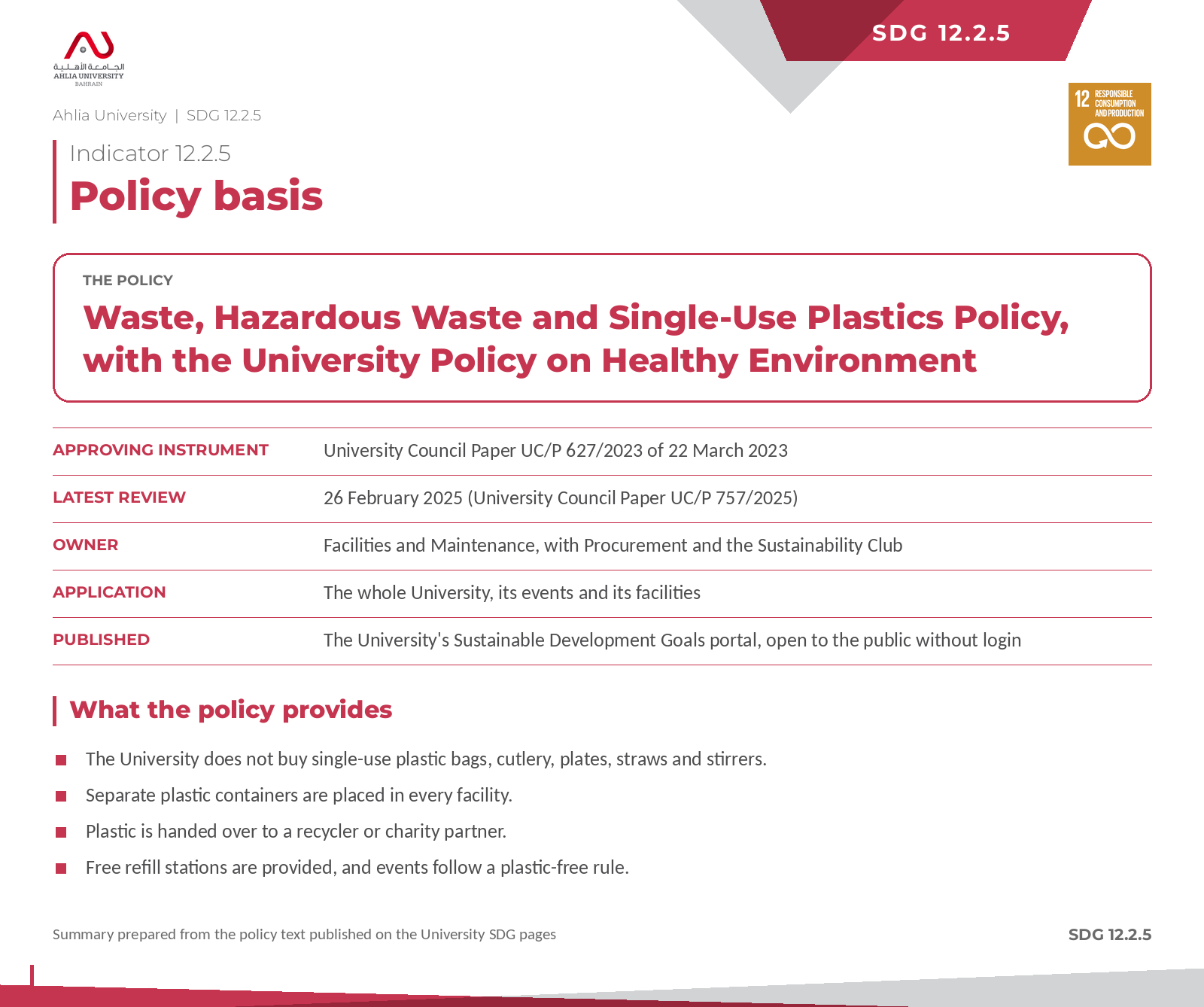
The Waste, Hazardous Waste and Single-Use Plastics Policy was approved by the University Council on 22 March 2023 and has a part on plastics. It tells Procurement not to buy single-use plastic bags, cutlery, plates, straws or stirrers, tells every unit to use reusable or paper and wood alternatives, and tells Facilities and Maintenance to keep a separate container for plastic in every facility and to hand the plastic to a recycler or to a charity partner. It rests on the University Policy on Healthy Environment, which asks every member of the University to re-think, reduce, re-use and recycle and to prevent the over-consumption of resources and reduce the production of waste [1]. The Sustainability Policy (University Council Paper UC/P 647/2023 of 21 June 2023) sets the wider commitment.
▪ Evidence: Climate Action Policy page, University Policy on Healthy Environment; Waste Policy, UC/P 627/2023 and review UC/P 757/2025 [2].
2. Minimising single-use plastic in operations
Procurement and the catering operator count the single-use plastic items they buy: bags, cutlery, plates, cups with plastic lids, straws and stirrers. The count was 96,000 items in 2023, 58,000 in 2024 and 31,000 in 2025, which is 40% fewer in 2024 and 68% fewer in 2025 than in 2023. The fall came from replacing plastic cutlery and plates with reusable crockery in the cafeteria and with paper and wood items for events, and from the clauses on plastics that the University adds to its service contracts, reported in detail under indicator 12.2.7. Procurement reviewed the purchases of the year on Tuesday 16 September 2025 and found no order of the banned items except for 4,000 plastic gloves for laboratories, which have no substitute.
▪ Evidence: purchase and stock records of single-use items, Procurement and the catering operator, 2023 to 2025 [3].
3. Collecting plastic for recycling and for the Association
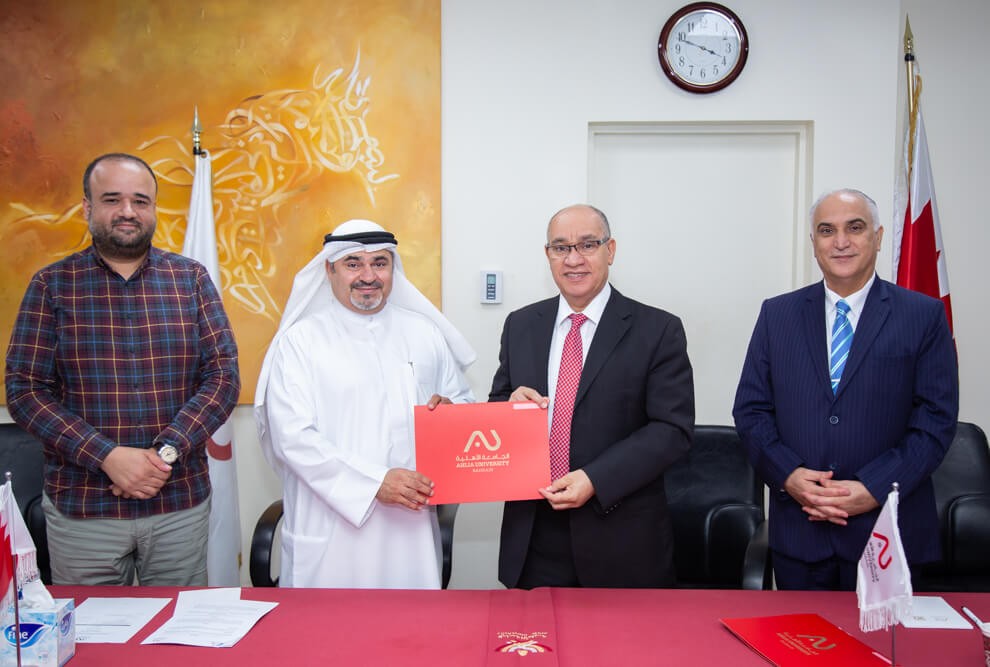
The University announced on Sunday 9 April 2023 that it had signed a memorandum of understanding with the Bahraini Association for Parents and Friends of the Disabled. The University supports the activities of the Association by collecting plastic materials in all University facilities and presenting them to the Association for recycling, to contribute to the purchase of the largest possible number of wheelchairs. The memorandum was signed for the University by its President and for the Association by its Chairman of the Board of Directors, Mr. Jassim Muhammad Siyadi [4]. The Recycle and Donate campaign collected 1,675.3 kg of plastic to the end of 2022/23; the CAQA SDG Commitment 2020 to 2023 reports 1,619.7 kg donated under the campaign Do not bin it, donate it. The donation is equal to two specially designed wheelchairs, as the University's Sustainable Development Goals page records, and it was reported in the press in November 2023 [5].
Facilities and Maintenance keeps a plastic container beside the dry waste containers on every floor and in the cafeteria, the library and the laboratories. It weighs the plastic at each handover and the Association gives a receipt. The plastic handed over, as weighed at each handover and entered in the register by calendar year, was 1.6 tonnes in 2023, 2.1 tonnes in 2024 and 2.6 tonnes in 2025, in 4 handovers in 2025, the last on Thursday 4 December 2025. The plastic is part of the recycled dry waste reported in detail under indicator 12.2.4.
▪ Evidence: memorandum of understanding with the Bahraini Association for Parents and Friends of the Disabled, news item of 9 April 2023; Ahlia University Sustainable Development Goals page, campaign figure [5]; handover receipts, Facilities and Maintenance, 2023 to 2025 [3].
4. Avoiding plastic bottles
The University does not buy bottled water for meetings or events and provides free refill stations on every floor. Counters on the stations recorded 21,000 refills of a half-litre bottle in 2023, 38,000 in 2024 and 55,000 in 2025, and each refill avoids one single-use bottle, so that the stations avoided 114,000 bottles in three years. The stations, the counters and the result are reported in detail under indicator 12.2.6 and indicator 6.3.3, and the figure is repeated here only so that the plastic result is complete.
▪ Evidence: refill counter readings and station register, Facilities and Maintenance, 2023 to 2025 [3].
5. Awareness
The Sustainability Club, the student-led society of the University, runs a Plastic-Free Week each April and asks every organiser of an event to follow the plastic-free rule: no bags, no single-use cutlery, no bottled water. The Week of 2025 was held from Sunday 20 to Thursday 24 April 2025, with a stand in the cafeteria, a collection challenge between the five colleges and a reuse exchange for bags and containers. The University held 9 plastic-free events in 2023, 14 in 2024 and 19 in 2025, 42 in three years, among them the open days, the graduation ceremonies and the public lectures. The University Sustainability Committee received the plastic figures at its meeting of Monday 8 December 2025.
▪ Evidence: Ahlia Sustainability Club activity record, 2023 to 2025 [3]; minutes of the University Sustainability Committee, 8 December 2025 [6].
Policy basis
Title: Waste, Hazardous Waste and Single-Use Plastics Policy, with the University Policy on Healthy Environment. Approving instrument: University Council Paper UC/P 627/2023 of 22 March 2023, reviewed by University Council Paper UC/P 757/2025 of 26 February 2025; the University Policy on Healthy Environment is published on the Climate Action Policy page. Owner: Facilities and Maintenance, with Procurement and the Sustainability Club. The clauses that answer the question are the ban on buying single-use plastic bags, cutlery, plates, straws and stirrers, the separate plastic containers in every facility, the handover of plastic to a recycler or charity partner, the free refill stations and the plastic-free rule for events. Application in 2024/25: 31,000 single-use items bought, 2.6 tonnes of plastic handed over and 19 plastic-free events. The Policy is published on the University's Sustainable Development Goals portal.
▪ Evidence: policy text and review record [2]; Climate Action Policy page.
Results by academic year
Registers are kept by calendar year, so the 2022/23 column is calendar 2023, 2023/24 is 2024 and 2024/25 is 2025. Plastic handed over is the weight in tonnes receipted by the Association (1.6 + 2.1 + 2.6 = 6.3). Single-use plastic items are those bought by the University and its catering operator, in thousands. Bottles avoided are the refill counter readings, which are reported in detail under indicator 12.2.6 (21,000 + 38,000 + 55,000 = 114,000). Plastic-free events are the events held under the rule (9 + 14 + 19 = 42). The reduction is measured against 96 thousand items in 2023: (96 - 58) / 96 = 40% and (96 - 31) / 96 = 68%.
| Indicator | 2022/23 | 2023/24 | 2024/25 |
|---|---|---|---|
| Plastic handed over to the Association (tonnes) | 1.6 | 2.1 | 2.6 |
| Single-use plastic items bought (thousands) | 96 | 58 | 31 |
| Single-use bottles avoided through refill stations | 21,000 | 38,000 | 55,000 |
| Plastic-free events | 9 | 14 | 19 |
| Reduction in single-use plastic items against 2023 | 0% | 40% | 68% |
Publication and verification
This document, which is the University's evidence for indicator 12.2.5 and is kept by Facilities and Maintenance and the SDG Unit within CAQA, was approved by University Council Paper UC/P 830/2026 of 14 January 2026 together with the 2025 edition of the SDG reports (University Council Paper UC/P 829/2026 of the same day, published 21 January 2026) and published on the University's Sustainable Development Goals portal on 28 January 2026, open to the public without login. The underlying registers, which are the purchase and stock records of single-use items, the handover receipts of the Association, the refill counter readings and the activity record of the Sustainability Club, are held by Facilities and Maintenance and the SDG Unit within CAQA and are quoted in the text above.
Evidence and references
- Ahlia University: Climate Action Policy page (University Policy on Healthy Environment; Waste Management and Recycling; page modified 24 May 2024) https://www.ahlia.edu.bh/climate-action-policy/
- Waste, Hazardous Waste and Single-Use Plastics Policy, University Council Paper UC/P 627/2023 of 22 March 2023, reviewed by UC/P 757/2025 of 26 February 2025, Facilities and Maintenance
- Purchase and stock records of single-use items, handover receipts of plastic, refill counter readings and Sustainability Club activity record, 2023 to 2025, Procurement, Facilities and Maintenance and the Sustainability Club
- Ahlia University: news item of 9 April 2023, memorandum of understanding with the Bahraini Association for Parents and Friends of the Disabled https://www.ahlia.edu.bh/ahlia-university-signs-an-mou-with-the-bahraini-association-for-parents-of-the-disabled/
- Ahlia University: Sustainable Development Goals page (CAQA SDG Commitment 2020 to 2023, campaign 'do not bin it donate it', 1,619.7 kg of plastics, page modified 24 March 2025); Ahlia University page on the Recycle and Donate campaign (1,675.3 kg of plastic to the end of 2022/23, page modified 28 April 2025); University World News, November 2023, report on the campaign
- Minutes of the University Sustainability Committee, Monday 8 December 2025, SDG Unit