Ahlia University, the first private university licensed in the Kingdom of Bahrain, housed in the Gosi Complex in Manama, systematically measures, as a body, the amount of food waste generated from food served within the University, for the whole university. The measurement covers the cafeteria service on the premises of the University in the Gosi Complex, which has three outlets: the cafeteria, the Food Court on the second floor and the coffee and snack counter, all run by one licensed catering operator under contract, which is all the food served on the premises. It is required by the Standard for Food Outlets on the Premises (Administrative Circular No. 901/2022 of 10 November 2022), which obliges the operator to weigh food waste at every service, and it is recorded in the register of the Sustainability Data Register Procedure (Administrative Circular No. 820/2022 of 13 October 2022), kept by Facilities and Maintenance and consolidated each quarter by the SDG Unit. The Waste, Hazardous Waste and Single-Use Plastics Policy (University Council Paper UC/P 627/2023 of 22 March 2023, reviewed by University Council Paper UC/P 757/2025 of 26 February 2025) is the policy basis.
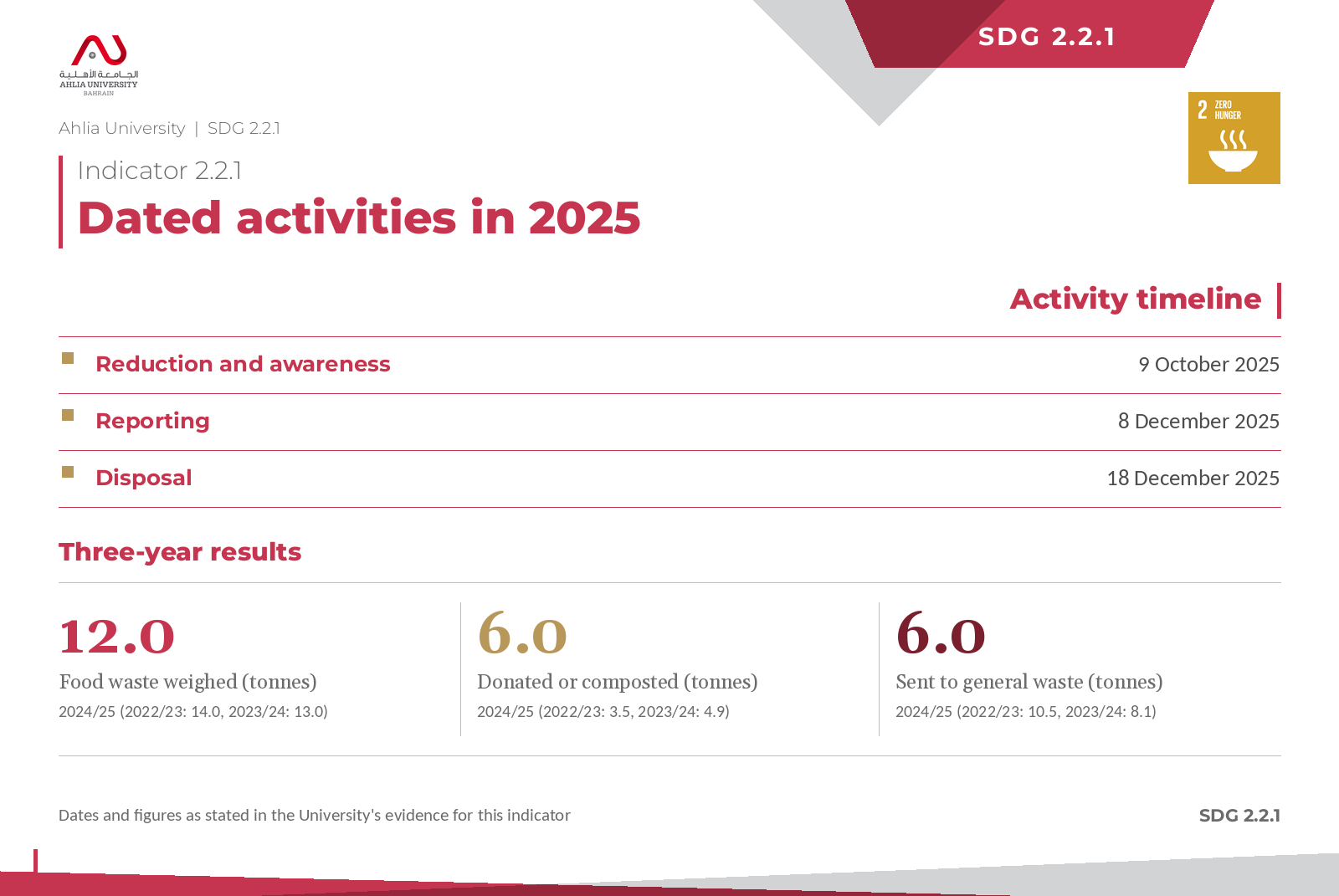
The register is kept by calendar year, and the 2022/23 column is calendar 2023, 2023/24 is 2024 and 2024/25 is 2025, so that events of September to December 2025 are counted in 2024/25. In 2025 the outlets generated 12 tonnes of food waste for 124,000 meals served, which is 97 grams a meal, and 50% of it (6.0 tonnes) was donated or composted. Over the three years the weighing recorded 39 tonnes (14, 13 and 12), of which 14.4 tonnes were donated or composted.
At a glance
Element of the question
| Scope of measurement | Standing activity or document: All three outlets of the cafeteria service, whole university Owner: Facilities and Maintenance Latest dated instance in 2025: Quarterly consolidation, Thursday 9 October 2025 Three-year figure: 3 outlets |
|---|---|
| Weighing method | Standing activity or document: Daily weighing of preparation, plate and unserved food on calibrated scales Owner: Catering operator; Facilities and Maintenance Latest dated instance in 2025: Food Waste Week, Sunday 5 to Thursday 9 October 2025 Three-year figure: 39 tonnes weighed |
| Reporting | Standing activity or document: Monthly totals to the SDG Unit; yearly figure to the University Council Owner: SDG Unit Latest dated instance in 2025: Meeting of the University Sustainability Committee, Monday 8 December 2025 Three-year figure: 3 yearly figures |
| Disposal | Standing activity or document: Donation of safe surplus and off-site composting; the rest to general waste Owner: Facilities and Maintenance Latest dated instance in 2025: Last donation of 2025, Thursday 18 December 2025 Three-year figure: 14.4 tonnes donated or composted |
| Reduction and awareness | Standing activity or document: Portion options, reusable containers and the Green Solutions for Leftovers session Owner: Sustainability Club; College of Business and Finance Latest dated instance in 2025: Food Waste Week, 5 to 9 October 2025 Three-year figure: 3 weeks of awareness |
▪ Evidence for each element is cited in its own section below.
1. What is measured and where
The measurement covers all food served within the University: the cafeteria, the Food Court on the second floor and the coffee and snack counter, which are run by one licensed catering operator under contract with the University. No other food service operates on the premises, and food served at an event is bought from the same operator, so the weighing covers the whole University and is not a sample. Three kinds of food waste are separated and weighed: preparation waste from the kitchen, plate waste returned by diners and unserved food. In 2025 preparation waste was 4.2 tonnes and plate waste, including unserved food, 7.8 tonnes, which is 12.0 tonnes; in 2024 the figures were 4.4 and 8.6 tonnes (13.0) and in 2023 they were 4.6 and 9.4 tonnes (14.0).
▪ Evidence: Standard for Food Outlets on the Premises, Administrative Circular No. 901/2022 of 10 November 2022 [1]; food waste register, Facilities and Maintenance, 2023 to 2025 [2].
2. How the weighing is done and checked
Staff of the operator weigh each bin at the end of every service on a scale calibrated each year, to 0.1 kilogram, and enter the weight on the daily log with the date, the outlet and the kind of waste. Facilities and Maintenance countersigns the log each week, adds the days to a monthly total and sends it to the SDG Unit. The Sustainability Club checks the log by spot audits and, once a year, in Food Waste Week, when students weigh and display the plate waste of the day. The week was held from Sunday 1 to Thursday 5 October 2023, from Sunday 6 to Thursday 10 October 2024 and from Sunday 5 to Thursday 9 October 2025. The number of meals served comes from the till records of the operator and is used to give grams per meal: 118,000 meals in 2023, 121,000 in 2024 and 124,000 in 2025, which is 119, 107 and 97 grams a meal.
▪ Evidence: daily weighing logs and till records, catering operator and Facilities and Maintenance, 2023 to 2025 [3]; Sustainability Data Register Procedure, Administrative Circular No. 820/2022 of 13 October 2022 [4].
3. What happens to the food waste
Climate Action Plan 3.2 on waste management commits the University to maintain waste segregation so that recyclables are processed by specialised waste companies. For food waste the operator separates safe surplus food, which is donated to a registered food donation society, and organic waste, which is composted off site by a licensed partner; the rest goes to general waste collected by specialised companies. The share donated or composted was 25% in 2023 (3.5 tonnes), 38% in 2024 (4.9 tonnes) and 50% in 2025 (6.0 tonnes), so the waste left for general disposal fell from 10.5 to 8.1 and 6.0 tonnes. The last donation of 2025 was on Thursday 18 December 2025.
▪ Evidence: Climate Action Plan, section 3.2; donation and composting receipts, Facilities and Maintenance, 2023 to 2025 [3].
4. Reducing and understanding food waste
The weighing is used to cut waste. The operator offers small and large portions, sells a pre-order meal for events, and the University encourages the use of reusable containers. Food waste fell by 14% from 2023 to 2025, and per meal by 18%, from 119 to 97 grams. The University also teaches the subject. On Wednesday 3 May 2023, from 12:00 to 13:30 in the Ahlia University Theatre, the College of Business and Finance invited Ms Manal Bucheery to give the session Green Solutions for Leftovers on the negative effects of wasting food, the environmental, economic and social importance of recycling waste and green solutions for leftovers. The University Sustainability Committee, which met on Monday 17 February, Monday 19 May, Monday 29 September and Monday 8 December 2025, received the figures at its December meeting.
▪ Evidence: Green Solutions for Leftovers event page; minutes of the University Sustainability Committee, 2025 [7].
Policy basis
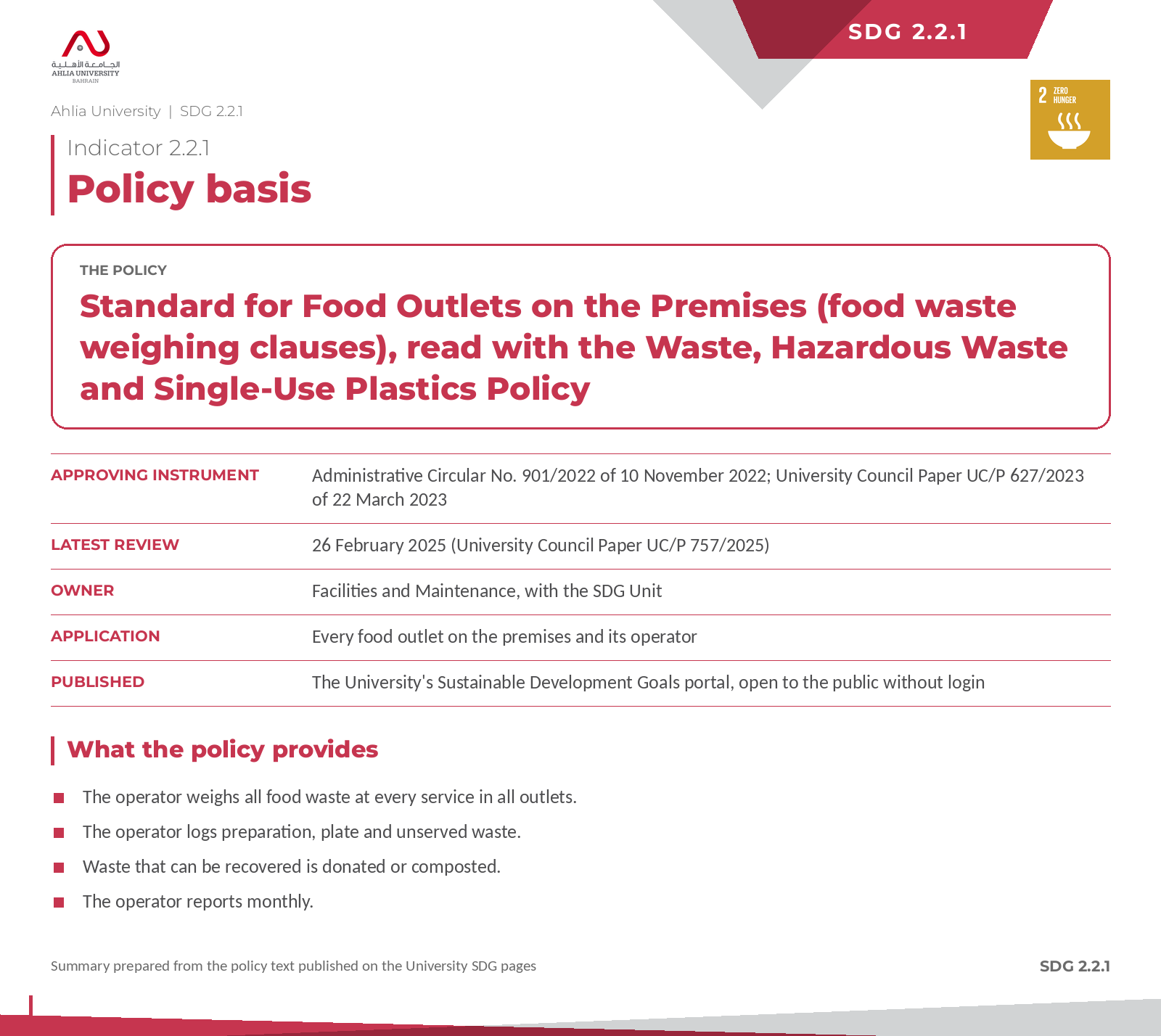
Title: Standard for Food Outlets on the Premises (food waste weighing clauses), read with the Waste, Hazardous Waste and Single-Use Plastics Policy. Approving instruments: Administrative Circular No. 901/2022 of 10 November 2022; University Council Paper UC/P 627/2023 of 22 March 2023; latest review: University Council Paper UC/P 757/2025 of 26 February 2025. Owner: Facilities and Maintenance, with the SDG Unit. The clauses that answer the question require the operator to weigh all food waste at every service in all outlets, to log preparation, plate and unserved waste, to donate or compost what can be recovered and to report monthly. Application in 2025: 12.0 tonnes weighed, 6.0 tonnes donated or composted, 97 grams a meal. The Standard and the Policy are published on the University's Sustainable Development Goals portal.
▪ Evidence: Standard for Food Outlets, Administrative Circular No. 901/2022 [1], and Waste Policy, UC/P 627/2023 with its review UC/P 757/2025 [8].
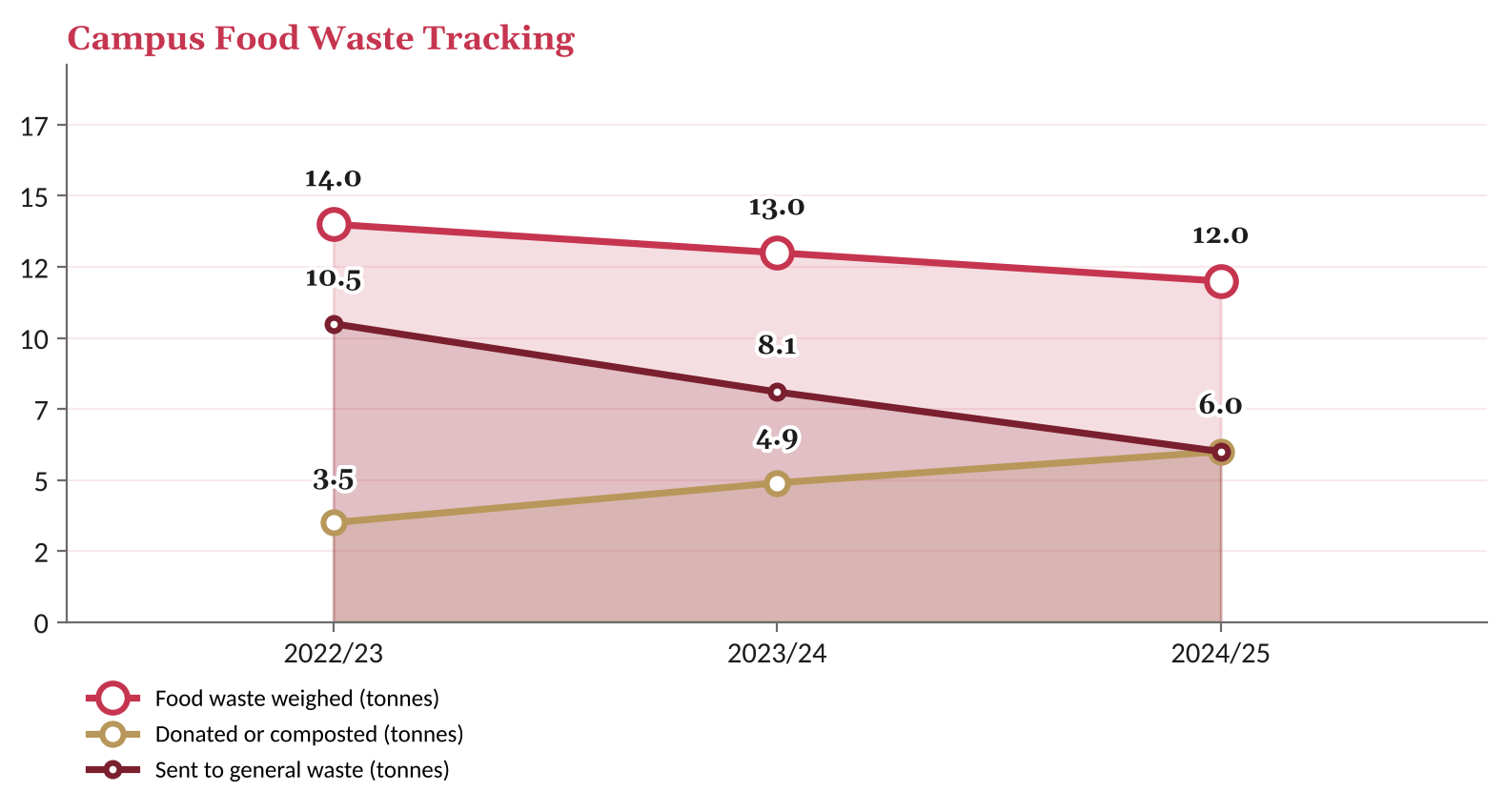
Results by academic year
Food waste is weighed at every service in all three outlets and recorded by calendar year: 2023 for 2022/23, 2024 for 2023/24 and 2025 for 2024/25, so events of September to December 2025 are in 2024/25. Weighed: 14, 13 and 12 tonnes, which is 39. Donated or composted: 25%, 38% and 50% of the weighed food, which is 3.5, 4.9 and 6.0 tonnes (3.5 + 10.5 = 14.0; 4.9 + 8.1 = 13.0; 6.0 + 6.0 = 12.0). The rest goes to general waste: 10.5, 8.1 and 6.0 tonnes. Meals served are in thousands (118, 121 and 124) and grams per meal are the weight divided by the meals: 14,000 kilograms for 118,000 meals is 119 grams.
| Indicator | 2022/23 | 2023/24 | 2024/25 |
|---|---|---|---|
| Food waste weighed (tonnes) | 14.0 | 13.0 | 12.0 |
| Donated or composted (tonnes) | 3.5 | 4.9 | 6.0 |
| Sent to general waste (tonnes) | 10.5 | 8.1 | 6.0 |
| Meals served (thousands) | 118 | 121 | 124 |
| Food waste per meal (grams) | 119 | 107 | 97 |
| Share donated or composted | 25% | 38% | 50% |
Publication and verification
The evidence for this indicator was approved by University Council Paper UC/P 830/2026 of 14 January 2026 together with the 2025 edition of the SDG reports (University Council Paper UC/P 829/2026 of the same day, published 21 January 2026) and was published on the University's Sustainable Development Goals portal on 28 January 2026, open to the public without login. The underlying registers, which are the daily weighing logs, the till records of meals served, the donation and composting receipts and the minutes of the University Sustainability Committee, are held by Facilities and Maintenance and the SDG Unit and are quoted in the text above.
Evidence and references
- Standard for Food Outlets on the Premises, Administrative Circular No. 901/2022 of 10 November 2022, Facilities and Maintenance
- Food waste register, Facilities and Maintenance, 2023 to 2025
- Daily weighing logs, donation and composting receipts and till records, catering operator and Facilities and Maintenance, 2023 to 2025
- Sustainability Data Register Procedure, Administrative Circular No. 820/2022 of 13 October 2022, Vice President for Administrative and Financial Affairs
- Ahlia University: Climate Action Plan, section 3.2 Waste Management https://www.ahlia.edu.bh/climate-action-plan/
- Ahlia University: Green Solutions for Leftovers, event of 3 May 2023 https://www.ahlia.edu.bh/events/green-solutions-for-leftovers/
- Minutes of the University Sustainability Committee, 17 February, 19 May, 29 September and 8 December 2025, SDG Unit
- Waste, Hazardous Waste and Single-Use Plastics Policy, University Council Paper UC/P 627/2023 of 22 March 2023, reviewed by UC/P 757/2025 of 26 February 2025