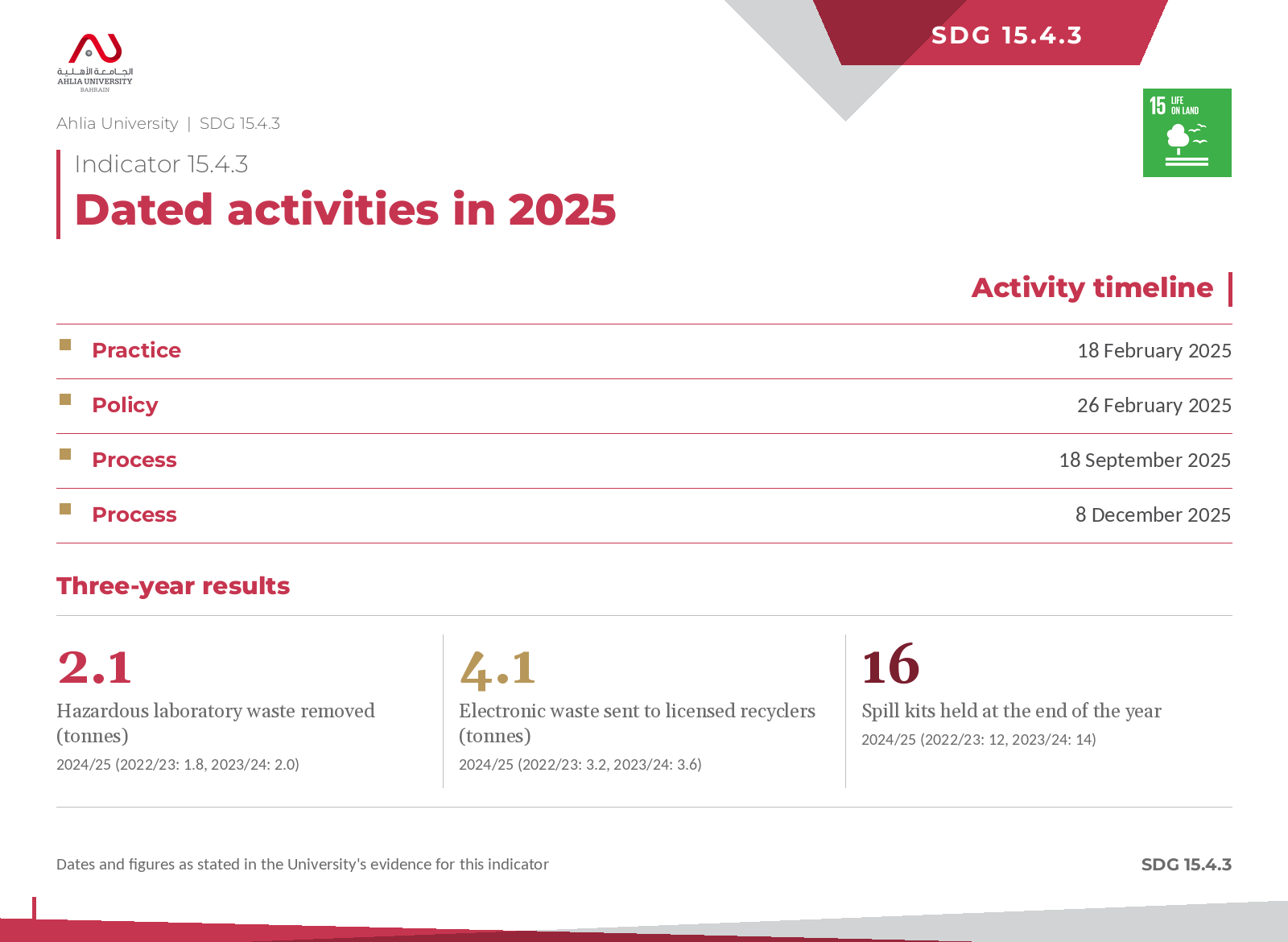
Ahlia University, the first private university licensed in the Kingdom of Bahrain, housed in the Gosi Complex in Manama, has, as a body, a policy, a process and a practice on waste disposal covering hazardous materials. The policy is the Waste, Hazardous Waste and Single-Use Plastics Policy (University Council Paper UC/P 627/2023 of 22 March 2023, reviewed by University Council Paper UC/P 757/2025 of 26 February 2025). The process is the collection of hazardous waste at source, its storage in a locked and inspected chemical store and its removal by licensed contractors, with a record of every consignment. The practice is that nothing hazardous goes to a drain or to the general waste. Hazardous materials are the items or agents, biological, chemical, radiological or physical, that can harm people, animals or the environment, and on the premises they are laboratory chemicals and rinse water, biological and sharp waste from the health laboratories and the clinic, electronic waste with batteries and toner, and cleaning products.
The figures are kept by calendar year, so that 2022/23 is calendar 2023, 2023/24 is 2024 and 2024/25 is 2025. The University sent 2.1 tonnes of hazardous laboratory waste and 4.1 tonnes of electronic waste to licensed contractors in 2025, which is 6.2 tonnes, against 5.0 tonnes in 2023 and 5.6 tonnes in 2024. Over the three years it sent 5.9 tonnes of hazardous laboratory waste and 10.9 tonnes of electronic waste, which is 16.8 tonnes, and none of it entered a drain.
At a glance
Element of the question
| Policy | Standing activity or document: Waste, Hazardous Waste and Single-Use Plastics Policy, hazardous waste clauses Owner: Facilities and Maintenance Latest dated instance in 2025: Review, UC/P 757/2025 of 26 February 2025 Three-year figure: 1 policy |
|---|---|
| Process: collection and storage | Standing activity or document: Labelled containers at source and a locked chemical store with safety data sheets Owner: Facilities and Maintenance; colleges with laboratories Latest dated instance in 2025: Chemical store inspection, Thursday 18 September 2025 Three-year figure: 6 inspections |
| Process: removal and disposal | Standing activity or document: Licensed hazardous waste contractors; licensed electronic waste recyclers; consignment records Owner: Facilities and Maintenance; Financial Affairs Directorate Latest dated instance in 2025: Committee review of the register, Monday 8 December 2025 Three-year figure: 16.8 tonnes removed |
| Practice: accidents and training | Standing activity or document: Spill kits, spill response course, incident register Owner: Facilities and Maintenance; Human Resources Directorate Latest dated instance in 2025: Spill response drill, Tuesday 18 February 2025 Three-year figure: 96 staff trained; 16 spill kits |
| Record and review | Standing activity or document: Waste register under Administrative Circular No. 820/2022 Owner: SDG Unit within CAQA Latest dated instance in 2025: Committee review, Monday 8 December 2025 Three-year figure: 3 annual registers |
▪ Evidence for each element is cited in its own section below.
1. The policy and the streams it covers
The hazardous waste clauses of the Policy name four streams. Laboratory chemicals and contaminated rinse water come from the laboratories of the College of Engineering, the College of Information Technology and the College of Medical and Health Sciences. Biological and sharp waste comes from the health laboratories and from the University clinic and health services, and is packed in sealed rigid containers. Electronic waste, which includes computers, batteries and toner cartridges, comes from the offices and laboratories. Cleaning products, which are bought only with a safety data sheet, are the fourth. The University holds no radioactive source, and the Policy forbids the purchase of one without the approval of the Vice President for Academic Affairs and the national authority. Lighting is LED throughout, so the University does not buy lamps that contain mercury. The Climate Action Policy page records that waste is collected in separate containers by specialised waste management companies, and the Policy extends the rule to hazardous streams.
▪ Evidence: Waste, Hazardous Waste and Single-Use Plastics Policy, UC/P 627/2023 with its review UC/P 757/2025 [1]; Climate Action Policy page, separate collection of waste.
2. The process: from the bench to the contractor
The process has five steps. Hazardous waste is separated at the place where it arises and put into a labelled container that names the substance and the date. The container is carried to the chemical store, a locked room with safety data sheets on the door and spill trays, where it is entered in the store register. A licensed hazardous waste contractor, engaged through the Financial Affairs Directorate, collects the containers and signs a consignment note that gives the kind and the weight of the waste. Electronic waste goes to a licensed recycler in the same way, with the data on computers wiped before they leave. Facilities and Maintenance keeps the consignment notes for five years and enters the weights in the waste register. Chemicals, solvents and reagents are never poured to a drain, which is also the rule of the discharge standards reported under indicator 15.4.1.
▪ Evidence: store register, consignment notes and waste register, Facilities and Maintenance and Financial Affairs Directorate, 2023 to 2025 [3].
3. The practice in 2023 to 2025
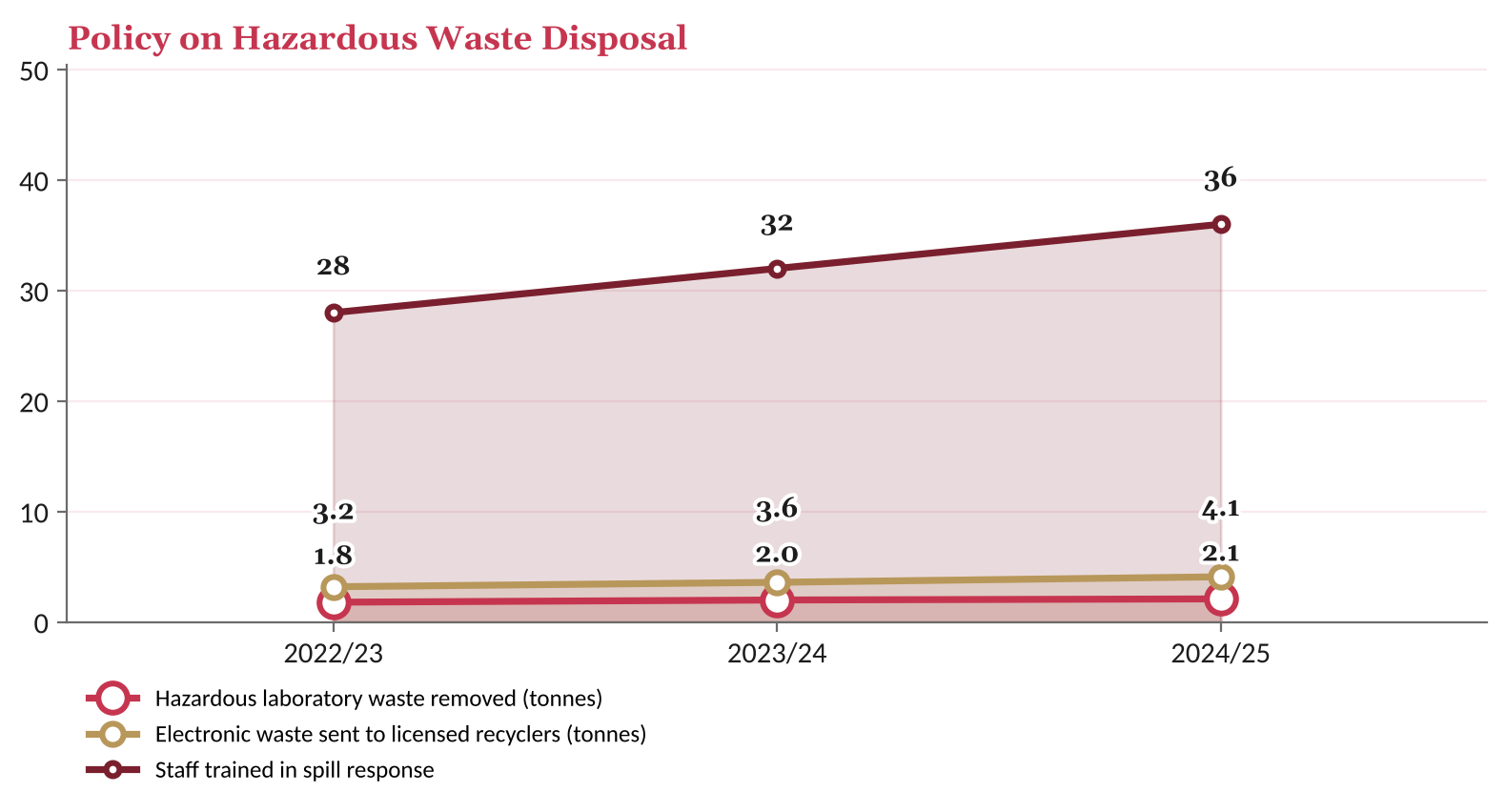
The University sent 1.8 tonnes of hazardous laboratory waste to the contractors in 2023, 2.0 tonnes in 2024 and 2.1 tonnes in 2025, and 3.2, 3.6 and 4.1 tonnes of electronic waste to licensed recyclers, which makes 5.0, 5.6 and 6.2 tonnes. These tonnages are reported in detail under indicator 12.2.3. The chemical store was inspected twice a year, on Thursday 27 February 2025 and Thursday 18 September 2025 in the last year, with no finding on storage or labelling, which makes 6 inspections in three years. The University held 12 spill kits at the end of 2023, 14 at the end of 2024 and 16 at the end of 2025. Its staff who handle chemicals, oil and cleaning products numbered 28, 32 and 36 in the spill response course, which is 96 in three years, and the last drill, on Tuesday 18 February 2025, contained a simulated oil spill in 6 minutes. The incident register holds 5, 4 and 3 incidents in the three years, and none reached a drain; the last, on Monday 13 October 2025, was a broken laboratory bottle of 200 millilitres of dilute acid that was caught in a spill tray and neutralised.
▪ Evidence: chemical store inspection sheets, spill-kit inventory, training sheets and incident register, Facilities and Maintenance and Human Resources Directorate, 2023 to 2025 [3].
4. Record and review
The consignment weights, the store register and the incident register are part of the waste register of the Sustainability Data Register Procedure (Administrative Circular No. 820/2022 of 13 October 2022), which the SDG Unit within the Centre for Accreditation and Quality Assurance (CAQA) consolidates each quarter. The University Sustainability Committee reviewed the register on Monday 8 December 2025 and confirmed that all the hazardous waste of the year had left the premises through licensed contractors and recyclers.
▪ Evidence: register, Administrative Circular No. 820/2022 [4]; Committee minutes, 8 December 2025 [5].
Policy basis
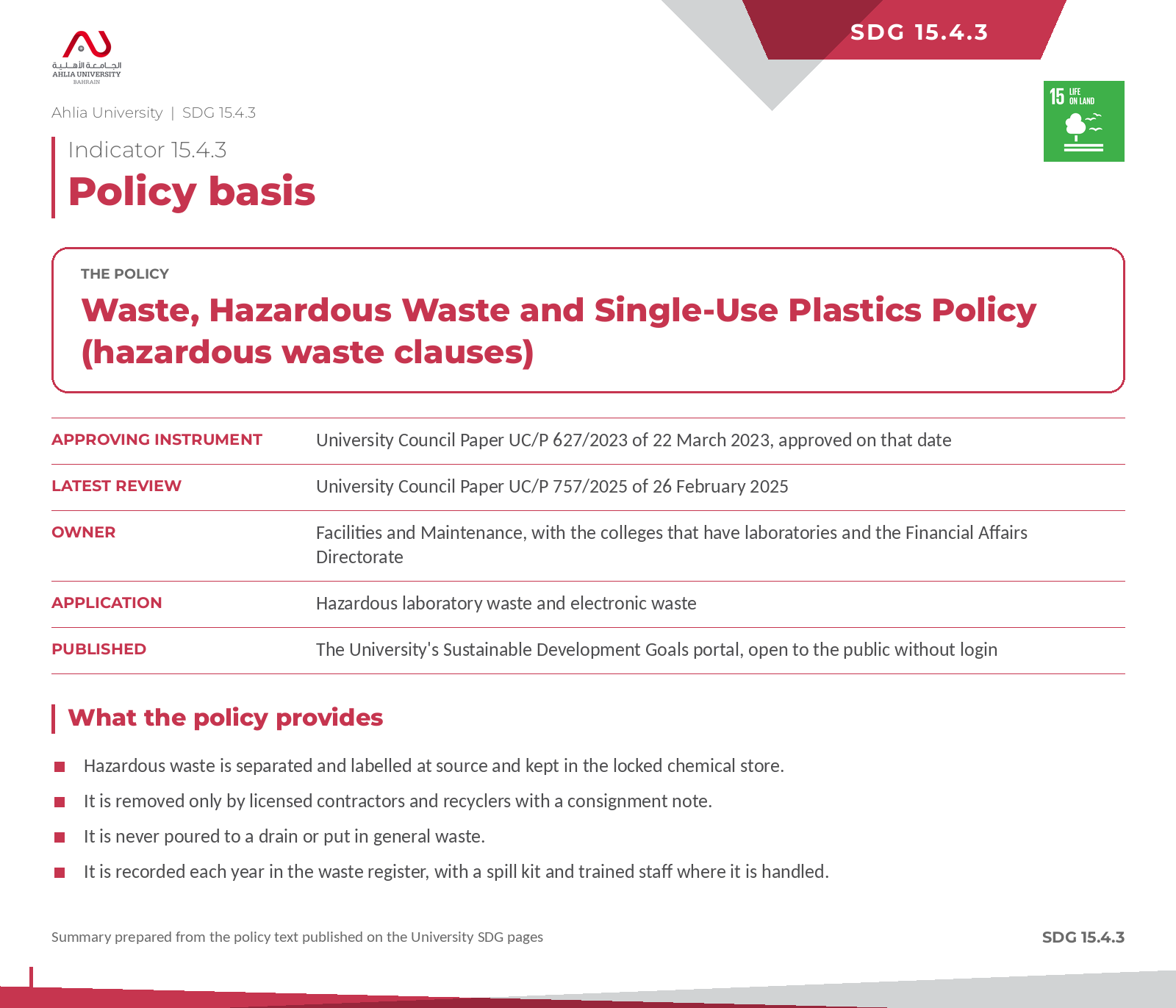
Title: Waste, Hazardous Waste and Single-Use Plastics Policy (hazardous waste clauses). Approving instrument: University Council Paper UC/P 627/2023 of 22 March 2023, approved on that date; latest review: University Council Paper UC/P 757/2025 of 26 February 2025. Owner: Facilities and Maintenance, with the colleges that have laboratories and the Financial Affairs Directorate. The clauses that answer the question require hazardous waste to be separated and labelled at source, kept in the locked chemical store, removed only by licensed contractors and recyclers with a consignment note, never poured to a drain or put in general waste, and recorded each year in the waste register, with a spill kit and trained staff at each place where it is handled. Application in 2024/25: 2.1 tonnes of hazardous laboratory waste and 4.1 tonnes of electronic waste removed, 2 inspections of the store, 16 spill kits. The Policy is published on the University's Sustainable Development Goals portal.
▪ Evidence: policy text and review record [1].
Results by academic year
Registers are kept by calendar year (2023, 2024 and 2025, read as 2022/23, 2023/24 and 2024/25) for the Gosi Complex premises. Hazardous laboratory waste is the weight on the consignment notes of the hazardous waste contractors: 1.8 + 2.0 + 2.1 = 5.9 tonnes. Electronic waste is the weight sent to licensed recyclers: 3.2 + 3.6 + 4.1 = 10.9 tonnes. Together they are 5.0, 5.6 and 6.2 tonnes, which is 16.8 tonnes. Spill kits are those held at the end of the year, and staff trained are those who completed the spill response course: 28 + 32 + 36 = 96. The share of hazardous waste removed by licensed contractors and recyclers is 100% in each year.
| Indicator | 2022/23 | 2023/24 | 2024/25 |
|---|---|---|---|
| Hazardous laboratory waste removed (tonnes) | 1.8 | 2.0 | 2.1 |
| Electronic waste sent to licensed recyclers (tonnes) | 3.2 | 3.6 | 4.1 |
| Spill kits held at the end of the year | 12 | 14 | 16 |
| Staff trained in spill response | 28 | 32 | 36 |
| Incidents that reached a drain | 0 | 0 | 0 |
| Share of hazardous waste removed by licensed contractors | 100% | 100% | 100% |
Publication and verification
This document, which is the University's evidence for indicator 15.4.3 and is kept by Facilities and Maintenance, with the colleges that have laboratories and the SDG Unit within CAQA, was approved by University Council Paper UC/P 830/2026 of 14 January 2026 together with the 2025 edition of the SDG reports (University Council Paper UC/P 829/2026 of the same day, published 21 January 2026) and published on the University's Sustainable Development Goals portal on 28 January 2026, open to the public without login. The underlying registers, which are the store register, the consignment notes, the waste register, the training sheets and the incident register, are held by the offices named above and are quoted in the text.
Evidence and references
- Waste, Hazardous Waste and Single-Use Plastics Policy, University Council Paper UC/P 627/2023 of 22 March 2023, reviewed by UC/P 757/2025 of 26 February 2025; owner Facilities and Maintenance
- Ahlia University: Climate Action Policy (waste collected in separate containers by specialised waste management companies; page modified 24 May 2024) https://www.ahlia.edu.bh/climate-action-policy/
- Store register, consignment notes, chemical store inspection sheets, spill-kit inventory, training sheets and incident register, Facilities and Maintenance, Financial Affairs Directorate and Human Resources Directorate, 2023 to 2025
- Sustainability Data Register Procedure, Administrative Circular No. 820/2022 of 13 October 2022; waste register, SDG Unit within CAQA
- Minutes of the University Sustainability Committee, 17 February, 19 May, 29 September and 8 December 2025, SDG Unit within CAQA