
Ahlia University (Ahlia), the first private university licensed in the Kingdom of Bahrain, as a body monitors the health of the aquatic ecosystem that it can observe and that it can affect, which is the Gulf shore at Manama, and does so at the level of a university with no marine laboratory. It records the condition of each shore section that its students clean, through the Shoreline Condition Record of the Coastal and Waterfront Clean-up Scheme (President's Decision No. 829/2024 of Tuesday 8 October 2024), and it monitors what its own premises send towards the sea through the batch logs of the Water Discharge Standards and Guidelines. Ahlia is an urban university housed in the Gosi Complex, Exhibition Road, Al-Hoora, Manama, a leased complex of two buildings with 10,386 m2 of built area. Its premises are not on the shore. It has no marine laboratory, aquarium, boat or fisheries programme, and it claims none: what it does for the sea is done through what leaves its premises, through what its students and the public learn, and through what its students do on the shore with partners. It does not sample sea water, count species or survey habitats, and it does not claim to; those tasks belong to the national authorities, and the University reports to them what its students see. The Dean of Student Affairs owns the Record, with the Sustainability Club, the student-led society of the University, and Facilities and Maintenance.
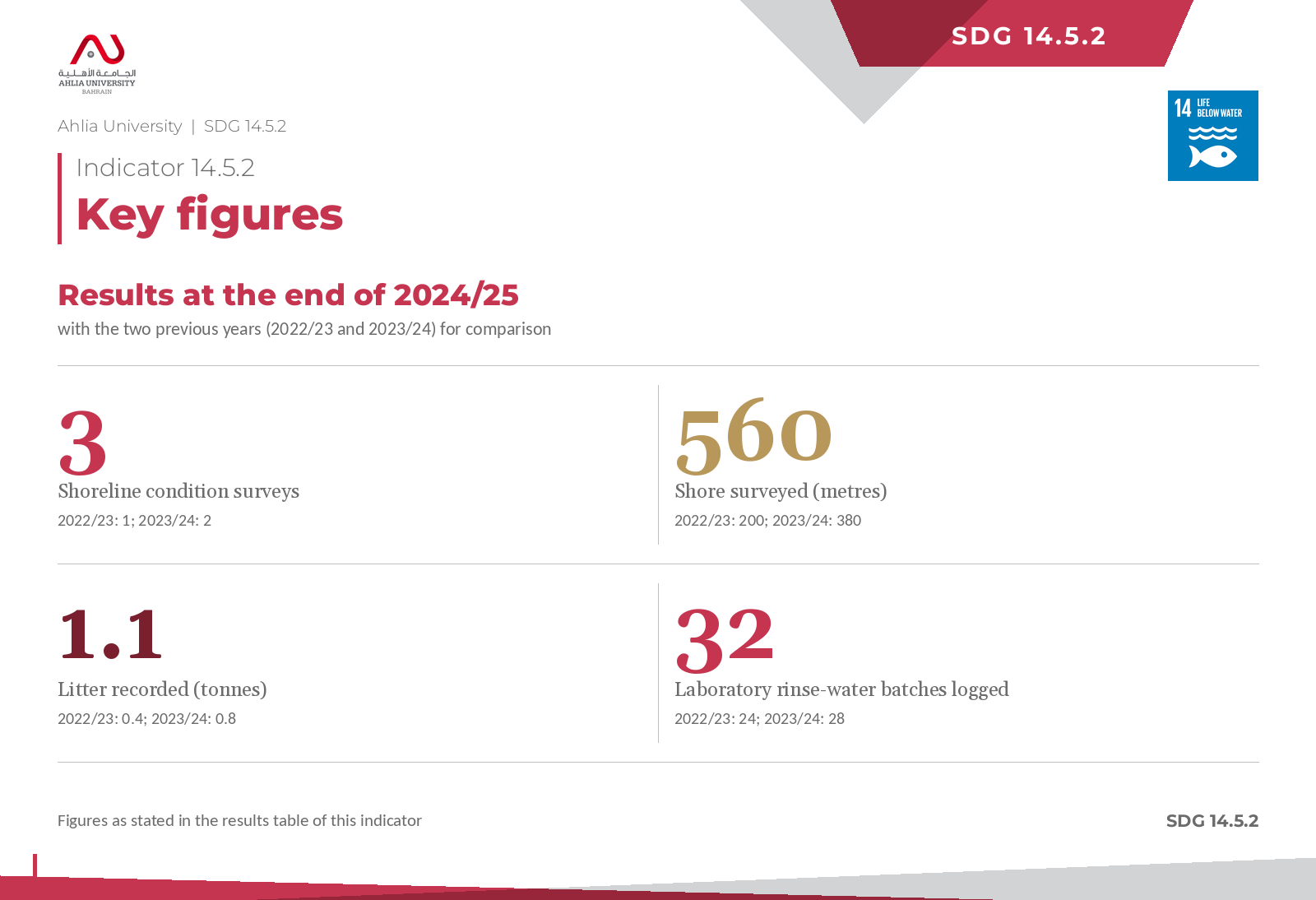
In calendar 2025, which is the 2024/25 column, students completed 3 shoreline surveys covering 560 m of shore, recorded 1.1 tonnes of litter of which 46% was plastic, and sent 3 reports to the Capital Governorate; no oil sheen or sewage odour was recorded. The laboratories logged 32 batches of rinse water. In 2024 there were 2 surveys, 380 m, 0.8 tonnes and 49% plastic, and in 2023 1 survey, 200 m, 0.4 tonnes and 52% plastic.
At a glance
Element of the question
| Shore condition | Standing activity or document: Shoreline Condition Record: a one-page sheet for each shore section surveyed Owner: Dean of Student Affairs; Sustainability Club Latest dated instance in 2025: Sunday 26 October 2025 (220 m) Three-year figure: 6 surveys, 1,140 m |
|---|---|
| Pressure from litter | Standing activity or document: Litter weighed and sorted by type at each survey Owner: Facilities and Maintenance; Sustainability Club Latest dated instance in 2025: Survey of Sunday 26 October 2025: 1.1 tonnes in 2025, 46% plastic Three-year figure: 2.3 tonnes |
| Pressure from the premises | Standing activity or document: Batch logs of rinse water (pH 6 to 9) and hazardous waste receipts Owner: Facilities and Maintenance; Colleges with laboratories Latest dated instance in 2025: Last hazardous waste collection of 2025, Sunday 23 November 2025; 32 batches in 2025 Three-year figure: 84 batches |
| Reporting | Standing activity or document: One-page report to the local authority of the site after each survey Owner: Dean of Student Affairs Latest dated instance in 2025: Report of 26 October 2025 Three-year figure: 6 reports |
▪ Evidence for each element is cited in its own section below.
1. What is monitored and what is not
The health of a shore ecosystem has many parts: water chemistry, species, habitat. The University monitors only the part that its students and staff can record with a sheet and a scale. That is the visible condition of the shore (litter, oil sheen, sewage odour, discoloured water, dead animals) and the amount and type of litter, which is a measure of the pressure that people place on the shore; and, on the premises, the quality of what leaves the laboratories. The University leaves water sampling, species counts and habitat surveys to the national authorities and to the researchers who hold the permits, and it sends them its sheets if they ask.
▪ Evidence: Coastal and Waterfront Clean-up Scheme, President's Decision No. 829/2024 of Tuesday 8 October 2024, and Shoreline Condition Record form [1].
2. The Shoreline Condition Record
The Shoreline Condition Record was formalised by the Scheme of Tuesday 8 October 2024, which kept the sheets already in use. Before each clean-up two trained students walk the section and fill in the sheet: the date, the site and the length of shore surveyed; whether there is an oil sheen, a sewage odour, discoloured water or dead animals; and, after the bags are weighed by Facilities and Maintenance, the litter in tonnes and the share of plastic, metal, glass and other material by weight. The College of Engineering trains the surveyors; the training of Sunday 9 February 2025 reached 18 students. The survey of Sunday 26 October 2025 covered 220 m, the surveys of 18 February and 11 May 2025 covered 200 m and 140 m, and the three surveys of 2025 covered 200 + 140 + 220 = 560 m.
| Year | Surveys | Shore surveyed | Litter (tonnes) | Plastic share by weight | Oil sheen or sewage odour recorded |
|---|---|---|---|---|---|
| 2023 | 1 | 200 m | 0.4 | 52% | None |
| 2024 | 2 | 380 m | 0.8 | 49% | None |
| 2025 | 3 | 560 m | 1.1 | 46% | None |
▪ Evidence: shoreline condition sheets and weighing sheets, 2023 to 2025, Dean of Student Affairs and Facilities and Maintenance [1].
3. Reading the results
Litter per kilometre of shore surveyed stayed close to 2 tonnes (2.00, 2.11 and 1.96), and the sheets show a falling share of plastic, from 52% to 49% and 46%. The University reads the figures with care: the sections change from year to year, the surveys are few, and a cleaner shore may reflect clean-ups as well as behaviour. It treats them as a record of pressure, not as proof that the ecosystem is healthy or improving. The condition sheets also give the Capital Governorate a dated record of the shore that the Governorate may find useful.
▪ Evidence: shoreline condition sheets, Dean of Student Affairs [1].
4. What leaves the premises
The University also monitors the premises as a source of pressure. The laboratories keep a batch log of rinse water neutralised to between pH 6 and 9, 24 batches in 2023, 28 in 2024 and 32 in 2025, and receipts for the hazardous laboratory waste collected by licensed contractors, 1.8, 2.0 and 2.1 tonnes; both are reported in detail under indicators 6.3.1 and 12.2.3; the last collection of 2025 was on Sunday 23 November 2025. The annual discharge statement says that the University has no discharge of its own. These logs are what the University can show about its own effect on the water that reaches the sea.
▪ Evidence: laboratory batch logs and contractor receipts, Facilities and Maintenance [2].
5. Reporting and review
After each survey the Dean of Student Affairs sends a one-page report to the local authority of the site, which is the Capital Governorate for the sites in Manama and the Amwaj Islands Municipality for the survey of Sunday 20 October 2024 at Amwaj Islands, with the length surveyed, the litter and any sighting; there were 1 report in 2023, 2 in 2024 and 3 in 2025. If a surveyor sees dead animals, an oil sheen or a sewage odour, the sheet is sent the same day to the Governorate and to the national authority responsible for the environment; none was recorded. The University Sustainability Committee reviewed the Record on Monday 8 December 2025.
▪ Evidence: reports to the Capital Governorate and minutes of the University Sustainability Committee, 8 December 2025 [3].
Policy basis
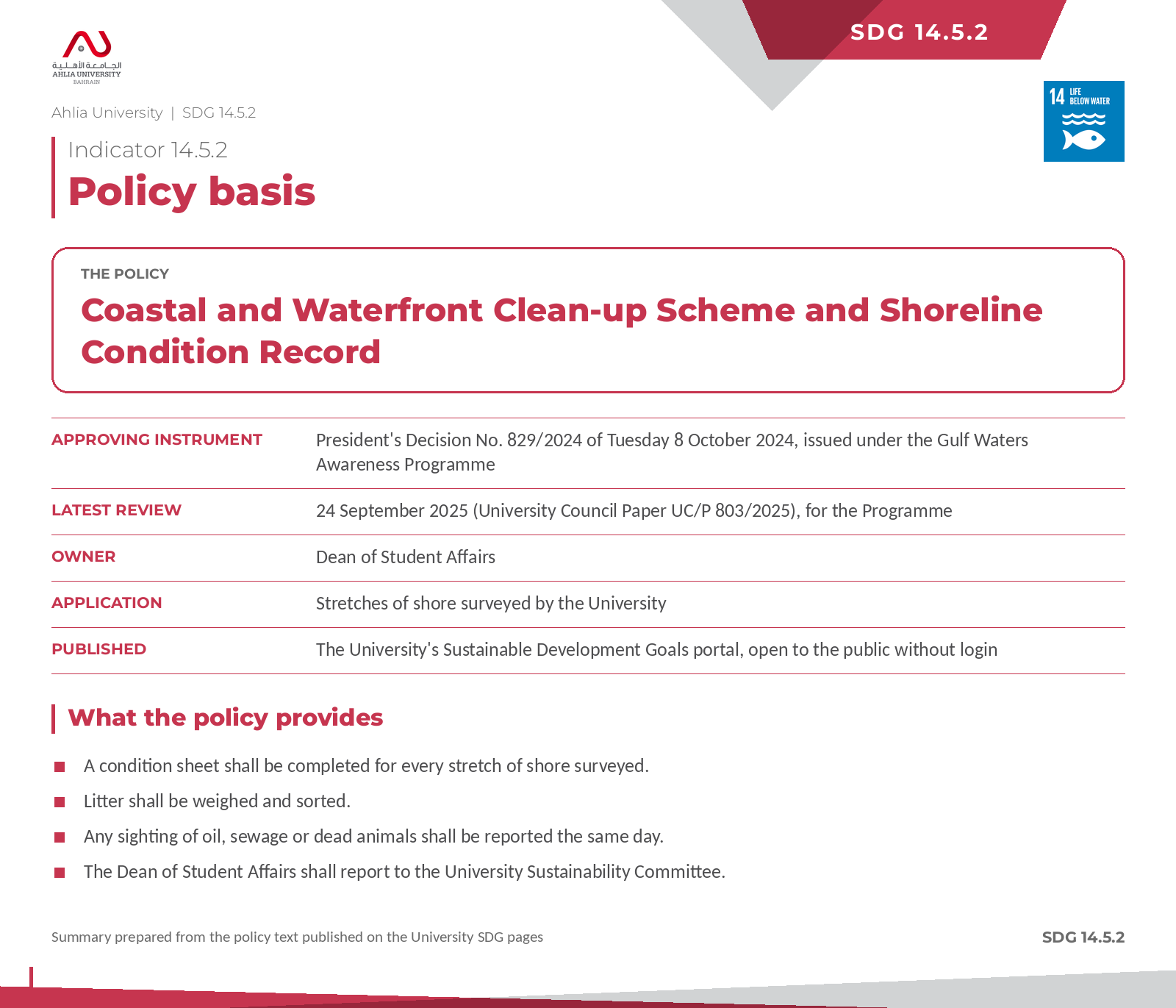
Title: Coastal and Waterfront Clean-up Scheme and Shoreline Condition Record. Approving instrument: President's Decision No. 829/2024 of Tuesday 8 October 2024, issued under the Gulf Waters Awareness Programme (University Council Paper UC/P 711/2024 of 26 June 2024, reviewed by University Council Paper UC/P 803/2025 of 24 September 2025). The Scheme states that a condition sheet shall be completed for every shore section surveyed, that litter shall be weighed and sorted, that any sighting of oil, sewage or dead animals shall be reported the same day, and that the Dean of Student Affairs shall report to the University Sustainability Committee. Owner: the Dean of Student Affairs. In 2024/25 it produced 3 surveys, 560 m of shore and 3 reports. It is published on the University's Sustainable Development Goals portal with this document.
▪ Evidence: Scheme text and Programme text with review record [1].
Results by academic year
Registers are kept by calendar year, so the 2022/23 column is calendar 2023, the 2023/24 column is 2024 and the 2024/25 column is 2025; events of September to December 2025 are counted in 2024/25. A survey is one completed Shoreline Condition Record sheet. Shore surveyed is the length of the sections, 200 + 180 = 380 m in 2024 and 200 + 140 + 220 = 560 m in 2025. Litter is the weight of the bags, as in indicator 14.3.1. Batches are the lines of the laboratory batch logs. The plastic share is the weight of plastic divided by the weight of litter. Percentages are rounded to whole numbers.
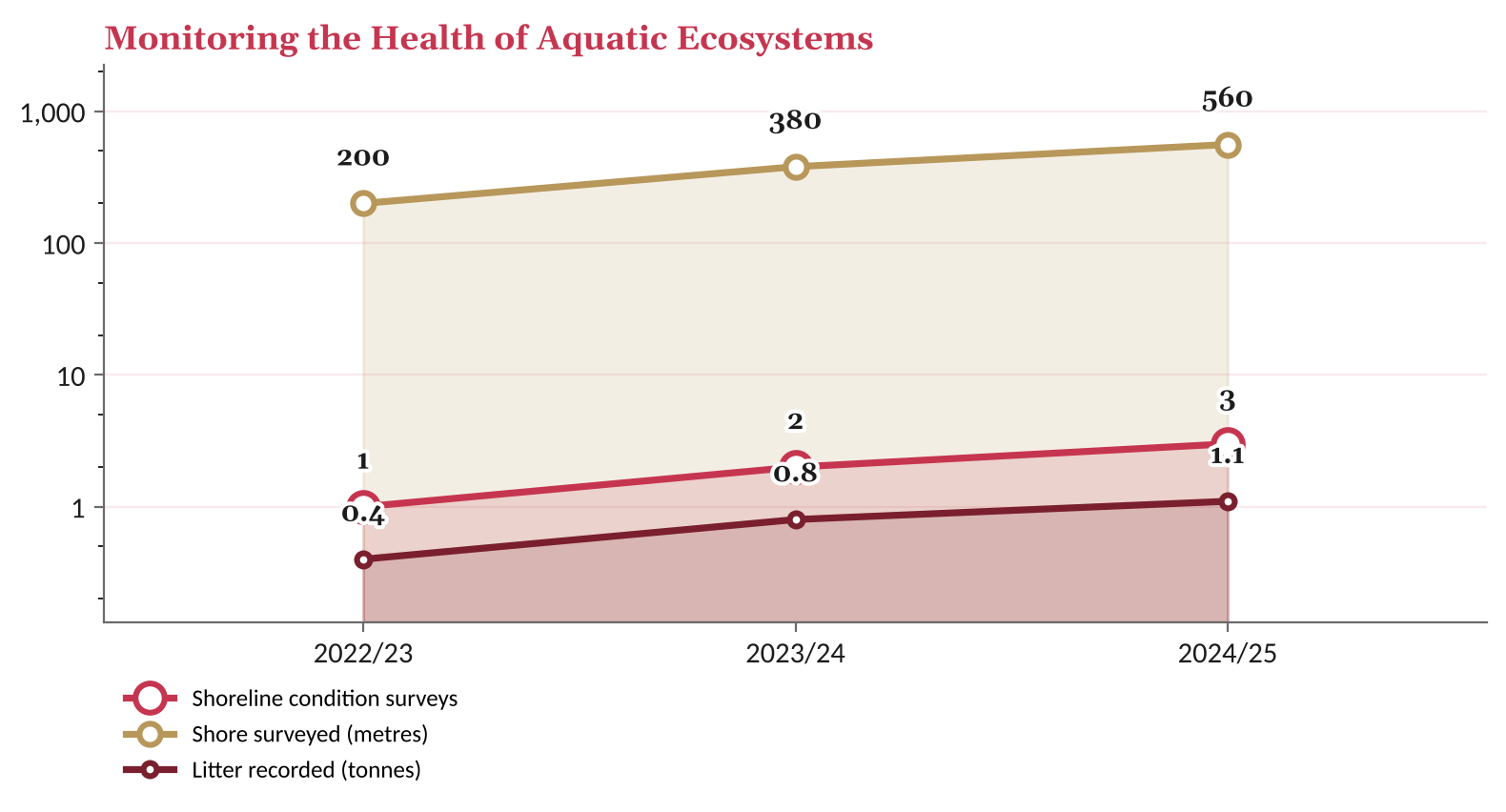
| Indicator | 2022/23 | 2023/24 | 2024/25 |
|---|---|---|---|
| Shoreline condition surveys | 1 | 2 | 3 |
| Shore surveyed (metres) | 200 | 380 | 560 |
| Litter recorded (tonnes) | 0.4 | 0.8 | 1.1 |
| Laboratory rinse-water batches logged | 24 | 28 | 32 |
| Plastic share of litter by weight | 52% | 49% | 46% |
▪ Evidence: registers listed in the references [1], [3].
Publication and verification
This document, which is the University's evidence for indicator 14.5.2 and is kept by the Dean of Student Affairs, with the SDG Unit within CAQA, was approved by University Council Paper UC/P 830/2026 of 14 January 2026 together with the 2025 edition of the SDG reports (University Council Paper UC/P 829/2026 of the same day, published 21 January 2026) and published on the University's Sustainable Development Goals portal on 28 January 2026, open to the public without login. The underlying registers, which are the condition sheets, the weighing sheets, the survey training sheet, the reports to the Capital Governorate, the batch logs and the contractor receipts, are held by the Dean of Student Affairs and Facilities and Maintenance and are quoted in the text above.
Evidence and references
- Coastal and Waterfront Clean-up Scheme and Shoreline Condition Record, President's Decision No. 829/2024 of Tuesday 8 October 2024; Gulf Waters Awareness Programme, University Council Paper UC/P 711/2024 of 26 June 2024; condition sheets, weighing sheets, survey training sheet and reports to the Capital Governorate, 2023 to 2025, Dean of Student Affairs and Facilities and Maintenance
- Laboratory batch logs, contractor receipts and annual discharge statements, 2023 to 2025, Facilities and Maintenance; Water Discharge Standards and Guidelines, Administrative Circular No. 149/2024 of Thursday 15 February 2024
- Minutes of the University Sustainability Committee, 8 December 2025 (SDG Unit, CAQA)