
Ahlia University, the first private university licensed in the Kingdom of Bahrain, housed in the Gosi Complex in Manama, has, as a body, a policy on supporting academic freedom, which covers research freedom and teaching freedom for senior academics and for junior academics. The Academic Freedom Policy (University Council Paper UC/P 634/2023 of 26 April 2023, reviewed by University Council Paper UC/P 758/2025 of 26 February 2025) guarantees the freedom to choose areas of research and to speak and teach publicly about the area of one's research. The Faculty HandBook states the principle in its own words: Ahlia University upholds the academic freedom of its faculty members. The Policy states what that principle covers, who is protected, what its limits are and where a faculty member can go if it is not respected.
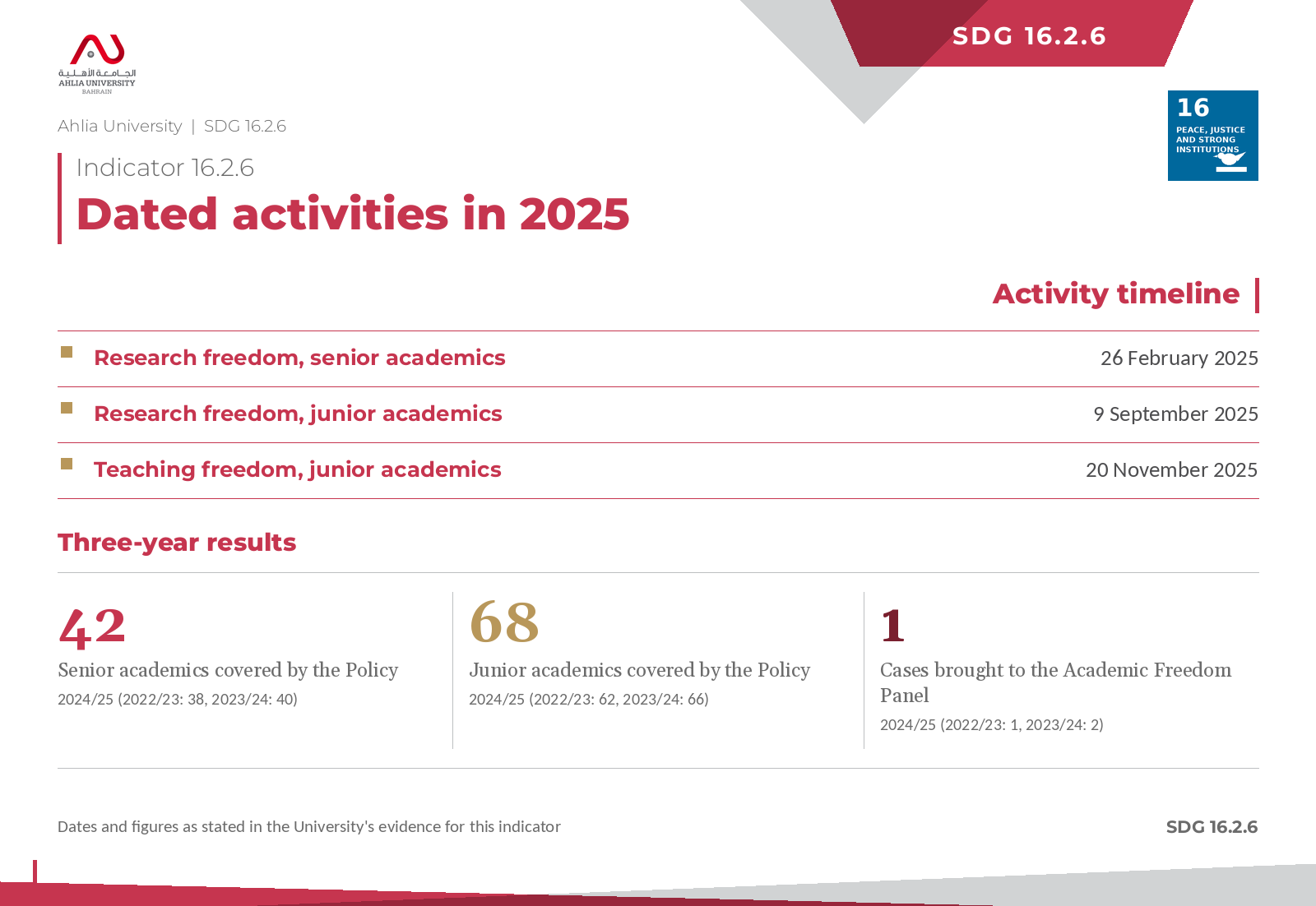
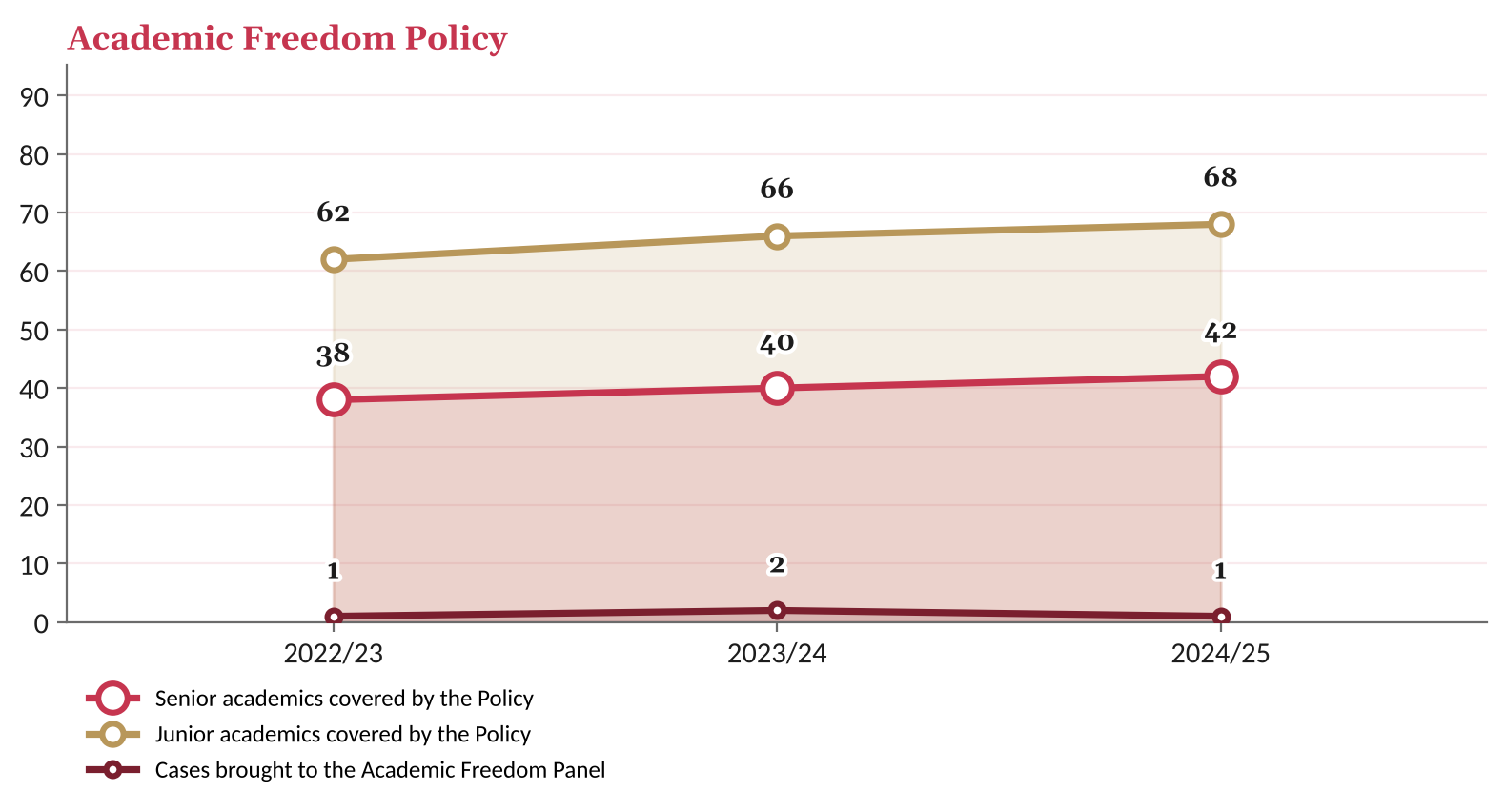
In 2025 the Policy covered 110 faculty, 42 senior academics (professors and associate professors) and 68 junior academics (assistant professors and lecturers), and 71 of them (65%) spoke or taught publicly on their research area. Over the three academic years 2022/23 to 2024/25 the faculty covered rose from 100 to 106 and 110, the share who spoke publicly from 46% to 55% and 65%, and the cases brought to the Academic Freedom Panel numbered 1, 2 and 1, all of them resolved.
At a glance
Option in the question
| Research freedom, senior academics | Standing document or practice: Freedom to choose areas of research and to publish the results, for professors and associate professors Owner: University Council; Deanship of Graduate Studies and Research Latest dated instance in 2025: Review, UC/P 758/2025 of 26 February 2025 Three-year figure: 42 senior academics in 2025 |
|---|---|
| Research freedom, junior academics | Standing document or practice: The same freedom for assistant professors and lecturers, including the choice of a research topic without approval of a senior colleague Owner: Colleges; Deanship of Graduate Studies and Research Latest dated instance in 2025: Faculty orientation, Tuesday 9 September 2025 Three-year figure: 68 junior academics in 2025 |
| Teaching freedom, senior academics | Standing document or practice: Freedom to design teaching methods and content within the approved learning outcomes, and to teach publicly Owner: Colleges Latest dated instance in 2025: Faculty orientation, Tuesday 9 September 2025 Three-year figure: 120 senior academics over 3 years |
| Teaching freedom, junior academics | Standing document or practice: The same freedom, with a mentor for advice and not for approval Owner: Colleges; Human Resources Directorate Latest dated instance in 2025: Panel report, Thursday 20 November 2025 Three-year figure: 196 junior academics over 3 years |
▪ Evidence for each element is cited in its own section below.
1. What the Policy guarantees
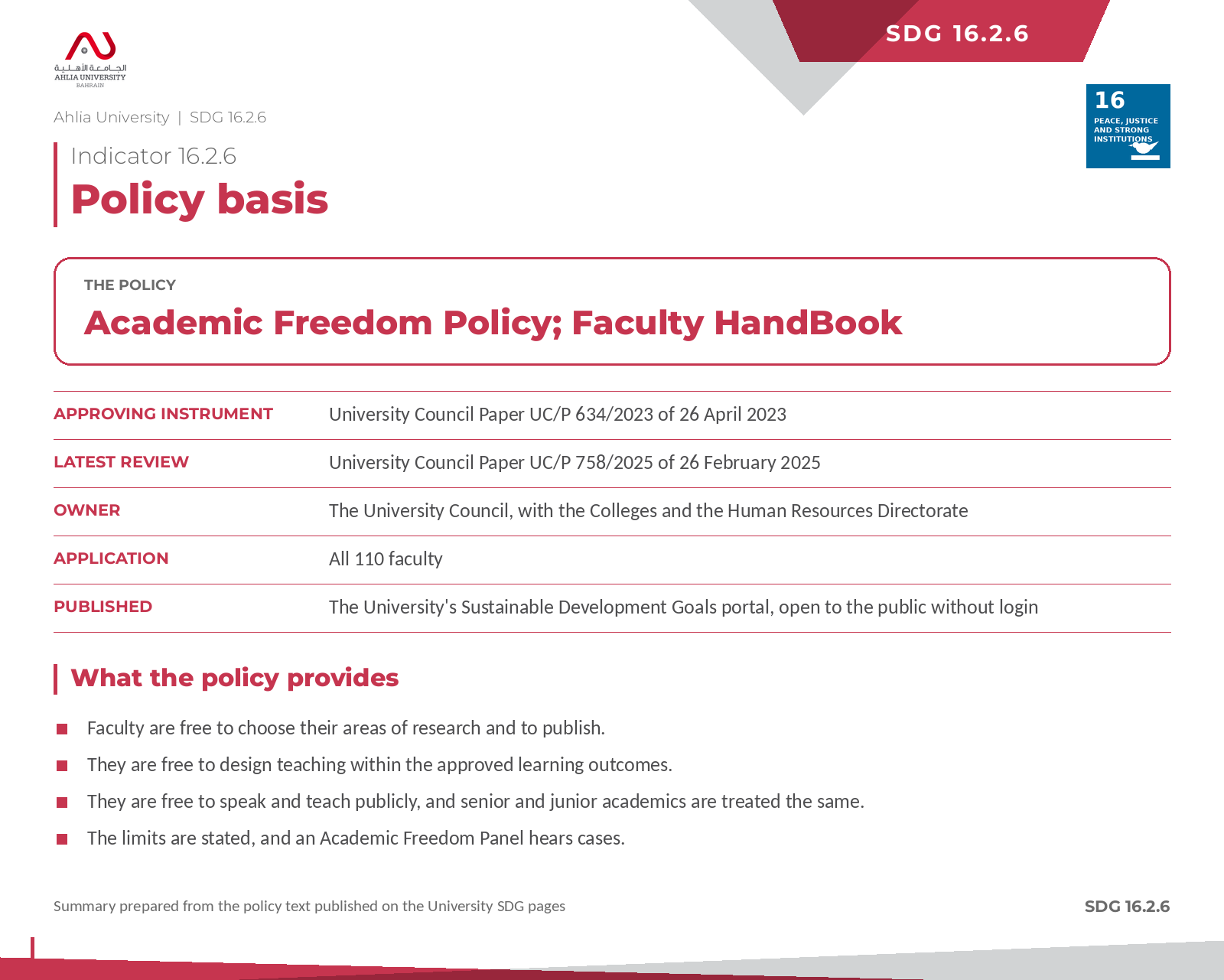
The Faculty HandBook states that, despite their responsibilities, the University upholds the academic freedom of its faculty members [1]. The Policy of 26 April 2023 sets out four freedoms. A faculty member may choose the areas of his or her research and the questions to study. A faculty member may publish the results, in a journal or a conference of his or her choice, subject to the rules on research ethics and on authorship. A faculty member may design the methods and the content of the courses taught, within the learning outcomes approved for the programme. A faculty member may speak and teach publicly about the area of the research, in the media, at conferences and in public lectures, and the University does not penalise the views expressed. These freedoms are the same for senior academics, who are professors and associate professors, and for junior academics, who are assistant professors and lecturers, and the contract or the rank does not change them.
▪ Evidence: Faculty HandBook [1]; Academic Freedom Policy, UC/P 634/2023 [2].
2. Limits and protections
The Policy has three limits. The freedom is exercised within the law of the Kingdom of Bahrain, within the ethical approval that research with people requires and within the learning outcomes that the accreditation of each programme fixes. A faculty member who speaks in public says that he or she speaks personally and not for the University. The Policy also gives three protections. The views expressed, the topic chosen and the publications made cannot be used against a faculty member in appraisal, promotion or contract renewal. A junior academic is protected in the same way as a senior one, and a mentor advises but does not approve the choice of topic. A faculty member who thinks that the freedom was not respected can bring the matter to the Academic Freedom Panel of five faculty members, who report to the University Council.
▪ Evidence: Academic Freedom Policy, clauses on limits and protections, UC/P 634/2023 [2].
3. Seniors and juniors covered
The University had 38 senior academics and 62 junior academics in 2023, 40 and 66 in 2024, and 42 and 68 in 2025, which is 100, 106 and 110 faculty. The Policy is explained to every new faculty member at the faculty orientation, which was held on Tuesday 9 September 2025 for the new faculty of the year, and each faculty member signs that he or she has received it. The faculty who spoke or taught publicly on their research area were 46 in 2023, 58 in 2024 and 71 in 2025, which is 175 in the three years. The Academic Freedom Panel received 1 case in 2023, 2 in 2024 and 1 in 2025, which is 4, and resolved all of them, and it reported to the University Council on Thursday 20 November 2025.
▪ Evidence: faculty registers, orientation attendance sheets and the Panel's register of cases, Human Resources Directorate and the University Council secretariat [3].
Policy basis
Titles: Academic Freedom Policy; Faculty HandBook. Approving instruments: University Council Paper UC/P 634/2023 of 26 April 2023, reviewed by University Council Paper UC/P 758/2025 of 26 February 2025. Owner: the University Council, with the Colleges and Human Resources Directorate. The clauses that answer the question are the freedom to choose areas of research, the freedom to publish, the freedom to design teaching within the approved learning outcomes, the freedom to speak and teach publicly, the same treatment of senior and junior academics, the limits and the Academic Freedom Panel. Application in 2024/25: 110 faculty covered and 1 case, which was resolved. The documents are published on the University's Sustainable Development Goals portal.
▪ Evidence: policy text and review record [2].
Results by academic year
Registers are kept by calendar year, so the 2022/23 column is calendar 2023, 2023/24 is 2024 and 2024/25 is 2025. Faculty are senior academics plus junior academics (38 + 62 = 100; 40 + 66 = 106; 42 + 68 = 110). Cases are those brought to the Academic Freedom Panel, and resolved cases are those closed with a written answer. The share is faculty who spoke or taught publicly on their research area divided by faculty (46 of 100, 58 of 106, 71 of 110).
| Indicator | 2022/23 | 2023/24 | 2024/25 |
|---|---|---|---|
| Senior academics covered by the Policy | 38 | 40 | 42 |
| Junior academics covered by the Policy | 62 | 66 | 68 |
| Cases brought to the Academic Freedom Panel | 1 | 2 | 1 |
| Cases resolved | 1 | 2 | 1 |
| Faculty who spoke or taught publicly on their research area | 46 | 58 | 71 |
| Share of faculty who spoke or taught publicly | 46% | 55% | 65% |
Publication and verification
This document, which is the University's evidence for indicator 16.2.6 and is kept by the University Council secretariat and Human Resources Directorate, was approved by University Council Paper UC/P 830/2026 of 14 January 2026 together with the 2025 edition of the SDG reports (University Council Paper UC/P 829/2026 of the same day, published 21 January 2026) and published on the University's Sustainable Development Goals portal on 28 January 2026, open to the public without login. The underlying registers, which are the faculty registers, the orientation attendance sheets and the register of cases of the Academic Freedom Panel, are held by the University Council secretariat and Human Resources Directorate and are quoted in the text above.
Evidence and references
- Ahlia University: Faculty HandBook (the University upholds the academic freedom of its faculty members)
- Academic Freedom Policy, University Council Paper UC/P 634/2023 of 26 April 2023, reviewed by UC/P 758/2025 of 26 February 2025, University Council secretariat
- Faculty registers, orientation attendance sheets and register of cases of the Academic Freedom Panel, 2023 to 2025, Human Resources Directorate and the University Council secretariat