Cross-Sectoral Dialogue
about the Sustainable Development Goals
Government | Civil Society | Business | United Nations | Universities
DIRECT RESPONSE: YES Ahlia University initiates and participates in recurring cross-sectoral dialogue on the Sustainable Development Goals. During the 2024 reporting year, the University convened conferences, policy-oriented forums, research exchanges and public debates that brought together government, Parliament, the United Nations, civil-society organisations, businesses, professional bodies and universities in Bahrain and internationally. |
INSTITUTIONAL RESPONSE
1. Ahlia University convenes and joins SDG dialogue across sectors
Ahlia University’s 2024 public record demonstrates an institutional pattern of cross-sectoral dialogue rather than a single event. The University initiated and hosted forums on gender equality, inclusive education, artificial intelligence, digital transformation, economic resilience and sustainable development. It also participated in dialogue with the United Nations, public authorities, civil society, business, professional organisations and universities. These activities enabled participants to identify challenges, compare evidence and practice, discuss policy options, share research and formulate recommendations.
The activities directly satisfy the indicator’s emphasis on different societal sectors pooling expertise and resources to address SDG-related issues. The University’s role included convening events, establishing agendas, coordinating partner institutions, contributing academic research, engaging students and maintaining formal cooperation arrangements for training, research, conferences and public awareness.
| Indicator element | 2024 evidence | Institutional result |
|---|---|---|
| University initiation | Ahlia convened the 7th Equal Opportunities Conference, the Second Forum on Inclusion of Students with Disabilities, the third ICGER and an SDG-focused robotics debate. | A recurring institutional platform for public, policy and research dialogue. |
| Government engagement | Parliament, the Ministry of Education, Higher Education Council, BQA, Ministry of Social Development, Ministry of Interior and other public bodies participated. | Public-policy perspectives were integrated into academic and community discussions. |
| NGO and civil-society engagement | The Bahraini Association for Parents and Friends of the Disabled, Rotary Club of Salmaniya and human-rights and community actors contributed to the inclusion forum. | Community experience informed proposed solutions and recommendations. |
| International and business participation | UNIC Manama, international universities, banks, technology firms and professional/research organisations joined the dialogue. | Local questions were connected to international evidence, innovation and implementation capacity. |
| University relationships | Ahlia worked with Brunel University London, University of Business and Technology, University of Bahrain and multiple regional and international universities. | Research exchange and comparative practice strengthened the quality of dialogue. |
Original public evidence: E01 | E02 | E05 | E07 | E09 | E10
THE evidence position
Existence. The University’s 2024 events and agreements demonstrate both initiation of and participation in cross-sectoral SDG dialogue.
Evidence. The record is supported by dated original event pages, conference programmes, institutional reports and independent United Nations reporting.
Public access. All cited evidence is publicly accessible through the original Ahlia University, conference, United Nations and THE sources listed in the evidence register.
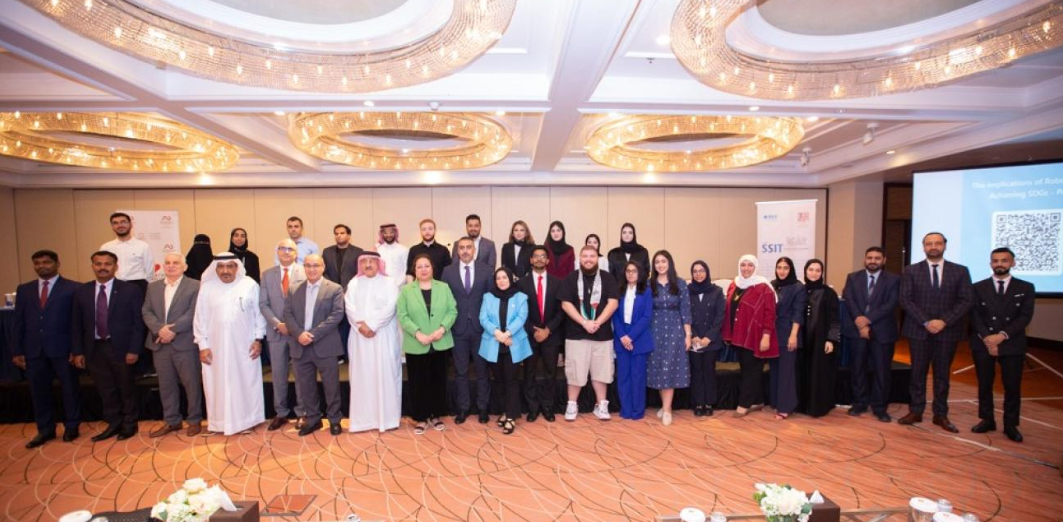
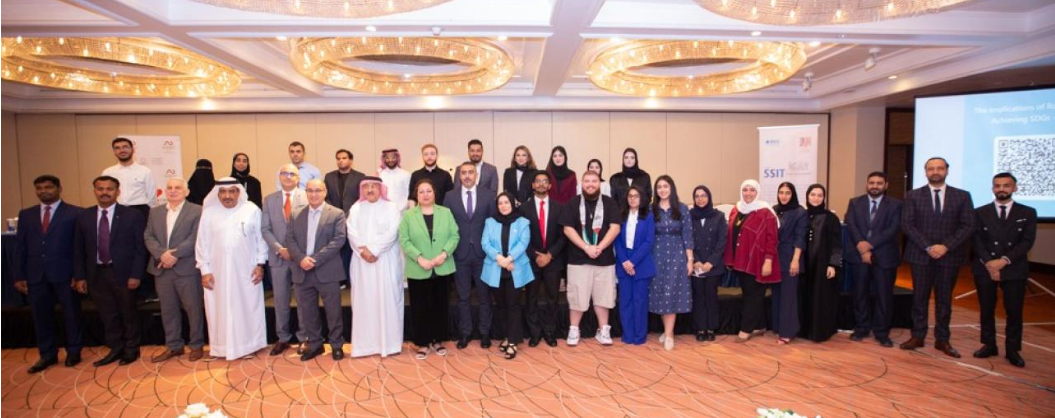
New technologies and SDGs discussed at a student debate at Ahlia University
"New technologies, including AI, must be safe, under human control, and governed fairly, inclusively, and transparently", the UNIC Manama Director said.
The United Nations Information Centre for the Gulf Countries (UNIC Manama) participated on 18 April in a student debate organized by Ahlia University in Bahrain on the implications of robotics for achieving the SDGs.
Speaking at the debate, UNIC Manama Director Ahmed Ben Lassoued highlighted the importance of new technologies for achieving the Sustainable Development Goals.
"However, new technologies, including AI, must be safe, under human control, and governed fairly, inclusively, and transparently," Ben Lassoued said, stressing the importance of the upcoming Summit of the Future, to be held in New York in September this year.
"One key point to be discussed at the Summit is how to leverage better science, technology, innovation, and digital information for sustainable development," he said.
Youth voices matter
"As the custodians of the planet, young people will have to live with the consequences of today's actions - or inaction," Ben Lassoued told the participants.
"The United Nations stands with you in your effort to make your voice heard and count," he said, calling the participants to engage with the United Nations in the lead-up to the Summit.
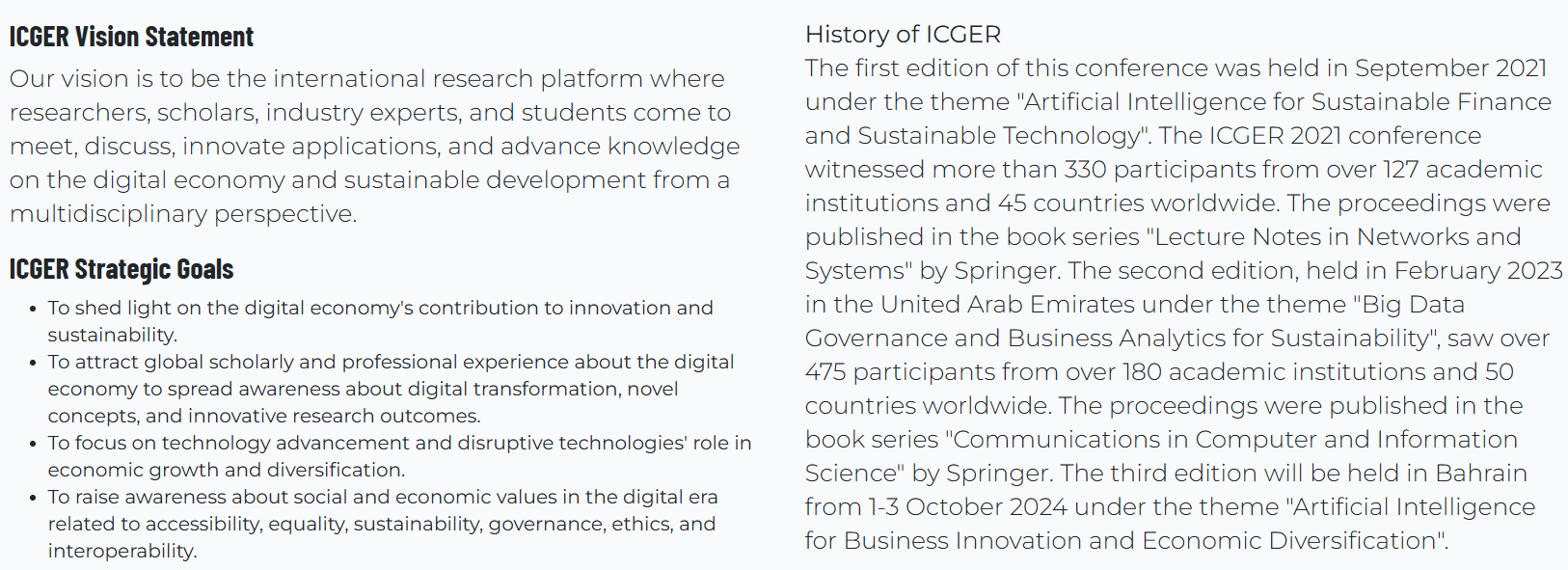
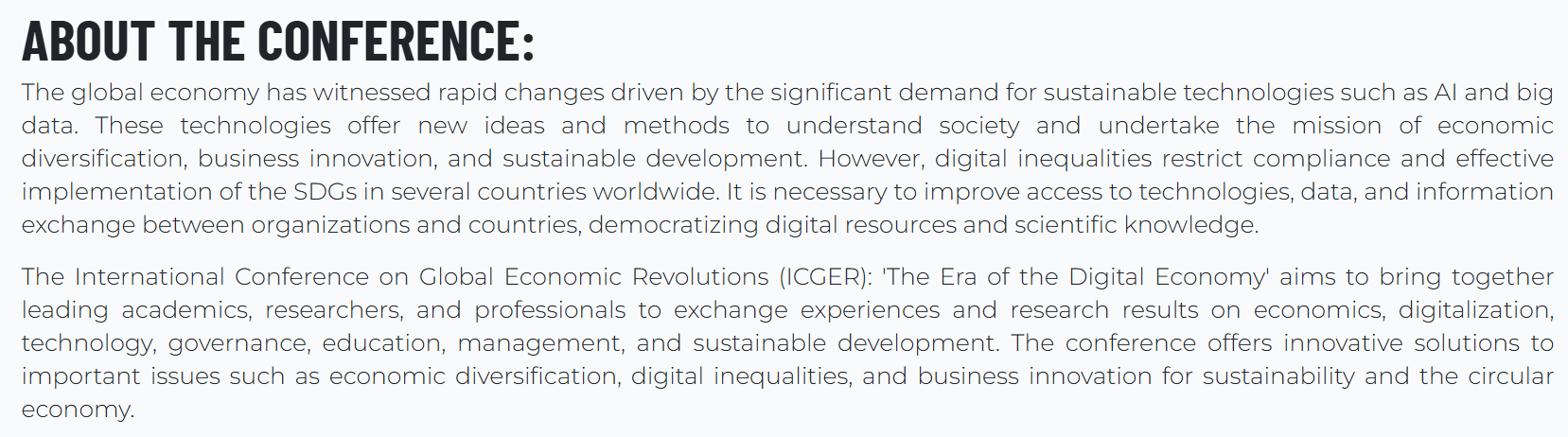
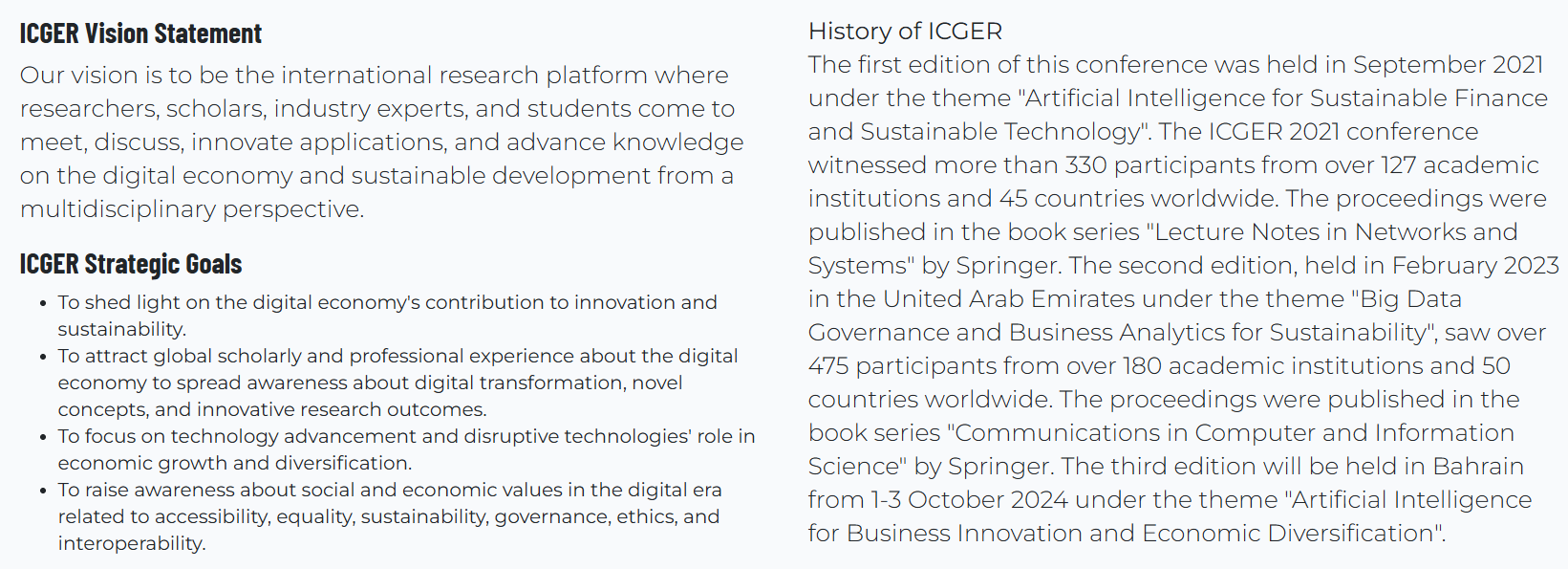
The third International Conference on Global Economic Revolutions: The Era of the Digital Economy Artificial Intelligence, Business Innovation and Economic Diversification
OPERATING MODEL
2. A recurring cross-sector dialogue model
Ahlia University’s dialogue model connects four complementary mechanisms: recurring conferences, issue-specific public forums, research exchange and formal partner agreements. Together, these mechanisms move discussions from awareness to evidence, collaboration and action.
| Mechanism | How it operates | Representative evidence |
|---|---|---|
| Recurring conferences | Ahlia establishes multi-year platforms with public objectives, partner universities, policy participants, research papers and structured sessions. | Equal Opportunities Conference; ICGER |
| Public problem-solving forums | The University convenes public authorities, civil society, service providers, businesses and educators around a defined social challenge. | Second Forum on Inclusion of Students with Disabilities |
| Research and youth dialogue | Researchers, practitioners and students compare arguments, evidence and likely social implications of emerging technologies. | AI debate; UN-supported robotics and SDG debate; PhD Symposium |
| Formal cooperation | Agreements create continuing routes for joint conferences, seminars, research, training, awareness and exchange of expertise. | BIPD; disability association; Ebrahim Khalil Kanoo |
Original public evidence: E02 | E05 | E07 | E09 | E12 | E13 | E14 | E15
New technologies and SDGs discussed at a student debate at Ahlia University
"New technologies, including AI, must be safe, under human control, and governed fairly, inclusively, and transparently", the UNIC Manama Director said.
The United Nations Information Centre for the Gulf Countries (UNIC Manama) participated on 18 April in a student debate organized by Ahlia University in Bahrain on the implications of robotics for achieving the SDGs.
Speaking at the debate, UNIC Manama Director Ahmed Ben Lassoued highlighted the importance of new technologies for achieving the Sustainable Development Goals.
"However, new technologies, including AI, must be safe, under human control, and governed fairly, inclusively, and transparently," Ben Lassoued said, stressing the importance of the upcoming Summit of the Future, to be held in New York in September this year.
"One key point to be discussed at the Summit is how to leverage better science, technology, innovation, and digital information for sustainable development," he said.
Youth voices matter
"As the custodians of the planet, young people will have to live with the consequences of today's actions - or inaction," Ben Lassoued told the participants.
"The United Nations stands with you in your effort to make your voice heard and count," he said, calling the participants to engage with the United Nations in the lead-up to the Summit.
The third International Conference on Global Economic Revolutions: The Era of the Digital Economy Artificial Intelligence, Business Innovation and Economic Diversification
Ahlia University Recognises Excellence of Postgraduate Students at Ph.D. Symposium
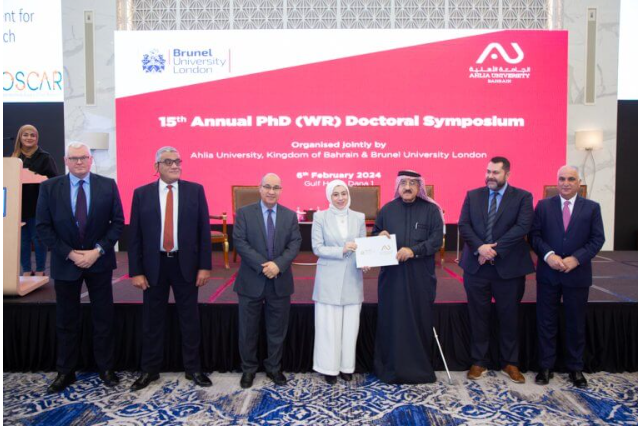
Ahlia University celebrated the academic achievements of its postgraduate students during a prestigious Ph.D. symposium. The event, held annually, showcased the exceptional research conducted by students enrolled in the Ph.D. programme offered by Ahlia University in collaboration with Brunel University. Esteemed guests, including Prof. Abdullah Al-Hawaj, the Founding President and Chairman of the Board of Trustees of Private University, Professor Mansoor Alaali, the President of Ahlia University, and representatives from both Universities, gathered to honour the remarkable contributions of these researchers.
The conference is a testament to Ahlia University’s commitment to fostering a culture of research and innovation, provided a platform for postgraduate students to present their cutting-edge research findings. Prof. Abdullah Al-Hawaj praised the students for their outstanding work, highlighting the overall excellence demonstrated by postgraduate students at Ahlia University, whether pursuing a Master’s or Ph.D. degree. He expressed his pride in the dedicated efforts of the University’s faculty members and the collaborative partnership with Brunel University, which contributed to the students’ success.
The event celebrated the exemplary achievements of several researchers. Yasmina Zaki captured the first-place for both the best scientific paper and the best presentation with her research on “Fashion Brands in the Metaverse: Redefining Digital Marketing and Branding Landscapes”.” Hameed Al-Mubarak secured the second-place for his paper on “Edge Computing Security: Overview and Challenges”, while Zainab Jaber earned the second-place for the best presentation with her work on “The Effects of of Transformational Leadership on Employee Job Satisfaction in Education Sector.”
Prof. Mansoor Alaali confirmed Ahlia University’s dedication to promoting scientific research in the Kingdom of Bahrain and beyond. He emphasised the importance of such conferences that provides a platform for researchers to exchange ideas, enhance their scientific skills, and address significant social, economic, health, and technological challenges faced by communities.
The Ph.D. Symposium featured engaging discussions that impressed the supervisors from both Ahlia University and Brunel University, as well as the attending researchers themselves. It served as a catalyst for professional dialogue and idea generation, boosting further advancements in various fields of study.
Ebrahim Khalil Kanoo Company and Ahlia University Sign Memorandum of Understanding to Enhance Cooperation
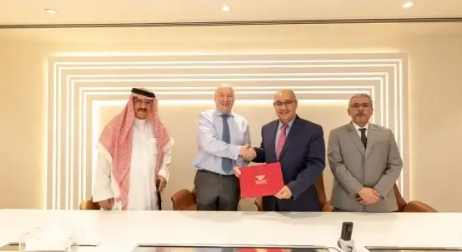
Ebrahim Khalil Kanoo Company and Ahlia University signed a Memorandum of Understanding (MoU) to enhance cooperation between the two entities. The signing ceremony took place during the visit of a delegation from Ahlia University to Ebrahim Khalil Kanoo’s headquarters. The delegation was led by Prof. Abdullah Al-Hawaj, the Founding President and the Chairman of the Board of Trustees, Prof. Mansoor Alaali, the President of Ahlia University, and Mr. Hussain Habib, the Director of Professional Relations.
The Ebrahim Khalil Kanoo team, including Mr. Mike Brightmore, the CEO of the company, and directors from various departments, welcomed the University delegation.
“This partnership with Ahlia University represents an important step in our ongoing commitment towards developing and enriching our team and their families,” said Mr. Mike Brightmore. He added:. “Through this agreement, we not only invest in their educational future, but also strengthen the bridge between the academic sector and the business community, ensuring a strong foundation for growth and mutual success.”
Professor Abdullah Al-Hawaj, the Founding President of Ahlia University, emphasised the importance of such joint cooperation between the educational sector and the labor market, stating that it will enable students to acquire the necessary skills for the workplace.
A Mutual MoU between “Bahrain Institute for Political Development” and Ahlia University
To Spread the National Awareness in Society
A Mutual MoU between “Bahrain Institute for Political Development” and Ahlia University
Based on the enhancement of collaboration, the Bahrain Institute for Political Development signed a mutual memorandum of understanding with Ahila University. This MoU aims to spread national awareness in society and support the academic aspects, scientific research, and the political awareness of the students at the university campus.
In signing the agreement, the Institute was represented by Ms. Eman Janahi, the Executive Director, while Ahlia University was represented by Prof. Mansoor Al-Aali, Ahlia University President.
On this occasion, Ms. Eman Janahi, Executive Director of the Bahrain Institute for Political Development praised this MoU, considering it a beneficial agreement to both parties. It will provide the University the academic staff to present the activities of the Institute and support the Institute’s efforts in raising awareness of the youths. Through this agreement, the Institute seeks to provide training and awareness-raising programs that target the University students.
Ms. Janahi added that the agreement comes in line with the Institute goals of disseminating a culture of democracy, supporting and consolidating the concept of democratic principles, providing training, studies and research programs related to the constitutional and legal field, in addition to its role in developing programs of human rights studies in the field of political systems and constitutional law.
For his part, Prof. Mansoor Al-Aali, the President of Ahlia University, affirmed that the Bahrain Institute for Political Development is one of the institutions emanating from the reform project of His Majesty the King just like Ahlia University. Both institutions share a set of goals related to enhancing community awareness and developing its staff. Also, both institutions work in the research field that aims to contribute positively to the development of society.
He explained that Ahlia University and the Institute can achieve a lot, which shed more light on the march of political and democratic development in the Kingdom of Bahrain through participation in conferences and discussion seminars to inform the community of the pioneering Bahraini model in the field of democratic transformation and the developments that gained the trust and respect of the international community.
According to the MoU, the two parties, to achieve their goals, will seek joint cooperation in the field of training and student capabilities development, and support the process of exchanging experiences between our national private and government institutions. Besides, exchanging experiences and studies depending on the available resources and providing consultations and developing programs and activities that fall within their competence, on condition that this does not contradict the laws and regulations binding on them.
Within the memorandum, Ahlia University expressed its readiness to support the Bahrain Institute for Political Development with specialized academic staff, while the Institute expressed its full readiness to cooperate in preparing training programs related to the rehabilitation of students expected to graduate from Ahlia University for the labor market in the areas of political participation of youth and promoting children’s rights and people with special needs.
Ahlia University Signs an MoU with the Bahraini Association for Parents of the Disabled
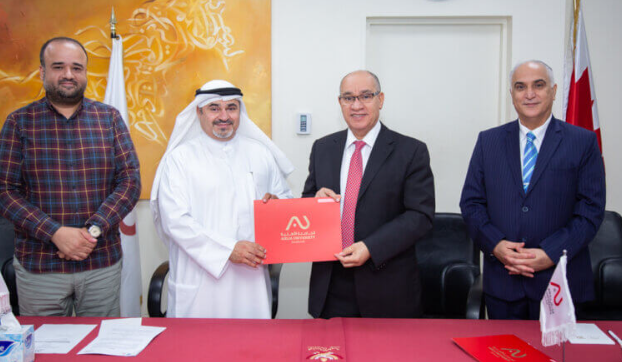
The President of Ahlia University, Professor Mansour Al-Aali, noted that disabled people receive special care and attention the academic and administrative bodies of the university. They also receive partial scholarships of 50% of the tuition fees, which is what made Ahlia university the most attractive among universities to this segment of society.
prof. Al-Aali praised the campaign launched by the Bahraini Association for Parents of the Disabled, which included collecting and recycling of plastics to benefit from its revenue in providing special chairs for the disabled.
For his part, the President of the Bahraini Association for Parents and Friends of the Disabled affirmed his pride in the prestigious status of Ahlia University and the role played by the university in supporting and assisting the disabled and their families, noting the successes achieved by the university in graduating dozens of students with disabilities in the past years, expressing the association’s desire for more cooperation with the university.
Ahlia University signed a memorandum of understanding with the Bahraini Association for Parents and Friends of the Disabled, with the aim of achieving fruitful cooperation between them on the basis of mutual benefit and common interests, in accordance with the laws and regulations in the Kingdom of Bahrain.
Ahlia University was represented by the President of the University, Professor Mansour Al-Aali, and the Bahraini Society for Parents and Friends of the Disabled was represented by the Chairman of the Board of Directors, Mr. Jassim Muhammad Siyadi.
This agreement comes within the framework of both parties’ desire to activate the role of cooperation between them, and bilateral cooperation in the field of supporting students with disabilities, that is through exchanging invitations to participate and attend events held by the two parties, and the university provided support for the activities of the Bahraini Association for Parents of the Disabled and their friends by collecting plastic materials in all University facilities and presenting them to the association for recycling in order to contribute to the purchase of the largest possible number of wheelchairs for specific cases of people with disabilities, in addition to organizing joint activities aimed at enhancing the opportunities of enabling students with disabilities from completing their university education.
Inspiring Change: Ahlia University a Beacon of Special Needs Integration in HEIs Alaali Advocates for Sharing Successful Practices in Universities
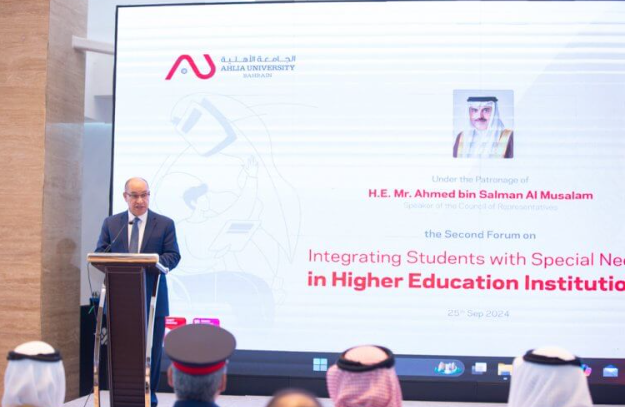
Professor Mansoor Alaali, President of Ahlia University, emphasized the need for greater focus on research and academic attention to issues faced by individuals with determination. He highlighted the importance of evaluating the integration in universities and sharing successful practices to improve the educational landscape.
During a forum on the integration of students with determination into higher education institutions, held under the patronage of Mr. Ahmed bin Salman Al-Musallam, Chairman of the House of Representatives, several recommendations were made. Key suggestions included increasing governmental and community support for institutions that assist individuals with determination, establishing supportive legislative frameworks, and creating specialized training programs tailored for these individuals, particularly in suitable fields such as administration, organization, reception, support roles, and public relations.
The forum also called for improving transportation and traffic systems in line with international standards for individuals with determination. It aimed to empower these individuals with tools like artificial intelligence, increase community initiatives, and develop clear strategies for training educators to effectively support students with disabilities, ensuring ongoing communication between academic institutions and organizations.
A presentation by Ms. Lulwa Ali Al-Rumaihi, Member of Parliament, highlighted the legislative and oversight efforts of the Parliament to protect the rights of individuals with determination. She underscored the Parliament’s role in enhancing these rights across various sectors, including health services, youth and sports, training, and employment.
Discussions revealed significant challenges faced by students with determination in universities, such as accessibility to buildings and facilities, social integration difficulties, limited access to assistive technologies, and financial constraints. Addressing these issues requires effective strategies for integration and comprehensive academic and financial support.
Ms. Shatha Al-Qasimi, HR Supervisor at the National Bank of Bahrain and a graduate of Ahlia University, shared the bank’s successful experience in integrating individuals with determination into its workforce in partnership with the Bahrain Down Syndrome Society. This initiative began with a specially prepared training room and followed a two-phase approach: obtaining necessary approvals and then moving to practical employment and on-the-job training. This effort led to notable success, with the number of employees with Down Syndrome at the bank increasing from three in 2018 to five in 2019.
Dr. Fatima Al-Dhaen, Assistant Professor at Ahlia University, discussed the role of artificial intelligence in helping students with determination pursue higher education. She emphasized how tools like “ChatGPT” can assist these individuals in reading by converting text to audio, simplifying complex language, and aiding in writing and grammar. Such technologies can also make difficult subjects more understandable by breaking them down into simpler terms or providing summaries.
SDG themes addressed through the dialogue
The 2024 agenda was multidisciplinary. Gender equality and inclusive opportunity connected to SDGs 4, 5 and 10; responsible digital innovation and AI connected to SDGs 8, 9 and 16; accessible higher education connected to SDGs 4, 10 and 16; sustainable economic transition and circular economy connected to SDGs 8, 9, 10 and 12; and the collaborative structures themselves advanced SDG 17.
From dialogue to usable knowledge Conference programmes included research presentations, expert panels, debates, case studies and recommendations. Formal partnerships extended the resulting relationships into joint training, research, awareness and future events. |
2024 FLAGSHIP EVIDENCE
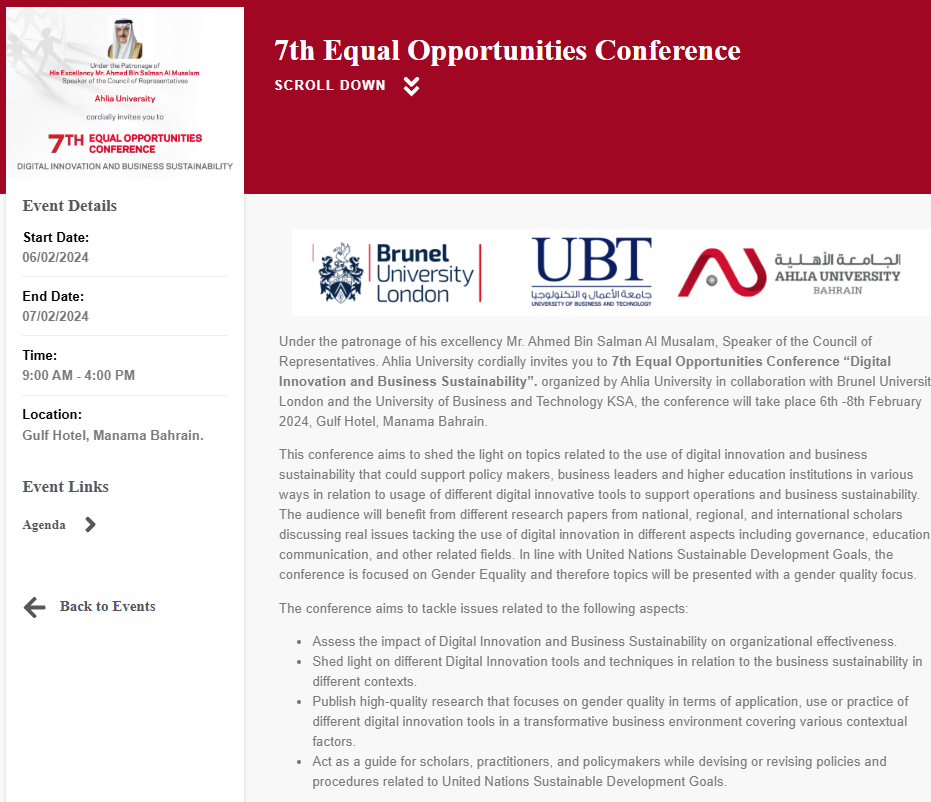
3. Seventh Equal Opportunities Conference
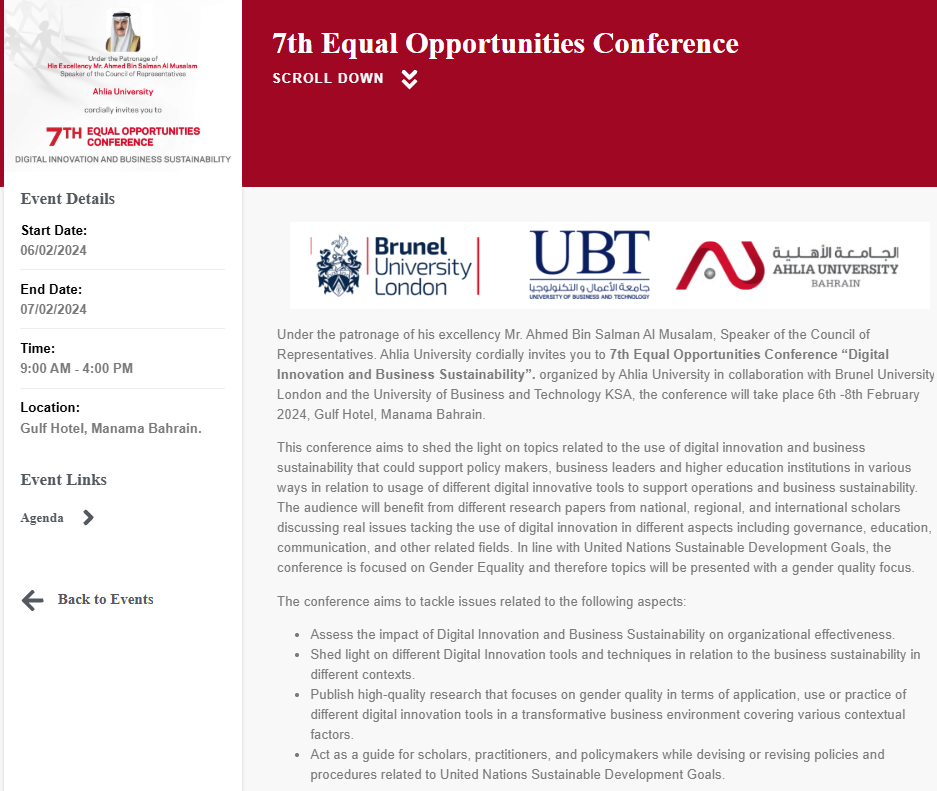
Ahlia University initiated and co-organised the Seventh Equal Opportunities Conference, held in Manama on 6–7 February 2024 under the patronage of H.E. Ahmed bin Salman Al Musalam, Speaker of Bahrain’s Council of Representatives. The University worked with Brunel University London and the University of Business and Technology in Saudi Arabia to create a national, regional and international forum on digital innovation and business sustainability.
The conference was expressly aligned with the United Nations Sustainable Development Goals and placed gender equality at the centre of its programme. Its published purpose was to support policymakers, business leaders and higher-education institutions and to guide scholars, practitioners and policymakers when devising or revising SDG-related policies and procedures. Research and discussion addressed governance, education, communication, inclusive growth, the national qualifications framework, knowledge sharing, public-sector leadership and the effects of AI on gender equality and employment.
| Sector | Participants represented in the programme | Contribution to dialogue |
|---|---|---|
| Government and public bodies | Council of Representatives; Education and Training Quality Authority; Bahrain Center for Strategic, International and Energy Studies (Derasat) | Legislative, quality-assurance, public-policy and national research perspectives. |
| Higher education | Ahlia; Brunel University London; University of Business and Technology; Atlantic Technological University; American University of Bahrain; University College of Bahrain | Comparative research, teaching practice and regional/international knowledge exchange. |
| Business and professional community | Business leaders, practitioners and conference delegates | Implementation implications for jobs, organisational sustainability and responsible innovation. |
| Researchers and students | National, regional and international scholars and an active debate audience | Evidence, scrutiny and participatory discussion of contested future scenarios. |
Original public evidence: E02 | E03
Cross-sector debate on artificial intelligence
The conference included the structured debate ‘AI Will Replace Humans’. Eight experts from the Education and Training Quality Authority, Ahlia University, Brunel University London, the American University of Bahrain, University College of Bahrain and the University of Business and Technology examined the implications of AI for employment and society. Leaders, academics and industry experts participated, and the audience vote—64 per cent against the proposition—made public deliberation part of the conference record.
Original public evidence: E04
Debate on “AI Will Replace Humans” Concludes with Strong Opposition: 64% of Audience Votes Against
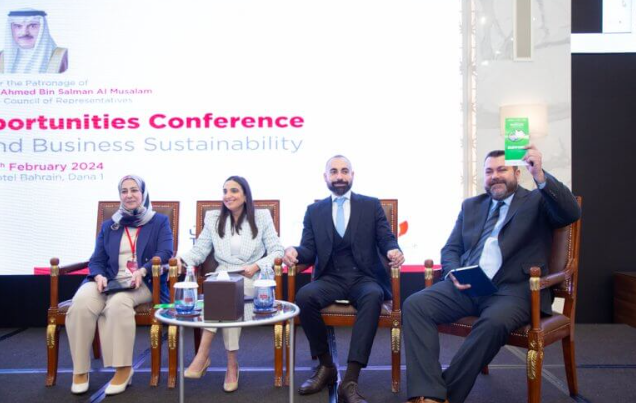
In a highly thought-provoking event, a panel of eight experts engaged in a debate on the topic of “AI Will Replace Humans.” The event, held within the 7th Equal Opportunity Conference, attended by leaders, academics, and industry experts from various fields to discuss the implications of artificial intelligence (AI) on the future of work and society.
The debate featured four individuals who argued in favour of the debate subject: Ms. Esmat Ali Jaffar, Genaeral Director NQF & National Examination, BQA Bahrain, Dr. Lefteris Kretsos, Lecturer, Brunel University London, UK, Dr. Esra AlDhaen, Executive Director, Strategy Quality and Sustainability, Ahlia University, Dr. Ammar AlHawaj, Executive Director, Communication and International Relations, Ahlia University. They asserted that AI possesses the capability to replace human labour across diverse industries.
Simultaneously, an opposing group of four individuals presented compelling arguments against the motion: Prof. Mansoor Alaali, President of Ahlia University, Dr. Hanan Nasser, Associate Provost (Interim), AUBH Bahrain, Dr. Reem Hamdan, Acting VP for Academic Affairs, UCB Bahrain, Dr. Mohamed Kanan, Vice Dean of Scientific Research, UBT KSA. They emphasised the unique qualities and abilities that make humans indispensable in the face of advancing AI technologies.
Throughout the debate, the panellists meticulously articulated their viewpoints, drawing upon extensive research, practical experiences, and theoretical insights. The speakers in favour of AI replacing humans highlighted the potential benefits, such as increased efficiency, cost-effectiveness, and the elimination of mundane tasks. They confirmed the capacity of AI to revolutionise industries and liberate humans to pursue higher-order cognitive and creative tasks. On the other hand, the panellists opposing the motion emphasised the human qualities that cannot be replicated by AI. They emphasised the importance of empathy, emotional intelligence, critical thinking, and the ability to adapt to complex and unpredictable situations. They argued that while AI can augment human capabilities, it cannot fully replace the depth and breadth of human skills and intuition.
The integration of robots in the workforce has sparked the debate on whether they will replace humans. However, the opposition team argued that technology should be seen as an assistant rather than a substitute for humans. They emphasised that while technology has its benefits in terms of efficiency and cost-effectiveness, it lacks the ability to handle unexpected situations and events. They provided examples of robots successfully aiding in court cases and performing critical medical procedures, but highlighted that human skills and adaptability are still essential. Moreover, they asserted that the integrating AI creates new job opportunities that require human expertise. Ultimately, the team recommended a collaborative relationship between humans and AI, to enhance productivity and problem-solving, while recognising the unique value humans bring to the workforce.
At the conclusion of the debate, the audience had the opportunity to cast their votes, expressing their stance on the subject matter. The results showed that a significant majority, 64% of the audience, voted against the idea of AI replacing humans. This outcome underscores the prevailing sentiment that while AI holds immense potential, it is unlikely to completely supplant human involvement in various spheres of life.
ORIGINAL EVIDENCE EXHIBIT
Seventh Equal Opportunities Conference programme
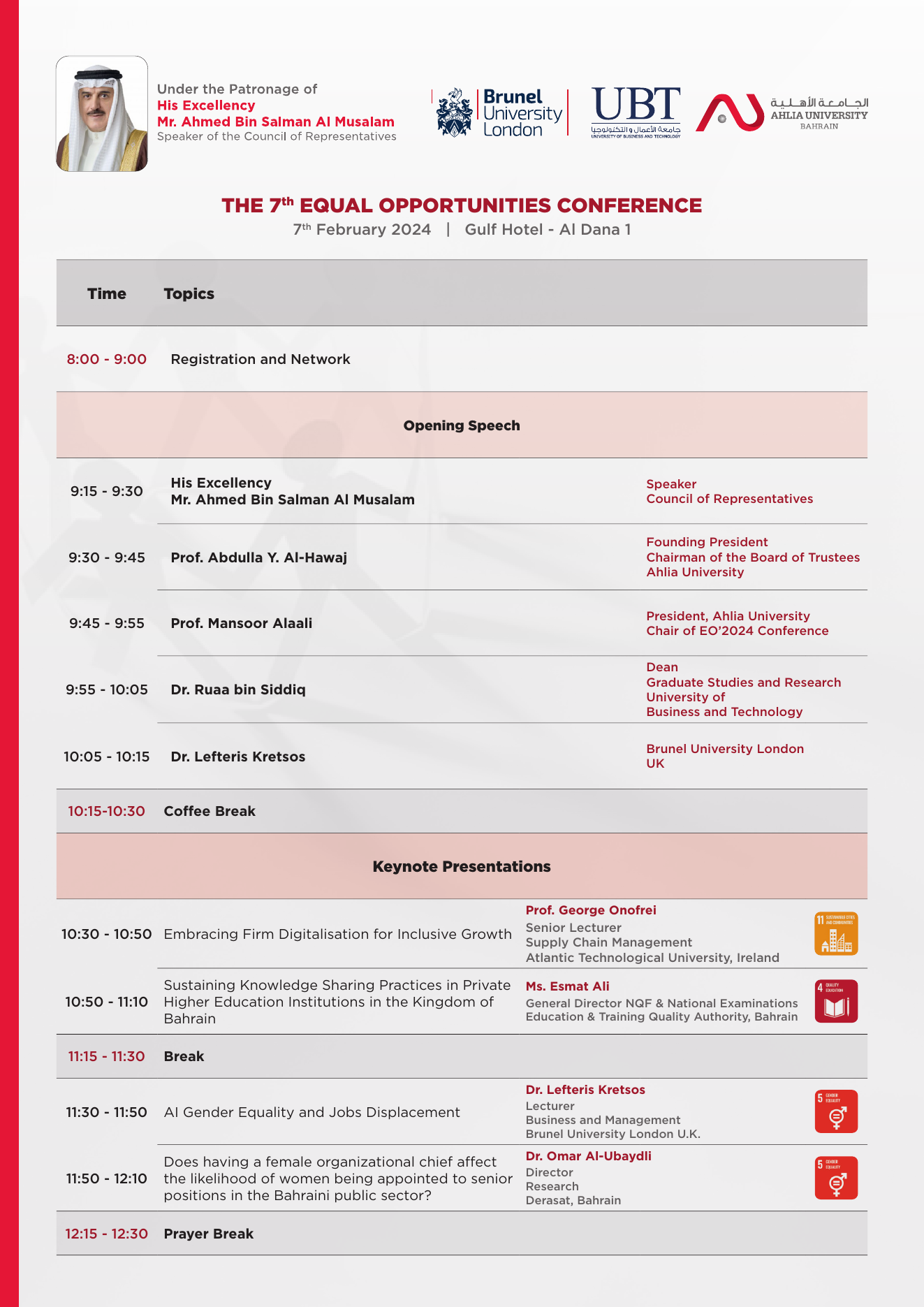
Original conference programme, page 1: parliamentary patronage, university co-organisers, BQA, Derasat and international university speakers, with sessions explicitly mapped to SDGs 4, 5 and 11.
Original public evidence: E03
2024 FLAGSHIP EVIDENCE
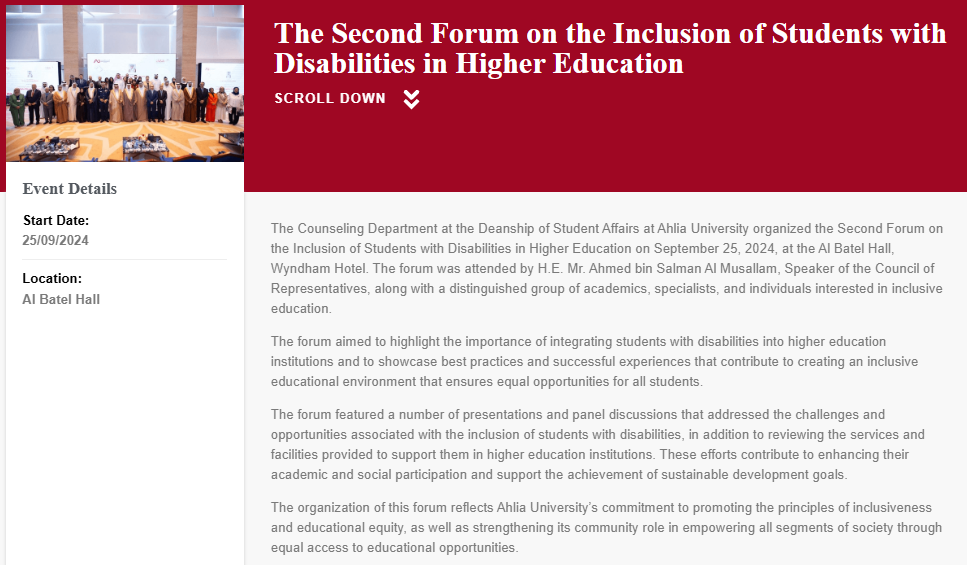
4. Second Forum on Inclusion of Students with Disabilities
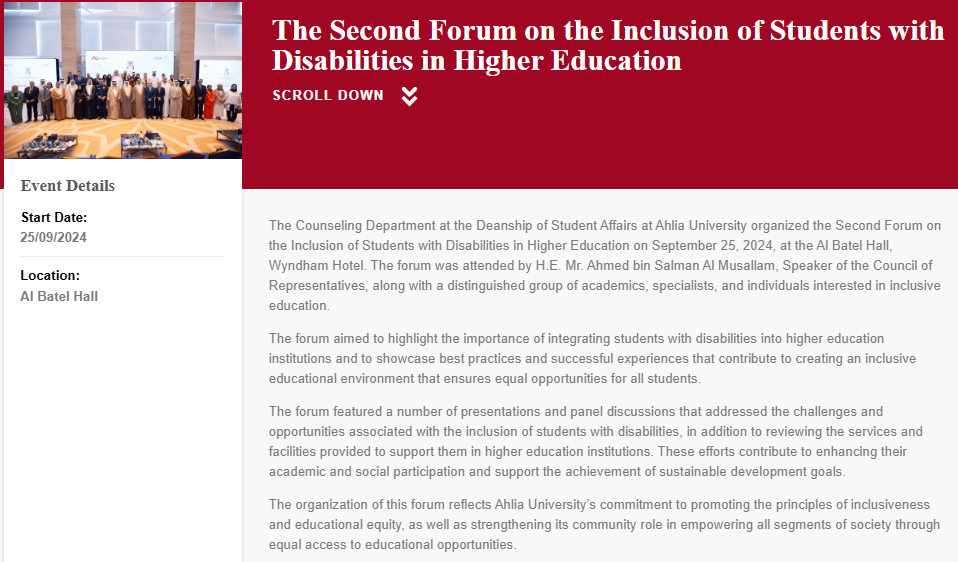
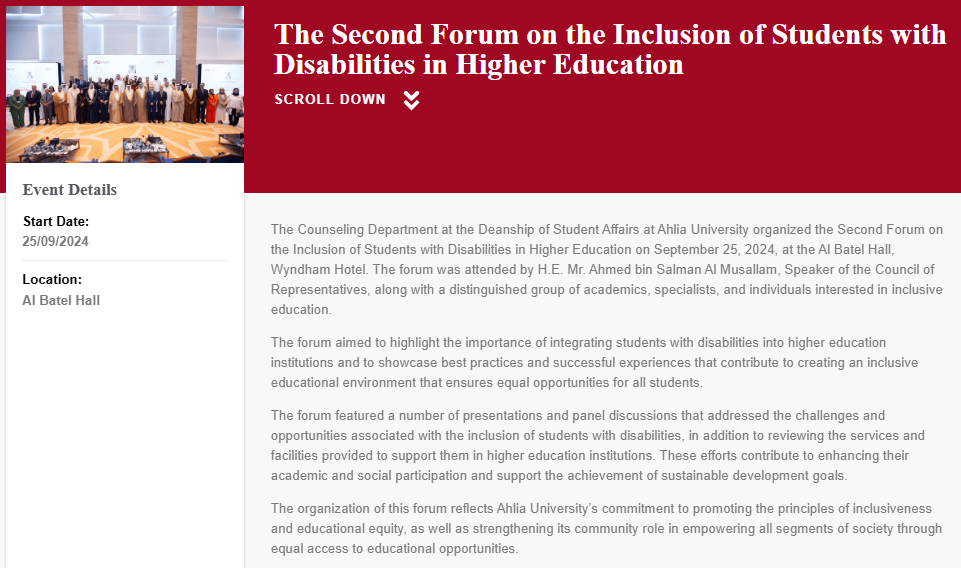
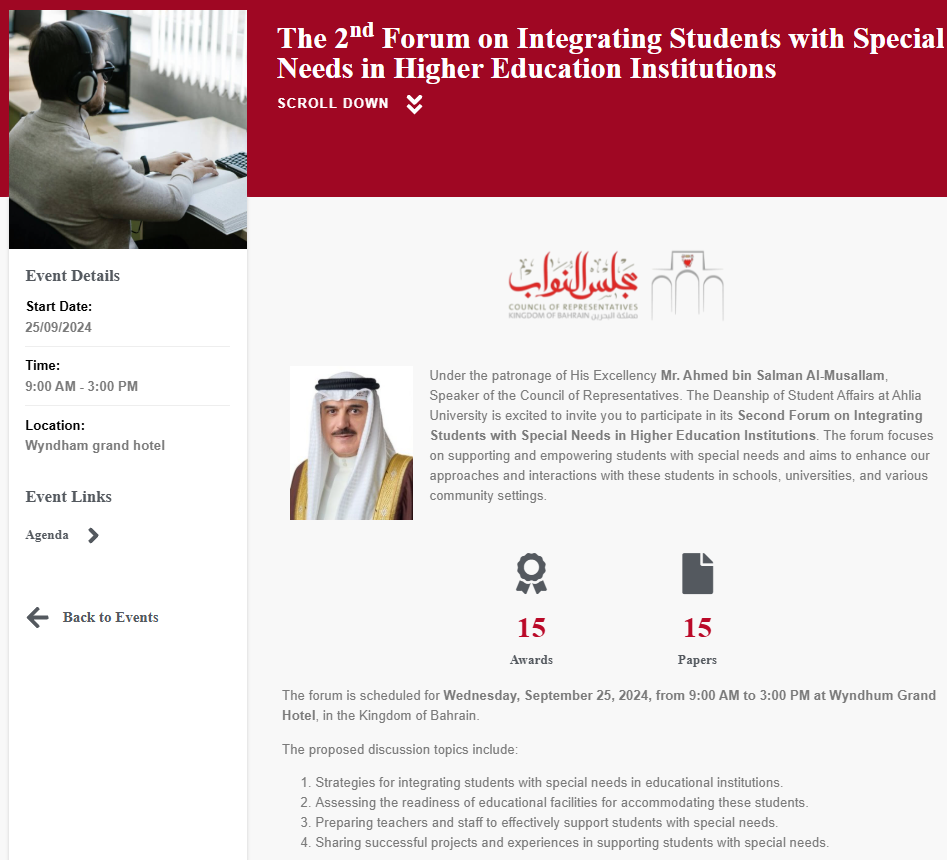
On 25 September 2024, Ahlia University convened the Second Forum on the Inclusion of Students with Disabilities in Higher Education under the patronage of the Speaker of the Council of Representatives. The forum focused on the practical conditions needed for inclusive participation in schools, universities and community life. Presentations and panel discussions addressed access to educational facilities, legal and regulatory frameworks, staff preparation, assistive technologies, artificial intelligence, social and psychological support, employability and successful institutional models.
The forum’s published programme demonstrates an unusually broad coalition. Parliament and public authorities contributed legislative, policy, traffic, social-development, correctional and education perspectives. The National Institution for Human Rights addressed accessibility as a right. The Bahraini Association for Parents and Friends of the Disabled and the Rotary Club of Salmaniya brought community and civil-society experience. National Bank of Bahrain, Zain Bahrain and Yousif bin Ahmed Kanoo contributed private-sector experience and support. University of Bahrain, Ahlia academics, specialist centres and practitioners contributed research and service expertise.
| Sector | Representative contributors | Dialogue value |
|---|---|---|
| Legislature and government | Council of Representatives; Ministry of Social Development; Ministry of Interior; General Directorate of Traffic; General Directorate of Reform and Rehabilitation | Policy, regulation, public services, access and institutional implementation. |
| Human rights and civil society | National Institution for Human Rights; Bahraini Association for Parents and Friends of the Disabled; Rotary Club of Salmaniya | Rights-based, family and community perspectives. |
| Business | National Bank of Bahrain; Zain Bahrain; Yousif bin Ahmed Kanoo | Inclusive workplace practice, sponsorship and applied innovation. |
| Education and specialist practice | Ahlia University; University of Bahrain; special-education and rehabilitation specialists | Research, campus practice, staff preparation and scalable educational approaches. |
Original public evidence: E05 | E06 | E18
Recommendations and adaptive learning
The programme concluded with recommendations, converting the day’s multi-sector presentations into a shared institutional output. By examining challenges alongside operating examples from public bodies, civil society, businesses and educational institutions, the forum enabled participants to compare practice and identify practical measures for more inclusive higher education. The dialogue advanced SDGs 4, 10, 16 and 17.
ORIGINAL EVIDENCE EXHIBIT
Inclusion Forum programme — sectors and first thematic stream
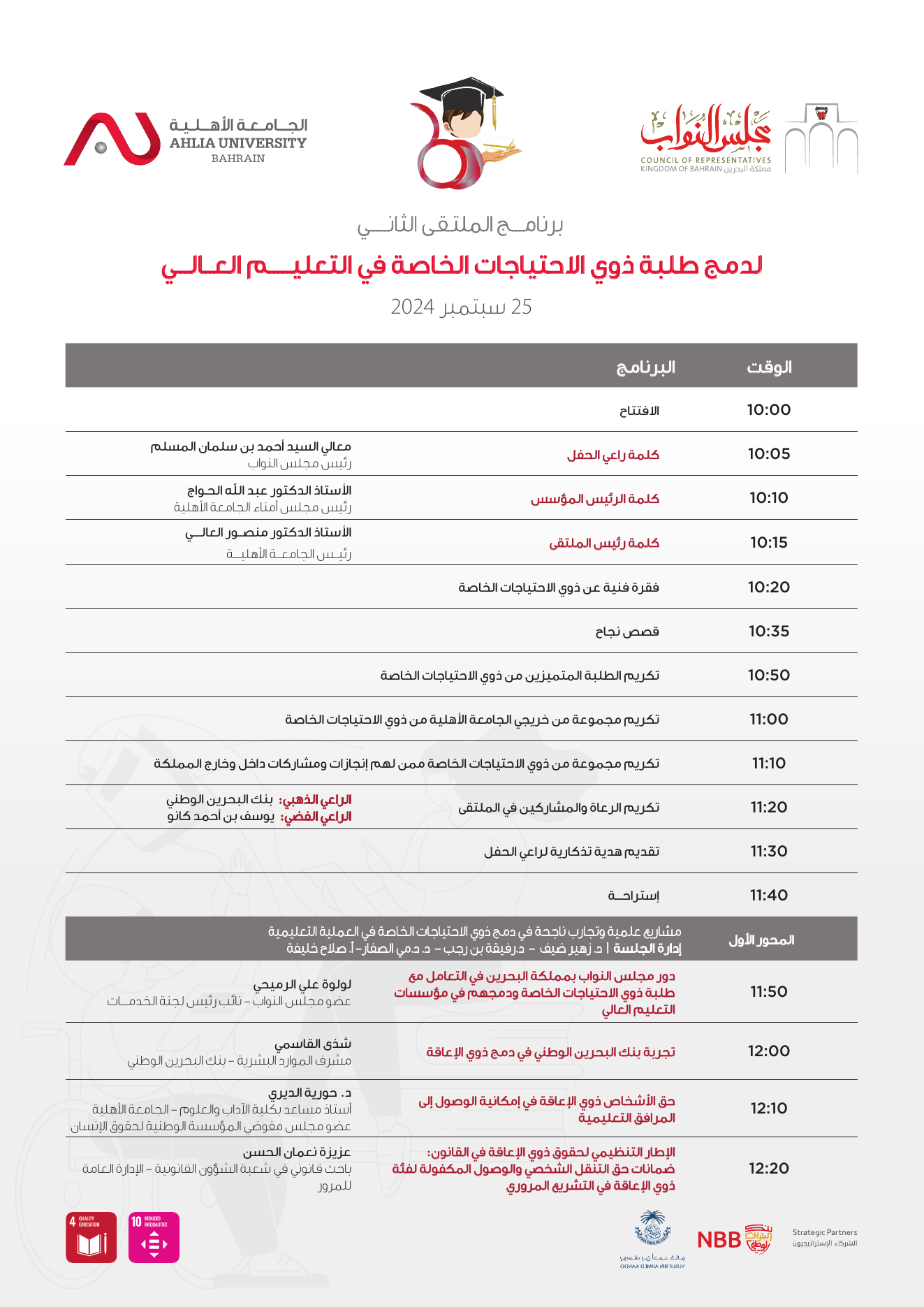
Original programme, page 1: parliamentary patronage; National Bank of Bahrain and Yousif bin Ahmed Kanoo support; speakers from Parliament, the National Institution for Human Rights and the General Directorate of Traffic; explicit SDG 4 and SDG 10 alignment.
Original public evidence: E06
ORIGINAL EVIDENCE EXHIBIT
Inclusion Forum programme — government, NGO and university dialogue
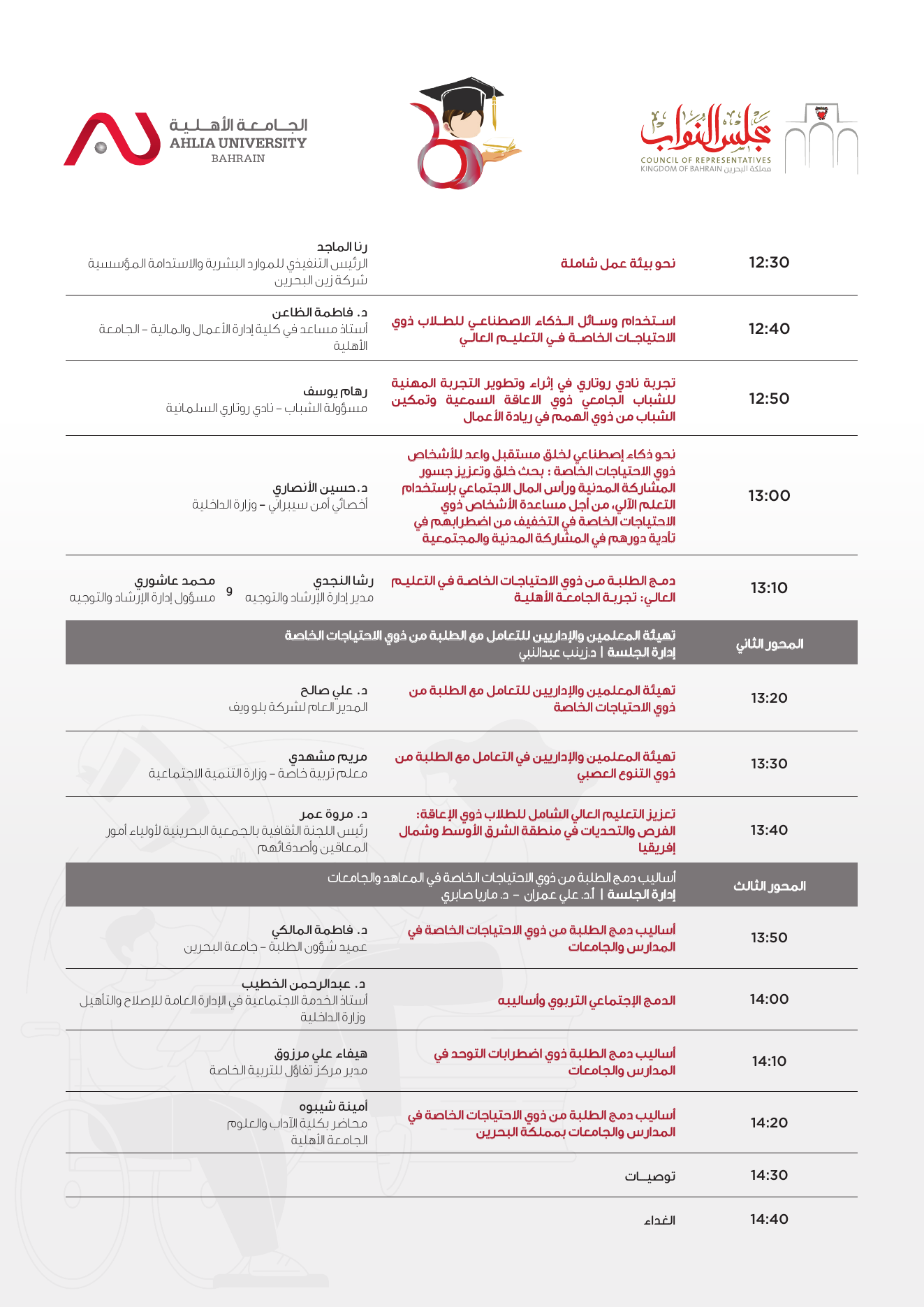
Original programme, page 2: contributions from the Ministry of Interior, Ministry of Social Development, University of Bahrain, Bahraini Association for Parents and Friends of the Disabled, specialist centres and Ahlia University, followed by formal recommendations.
Original public evidence: E06
2024 FLAGSHIP EVIDENCE
5. International Conference on Global Economic Revolutions
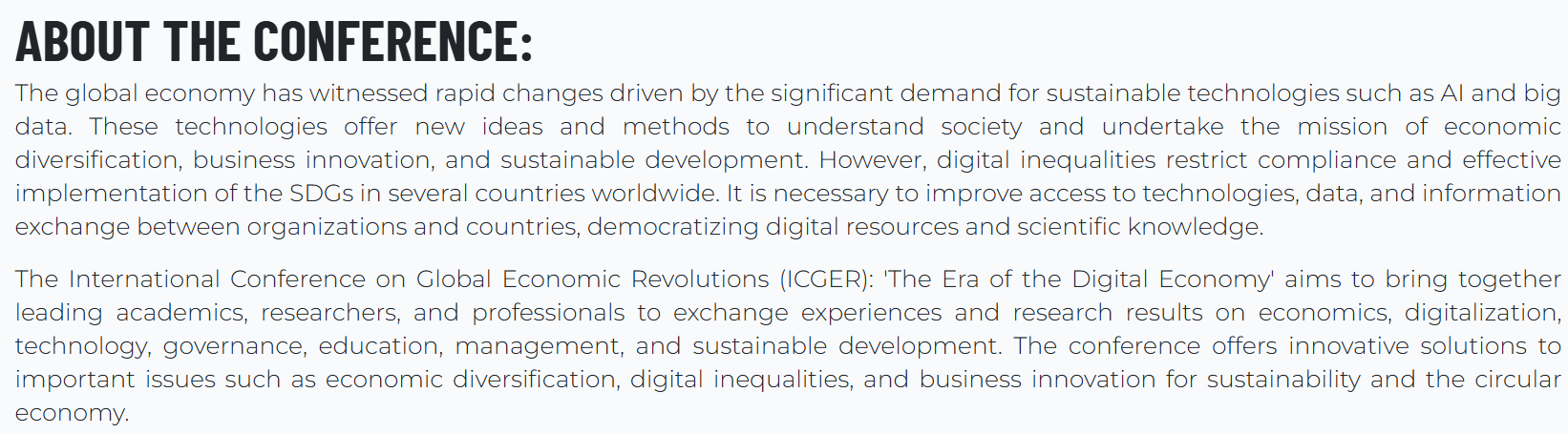
Ahlia University hosted the third International Conference on Global Economic Revolutions (ICGER) in Bahrain on 1–3 October 2024 under the patronage and attendance of the Minister of Education and Chairman of the Higher Education Council. The conference brought together government leadership, researchers, academics, scientists, scholars, industry professionals and universities from Bahrain, the Gulf region and the wider Arab world.
ICGER was structured around major SDG challenges: economic diversification, digital inequalities and the data divide, circular economy and sustainability governance, and sustainable technologies. Its purpose was to exchange ideas and strategies for present economic challenges and to connect scholarly evidence with the experience of industry and public decision-makers.
| Dialogue dimension | Evidence from ICGER 2024 | SDG relevance |
|---|---|---|
| Government participation | Patronage and attendance by Bahrain’s Minister of Education and Chairman of the Higher Education Council | Public leadership and higher-education policy connection |
| Academic collaboration | Ahlia and participating Gulf and Arab universities; strategic academic partners included Liwa College and Applied Science Private University | International research exchange and comparative approaches |
| Industry and professional participation | Industry professionals and professional partners including Nasser AI Research and Development Center, Shafrra and research organisations | Innovation, digital transformation and application of research |
| Social partnership | The conference identified ITPO Bahrain as a social partner and invited organisational participation as support for CSR and the SDGs | Broader societal participation and partnership mobilisation |
| Problem domains | AI and economic diversification; digital divide; circular economy; sustainability governance; sustainable technologies | SDGs 8, 9, 10, 12, 16 and 17 |
Original public evidence: E09 | E10 | E11
Research as a basis for dialogue ICGER connected research presentations with government, university and industry perspectives. This made the conference a forum for interpreting evidence, comparing strategies and discussing how digital and economic transformation could be managed inclusively and sustainably. |
Under the Patronage of the Minister of Education Ahlia University Hosts the 3rd International Conference on Global Economic Revolutions
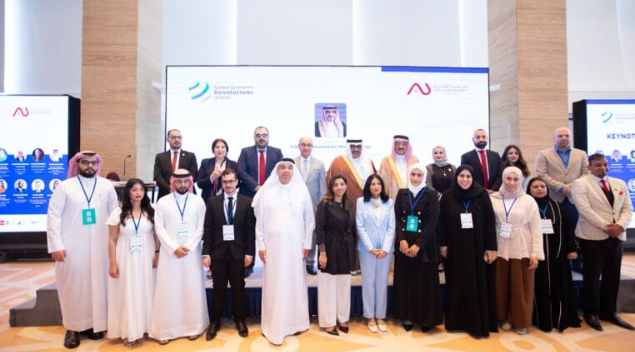
Under the patronage of the Minister of Education and with participation from several Gulf and Arab universities, Ahlia University recently held the third international conference on global economic revolutions, under the theme “Artificial Intelligence for Business Innovation and Economic Diversification”, at the Wyndham Grand Hotel in Bahrain Bay.
The Conference was attended by H.E. Dr. Mohammed bin Mubarak Juma, Minister of Education and Chairman of the Board of Trustees of the Higher Education Council, along with representatives from numerous Gulf and Arab universities.
In his opening remarks, Prof. Abdulla Yousif Al-Hawaj, Founding President and Chairman of the Board of Trustees of Ahlia University, expressed his gratitude to the Minister for his presence. He highlighted the University’s commitment since its establishment to staying ahead of the rapidly changing technological and educational landscape, ensuring that students are well-equipped to thrive in the modern workforce.
Ahlia University President, Prof. Mansoor Alaali, described the conference as a key platform for exchanging ideas and strategies to address contemporary economic challenges. He thanked the scholars, academics, and experts who contributed to its success, particularly those who presented research papers.
Dr. Abdulmuttaleb Al-Sartawi, Chairperson of Accounting Finance & Banking Department, and CEO of the conference, also gave an overview of the conference objective and its sessions.
The opening session concluded with His Excellency Dr. Mohammed bin Mubarak Juma honoring the conference’s strategic partners and keynote speakers.
INTERNATIONAL AND YOUTH DIALOGUE
6. United Nations-supported dialogue on technology and the SDGs
Ahlia University’s student debate on 18 April 2024 examined whether robotics could support sustainable development and humanitarian action. The United Nations Information Centre in Manama participated directly. Its Director discussed the need for safe, fair and inclusive artificial intelligence, connected the discussion to the Summit of the Future and invited young people to engage with the United Nations.
The debate brought together researchers, specialists and information-technology students from Bahraini universities and schools. Participants considered robotics in employment, education, medicine, renewable energy, agriculture, water management and disaster response. The event therefore combined youth participation, academic knowledge, international-organisation expertise and public-interest questions across multiple SDGs.
Original public evidence: E07 | E08
Dialogue characteristics
| Characteristic | How the 2024 debate delivered it |
|---|---|
| International participation | UNIC Manama represented the United Nations and placed the discussion within global governance and the Summit of the Future. |
| Cross-institution participation | Researchers, specialists and students from universities and schools joined the exchange. |
| Multi-SDG scope | Applications covered education, health, energy, agriculture, water, employment and disaster management. |
| Participatory format | A structured debate required evidence-based arguments and enabled students to assess benefits, risks and humanitarian consequences. |
University-to-university research dialogue
Ahlia’s 2024 PhD Symposium with Brunel University London provided a further recurring channel for comparative research dialogue. Representatives of both universities reviewed and recognised postgraduate research addressing social, economic, health and technological challenges. The symposium reinforced the research relationship underpinning Ahlia’s wider conferences and provided a route for developing evidence that can inform future policy and practice.
Original public evidence: E12
Ahlia University Recognises Excellence of Postgraduate Students at Ph.D. Symposium

Ahlia University celebrated the academic achievements of its postgraduate students during a prestigious Ph.D. symposium. The event, held annually, showcased the exceptional research conducted by students enrolled in the Ph.D. programme offered by Ahlia University in collaboration with Brunel University. Esteemed guests, including Prof. Abdullah Al-Hawaj, the Founding President and Chairman of the Board of Trustees of Private University, Professor Mansoor Alaali, the President of Ahlia University, and representatives from both Universities, gathered to honour the remarkable contributions of these researchers.
The conference is a testament to Ahlia University’s commitment to fostering a culture of research and innovation, provided a platform for postgraduate students to present their cutting-edge research findings. Prof. Abdullah Al-Hawaj praised the students for their outstanding work, highlighting the overall excellence demonstrated by postgraduate students at Ahlia University, whether pursuing a Master’s or Ph.D. degree. He expressed his pride in the dedicated efforts of the University’s faculty members and the collaborative partnership with Brunel University, which contributed to the students’ success.
The event celebrated the exemplary achievements of several researchers. Yasmina Zaki captured the first-place for both the best scientific paper and the best presentation with her research on “Fashion Brands in the Metaverse: Redefining Digital Marketing and Branding Landscapes”.” Hameed Al-Mubarak secured the second-place for his paper on “Edge Computing Security: Overview and Challenges”, while Zainab Jaber earned the second-place for the best presentation with her work on “The Effects of of Transformational Leadership on Employee Job Satisfaction in Education Sector.”
Prof. Mansoor Alaali confirmed Ahlia University’s dedication to promoting scientific research in the Kingdom of Bahrain and beyond. He emphasised the importance of such conferences that provides a platform for researchers to exchange ideas, enhance their scientific skills, and address significant social, economic, health, and technological challenges faced by communities.
The Ph.D. Symposium featured engaging discussions that impressed the supervisors from both Ahlia University and Brunel University, as well as the attending researchers themselves. It served as a catalyst for professional dialogue and idea generation, boosting further advancements in various fields of study.
TRAINING AND RESEARCH COOPERATION
7. Governmental, non-governmental and business cooperation
Ahlia University supports its event-based dialogue with formal cooperation frameworks. These agreements establish continuing routes for training, research, seminars, conferences, awareness and exchange of expertise, enabling relationships formed through dialogue to continue beyond individual events.
| Partner | Cooperation commitments | Contribution to SDG dialogue |
|---|---|---|
| Bahrain Institute for Political Development | Academic cooperation, scientific research, political-awareness training, joint conferences and discussion seminars, exchange of studies and experience, consultations and programmes supporting human rights and inclusion. | Government–university connection across SDGs 4, 10, 16 and 17. |
| Bahraini Association for Parents and Friends of the Disabled | Joint activities, reciprocal participation in events and support for students with disabilities. | Civil-society knowledge and lived experience underpin inclusion dialogue; reflected in the 2024 forum. |
| Ebrahim Khalil Kanoo | Cooperation between the University and a major Bahraini business to develop skills and connect academic preparation with labour-market requirements. | Academic–business dialogue supporting employability, innovation and SDGs 4, 8 and 17. |
| Brunel University London | Long-term research and doctoral cooperation, conference co-organisation and annual postgraduate research exchange. | International research evidence and comparative practice across multiple SDGs. |
Original public evidence: E12 | E13 | E14 | E15
Relationships among colleges and universities
Ahlia’s conferences and workshops consistently connect institutions rather than operating as internal university events. The Equal Opportunities Conference was co-organised with Brunel University London and the University of Business and Technology and included other Bahraini and international universities. ICGER used academic partners and attracted Gulf and Arab institutions. The inclusion forum involved the University of Bahrain alongside Ahlia and specialist education providers. These relationships enabled comparison of educational practice, research dissemination and the formation of regional and international professional networks.
Original public evidence: E02 | E03 | E05 | E06 | E09 | E10 | E12
REPORTING-YEAR SYNTHESIS
8. Consolidated 2024 cross-sector dialogue portfolio
| 2024 activity | Convening sectors | Dialogue and output | Core SDGs |
|---|---|---|---|
| 7th Equal Opportunities Conference 6–7 Feb |
Parliament; BQA; Derasat; businesses; researchers; Ahlia and international universities | Research and debate on gender equality, digital innovation, jobs, governance and sustainable business; guidance for SDG-related policies and procedures | 4, 5, 8, 9, 16, 17 |
| Ahlia–Brunel PhD Symposium 6 Feb |
Ahlia and Brunel researchers, doctoral candidates and academic leaders | Exchange and recognition of research addressing social, economic, health and technological challenges | 3, 4, 8, 9, 10, 17 |
| Robotics and SDGs debate 18 Apr |
United Nations; researchers; specialists; university and school students | Dialogue on inclusive AI and robotics in education, health, energy, agriculture, water, jobs and disaster response | 3, 4, 6, 7, 8, 9, 13, 17 |
| Inclusion Forum 25 Sep |
Parliament; ministries; NHRI; NGO; Rotary; business; universities; specialist providers | Practical and rights-based approaches to inclusive education, employment, facilities and staff capacity; final recommendations | 4, 8, 10, 16, 17 |
| Third ICGER 1–3 Oct |
Education Ministry/HEC; universities; industry; researchers; professional and social partners | Research and strategies on diversification, digital inequality, circular economy, governance and sustainable technologies | 8, 9, 10, 12, 16, 17 |
| Ebrahim Khalil Kanoo cooperation 5 Jun |
University and business | Skills development, academic–industry exchange and alignment with labour-market needs | 4, 8, 9, 17 |
Original public evidence: E02 | E05 | E07 | E09 | E10 | E12 | E13
Institutional strengths demonstrated
Convening authority. Ahlia secured public patronage and participation from senior national bodies while retaining an academic, evidence-led programme.
Sector breadth. Government, Parliament, international organisations, civil society, business, professional bodies, universities, researchers and students all contributed.
Continuity. Recurring conference series and formal agreements sustained relationships across reporting cycles.
Action orientation. Programmes focused on research findings, institutional practice, policy considerations and recommendations, not ceremonial participation alone.
INSTITUTIONAL CONTINUITY
9. Cross-sector dialogue continued in 2025 and 2026
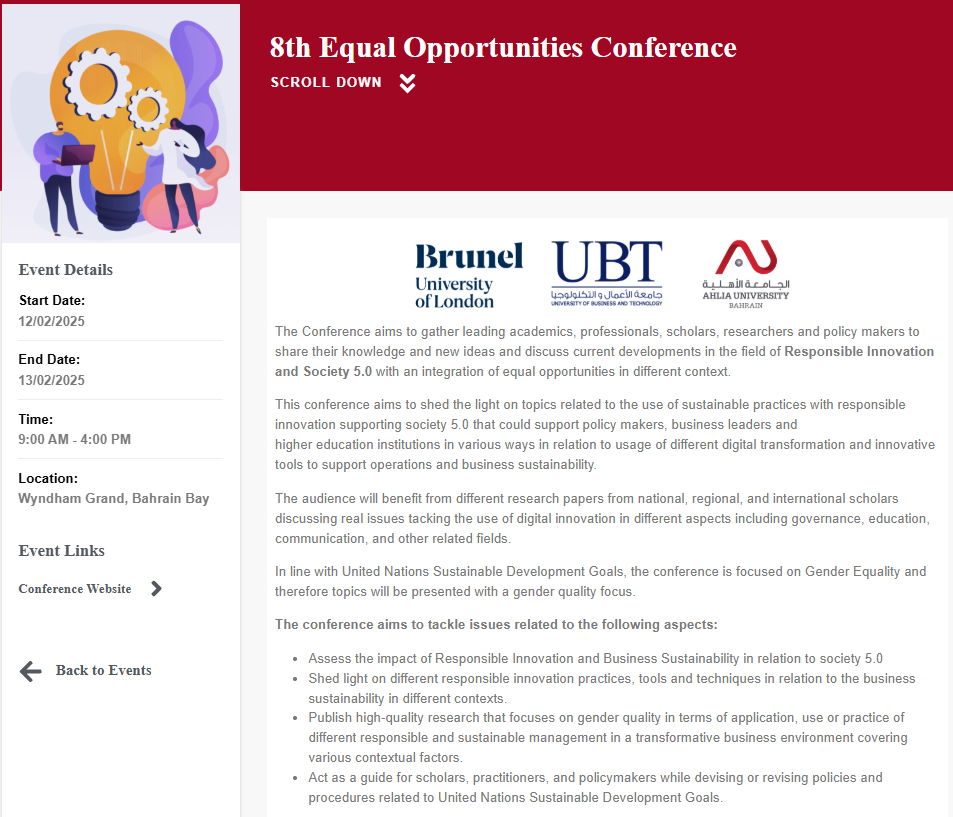
Ahlia continued the Equal Opportunities Conference after the 2024 reporting year, demonstrating that cross-sector SDG dialogue is an institutional series. The eighth conference in February 2025 brought together academics, professionals, researchers and policymakers around responsible innovation, Society 5.0, gender equality and the SDGs. Its stated purpose remained to support policy, business and higher education and to guide SDG-related policy and procedure.
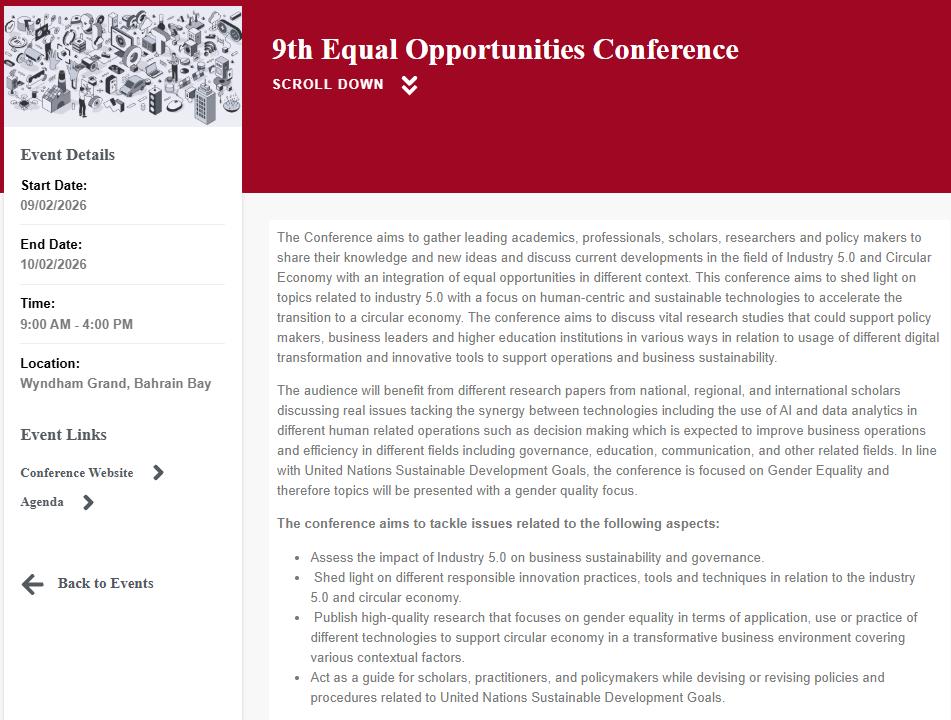
The ninth conference in February 2026 advanced the platform toward Industry 5.0 and the circular economy, with emphasis on human-centred sustainable technologies, governance, education and business sustainability. The sequence from the seventh through ninth conferences evidences an evolving programme that responds to emerging challenges while preserving its cross-sector and SDG orientation.
| Conference cycle | Theme | Cross-sector orientation |
|---|---|---|
| 7th — 2024 | Digital innovation and business sustainability | Parliamentary patronage; policymakers; business; BQA; Derasat; national and international universities |
| 8th — 2025 | Responsible innovation and Society 5.0 | Academics, professionals, researchers and policymakers; explicit SDG and gender-equality focus |
| 9th — 2026 | Industry 5.0 and circular economy | Policy, research, education and business dialogue on sustainable, human-centred transformation |
Original public evidence: E02 | E16 | E17 — 2025–2026 sources demonstrate continuity beyond the 2024 evidence year.
10. Conclusion
Ahlia University answers this indicator affirmatively. In 2024, the University initiated and participated in substantial cross-sector dialogue on the Sustainable Development Goals through national and international conferences, public forums, research symposia, youth debates and formal cooperation frameworks. The evidence demonstrates meaningful involvement by government, Parliament, the United Nations, NGOs, civil society, business, professional organisations and partner universities.
The University’s strongest contribution is its ability to connect these sectors around defined problems—gender equality, inclusive education, responsible technology, sustainable economic transformation and employability—and to structure discussion through research, panels, debates, practical experience and recommendations. The continuation of the Equal Opportunities Conference and the maintenance of partner agreements confirm that cross-sector SDG dialogue is embedded in Ahlia University’s institutional practice.
PUBLIC EVIDENCE
11. Original-source evidence register
The following original public sources substantiate this submission. Each evidence ID is a clickable link to the source itself; no prior-year SDG indicator report is used as evidence.
| ID | Original source | Evidence supplied |
|---|---|---|
| E01 | THE Sustainability Impact Ratings Methodology 2026, Version 1.1 | Official indicator definition, evidence year and public-evidence requirements. |
| E02 | Ahlia University — 7th Equal Opportunities Conference | Dates, parliamentary patronage, co-organisers, policy audience, SDG and gender-equality purpose. |
| E03 | 7th Equal Opportunities Conference — official programme | Primary programme showing government, research, business and university contributors and SDG-labelled sessions. |
| E04 | Ahlia University — cross-sector debate on ‘AI Will Replace Humans’ | Expert debate involving BQA and multiple universities; leaders, academics, industry and audience vote. |
| E05 | Ahlia University — Second Forum on Inclusion of Students with Disabilities in Higher Education | 2024 public forum addressing disability inclusion across education and community settings. |
| E06 | Second Forum on Inclusion — official programme | Primary programme showing Parliament, ministries, NHRI, NGO, Rotary, business and universities; recommendations. |
| E07 | United Nations in Bahrain — New technologies and the SDGs discussed at Ahlia University | Independent UN confirmation of UNIC participation in Ahlia’s student SDG debate. |
| E08 | Ahlia University — robotics, humanitarian applications and the SDGs student debate | Ahlia account of the debate’s participants and SDG-related humanitarian applications. |
| E09 | International Conference on Global Economic Revolutions 2024 — overview | ICGER purpose, cross-sector participants, sustainability themes and research tracks. |
PUBLIC EVIDENCE CONTINUED
Original-source evidence register
| ID | Original source | Evidence supplied |
|---|---|---|
| E10 | Ahlia University — Minister of Education patronage of the 3rd ICGER | Minister of Education/Higher Education Council patronage; participating Gulf and Arab universities; exchange of strategies. |
| E11 | International Conference on Global Economic Revolutions 2024 — conference site | Official ICGER conference platform, partners and 2024 dates. |
| E12 | Ahlia University — Ahlia–Brunel PhD Symposium 2024 | Recurring Ahlia–Brunel postgraduate research exchange addressing societal challenges. |
| E13 | Ahlia University and Ebrahim Khalil Kanoo — academic–business cooperation agreement | 2024 academic–business cooperation for skills and labour-market alignment. |
| E14 | Ahlia University and Bahrain Institute for Political Development — cooperation agreement | Government–university framework for research, training, conferences, seminars and awareness. |
| E15 | Ahlia University and Bahraini Association for Parents and Friends of the Disabled — cooperation agreement | NGO–university framework for joint activities, events and disability support. |
| E16 | Ahlia University — 8th Equal Opportunities Conference | 2025 continuation of cross-sector SDG and policy dialogue. |
| E17 | Ahlia University — 9th Equal Opportunities Conference | 2026 continuation focused on Industry 5.0, circular economy and sustainable transformation. |
| E18 | Ahlia University — 2024 forum on integrating students with special needs | Ahlia’s original 2024 event record for the disability-inclusion forum. |
Evidence note: Core evidence is dated 2024. Sources E16–E17 are included only to establish the continuation and development of the institutional conference series.