Direct Involvement in National
Government SDG Policy Development
DIRECT RESPONSE: YES
Ahlia University demonstrates direct, public input into Bahrain's SDG-related policy development through policy-facing forums convened with parliamentary, ministerial and national-agency participation; research and debate that identify national challenges and test future interventions; and a formal governance system that monitors implementation and converts evidence and stakeholder feedback into improvement action.
INSTITUTIONAL RESPONSE
1. Direct answer and 2024 evidence position
Ahlia University has direct involvement in and provides input into national government SDG policy development. During 2024, the University convened research-led dialogue with the Council of Representatives, the Ministry of Education and Higher Education Council, the Ministry of Social Development, the Education and Training Quality Authority, DERASAT and other national stakeholders. These activities moved beyond general awareness: they identified policy problems, developed legislative and implementation recommendations, examined alternative future pathways and connected the results to institutional and national decision-making.
| 2024 policy-input channel | Government / national interface | Substantive contribution |
|---|---|---|
| Second Forum on Inclusion of Students with Determination in Higher Education | Patronage of the Speaker of the Council of Representatives; parliamentary contribution; participation by the Minister of Social Development and public bodies | Documented barriers and produced recommendations on legislation, government support, transport standards, educator training, assistive technology and employment pathways. |
| 7th Equal Opportunities Conference | Speaker of the Council of Representatives; BQA/NQF; DERASAT; Bahraini higher-education leaders | Designed expressly to guide policymakers devising or revising SDG-related policies and procedures; addressed governance, gender equality, employment and inclusive growth. |
| Third International Conference on Global Economic Revolutions | Under the patronage and in the presence of the Minister of Education and Chairman of the Higher Education Council | Research and strategy exchange on AI, economic diversification, the digital divide, circular economy, resilience and sustainability governance. |
Public evidence: E02 | E03 | E05 | E06 | E07 | E08
Inspiring Change: Ahlia University a Beacon of Special Needs Integration in HEIs Alaali Advocates for Sharing Successful Practices in Universities
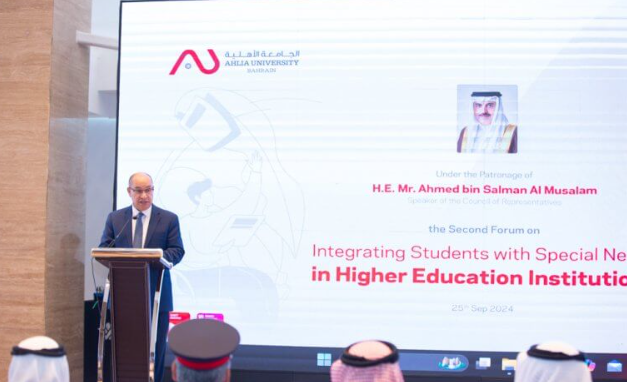
Professor Mansoor Alaali, President of Ahlia University, emphasized the need for greater focus on research and academic attention to issues faced by individuals with determination. He highlighted the importance of evaluating the integration in universities and sharing successful practices to improve the educational landscape.
During a forum on the integration of students with determination into higher education institutions, held under the patronage of Mr. Ahmed bin Salman Al-Musallam, Chairman of the House of Representatives, several recommendations were made. Key suggestions included increasing governmental and community support for institutions that assist individuals with determination, establishing supportive legislative frameworks, and creating specialized training programs tailored for these individuals, particularly in suitable fields such as administration, organization, reception, support roles, and public relations.
The forum also called for improving transportation and traffic systems in line with international standards for individuals with determination. It aimed to empower these individuals with tools like artificial intelligence, increase community initiatives, and develop clear strategies for training educators to effectively support students with disabilities, ensuring ongoing communication between academic institutions and organizations.
A presentation by Ms. Lulwa Ali Al-Rumaihi, Member of Parliament, highlighted the legislative and oversight efforts of the Parliament to protect the rights of individuals with determination. She underscored the Parliament’s role in enhancing these rights across various sectors, including health services, youth and sports, training, and employment.
Discussions revealed significant challenges faced by students with determination in universities, such as accessibility to buildings and facilities, social integration difficulties, limited access to assistive technologies, and financial constraints. Addressing these issues requires effective strategies for integration and comprehensive academic and financial support.
Ms. Shatha Al-Qasimi, HR Supervisor at the National Bank of Bahrain and a graduate of Ahlia University, shared the bank’s successful experience in integrating individuals with determination into its workforce in partnership with the Bahrain Down Syndrome Society. This initiative began with a specially prepared training room and followed a two-phase approach: obtaining necessary approvals and then moving to practical employment and on-the-job training. This effort led to notable success, with the number of employees with Down Syndrome at the bank increasing from three in 2018 to five in 2019.
Dr. Fatima Al-Dhaen, Assistant Professor at Ahlia University, discussed the role of artificial intelligence in helping students with determination pursue higher education. She emphasized how tools like “ChatGPT” can assist these individuals in reading by converting text to audio, simplifying complex language, and aiding in writing and grammar. Such technologies can also make difficult subjects more understandable by breaking them down into simpler terms or providing summaries.
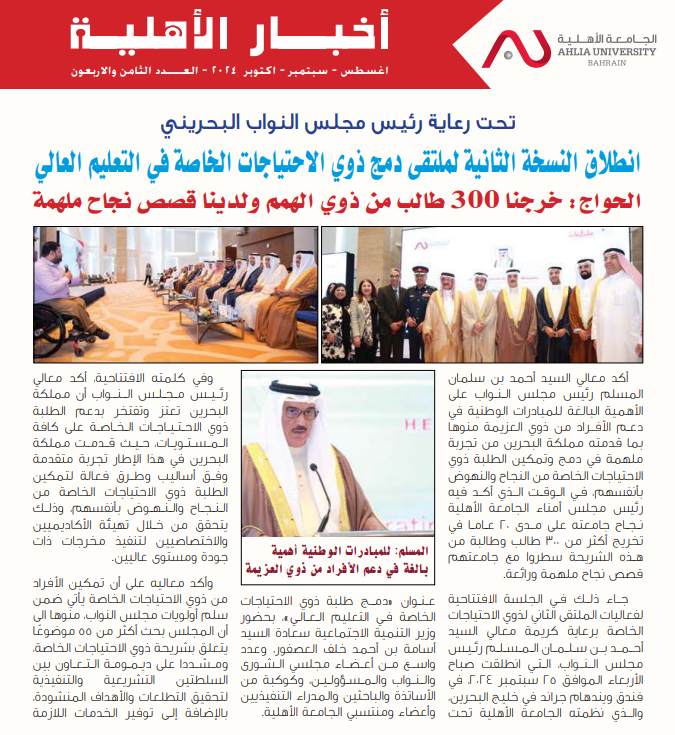
Second Forum on Inclusion of Students with Determination in Higher Education
7th Equal Opportunities Conference
Under the Patronage of the Minister of Education Ahlia University Hosts the 3rd International Conference on Global Economic Revolutions
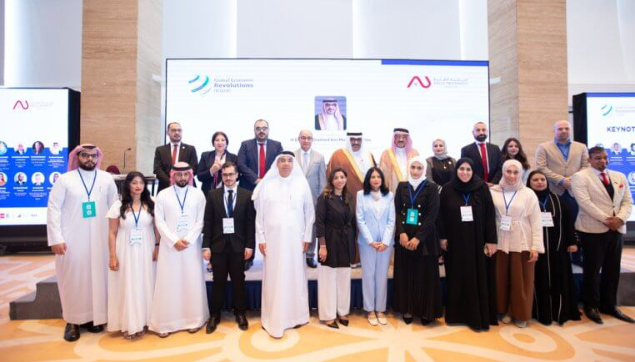
Under the patronage of the Minister of Education and with participation from several Gulf and Arab universities, Ahlia University recently held the third international conference on global economic revolutions, under the theme “Artificial Intelligence for Business Innovation and Economic Diversification”, at the Wyndham Grand Hotel in Bahrain Bay.
The Conference was attended by H.E. Dr. Mohammed bin Mubarak Juma, Minister of Education and Chairman of the Board of Trustees of the Higher Education Council, along with representatives from numerous Gulf and Arab universities.
In his opening remarks, Prof. Abdulla Yousif Al-Hawaj, Founding President and Chairman of the Board of Trustees of Ahlia University, expressed his gratitude to the Minister for his presence. He highlighted the University’s commitment since its establishment to staying ahead of the rapidly changing technological and educational landscape, ensuring that students are well-equipped to thrive in the modern workforce.
Ahlia University President, Prof. Mansoor Alaali, described the conference as a key platform for exchanging ideas and strategies to address contemporary economic challenges. He thanked the scholars, academics, and experts who contributed to its success, particularly those who presented research papers.
Dr. Abdulmuttaleb Al-Sartawi, Chairperson of Accounting Finance & Banking Department, and CEO of the conference, also gave an overview of the conference objective and its sessions.
The opening session concluded with His Excellency Dr. Mohammed bin Mubarak Juma honoring the conference’s strategic partners and keynote speakers.
Call For Papers: ICGER 2024 Artificial Intelligence For Business Innovation And Economic Diversification
While Industry 4.0 witnessed the beginnings of Artificial Intelligence, Internet of Things (IoT) and big data, the new digital revolution will take a societal approach to digitalization. Therefore, it is essential to prepare for the upcoming revolution starting today. With the ongoing advancement in technology, from AI to the metaverse, the phenomenon of the digital divide has become more prominent, particularly post-pandemic. Thus, hindering and limiting equal opportunities among countries and societies for economic diversification, business innovation and sustainable development. The digital divide refers to the disparities and inequalities among societies in Information and Communications Technology access, usage, and impacts.
Sustainable technologies such as AI and big data o!ers us new ideas and methods to understand society and undertake the epic mission of economic diversification, business innovation and sustainable development with a new impetus. Nevertheless, digital inequalities restrict compliance and effective implementation of the SDGs in several countries around the world. Thus, it is particularly necessary to improve access to technologies, data, and the exchange of information between di!erent organizations and countries. This is only possible by democratizing digital resources, information, data and in particular scientific knowledge.
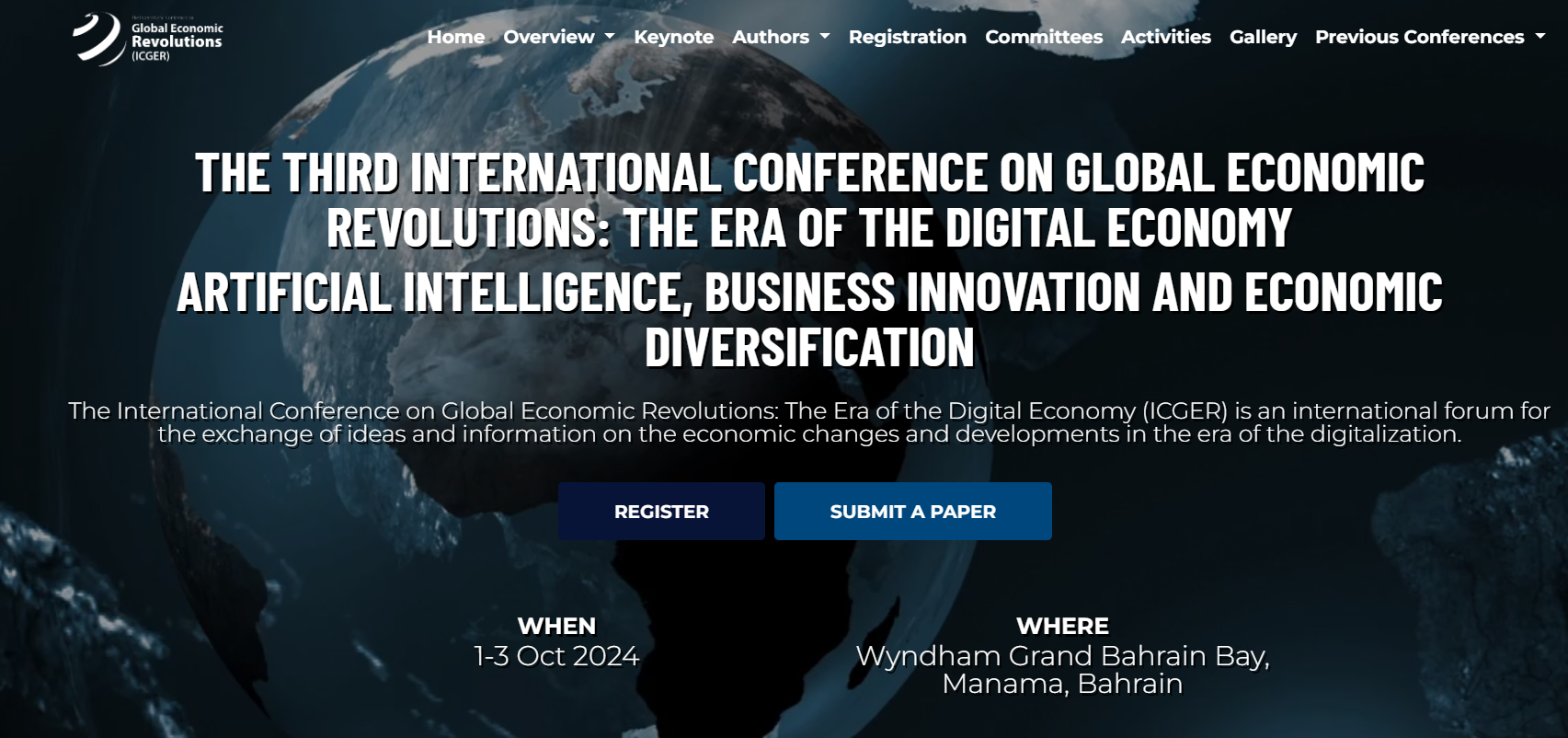
The International Conference on Global Economic Revolutions: The Era of the Digital Economy (ICGER) is an international forum for the exchange of ideas and information on the economic changes and developments in the era of the digitalization. ICGER aims to provide a premier platform for discussing a variety of views on a wide range of novel and important topics in the digital era. ICGER brings together contributors from a variety of perspectives, disciplines, and communities seeking the advancement of knowledge regarding the digital economy.
The purpose of the ICGER 2024 conference is to bring together leading researchers, academics, scientists, research scholars and industry professionals to exchange their ideas, present their research, and offer solutions to important issues such as economic diversification, digital inequalities, business innovation for sustainability and the circular economy. This conference further aims to provide an interdisciplinary platform to discuss the most recent innovations, trends, and approaches which will support economic diversification strategies and address concerns faced by businesses in the era of the digital economy.
This year’s hybrid conference will be organized by Ahlia University, the Kingdom of Bahrain. ICGER 2024 “Artificial Intelligence for Business Innovation and Economic Diversification” will be held on 1-3 October 2024
The conference is seeking submissions related to the following four main tracks:
Artificial Intelligence, Business Innovation & Economic Diversification
Artificial Intelligence, Big Data & the Digital Divide
Business Resilience, Circular Economy, & Sustainability governance
Digital Social Equality, Industry 5.0, Society 5.0
Authors of selected papers will be invited to submit an extended version of their papers to be considered for publication in Special Issues and Journals published by:
Springer
Emerald
Routledge Taylor & Francis
Inderscience
Elsevier
Indexed By
SCOPUS
ABS
ADBC
SJR
WEB OF SCIENCE
SCI
ESCI
ABS
UGC CARE
Submission link
All the papers to be submitted through the following link:
Inquires
For further information or any inquiries, please visit the conference website:
1.1 Coverage of the policy-development cycle
| THE policy-development element | Ahlia University contribution evidenced in 2024 |
|---|---|
| Identify problems and challenges | Accessibility and social-integration barriers, limited assistive technology, financial constraints, digital inequality, job displacement, gender inequality, economic resilience and sustainability-governance challenges. |
| Develop policies and strategies | Legislative frameworks for people with determination; specialised training and employment routes; educator-development strategies; inclusive-growth, digital-economy and economic-diversification approaches. |
| Model likely futures and interventions | Research and debate on AI and job displacement, AI-enabled inclusion, digital transformation, Industry/Society 5.0, circular-economy pathways and national economic resilience. |
| Monitor and report interventions | Formal self-evaluation, monitoring reports, implementation evidence, semester and annual reporting, and reporting to national quality and higher-education bodies. |
| Enable adaptive management | Quality-loop closure, stakeholder-feedback action plans, policy/procedure improvement, further actions and strategic KPI adjustment through Ahlia's governance system. |
STRATEGY AND GOVERNANCE
2. Alignment with Bahrain Economic Vision 2030 and the SDGs
Ahlia University embeds national development priorities and the Sustainable Development Goals in its strategic direction, quality architecture, research partnerships and community engagement. This alignment provides the institutional foundation for sustained government-facing contributions rather than isolated consultation activity.
2.1 National and international reference framework
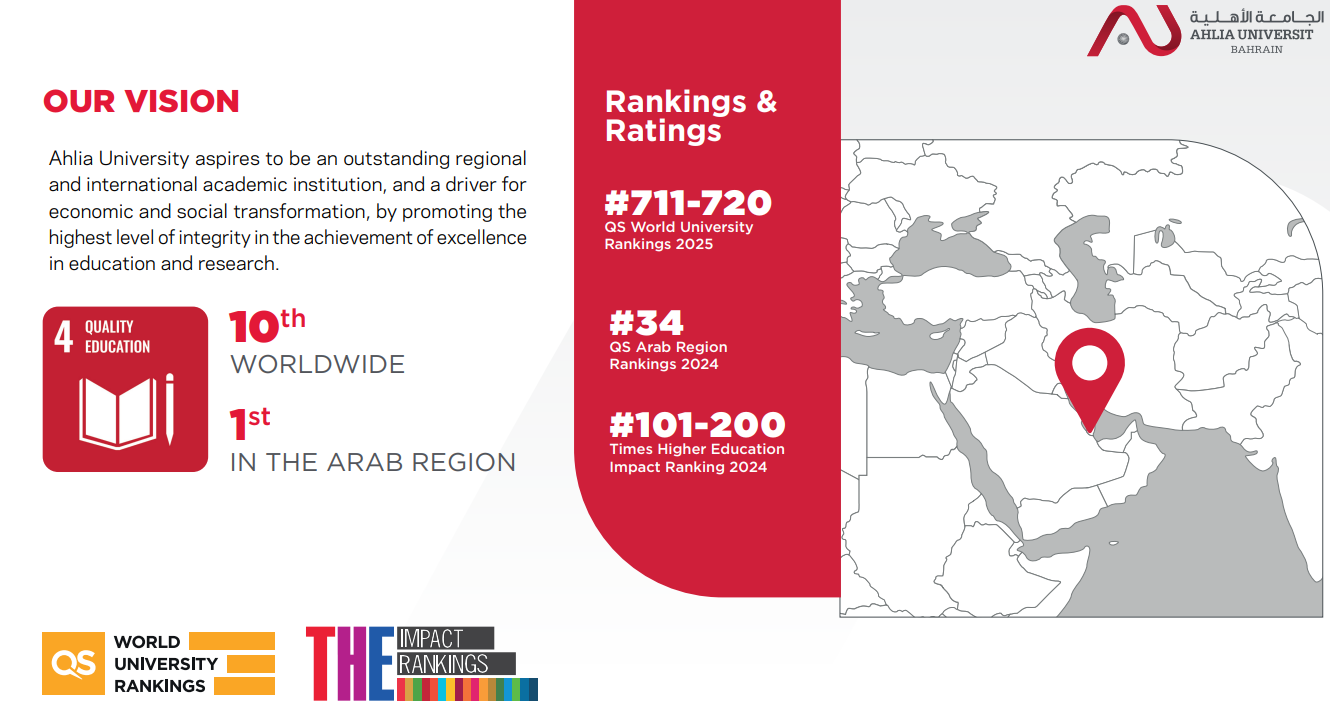
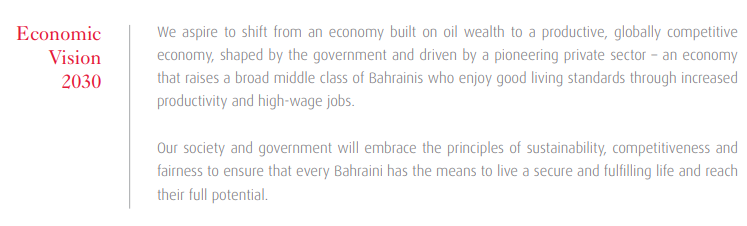
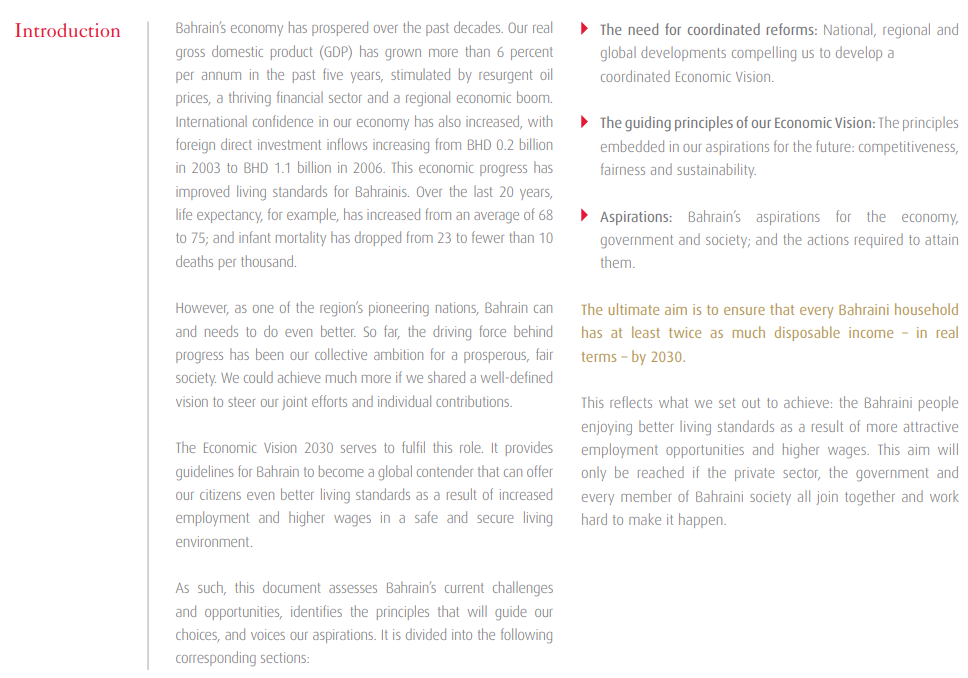
Bahrain Economic Vision 2030. The national vision is built around sustainability, competitiveness and fairness. Ahlia's 2024 strategic-direction presentation identifies Bahrain Vision 2030, Higher Education Council regulation and research strategy, BQA quality assurance, professional standards and sustainable international academic partnerships as institutional enablers.
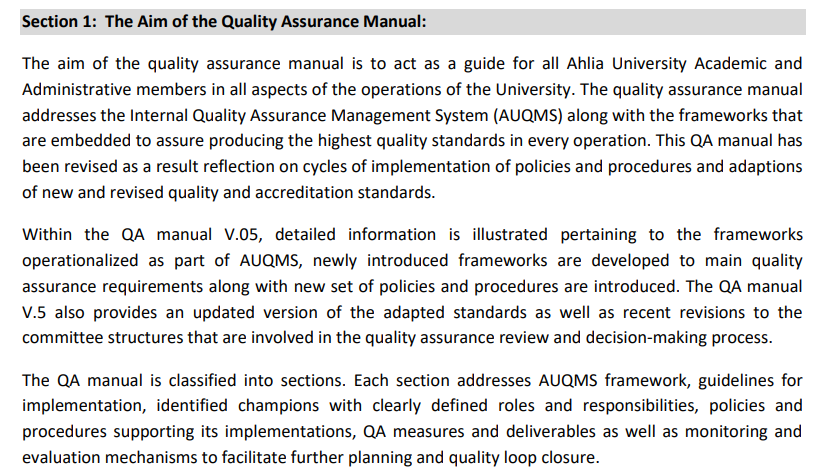
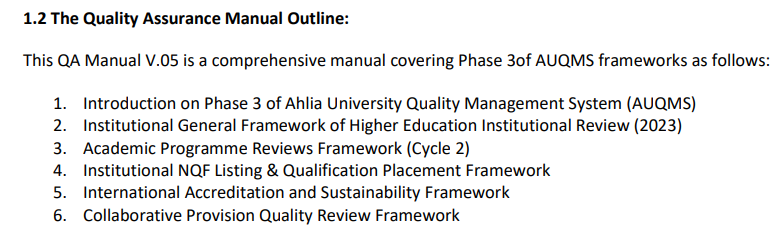
SDG governance. Ahlia's Quality Assurance Manual Version 5.0 expressly aligns its quality system with the Higher Education Council Strategy in line with Bahrain Vision 2030, Bahrain Quality Assurance Standards, SDG 4 and SDG 17.
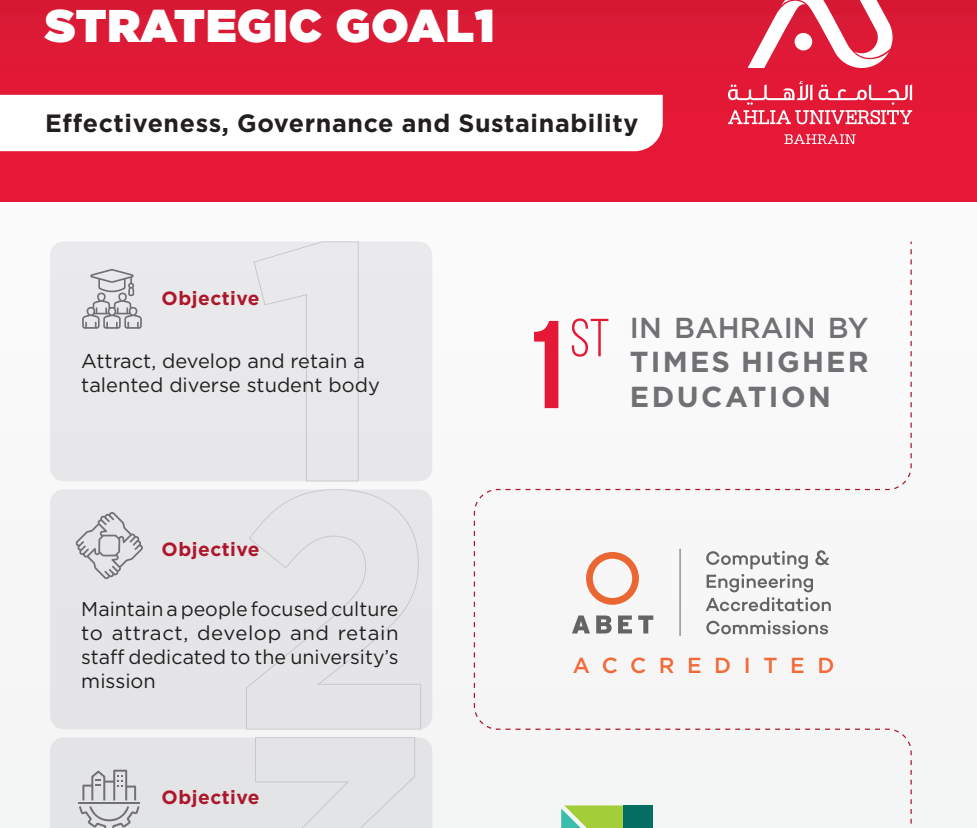
Institutional priorities. The University's published strategic goals cover effectiveness, governance and sustainability; education excellence and learner experience; knowledge-transfer partnerships in research; and social responsibility and community engagement.
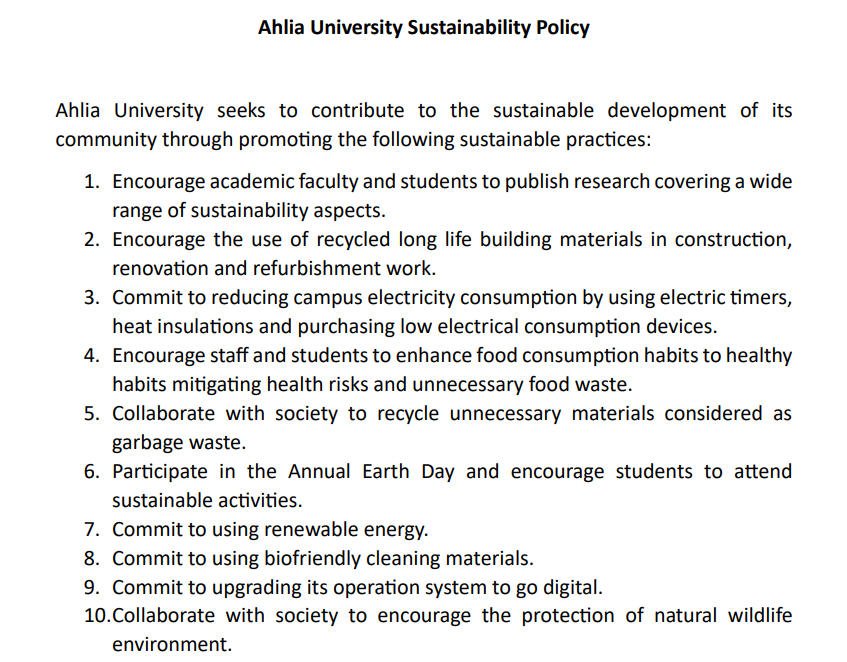
Sustainability policy. The University Council-approved Sustainability Policy commits Ahlia to research across sustainability themes and collaboration with society on sustainable practices.
Public evidence: E11 | E12 | E13 | E14 | E15
Ahlia University Quality Assurance Manual
STRATEGIC GOAL
Strategic Directions Towards A World-Class University
Ahlia University Sustainability Policy
The Economic Vision 2030 for Bahrain
2.2 Governance route from evidence to institutional action
| Institutional mechanism | Function in SDG and national-policy alignment |
|---|---|
| University Council | Approves institutional policy and receives assurance through the quality-management structure. |
| Strategic Planning Directorate | Connects mission, strategic priorities, objectives and key performance indicators with external and national expectations. |
| Centre for Accreditation and Quality Assurance | Reviews implementation against BQA/HEC standards, produces internal review reports and monitors evidence and actions. |
| Centre for Measurement and Evaluation | Supports evidence-based evaluation and the use of stakeholder feedback in decision-making. |
| Academic and Quality Assurance Committee / Teaching, Learning and Assessment Committee | Review monitoring reports, decide improvement action and identify further measures. |
| Colleges and research centres | Generate the research, public dialogue and sector engagement used to define challenges and develop solutions. |
Public evidence: E11 | E12 | E13
DIRECT NATIONAL POLICY INPUT
3. Policy recommendations on inclusion in higher education
The Second Forum on the Integration of Students with Determination into Higher Education Institutions provides Ahlia University's clearest 2024 example of direct policy input. Held in September 2024 under the patronage of H.E. Ahmed bin Salman Al-Musallam, Speaker of the Council of Representatives, the forum joined the University with parliamentary, ministerial, educational, social and employer stakeholders. Its public record identifies the problems and sets out proposed legislative and practical interventions.
3.1 Problems and challenges identified
-
Physical access to university buildings and facilities.
-
Barriers to social integration in higher education.
-
Limited access to assistive technologies.
-
Financial constraints affecting participation and completion.
-
Need for comprehensive academic, financial and transition-to-employment support.
3.2 Recommendations directed to policy and implementation
| Recommendation | National SDG-policy relevance |
|---|---|
| Increase governmental and community support for institutions serving people with determination. | Strengthens inclusive institutions and public-service delivery under SDGs 4, 10, 16 and 17. |
| Establish supportive legislative frameworks. | Constitutes explicit input into the legal and policy environment for disability inclusion. |
| Create specialised training and employment pathways. | Connects inclusive education with decent work and labour-market participation under SDGs 4, 8 and 10. |
| Align transport and traffic systems with international accessibility standards. | Extends policy input beyond campus to inclusive mobility and communities under SDGs 10 and 11. |
| Use artificial intelligence and assistive technologies to enable learning. | Provides an intervention pathway for closing access and participation gaps. |
| Develop clear educator-training strategies and continuous institutional-family communication. | Creates an implementation framework linking higher education, specialist bodies and families. |
Public evidence: E02 | E03 | E04
Launch of the forum for integrating people with special needs into higher education
The second edition of the Forum for Integrating People with Special Needs into Higher Education will be launched at 10:00 AM on Wednesday, organized by the National University and with the participation of a large number of academics, members of parliament, businessmen, journalists, media figures, and public figures, in order to intensify community efforts to enable this segment of society to reach the highest levels in higher education, and to make the greatest possible use of their talents and abilities in achieving sustainable development.
The Founding President and Chairman of the Board of Trustees of Ahlia University, Professor Abdullah Al-Hawaj, expressed his thanks and pride in the generous patronage of the Speaker of the House of Representatives, Ahmed Salman Al-Muslim, for the forum’s activities, noting at the same time the legislative role that supports and assists this segment, a role that is witnessed and appreciated by the Speaker and members of the House of Representatives.
Al-Hawaj said that the forum confirms the Ahlia University’s keenness to integrate people with special needs into higher education, by motivating this segment of society to complete their university education and beyond and integrating them into the educational process, noting that Ahlia University has been a close friend to people with special needs since its inception, and includes students from this category in its various study programs at the bachelor’s, master’s and doctoral levels.
He confirmed that the private university grants people with special needs partial scholarships of 50% for undergraduate studies, and partial scholarships of 20% for master's studies.
Professor Mansour Al-Aali, President of Ahlia University, expressed his gratitude to the Presidency of the House of Representatives for the generous sponsorship of the forum, and to the National Bank of Bahrain and the Yusuf Bin Ahmed Kanoo Group, the strategic partners in organizing the forum. He emphasized Ahlia University's determination to achieve more in the field of enabling people with special needs to complete their higher university studies and to promote this culture in society in general. This forum comes to discuss the various challenges and difficulties facing this segment of society and to reach appropriate solutions and treatments for them through partnership in responsibility and attention to this issue from the representatives as the legislative authority, the competent government agencies as the primary supporter of this segment, and private sector institutions as an important social and economic partner in the development and building process.
He added: “The forum’s activities include three main themes, which include scientific projects and successful experiences in integrating people with special needs into the educational process. The second theme deals with the requirements for preparing teachers and administrators to deal with students with special needs, and the third theme addresses policies for integrating students with special needs in institutes and universities.”
The forum will feature research papers from several Bahraini ministries, institutions, universities and companies, while researchers and workers in the care of people with special needs from multiple institutions and companies will attend the forum.
3.3 Government and stakeholder interface
The policy relevance was reinforced by a parliamentary presentation on legislative and oversight measures protecting the rights of people with determination across health, youth and sport, training and employment. Ahlia University's contribution included research-based advocacy for evaluating integration outcomes, sharing effective university practices and applying AI tools to accessible education. Employer evidence from the National Bank of Bahrain and the Bahrain Down Syndrome Society connected the recommendations to a tested training-and-employment pathway.
RESEARCH TO POLICY
4. Equal Opportunities Conference: evidence for policy revision
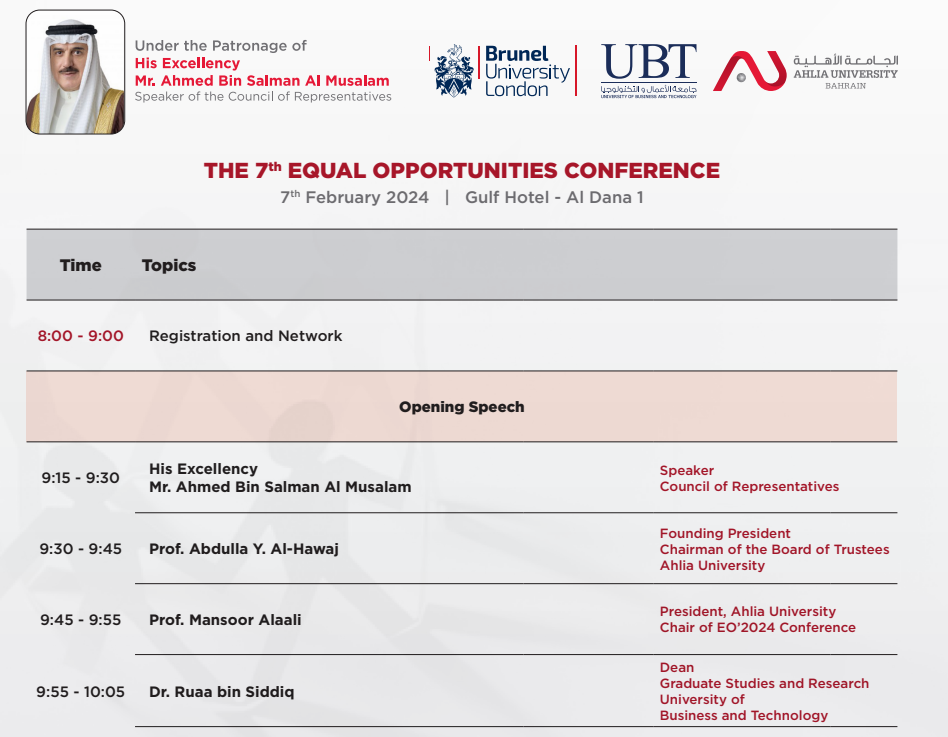
Ahlia University's seventh Equal Opportunities Conference, held on 6-7 February 2024 in Manama, was convened under the patronage of the Speaker of the Council of Representatives and in collaboration with Brunel University London and the University of Business and Technology, Saudi Arabia. Its stated purpose included acting as a guide for scholars, practitioners and policymakers when devising or revising policies and procedures related to the United Nations Sustainable Development Goals.
4.1 National decision-makers and policy institutions
| Participant / institution | Policy-development contribution |
|---|---|
| Speaker, Council of Representatives | Opened the policy-facing conference and connected its research dialogue to Bahrain's legislative institution. |
| Education and Training Quality Authority - NQF and National Examinations | Presented on sustaining knowledge-sharing practices in Bahrain's private higher-education institutions and joined the future-of-work debate. |
| DERASAT - Bahrain Center for Strategic, International and Energy Studies | Presented research on women's appointment to senior positions in Bahrain's public sector. |
| Ahlia University Strategy, Quality and Sustainability leadership | Participated in the debate on AI, jobs and the future workforce. |
| National, regional and international academics | Supplied comparative research evidence across governance, education, communication, equality and business sustainability. |
4.2 Policy questions and future scenarios
-
How firm digitalisation can support inclusive growth.
-
How private higher-education institutions in Bahrain can sustain knowledge sharing.
-
How AI may affect gender equality and job displacement.
-
Whether female organisational leadership changes the appointment of women to senior public-sector roles.
-
How GCC digital-transformation strategies affect economic resilience.
-
How human sustainability can be advanced through education, governance and responsible innovation.
MODELLING FUTURES
5. Economic diversification and sustainable digital futures
The third International Conference on Global Economic Revolutions, held on 1-3 October 2024, extended Ahlia University's policy contribution into national economic strategy. It was held under the patronage and in the presence of H.E. Dr Mohammed bin Mubarak Juma, Minister of Education and Chairman of the Higher Education Council, with participation from Gulf and Arab universities. Ahlia described the conference as a platform for exchanging ideas and strategies to address contemporary economic challenges.
5.1 Research agenda linked to intervention choices
| Research theme | Policy and strategy application |
|---|---|
| AI, business innovation and economic diversification | Tests how technology and innovation can support a more diversified, knowledge-based economy. |
| AI, big data and the digital divide | Identifies unequal access to technology, data and knowledge as constraints on SDG implementation. |
| Business resilience, circular economy and sustainability governance | Compares interventions that can improve resilience, resource efficiency and accountable transition. |
| Digital social equality, Industry 5.0 and Society 5.0 | Examines the distributional and societal consequences of future digital-development pathways. |
| ICT, e-government and data-governance strategies | Connects digital transformation with public-sector capability, ethical governance and inclusive service delivery. |
5.2 Future-oriented contribution
The conference framing explicitly compared present digital inequalities with future possibilities enabled by wider access to technology, information, data and scientific knowledge. Its research agenda covered AI, the metaverse, digital twins, ethical AI, e-government, circular-economy strategies and transformation enablers. In this way, Ahlia provided a structured setting in which likely economic and social futures, with and without effective interventions, could be examined with national higher-education leadership and regional experts.
Independent coverage in Al Bilad reported that the three-day programme combined workshops, research papers and scientific debate on sustainable growth, national priorities, technology and the role of education. It also highlighted the intended movement from research theory to applications that serve society.
Public evidence: E07 | E08 | E09 | E10
Call For Papers: ICGER 2024 Artificial Intelligence For Business Innovation And Economic Diversification
The third International Conference on Global Economic Revolutions: The Era of the Digital EconomyArtificial Intelligence, Business Innovation and Economic Diversification
The global economy and the “Eligibility” conference
The global economy is in a predicament, with countries of the Global South and the Global North caught between an East striving for progress and a West saturated with technology, amidst a persistent ozone layer and a struggle poised to exert its influence on various contemporary issues.
They say it's wars, but we say it's science and civilization. They say it's machines, but we say it's the human element.
It is from this perspective that the Ahlia University, in its third edition, organized the Conference on Global Economic Revolutions (The Digital Economy Era), with the participation of a distinguished group of thinkers, experts, academics, and researchers, led by the Minister of Education and Chairman of the Board of Trustees of the Higher Education Council, Dr. Mohammed bin Mubarak Juma, to discuss all aspects of the changes that have swept across the global economy and their impact on the economies of emerging countries, including those in the region.
The research papers and scientific debates that punctuated the conference revealed a clash of opinions, between supporters and opponents. Some were enthusiastic about the idea of sustainable development, the ultimate goal pursued by national economies, while others viewed it merely as a UN slogan, unattainable unless the world, North and South, East and West, agreed on fundamental truths that ensure justice in protecting the planet from pollution and safeguarding the human environment from the increasing cosmic radiation caused by ozone layer depletion and the ongoing "Western" aggression against it.
The debates addressed humanity's role in strengthening the planet's resilience against the "lack of peace" and the "injustice" in the distribution of the universe's burdens equitably and without exception.
Over three days of workshops, working sessions, and research paper reviews, the International Economic Conference of the National University arrived at a firm conclusion: “What is achieved in its entirety should not be abandoned altogether.” This truth underscores the far-reaching impact the National University has made through its research teams and collaborative research in the fields of financial management, communication technology, and sustainable knowledge algorithms. This is what consistently qualifies the National University to be at the forefront of bridging the historical gap between theory and practice, or between scientific research as an end in itself and its practical applications that serve society and people.
Based on figures and research findings, we can discuss the equitable distribution of burdens on Earth and the possibility of reordering priorities for technology-producing nations and those that overuse it. This includes the gap between progress, which has acquired the secrets of knowledge and the intricacies of communication between nations, and backwardness, which has widened due to wars, rivalries, and conflicts over spheres of influence and wealth. With
the planet's debt reaching $320 trillion by the end of 2023, who will ultimately bear the burden of this debt? Only two countries possess half of the world's GDP. Which one contributed to increasing these burdens?
They say: It couldn't have been better, but I see from outside the conference circle, and even from within the strategic depth of human thought that fears for its country's interests and human resources, I believe that it is possible to do better. We can rely on ourselves by recycling the outputs of our consumption of technology, and reactivating the dormant within our spheres of influence and transforming them into far-reaching effective forces that plan to implement, and implement to save.
Thus, the recommendations of our economic conference workshops can have a real impact, becoming a driving force in societal development, and ensuring that sustainable development becomes a legitimate right and an existential reality within the context of nations committed to its seventeen goals and its vision for the years 2030-2050.
Therefore, at the private university, we have been keen to ensure that our curricula, academic programs, and research papers align with the growing needs of our society, transforming it into a society of self-sufficiency in production and equitable distribution of challenging tasks.
Economic activity in our beloved Kingdom experiences periods of both growth and slowdown, but ultimately, it can achieve financial equilibrium on schedule and realize the goal of prosperity for all, once everyone fulfills the hopes placed upon them through high-quality human development and a civilizational leap forward, in which education plays the role of a guiding force, never losing its way.
MONITORING AND ADAPTIVE MANAGEMENT
6. Institutional system for monitoring, reporting and adaptation
Ahlia's 2024 Quality Assurance Manual provides the governance system through which national requirements, stakeholder evidence and improvement recommendations are monitored and translated into action. The manual places the Higher Education Council Strategy, Bahrain Vision 2030, BQA standards, SDG 4 and SDG 17 within the University's quality framework.
| Cycle stage | Documented mechanism | Adaptive-management result |
|---|---|---|
| Self-evaluation | Responsible champions submit self-evaluation, data and supporting evidence against national standards and indicators. | Creates an evidence base for institutional and external review. |
| Internal review | CAQA reviews implementation of BQA/HEC standards and associated university policies and procedures. | Identifies compliance, performance and improvement priorities. |
| Decision-making | Quality committees and the University Council receive review reports and determine actions. | Converts evidence into policy, procedure and operational decisions. |
| Implementation monitoring | Status reports, committee minutes and implementation evidence record progress on recommendations and action plans. | Makes intervention delivery traceable and accountable. |
| Loop closure | The system requires further actions, institutional quality-improvement plans and evidence that recommendations have been implemented. | Enables adjustment when evidence shows that an intervention or process must change. |
| Recurring reporting | Semester, annual and multi-year monitoring frequencies are assigned across programme and institutional review cycles. | Sustains learning, reporting and continuous improvement over time. |
Public evidence: E11
6.1 Connection to external public governance
The quality cycle is directly connected to Bahrain's public higher-education architecture: evidence and self-evaluation are prepared against Higher Education Council and BQA requirements, external panels review performance, and improvement plans and follow-up evidence are maintained. This gives Ahlia a systematic basis for reporting on interventions, responding to national standards and adapting institutional policies and programmes.
STRATEGIC PARTNERSHIPS
7. Agreements and success partners in education and national development
Ahlia University strengthens its SDG policy contribution through partnerships that connect government, higher education, research, business and civil society. These relationships expand the evidence available to policymakers and create implementation routes for education, inclusion, workforce readiness and economic diversification.
| Partner or sector | 2024 role | Contribution to national development and the SDGs |
|---|---|---|
| Council of Representatives | Patronage and direct parliamentary participation in Ahlia's inclusion and equal-opportunities forums. | Links academic evidence and public recommendations to legislative and oversight institutions. |
| Ministry of Education / Higher Education Council | Ministerial patronage and participation in ICGER; regulatory and strategic alignment through the quality system. | Connects research, programme development and quality assurance with national education and economic priorities. |
| Ministry of Social Development | Ministerial-level participation in the forum on students with determination. | Connects inclusion recommendations with social-development policy and services. |
| Education and Training Quality Authority | NQF/BQA contribution to the Equal Opportunities Conference and national-quality monitoring. | Supports evidence-based higher-education policy, qualifications and institutional improvement. |
| DERASAT | National research participation on women in senior public-sector roles. | Brings strategic policy research into the University's SDG dialogue. |
| Brunel University London and UBT | Co-organisers and research contributors to the Equal Opportunities Conference. | Provide international and regional comparative evidence for policy development. |
| Ebrahim Khalil Kanoo Company | June 2024 MoU linking higher education and the labour market. | Strengthens workforce skills, educational opportunity and the academic-business bridge. |
| Mastercard, BENEFIT, Tamkeen and Startup Bahrain | Mentorship and support for the 2024 Financial Inclusion for the SDGs Challenge. | Creates data-driven solutions and youth participation around financial inclusion and sustainable development. |
Public evidence: E02 | E03 | E05 | E06 | E07 | E16 | E18
Under the Patronage of the Minister of Education Ahlia University Hosts the 3rd International Conference on Global Economic Revolutions
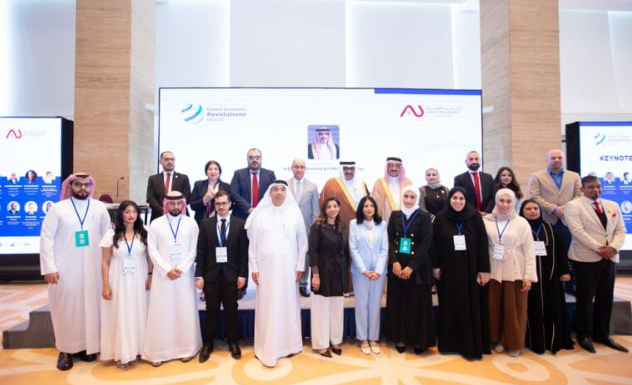
Under the patronage of the Minister of Education and with participation from several Gulf and Arab universities, Ahlia University recently held the third international conference on global economic revolutions, under the theme “Artificial Intelligence for Business Innovation and Economic Diversification”, at the Wyndham Grand Hotel in Bahrain Bay.
The Conference was attended by H.E. Dr. Mohammed bin Mubarak Juma, Minister of Education and Chairman of the Board of Trustees of the Higher Education Council, along with representatives from numerous Gulf and Arab universities.
In his opening remarks, Prof. Abdulla Yousif Al-Hawaj, Founding President and Chairman of the Board of Trustees of Ahlia University, expressed his gratitude to the Minister for his presence. He highlighted the University’s commitment since its establishment to staying ahead of the rapidly changing technological and educational landscape, ensuring that students are well-equipped to thrive in the modern workforce.
Ahlia University President, Prof. Mansoor Alaali, described the conference as a key platform for exchanging ideas and strategies to address contemporary economic challenges. He thanked the scholars, academics, and experts who contributed to its success, particularly those who presented research papers.
Dr. Abdulmuttaleb Al-Sartawi, Chairperson of Accounting Finance & Banking Department, and CEO of the conference, also gave an overview of the conference objective and its sessions.
The opening session concluded with His Excellency Dr. Mohammed bin Mubarak Juma honoring the conference’s strategic partners and keynote speakers.
Ebrahim Khalil Kanoo Company and Ahlia University Sign Memorandum of Understanding to Enhance Cooperation
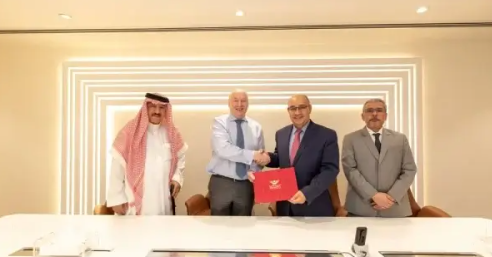
Ebrahim Khalil Kanoo Company and Ahlia University signed a Memorandum of Understanding (MoU) to enhance cooperation between the two entities. The signing ceremony took place during the visit of a delegation from Ahlia University to Ebrahim Khalil Kanoo’s headquarters. The delegation was led by Prof. Abdullah Al-Hawaj, the Founding President and the Chairman of the Board of Trustees, Prof. Mansoor Alaali, the President of Ahlia University, and Mr. Hussain Habib, the Director of Professional Relations.
The Ebrahim Khalil Kanoo team, including Mr. Mike Brightmore, the CEO of the company, and directors from various departments, welcomed the University delegation.
“This partnership with Ahlia University represents an important step in our ongoing commitment towards developing and enriching our team and their families,” said Mr. Mike Brightmore. He added:. “Through this agreement, we not only invest in their educational future, but also strengthen the bridge between the academic sector and the business community, ensuring a strong foundation for growth and mutual success.”
Professor Abdullah Al-Hawaj, the Founding President of Ahlia University, emphasised the importance of such joint cooperation between the educational sector and the labor market, stating that it will enable students to acquire the necessary skills for the workplace.
The Mastercard Challenge on Financial Inclusion for the SDGs: Solving for the Future
Participate in Mastercard ‘Financial Inclusion for the SDGs University Challenge Solving for the Future’ which is a competition and an award that recognizes Bahraini students’ talent in the quest for new innovative ideas and data driven solutions which can help ignite the UN’s Sustainable Development Goals (SDGs) progress through financial inclusion.
The competition is open to all undergraduate and graduate students currently enrolled in the universities that are taking part in this competition.
All participants must be students at the time of submission.
Projects require a multidisciplinary approach, which is essential for innovative financial solutions to accelerate progress towards achieving the SDGs in several sectors.
Applications can be made on an individual basis or in teams consisting of no more than 3, preferably from different fields of study, to cover the technological, legal, economic, and social aspects of the problem to be addressed.
The selected teams will be supported by mentors from Mastercard, Benefit, Tamkeen and Startup Bahrain who will help the students enhance their proposals throughout the contest
7.1 Education-sector implementation
Ahlia's institutional planning is complemented by programme-level implementation. In September 2024, the University reported the launch of undergraduate and master's programmes designed around labour-market demand and acknowledged Higher Education Council support. This demonstrates how national priorities and stakeholder requirements are translated into the University's academic portfolio and future workforce contribution.
Public evidence: E17
Al-Moayyed: We have launched new programs aligned with labor market needs, and we are welcoming Gulf students
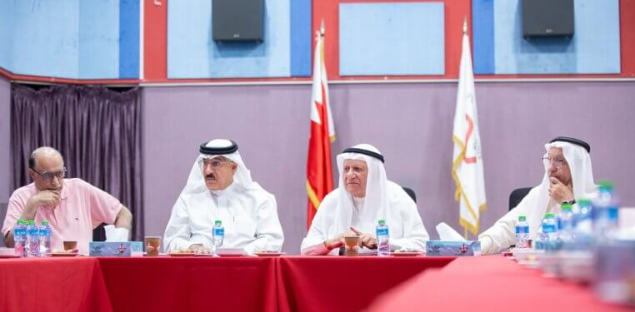
Mr. Farooq Al-Moayyed, Chairman of the Board of Directors – Arab Academy for Research and Studies (Ahlia University), praised the recent launch of several new undergraduate and master’s programs designed to meet labor market demands. He expressed his gratitude for the HEC support, led by Minister of Education Dr. Mohammed bin Mubarak Juma. The General Assembly also recognized the University’s recent accomplishments in educational quality and international accreditations.
This announcement was made during the recent ordinary meeting of the General Assembly of the Arab Academy for Research and Studies, which owns Ahlia University, the Ahlia School, and Bahrain Institute of Technology. The meeting took place at Ahlia University in Manama on September 18, 2024. Al-Moayyed emphasized that these commendable achievements were made possible by the unwavering support that educational institutions receive from the government, which serves as a significant morale boost for all involved. He expressed his gratitude, on behalf of the University’s owners, leaders, faculty, and students, for the support received from the wise leadership of His Majesty the King and His Royal Highness the Crown Prince and Prime Minister.
Prof. Abdulla Al-Hawaj, Founding President and Chairman of the Board of Trustees of Ahlia University, confirmed that the University is confidently moving forward with plans to expand its graduate programs and launch new bachelor’s programs that are highly demanded in the job market, benefiting from the support of the Higher Education Council led by the Minister Dr. Mohammed bin Mubarak Juma.
Al-Hawaj also highlighted the University’s success in attracting a greater number of new students for the upcoming academic year, along with the partial scholarships offered to high achievers, orphans, students with special needs, and others. Additionally, he provided an update on the construction of the new University campus in Salman City, which aims to reflect the University’s stature and contributions. The first phase of the campus project is expected to be completed within a year, with further phases planned for the next few years.
The Board of Directors updated the General Assembly on the academic and scientific achievements of Ahlia University, its financial status, and the ongoing efforts to complete the new campus in Salman City.
The General Assembly reaffirmed its confidence in Mr. Farooq Al-Moayyed as Chairman of the Board, Professor Abdullah Al-Hawaj as Executive Member, and Mr. Mohammed Ali Al-Naqi as Vice Chairman. Additionally, Dr. Muhannad Abdulla Dahlan, Dr. Bakr Ahmed Hassan, Ms. Fawziya Zainal, Dr. Ali Jafar Al-Aradi, Dr. Lulwa Al-Mutlaq, and Hamid Salman were elected as Board members.
PUBLIC EVIDENCE EXHIBITS
8. Selected 2024 documentary evidence
The exhibits below are drawn from original Ahlia University publications. The complete, clickable sources are recorded in the evidence register.
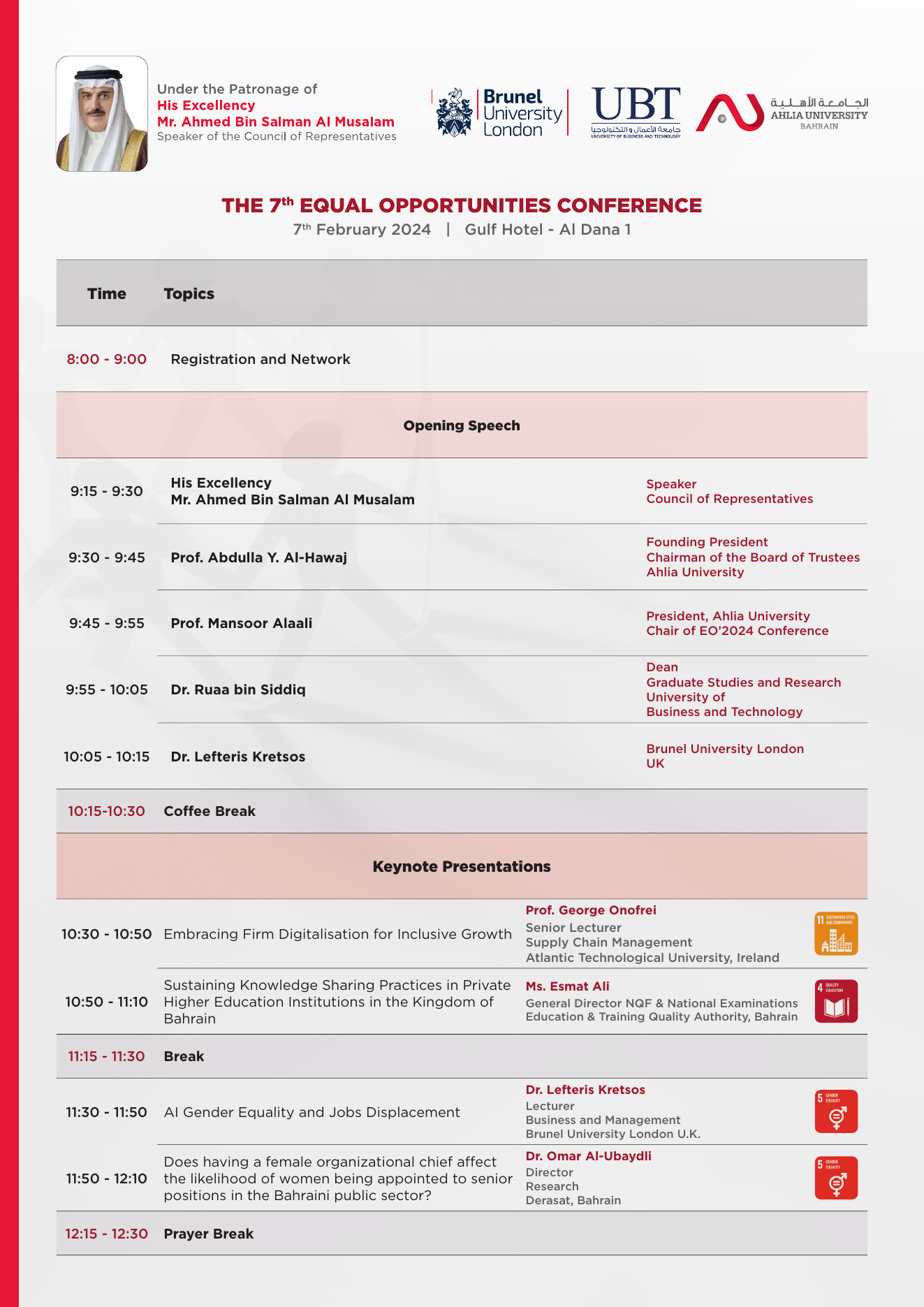
Exhibit 1. Official agenda for the 7th Equal Opportunities Conference, showing the Speaker of the Council of Representatives, Bahrain's NQF/BQA leadership, DERASAT and policy-relevant research on inclusive growth, gender equality and future jobs. Source E06.
8.1 Inclusion forum and global economic futures
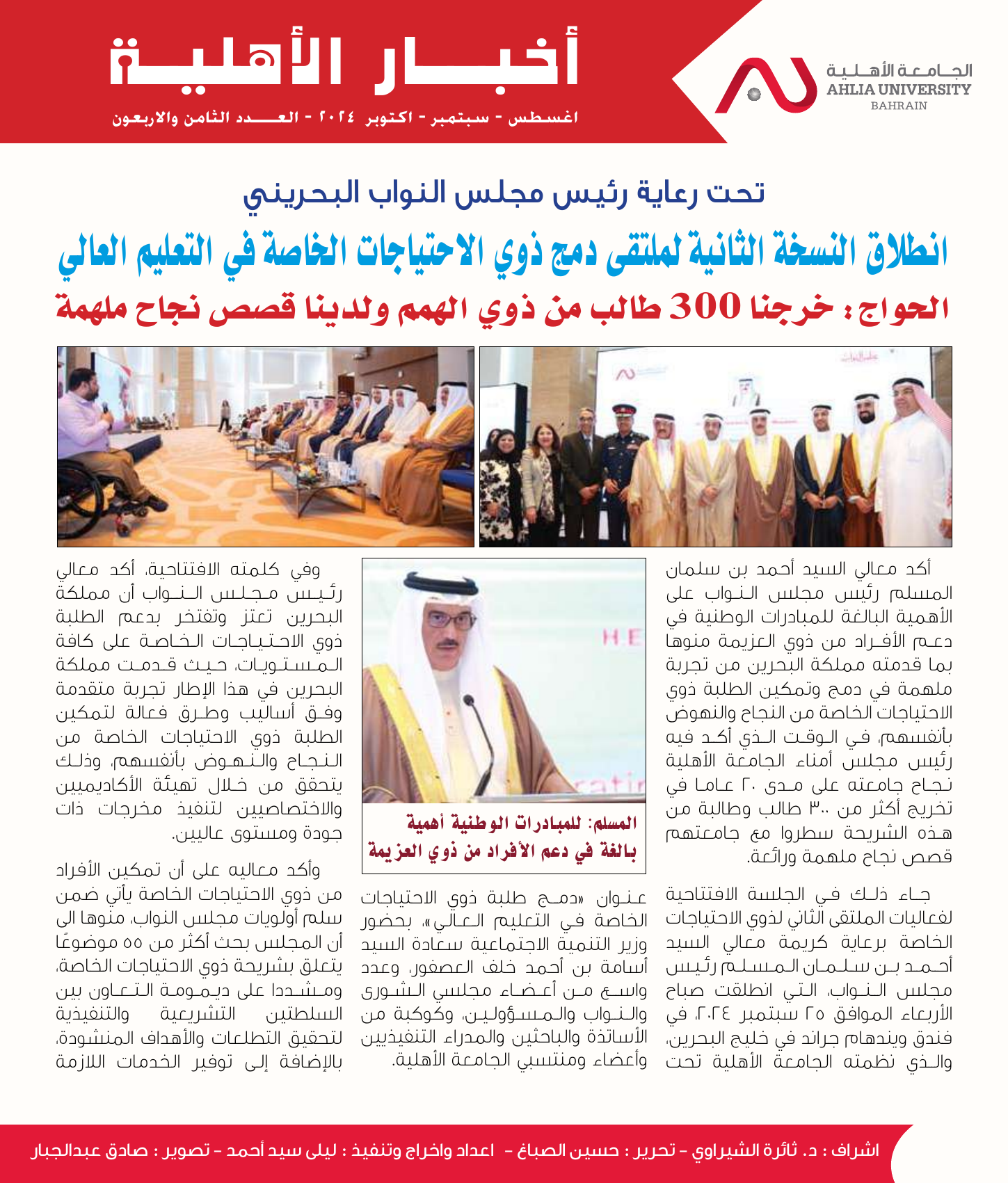
Exhibit 2. Ahlia University Newsletter coverage of the September 2024 higher-education inclusion forum, held under the patronage of the Speaker of the Council of Representatives and attended by national stakeholders. Source E03.
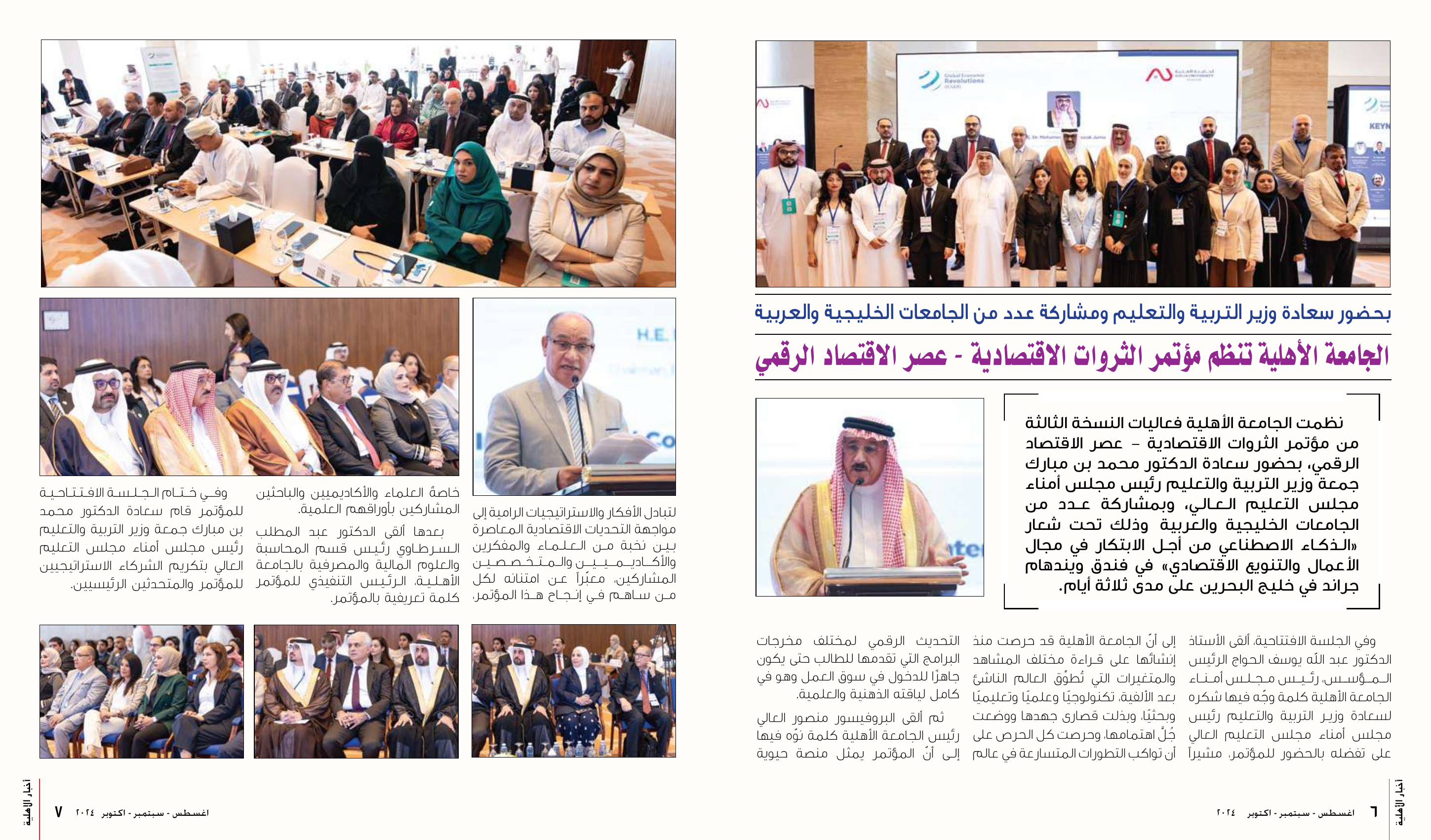
Exhibit 3. Ahlia University Newsletter coverage of the October 2024 International Conference on Global Economic Revolutions, convened with the Minister of Education and Higher Education Council leadership. Source E03.
INSTITUTIONAL CONTINUITY
9. Sustained policy dialogue beyond the evidence year
The 2024 evidence forms part of an established and continuing policy-dialogue platform. In February 2026, Ahlia University again hosted its Equal Opportunities Conference under the patronage of the Speaker of the Council of Representatives. A policy-facing panel on women's leadership compared global standards with local realities and called for practical, research-based solutions adapted to local communities.
The panel examined international models, gender quotas, organisational culture, leadership development, Bahrain's national experience and the role of education. Its conclusion joined policy, legislation and education as the foundation for sustainable representation of women in decision-making. This current activity confirms that Ahlia's government-facing SDG dialogue is recurrent and remains connected to national institutions and local policy priorities.
Public evidence: E19 - Continuity evidence; the formal reporting-year case remains anchored in 2024.
Examining Women’s Leadership Between Global Standards and Local Realities
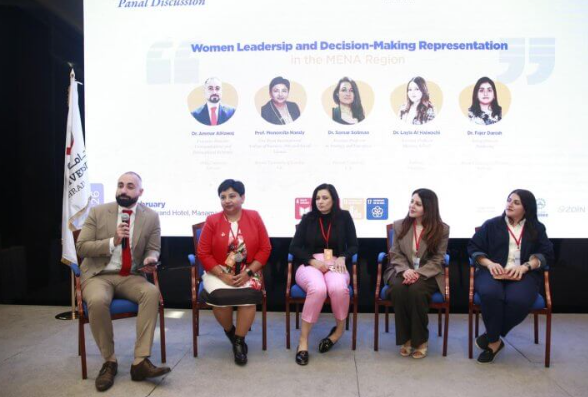
A panel discussion at the Equal Opportunities Conference, hosted by Ahlia University under the patronage of H.E. Ahmed bin Salman Al Musallam, Speaker of the Council of Representatives, explored key issues surrounding women’s leadership and decision-making in the region, bringing together diverse academic perspectives on the subject.
The session examined differing views on whether to adopt international models or develop approaches that better reflect local cultural and social contexts, setting the stage for a deeper exchange of ideas among participants.
In this context, Dr. Ammar Al-Hawaj, Executive Director of Communications at the university, emphasised that empowering women in leadership is a key pillar of sustainable development and effective governance. He called for practical, research-based solutions that are closely aligned with the realities of local communities.
Building on this point, Professor Monomita Nandy of Brunel University London cautioned against directly replicating Western models, stressing the importance of adapting global best practices to suit societies that are rooted in collective values.
Meanwhile, Dr. Samer Suleiman addressed the role of gender quotas, describing them as a useful mechanism to accelerate women’s representation, while noting that they remain insufficient without parallel reforms in organisational culture and leadership development.
Continuing the discussion, Dr. Laila Al-Halwaji highlighted the shift from empowerment to diversity and inclusion, pointing to the ongoing influence of unconscious bias and the need for targeted training programs to better prepare female talent.
From a national perspective, Dr Fajer Danish reviewed Bahrain’s experience, praising the role of the Supreme Council for Women in supporting women’s participation in leadership and entrepreneurship through sustained institutional and societal support.
The discussion further emphasised the role of education in preparing future female leaders, particularly through mentorship and the integration of leadership development within academic systems.
The session concluded with a shared consensus on the need for a comprehensive approach that combines policy, legislation, and education to ensure sustainable and meaningful representation of women across all levels of decision-making.
9.1 Institutional outcome
Across the University's strategy, conferences, inclusion forum, research partnerships and quality-management system, Ahlia maintains a coherent route from national challenge identification to evidence generation, policy and strategy discussion, implementation monitoring and adaptive improvement. Its contribution is supported by direct participation from Bahrain's legislative, ministerial, regulatory and research institutions and by public documentation of the recommendations and research themes produced.
10. Conclusion
Ahlia University can answer this indicator YES. The University's 2024 record demonstrates direct input into Bahrain's SDG-related policy development through explicit legislative and implementation recommendations on disability inclusion; a conference whose stated purpose is to guide policymakers devising or revising SDG policies; government-facing research on equality, digitalisation and future employment; and ministerial dialogue on AI, economic diversification, circular economy and sustainability governance. These public-facing contributions are reinforced by formal strategic alignment with Bahrain Economic Vision 2030, a documented monitoring and quality-loop system, and partnerships spanning government, higher education, research, business and community organisations.
EVIDENCE REGISTER
11. Public evidence sources
All entries below are original public sources or independent public corroboration. The earlier Ahlia SDG indicator report is not used as a source. Core reporting-year evidence is identified as 2024; later evidence is used only to demonstrate continuity.
| ID | Original public source | Use in this report |
|---|---|---|
| E01 | THE Sustainability Impact Ratings Methodology 2026, Version 2 | Indicator definition, evidence year and assessment basis. |
| E02 | Ahlia University: Second Forum on Integration of Students with Determination in Higher Education | Primary 2024 evidence of problems, recommendations, legislative interface and intervention design for disability inclusion. |
| E03 | Ahlia University Newsletter, Issue 48 (August-October 2024) | Official 2024 institutional record of the inclusion forum and ICGER, including national participants and recommendations. |
| E04 | Al Ayam: Second Forum on the Inclusion of Students with Special Needs in Higher Education | Independent media corroboration of the national inclusion forum. |
| E05 | Ahlia University: 7th Equal Opportunities Conference | Primary evidence that the 2024 conference was designed to guide SDG policymakers and involved parliamentary patronage. |
| E06 | Official agenda: 7th Equal Opportunities Conference, 7 February 2024 | Official agenda identifying government and national-policy participants and future-oriented research topics. |
| E07 | Ahlia University: Third International Conference on Global Economic Revolutions | Primary evidence of ministerial/HEC participation and strategy exchange at ICGER 2024. |
| E08 | Ahlia University: ICGER 2024 call for papers - AI, innovation and economic diversification | Primary evidence of the research agenda on economic diversification, digital inequality, circular economy and sustainability governance. |
| E09 | International Conference on Global Economic Revolutions official conference site | Conference programme and future-oriented thematic scope. |
| E10 | Al Bilad: The global economy and Ahlia University's conference, 6 October 2024 | Independent coverage of the three-day conference, research debate and sustainable-development application. |
| E11 | Ahlia University Quality Assurance Manual, Version 5.0 (UC/P 707/2024) | 2024 governance, national alignment, monitoring, reporting and quality-loop mechanisms. |
| E12 | Ahlia University Strategic Goals | Published institutional strategic goals for governance, research partnerships and social responsibility. |
| E13 | Ahlia University: Strategic Directions Towards a World-Class University, June 2024 | June 2024 evidence of Vision 2030, HEC/BQA alignment, data-driven decisions and stakeholder engagement. |
| E14 | Ahlia University Sustainability Policy (UC/P 647/2023) | University Council-approved sustainability policy and commitment to research and societal collaboration. |
| E15 | Government of Bahrain: Economic Vision 2030 | Official national policy framework used to establish Bahrain Vision 2030 alignment. |
| E16 | Ahlia University and Ebrahim Khalil Kanoo Company memorandum of understanding, 5 June 2024 | 2024 strategic agreement connecting education, workforce development and business needs. |
| E17 | Ahlia University programmes aligned with labour-market needs and Higher Education Council support, 29 September 2024 | 2024 programme implementation aligned with labour-market demand and Higher Education Council support. |
| E18 | Ahlia University: Mastercard Challenge on Financial Inclusion for the SDGs, 21 July 2024 | 2024 government-business-university collaboration producing data-driven solutions for financial inclusion and the SDGs. |
| E19 | Ahlia University: Women's leadership between global standards and local realities, 10 February 2026 | 2026 continuity of parliamentary, research-led dialogue on policy, legislation, education and women's leadership. |