
Ahlia University (Ahlia), the first private university licensed in the Kingdom of Bahrain, as a body has a plan to minimise physical, chemical and biological alterations of related aquatic ecosystems. It is the Plan to Minimise Physical, Chemical and Biological Alteration of Related Aquatic Ecosystems 2024 to 2025 (University Council Paper UC/P 723/2024 of 25 September 2024), reviewed by University Council Paper UC/P 825/2025 of 24 December 2025. The ecosystems related to the University are the Gulf shore and waters off Manama, which receive what the public drains carry, and where its students work. Ahlia is an urban university housed in the Gosi Complex, Exhibition Road, Al-Hoora, Manama, a leased complex of two buildings with 10,386 m2 of built area. Its premises are not on the shore. It has no marine laboratory, aquarium, boat or fisheries programme, and it claims none: what it does for the sea is done through what leaves its premises, through what its students and the public learn, and through what its students do on the shore with partners. The plan therefore commits the University to cause no alteration, and sets the measures that keep it so. Facilities and Maintenance owns the plan, with the College of Engineering, the Dean of Student Affairs and the Sustainability Club, the student-led society of the University.
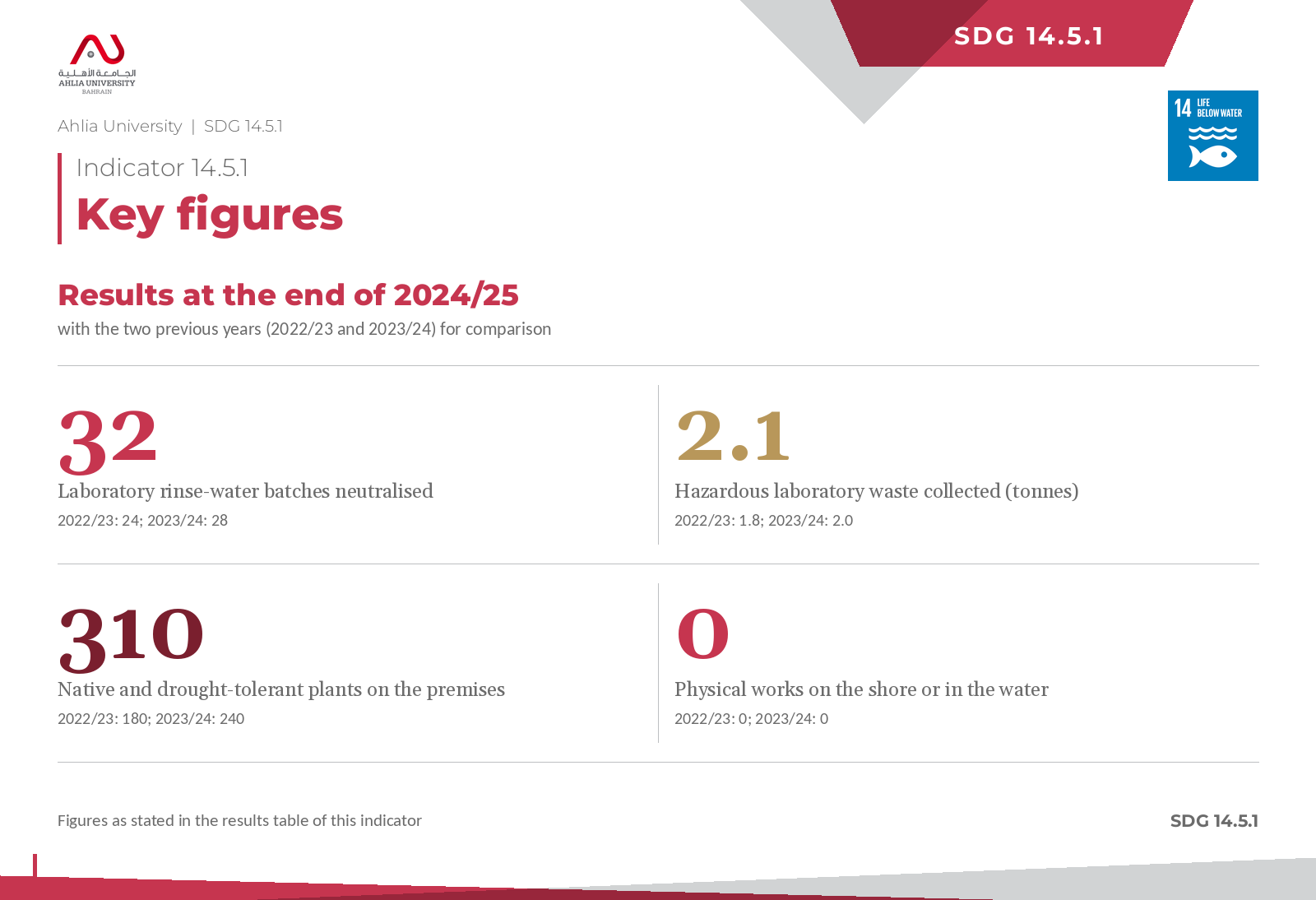
In calendar 2025, which is the 2024/25 column, the University carried out no physical work on the shore or in the water, had no discharge of its own, neutralised 32 batches of laboratory rinse water, had 2.1 tonnes of hazardous laboratory waste collected by licensed contractors, kept 310 native and drought-tolerant plants on its premises and bought seafood only from 3 suppliers that signed declarations excluding threatened species. The same measures in 2024 were 28 batches, 2.0 tonnes and 240 plants, and in 2023 24 batches, 1.8 tonnes and 180 plants.
At a glance
Element of the question
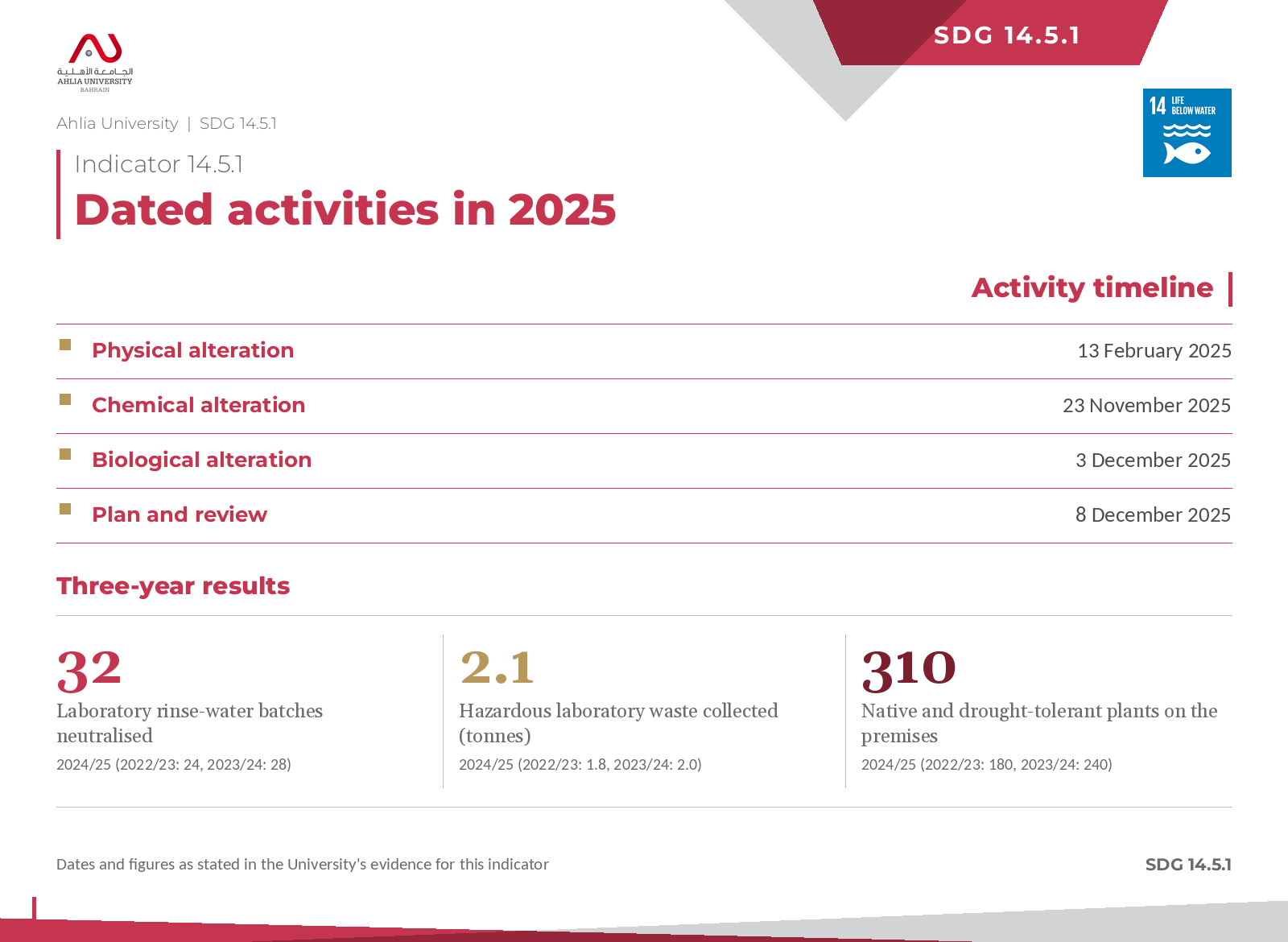
| Physical alteration | Standing activity or document: No works on the shore or in the water; premises in a leased complex; design standards for the new campus in Northern City Owner: Facilities and Maintenance; Vice President for Administrative and Financial Affairs Latest dated instance in 2025: Drain survey, Thursday 13 February 2025: all drains to the sewer Three-year figure: 0 works in three years |
|---|---|
| Chemical alteration | Standing activity or document: Discharge standards, neutralisation of rinse water, hazardous liquids to licensed contractors, plastics plan Owner: Facilities and Maintenance; Colleges with laboratories Latest dated instance in 2025: Last hazardous waste collection of 2025, Sunday 23 November 2025; 32 batches in 2025 Three-year figure: 84 batches; 5.9 tonnes |
| Biological alteration | Standing activity or document: No aquaria or ponds; native and drought-tolerant plants only; threatened species excluded from the cafeteria Owner: Facilities and Maintenance; catering operator Latest dated instance in 2025: Planting register closed Wednesday 3 December 2025: 310 plants in 2025 Three-year figure: 3 suppliers with declarations |
| Plan and review | Standing activity or document: Plan of 25 September 2024, reviewed on 24 December 2025 Owner: SDG Unit within CAQA Latest dated instance in 2025: Review by the University Sustainability Committee, Monday 8 December 2025 Three-year figure: 1 plan, 1 review |
▪ Evidence for each element is cited in its own section below.
1. Related ecosystems and what the University can alter
The University does not own the shore and has none of its own. It can alter the Gulf only at a distance, through three channels: through works that it carries out, through what leaves its drains and waste bins, and through what it brings in from living systems, such as plants and food. The plan takes each channel in turn, as the question does, as physical, chemical and biological alteration, and states for each what the University will not do and what it does to check. The plan runs from 25 September 2024 to the end of 2025.
▪ Evidence: Plan to Minimise Physical, Chemical and Biological Alteration of Related Aquatic Ecosystems, University Council Paper UC/P 723/2024 of 25 September 2024 [1].
2. Physical alteration
The University carries out no construction, dredging, reclamation, shore protection or water feature on the shore or in the sea, and the plan forbids any such work without the written approval of the University Council and the permits that national law requires. The premises are in the Gosi Complex, a leased complex of two buildings, where every drain of the University leads to the public sewerage network and none to the storm-water system, as the annual drain survey records; the survey of 2025 was made on Thursday 13 February 2025. For the new campus planned in Northern City, whose design the Climate Action Plan states will follow sustainability principles, the plan requires an environmental assessment under the national procedure before any design near water is approved. No physical work was carried out in the three years.
▪ Evidence: drain survey of 13 February 2025 and register of works, Facilities and Maintenance [1]; Climate Action Plan page.
3. Chemical alteration
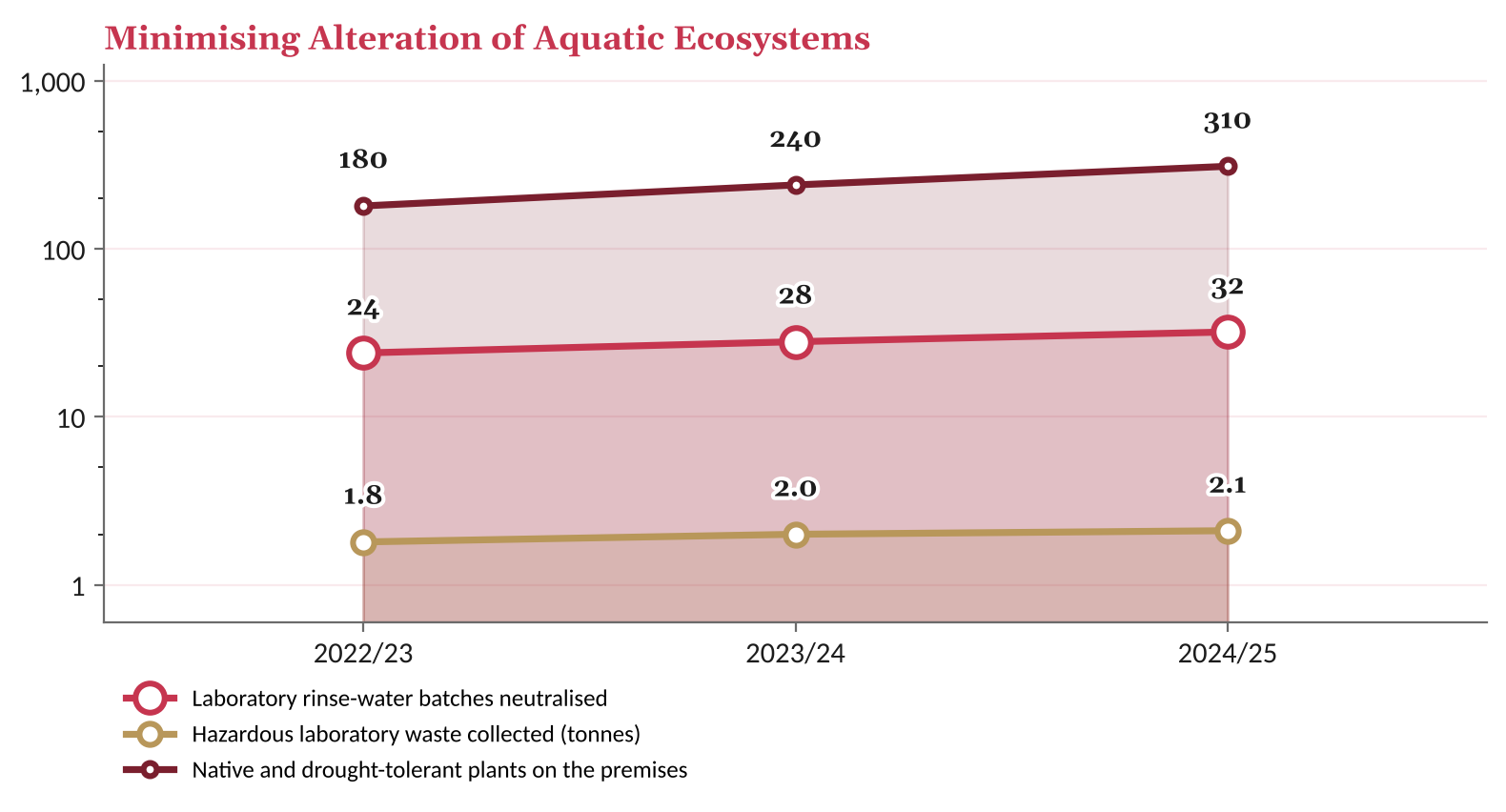
The chemical measures are those of the Water Discharge Standards and Guidelines (Administrative Circular No. 149/2024 of Thursday 15 February 2024), reported in detail under indicator 14.4.1: rinse water neutralised to between pH 6 and 9 in batches, 24, 28 and 32 in the three years; no solvents, reagents or chemical waste to any drain; and licensed contractors for the hazardous liquids and solids, 1.8, 2.0 and 2.1 tonnes, the last collection of 2025 being that of Sunday 23 November 2025. The Plastic Waste Reduction Action Plan (University Council Paper UC/P 635/2023 of 26 April 2023), reported under indicator 14.4.2, keeps plastic out of the water, and the Policy on the Prevention and Reduction of Marine Pollution from Land-based Activities (University Council Paper UC/P 646/2023 of 21 June 2023), reported under indicator 14.4.3, ties them together.
▪ Evidence: batch logs and contractor receipts, 2023 to 2025, Facilities and Maintenance [1].
4. Biological alteration
A system is altered biologically when a species is added or removed. The University keeps no aquarium, pond or other water feature in which a non-native species could be held and later released. Its planting uses native and drought-tolerant plants only, 180 in 2023, 240 in 2024 and 310 in 2025, a series reported in detail under indicator 15.2.3, so that no plant likely to spread to the shore is introduced. On the removal side, the Cafeteria Seafood Sourcing Standard (Administrative Circular No. 949/2024 of Thursday 21 November 2024), reported under indicator 14.3.2, keeps species listed as threatened by the competent Bahraini authority out of the cafeteria; three suppliers held declarations at the end of 2024 and of 2025, and the planting register of 2025 was closed on Wednesday 3 December 2025 with 310 plants. The University makes no survey of aquatic species.
▪ Evidence: planting register and seafood declarations, Facilities and Maintenance and Financial Affairs Directorate [1].
5. Review
The plan was approved by University Council Paper UC/P 723/2024 of 25 September 2024 and reviewed by University Council Paper UC/P 825/2025 of 24 December 2025. The University Sustainability Committee reviewed it on Monday 8 December 2025. The review of December 2025 found that no physical work had been carried out, that every batch was recorded inside pH 6 to 9 and that planting remained native.
▪ Evidence: review record and minutes of the University Sustainability Committee, 8 December 2025 [1].
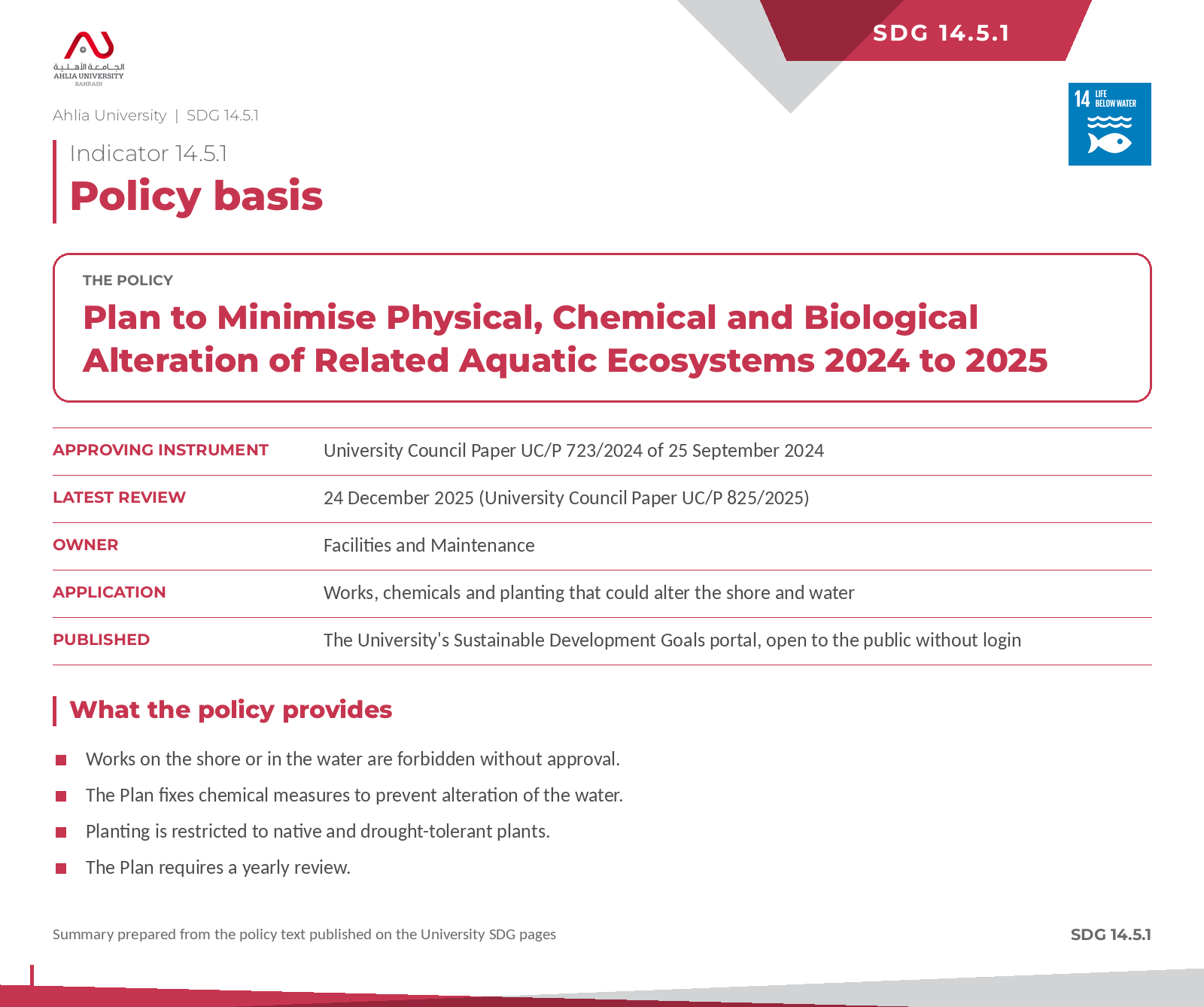
Policy basis
Title: Plan to Minimise Physical, Chemical and Biological Alteration of Related Aquatic Ecosystems 2024 to 2025. Approving instrument: University Council Paper UC/P 723/2024 of 25 September 2024, approved on that date and reviewed by University Council Paper UC/P 825/2025 of 24 December 2025. It is issued under the Biodiversity and Landscape Stewardship Policy (University Council Paper UC/P 651/2023 of 20 September 2023) and the Water Management, Reuse and Pollution Prevention Policy (University Council Paper UC/P 626/2023 of 22 March 2023). Its clauses forbid works on the shore or in the water without approval, fix the chemical measures of section 3, restrict planting to native and drought-tolerant plants, and require a yearly review. Owner: Facilities and Maintenance. In 2024/25 it produced no physical works, no discharges of its own, 32 neutralised batches and 310 native plants. It is published on the University's Sustainable Development Goals portal with this document.
▪ Evidence: plan text and review record [1].
Results by academic year
Registers are kept by calendar year, so the 2022/23 column is calendar 2023, the 2023/24 column is 2024 and the 2024/25 column is 2025; the scope is the Gosi Complex premises. Batches are the lines of the laboratory batch logs, 24 + 28 + 32 = 84. Hazardous waste is the weight collected by licensed contractors, 1.8 + 2.0 + 2.1 = 5.9 tonnes. Plants are the native and drought-tolerant plants on the premises at the end of the year. Works are the physical works on the shore or in the water carried out by the University. Suppliers are the seafood suppliers holding a signed declaration at the end of the year.
| Indicator | 2022/23 | 2023/24 | 2024/25 |
|---|---|---|---|
| Laboratory rinse-water batches neutralised | 24 | 28 | 32 |
| Hazardous laboratory waste collected (tonnes) | 1.8 | 2.0 | 2.1 |
| Native and drought-tolerant plants on the premises | 180 | 240 | 310 |
| Physical works on the shore or in the water | 0 | 0 | 0 |
| Discharges of its own to the sea, ground or storm drains | 0 | 0 | 0 |
| Seafood suppliers with a signed declaration | 0 | 3 | 3 |
▪ Evidence: registers listed in the references [1].
Publication and verification
This document, which is the University's evidence for indicator 14.5.1 and is kept by Facilities and Maintenance, with the SDG Unit within CAQA, was approved by University Council Paper UC/P 830/2026 of 14 January 2026 together with the 2025 edition of the SDG reports (University Council Paper UC/P 829/2026 of the same day, published 21 January 2026) and published on the University's Sustainable Development Goals portal on 28 January 2026, open to the public without login. The underlying registers, which are the drain survey sheet, the register of works, the laboratory batch logs, the contractor receipts, the planting register and the seafood declarations, are held by Facilities and Maintenance and the Financial Affairs Directorate and are quoted in the text above.
Evidence and references
- Plan to Minimise Physical, Chemical and Biological Alteration of Related Aquatic Ecosystems 2024 to 2025, University Council Paper UC/P 723/2024 of 25 September 2024, reviewed by UC/P 825/2025 of 24 December 2025; drain survey, register of works, batch logs, contractor receipts, planting register and seafood declarations, Facilities and Maintenance and Financial Affairs Directorate
- Ahlia University, Climate Action Plan page (page modified 28 April 2025): action areas for energy and buildings, waste segregation, water conservation, education and community engagement; the Northern City campus designed with sustainability principles https://www.ahlia.edu.bh/climate-action-plan/