Ahlia University, the first private university licensed in the Kingdom of Bahrain, housed in the Gosi Complex in Manama, has, as a body, a policy on waste disposal to measure the amount of waste sent to landfill and recycled. The Waste, Hazardous Waste and Single-Use Plastics Policy (University Council Paper UC/P 627/2023 of 22 March 2023, reviewed by University Council Paper UC/P 757/2025 of 26 February 2025) requires the University to weigh all of its solid waste and to report separately what is recycled and what goes to landfill. The Waste Weighing and Landfill Diversion Standard (Administrative Circular No. 468/2023 of 8 June 2023) sets the method, and the results are entered in the waste register of the Sustainability Data Register Procedure (Administrative Circular No. 820/2022 of 13 October 2022). Waste at the University is collected in separate containers by specialised waste management companies, which is how the two streams are weighed.
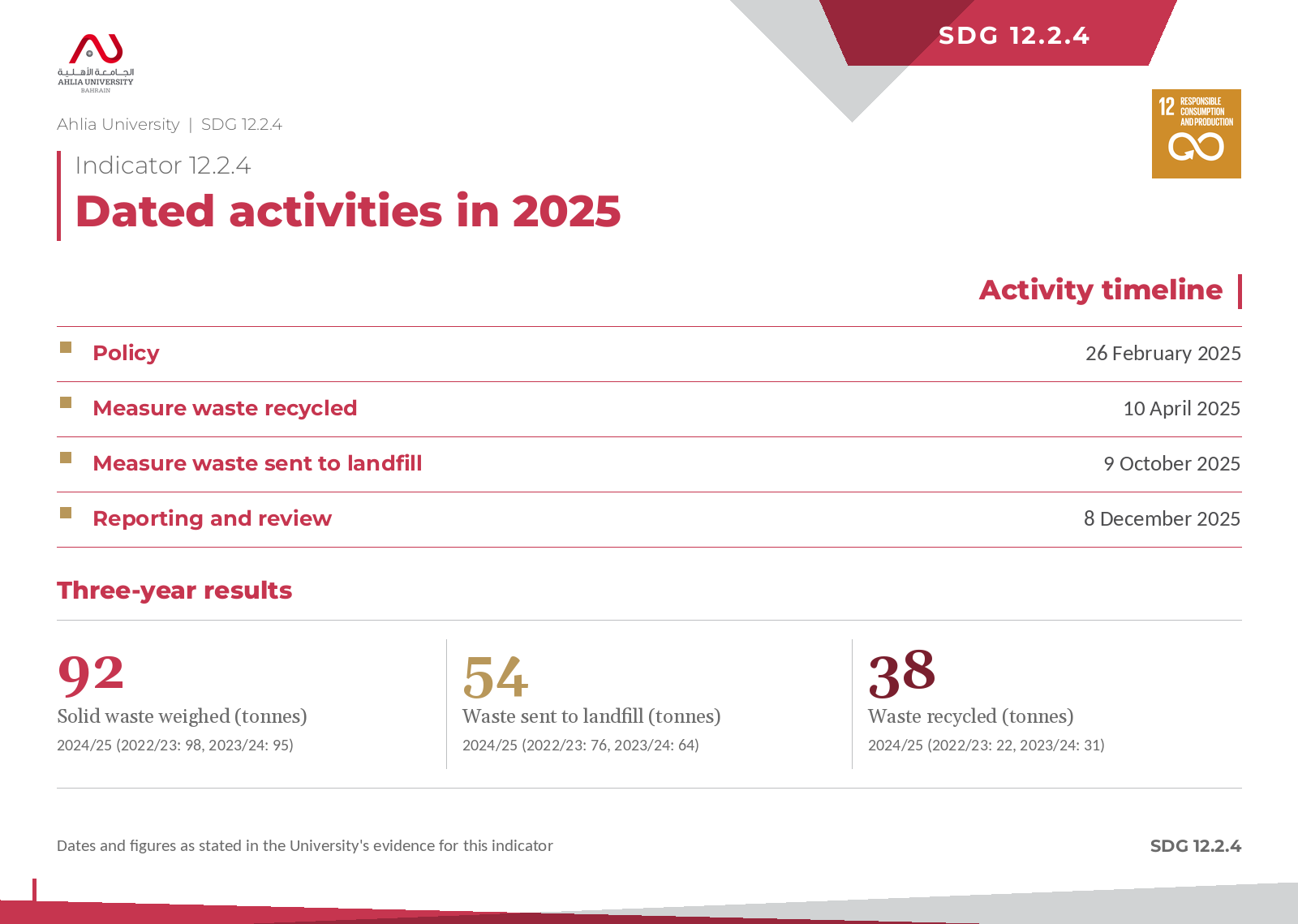
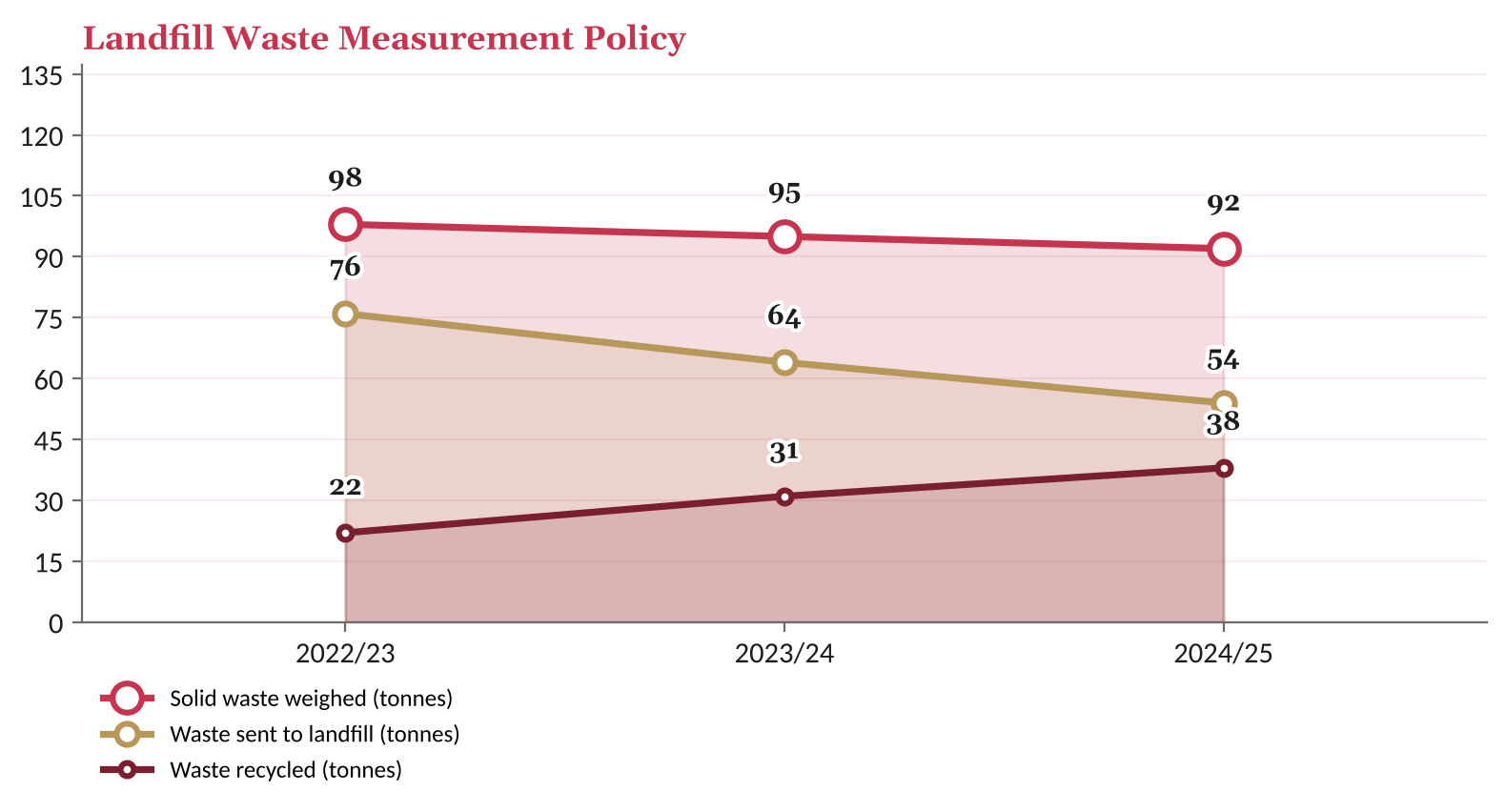
In 2025 the University produced 92 tonnes of solid waste: 38 tonnes (41%) were recycled and 54 tonnes (59%) were sent to landfill. In 2023 the figures were 98 tonnes, 22 recycled (22%) and 76 to landfill (78%), and in 2024 they were 95 tonnes, 31 recycled (33%) and 64 to landfill (67%). Over the three academic years 2022/23 to 2024/25 the University sent 194 tonnes to landfill and recycled 91 tonnes.
At a glance
Element of the question
| Policy | Standing document or practice: Waste, Hazardous Waste and Single-Use Plastics Policy Owner: University Council; Facilities and Maintenance Latest dated instance in 2025: Review, UC/P 757/2025 of 26 February 2025 Three-year figure: 1 policy |
|---|---|
| Measure waste sent to landfill | Standing document or practice: Weighbridge ticket for every collection of general waste; landfill is general waste plus rejected recyclables Owner: Facilities and Maintenance Latest dated instance in 2025: Quarterly consolidation, Thursday 9 October 2025 Three-year figure: 194 tonnes to landfill |
| Measure waste recycled | Standing document or practice: Weight of paper, plastics and cans accepted by the recycling company, with its certificate Owner: Facilities and Maintenance; recycling company Latest dated instance in 2025: Waste Audit Week, Sunday 6 to Thursday 10 April 2025 Three-year figure: 91 tonnes recycled |
| Reporting and review | Standing document or practice: Monthly reconciliation, quarterly consolidation and yearly figure to the University Council Owner: SDG Unit, CAQA Latest dated instance in 2025: Committee meeting, Monday 8 December 2025 Three-year figure: 3 yearly figures |
▪ Evidence for each element is cited in its own section below.
1. The policy and the standard
The Policy approved on 22 March 2023 says that all solid waste produced on the premises is to be weighed, that general waste and recyclable dry waste are to be kept in separate containers, and that the amount sent to landfill and the amount recycled are to be reported each year. The Waste Weighing and Landfill Diversion Standard of 8 June 2023 turns this into rules for who weighs, how often and with what record. It also gives a diversion target, which is that at least 40% of solid waste is recycled by 2025. The target was met in 2025, when 41% was recycled. The Policy follows the University Policy on Healthy Environment, which asks every member of the University to re-think, reduce, re-use and recycle, and the statement of the Climate Action Policy page that the University's wastes are collected in special containers by specialised waste management companies for recycling [1].
▪ Evidence: Climate Action Policy page, Waste Management and Recycling; Waste Policy, UC/P 627/2023 and review UC/P 757/2025 [2]; Waste Weighing and Landfill Diversion Standard, Administrative Circular No. 468/2023 [3].
2. How waste sent to landfill is measured
The premises have general waste containers on every floor and dry waste containers beside them for paper, plastics and cans. The general waste is collected three times a week by a specialised waste management company. Its truck is weighed at a weighbridge, the company issues a ticket for each collection, and Facilities and Maintenance countersigns the ticket and enters the weight in the register. Landfill is the weight of general waste plus the weight of dry waste that the recycler rejects because it is contaminated or not recyclable. Facilities and Maintenance reconciles the tickets with the invoice of the company every month, and a difference of more than 2% is investigated.
The share of waste placed by users in the dry containers is the share segregated at source. It was 38% in 2023, which is about 37 tonnes of 98, 51% in 2024, about 48 tonnes of 95, and 63% in 2025, about 58 tonnes of 92. The recycler accepted 22, 31 and 38 tonnes of these, which is 59%, 64% and 66% of the dry waste collected, so that the rejected part, which went to landfill, fell as users learned to separate better.
▪ Evidence: weighbridge tickets and monthly reconciliation sheets, Facilities and Maintenance, 2023 to 2025 [4]; waste register of the Sustainability Data Register Procedure [5].
3. How recycled waste is measured
Paper, plastics and cans collected in the dry containers go to a specialised recycling company, which weighs them on delivery and returns a certificate of the weight accepted and the weight rejected. Recycled dry waste was 22 tonnes in 2023, 31 in 2024 and 38 in 2025. The plastics that the University hands to the Bahraini Association for Parents and Friends of the Disabled, reported in detail under indicator 12.2.5, are part of the recycled dry waste. Hazardous waste and electronic waste, reported in detail under indicator 12.2.3, are weighed and removed through licensed contractors and are not counted in the 92 tonnes.
The Sustainability Club checks the weighing by a waste audit. In Waste Audit Week, from Sunday 6 to Thursday 10 April 2025, club members and Facilities and Maintenance opened a sample of containers on four floors, separated the contents by hand and compared the shares with the weights in the register. The audit found paper and cardboard to be the largest part of the dry waste and confirmed that the register was within 3% of the sample.
▪ Evidence: recycler certificates and delivery weights, Facilities and Maintenance, 2023 to 2025 [4]; waste audit sheets, Sustainability Club, 6 to 10 April 2025 [6].
4. Use of the measurements
Solid waste fell from 98 tonnes in 2023 to 95 in 2024 and 92 in 2025, and landfill fell from 76 to 64 and 54 tonnes, which is 29% less over the two years. The University also publishes the emissions of its waste. The Campus building footprint page reports waste as a Scope 3 source of 67.99 tonnes of carbon dioxide equivalent in 2021, 57.77 in 2022 and 49.84 in 2024, which is 26.7% less from 2021 to 2024, and names improved waste segregation and recycling among the reasons for the fall in Scope 3 [7]. The SDG Unit within the Centre for Accreditation and Quality Assurance (CAQA) consolidates the register each quarter, the quarter of 2025 being closed on Thursday 9 October 2025, and the University Sustainability Committee received the yearly figures on Monday 8 December 2025. The total, the recycled share and the segregated share are reported in detail under indicator 12.3.1.
▪ Evidence: Campus building footprint page, Scope 3 waste; minutes of the University Sustainability Committee, 8 December 2025 [8].
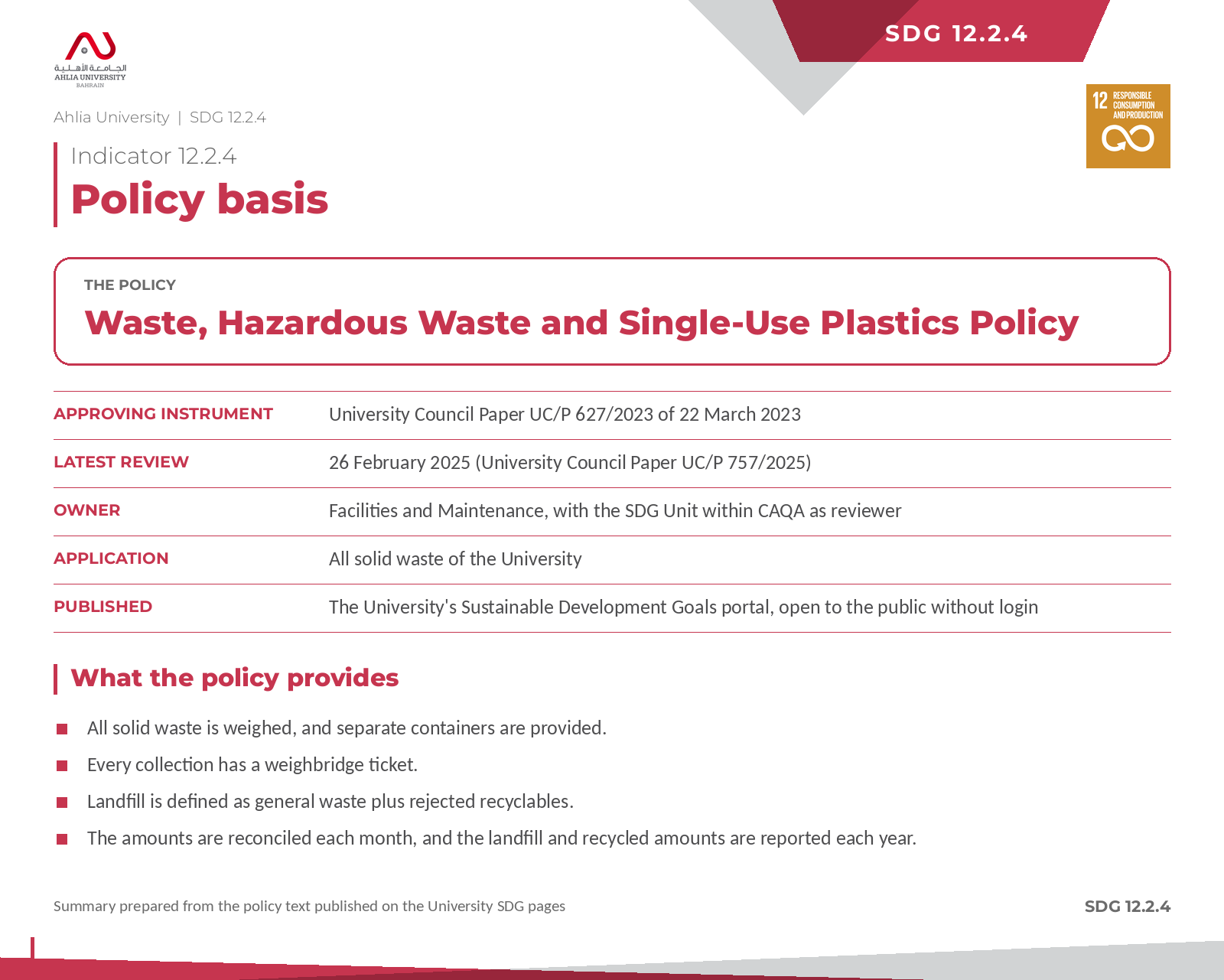
Policy basis
Title: Waste, Hazardous Waste and Single-Use Plastics Policy. Approving instrument: University Council Paper UC/P 627/2023 of 22 March 2023, reviewed by University Council Paper UC/P 757/2025 of 26 February 2025. Method: Waste Weighing and Landfill Diversion Standard, Administrative Circular No. 468/2023 of 8 June 2023, and Sustainability Data Register Procedure, Administrative Circular No. 820/2022 of 13 October 2022. Owner: Facilities and Maintenance, with the SDG Unit within CAQA as reviewer. The clauses that answer the question are the weighing of all solid waste, the separate containers, the weighbridge ticket for every collection, the definition of landfill as general waste plus rejected recyclables, the monthly reconciliation and the yearly report of the landfill and recycled amounts. Application in 2024/25: 92 tonnes weighed, 54 to landfill and 38 recycled. The Policy and the Standard are published on the University's Sustainable Development Goals portal.
▪ Evidence: policy text and review record [2]; Standard [3].
Results by academic year
Registers are kept by calendar year, so the 2022/23 column is calendar 2023, 2023/24 is 2024 and 2024/25 is 2025. Solid waste is the sum of recycled dry waste and waste sent to landfill: 22 + 76 = 98, 31 + 64 = 95 and 38 + 54 = 92. The three-year totals are 194 tonnes to landfill (76 + 64 + 54) and 91 tonnes recycled (22 + 31 + 38). The recycled share is recycled waste divided by solid waste (22 / 98 = 22%, 31 / 95 = 33%, 38 / 92 = 41%), and the segregated share is the part placed in the dry containers. Hazardous waste and electronic waste are not included.
| Indicator | 2022/23 | 2023/24 | 2024/25 |
|---|---|---|---|
| Solid waste weighed (tonnes) | 98 | 95 | 92 |
| Waste sent to landfill (tonnes) | 76 | 64 | 54 |
| Waste recycled (tonnes) | 22 | 31 | 38 |
| Share of waste recycled | 22% | 33% | 41% |
| Share of waste segregated at source | 38% | 51% | 63% |
Publication and verification
This document, which is the University's evidence for indicator 12.2.4 and is kept by Facilities and Maintenance and the SDG Unit within CAQA, was approved by University Council Paper UC/P 830/2026 of 14 January 2026 together with the 2025 edition of the SDG reports (University Council Paper UC/P 829/2026 of the same day, published 21 January 2026) and published on the University's Sustainable Development Goals portal on 28 January 2026, open to the public without login. The underlying registers, which are the weighbridge tickets, the monthly reconciliation sheets, the recycler certificates and the audit sheets, are held by Facilities and Maintenance and the SDG Unit within CAQA and are quoted in the text above.
Evidence and references
- Ahlia University: Climate Action Policy page (Waste Management and Recycling; University Policy on Healthy Environment; page modified 24 May 2024) https://www.ahlia.edu.bh/climate-action-policy/
- Waste, Hazardous Waste and Single-Use Plastics Policy, University Council Paper UC/P 627/2023 of 22 March 2023, reviewed by UC/P 757/2025 of 26 February 2025, Facilities and Maintenance
- Waste Weighing and Landfill Diversion Standard, Administrative Circular No. 468/2023 of 8 June 2023, Facilities and Maintenance
- Weighbridge tickets, monthly reconciliation sheets and recycler certificates, 2023 to 2025, Facilities and Maintenance
- Sustainability Data Register Procedure, Administrative Circular No. 820/2022 of 13 October 2022; waste register, SDG Unit, CAQA
- Waste audit sheets, Waste Audit Week, 6 to 10 April 2025, Sustainability Club and Facilities and Maintenance
- Ahlia University: Campus building footprint page (carbon footprint 2021, 2022 and 2024 by scope, including waste; page modified 28 April 2025) https://www.ahlia.edu.bh/campus-building-footprint/
- Minutes of the University Sustainability Committee, Monday 8 December 2025, SDG Unit