
Ahlia University (Ahlia), the first private university licensed in the Kingdom of Bahrain, as a body measures the reuse of water across the university. The University is housed in the Gosi Complex, Exhibition Road, Al-Hoora, Manama, a leased complex of two buildings, and it reuses the condensate that the air-conditioning units of both buildings produce. The condensate is collected in two tanks and sent to the planters and to the cleaning machines, and every cubic metre (m3) that leaves the tanks passes a totalising flow meter. Facilities and Maintenance reads the meters on the last working day of each month under the Condensate Recovery Metering Procedure (Administrative Circular No. 44/2024 of 11 January 2024) and enters the reading in the water register of the University. The last reading of 2025 was made on Wednesday 31 December 2025 and gave the 4,200 m3 reused over the three years.
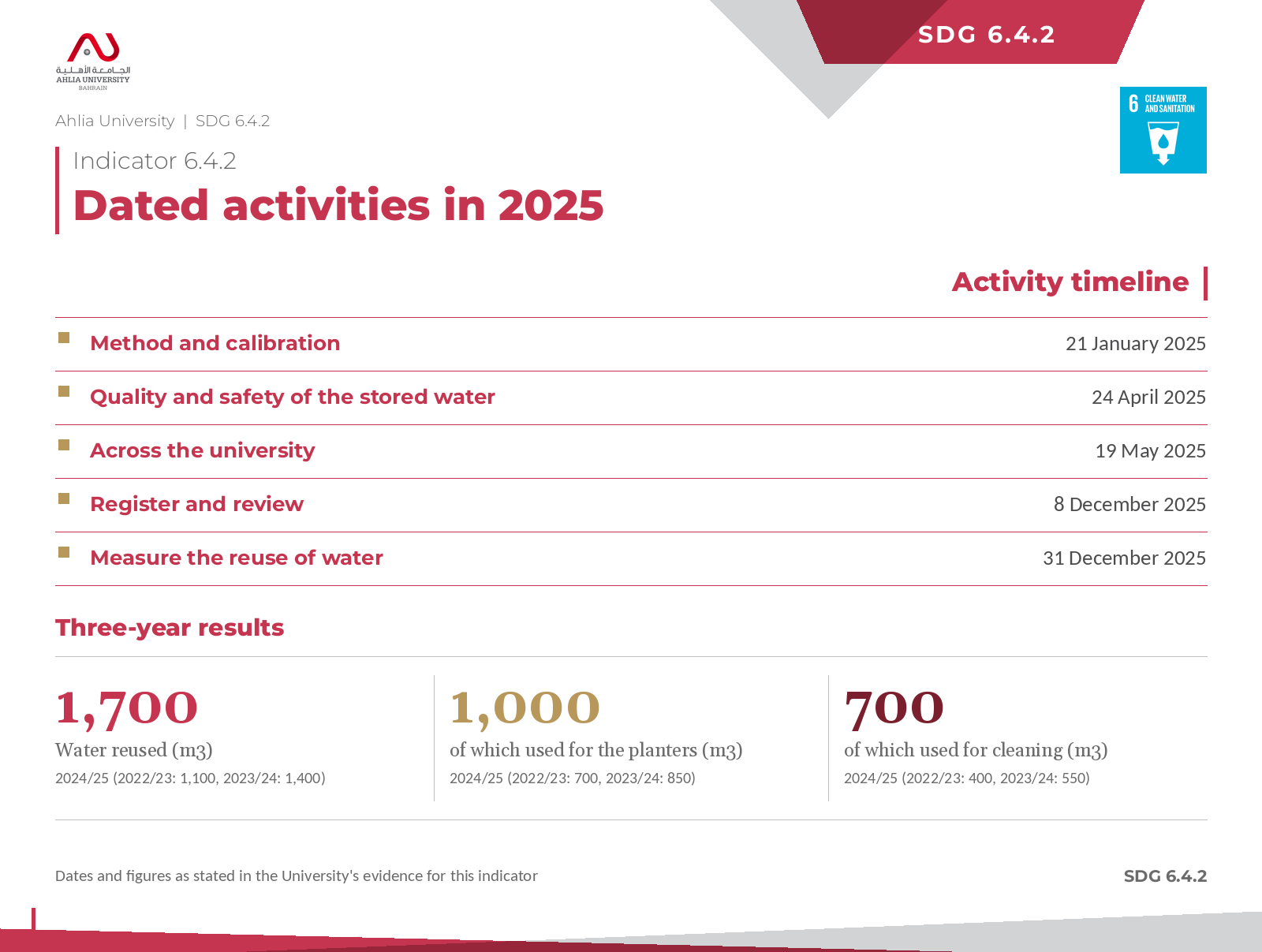
In calendar 2025, which is the 2024/25 column, the University reused 1,700 m3 of water, against 1,400 m3 in 2024 and 1,100 m3 in 2023, which is 4,200 m3 in three years. The reused water was 7% of the 24,300 m3 of mains water that the University used in 2025, against 6% in 2024 and 4% in 2023. Of the 1,700 m3 of 2025, 1,000 m3 went to the planters and 700 m3 to the cleaning machines.
At a glance
Element of the question
| Measure the reuse of water | Standing activity or document: Flow meters on the outlets of two condensate tanks, read monthly Owner: Facilities and Maintenance Latest dated instance in 2025: Reading, Wednesday 31 December 2025 Three-year figure: 4,200 m3 reused |
|---|---|
| Across the university | Standing activity or document: Both buildings, all uses: planters and cleaning; no reuse for drinking, food or laboratories Owner: Facilities and Maintenance; colleges with laboratories Latest dated instance in 2025: Committee review, Monday 19 May 2025 Three-year figure: 2 tanks, 4 meters |
| Method and calibration | Standing activity or document: Condensate Recovery Metering Procedure (Administrative Circular No. 44/2024); check against pump run-hours Owner: Facilities and Maintenance Latest dated instance in 2025: Calibration, Tuesday 21 January 2025 Three-year figure: 2 calibrations |
| Quality and safety of the stored water | Standing activity or document: Tanks cleaned and disinfected twice a year Owner: Facilities and Maintenance Latest dated instance in 2025: Tank cleaning, Thursday 24 April 2025 Three-year figure: 6 cleanings |
| Register and review | Standing activity or document: Water register under Administrative Circular No. 820/2022 Owner: SDG Unit, CAQA Latest dated instance in 2025: Committee review, Monday 8 December 2025 Three-year figure: 12 quarterly consolidations |
▪ Evidence for each element is cited in its own section below.
1. What is reused and what is counted
The University counts the water that it recovers and uses a second time on its premises. Today that is the condensate that forms on the cooling coils of the air-handling units in the two buildings, which the units drain into collecting pipes. The Gosi Complex receives its cooling as a purchased cold supply, and the University has no greywater system of its own, so condensate is the only reused water at the premises. It is clean water without minerals, and it is used where drinking-quality water is not needed: the watering of the planters and the filling of cleaning machines and mop buckets. The University does not count rainwater, because the roof of the complex is not the University's, and it does not count water that is merely used twice by a person at a tap. Rainwater harvesting and recycled water for irrigation and toilet flushing are in the design of the new campus in Northern City, but the campus is at the design stage and no volume is reported for it.
The Climate Action Policy of the University records the practices on which this measurement rests, among them spray irrigation, low-water plants and the quick repair of leaks. The reuse of condensate comes on top of those practices and not in their place.
▪ Evidence: Condensate Recovery Metering Procedure, Administrative Circular No. 44/2024 of 11 January 2024, and the register of tanks and meters, Facilities and Maintenance [1]; SDG 6 institutional report 2021 to 2025 [2]; Climate Action Policy.
2. How the reuse is measured
There are two tanks, one on the roof level of Building 1 and one in the service room of Building 2. Each has a totalising flow meter on its outlet, and the pipes that lead to the planters and to the cleaning points each carry a use meter, so that there are four meters in all. Facilities and Maintenance reads all four on the last working day of each month, two staff sign the sheet, and the figures go to the water register. The four meters were fitted in January 2024. For 2023, before the meters, the University reconstructed the volume from the run-hours of the transfer pumps multiplied by their rated flow, and it checks every metered month against the run-hours: the two agreed within 5% in every month of 2025. The meters were calibrated on Tuesday 21 January 2025 together with the floor sub-meters reported in detail under indicator 6.2.1.
The table gives the 2025 volume by quarter and by use. The volume is highest in the third quarter, when the units run hardest and the planters need most water.
| 2025, m3 | Q1 | Q2 | Q3 | Q4 | Total |
|---|---|---|---|---|---|
| Condensate recovered and reused | 200 | 490 | 710 | 300 | 1,700 |
| of which to the planters | 110 | 300 | 430 | 160 | 1,000 |
| of which to cleaning | 90 | 190 | 280 | 140 | 700 |
▪ Evidence: meter reading sheets by month and use, pump run-hours and calibration record of 21 January 2025, Facilities and Maintenance [1]; water register [4].
3. Use of the reused water
The planters of the entrance garden, the terraces and the roof level took 700 m3 in 2023, 850 m3 in 2024 and 1,000 m3 in 2025, and this water forms part of the irrigation reported in detail under indicator 6.3.5. The cleaning machines and the mop buckets took 400 m3 in 2023, 550 m3 in 2024 and 700 m3 in 2025; the Climate Action Policy records that the University cleans by mopping and with efficient machines. Each tank is cleaned and disinfected twice a year, and the 2025 cleanings were made on Thursday 24 April 2025 and Thursday 23 October 2025, which gives 6 cleanings in three years. Reused water is not used for drinking, for food or in the laboratories.
▪ Evidence: tank cleaning sheets, 2023 to 2025, and use sheets by outlet, Facilities and Maintenance [1].
4. Register and review
The reuse volumes belong to the water register of the Sustainability Data Register Procedure (Administrative Circular No. 820/2022 of 13 October 2022), and the SDG Unit within the Centre for Accreditation and Quality Assurance (CAQA) consolidates them every quarter. The University Sustainability Committee reviewed the first-quarter volume on Monday 19 May 2025 and the result of the year against the target of 6% on Monday 8 December 2025. The reuse targets themselves are set by the Water Reuse Targets and Condensate Recovery Procedure (University Council Paper UC/P 692/2024 of 27 March 2024), reported in detail under indicator 6.4.1.
▪ Evidence: Administrative Circular No. 820/2022 [4]; Committee minutes, 19 May and 8 December 2025 [5].
Policy basis
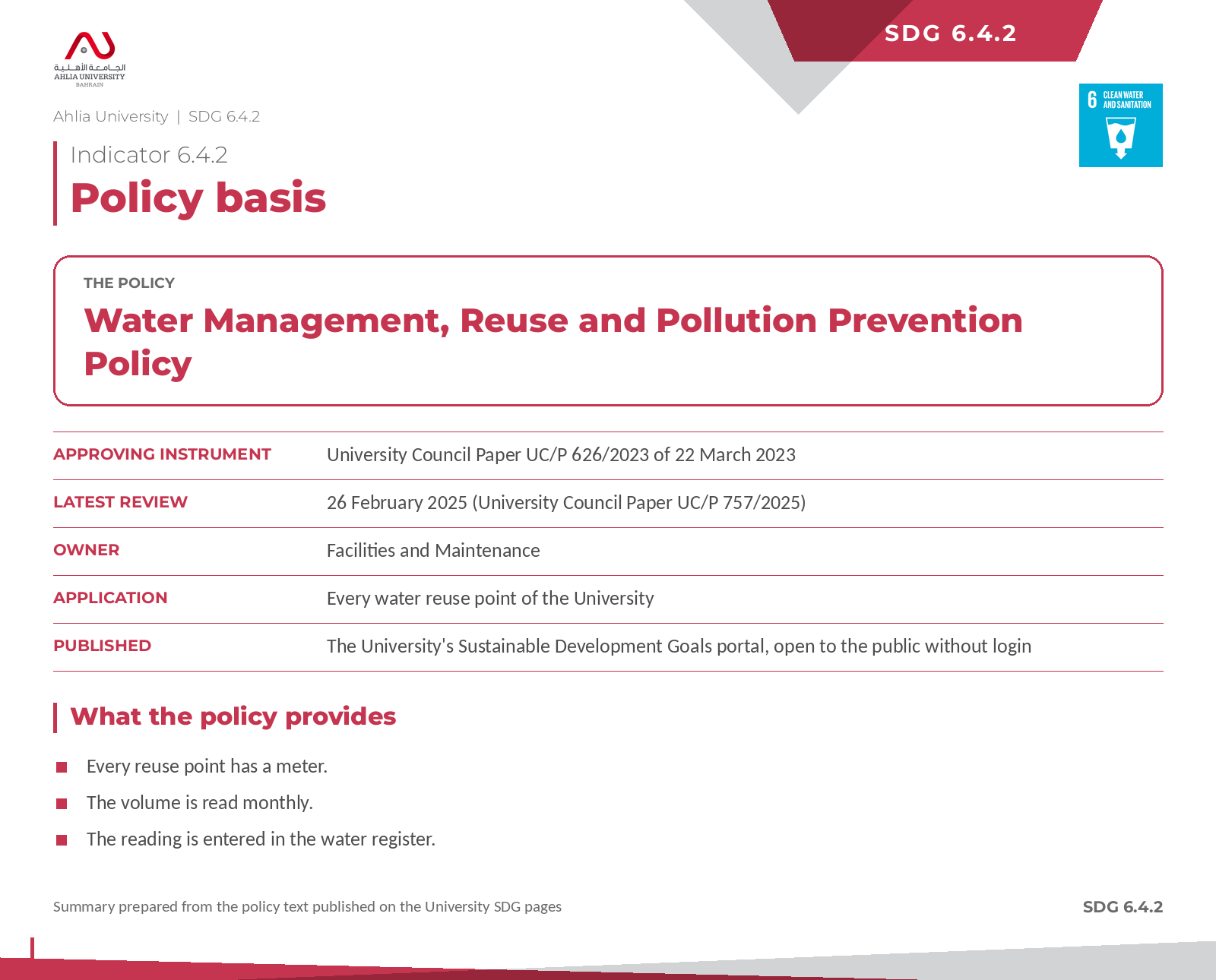
Title: Water Management, Reuse and Pollution Prevention Policy. Approving instrument: University Council Paper UC/P 626/2023 of 22 March 2023, reviewed by University Council Paper UC/P 757/2025 of 26 February 2025. The measurement clause requires that every reuse point have a meter and that the volume be read monthly and entered in the water register. It is applied through the Condensate Recovery Metering Procedure (Administrative Circular No. 44/2024 of 11 January 2024), which names the two tanks, the four meters and the reading rule. Owner: Facilities and Maintenance. In 2024/25 it produced 12 monthly readings and a reused volume of 1,700 m3. It is published on the University's Sustainable Development Goals portal with this indicator.
▪ Evidence: policy text and review record [6]; Administrative Circular No. 44/2024 [1].
Results by academic year
Registers are kept by calendar year, so the 2022/23 column is calendar 2023, the 2023/24 column is 2024 and the 2024/25 column is 2025. Water reused is the metered condensate that leaves the two tanks; the 2023 volume is the reconstruction from pump run-hours described in section 2. The use lines add to the total: 700 + 400 = 1,100, 850 + 550 = 1,400 and 1,000 + 700 = 1,700, and the three-year volume is 1,100 + 1,400 + 1,700 = 4,200 m3. Condensate tank cleanings are 2 in each year. The share is the reused volume divided by the mains water withdrawn, reported under indicator 6.2.1: 1,100 / 26,400, 1,400 / 25,100 and 1,700 / 24,300, which are 4%, 6% and 7%. Percentages are rounded to whole numbers.
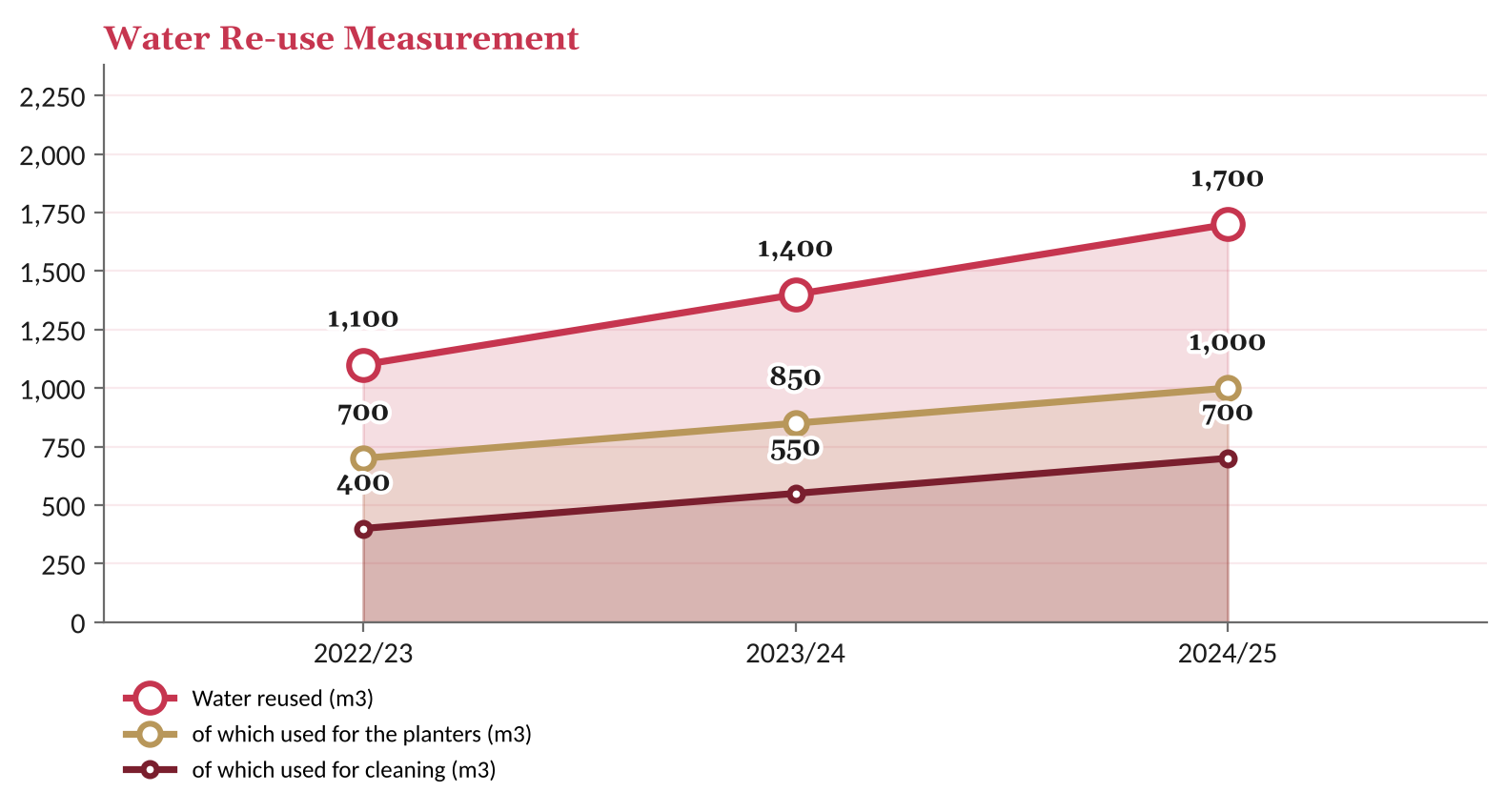
| Indicator | 2022/23 | 2023/24 | 2024/25 |
|---|---|---|---|
| Water reused (m3) | 1,100 | 1,400 | 1,700 |
| of which used for the planters (m3) | 700 | 850 | 1,000 |
| of which used for cleaning (m3) | 400 | 550 | 700 |
| Condensate tank cleanings | 2 | 2 | 2 |
| Share of mains water that is reused | 4% | 6% | 7% |
▪ Evidence: meter reading sheets and register listed in the references [1], [4].
Publication and verification
The evidence for this indicator was approved by University Council Paper UC/P 830/2026 of 14 January 2026 together with the 2025 edition of the SDG reports (University Council Paper UC/P 829/2026 of the same day, published 21 January 2026) and was published on the University's Sustainable Development Goals portal on 28 January 2026, open to the public without login. The underlying registers are held by Facilities and Maintenance, with the SDG Unit within CAQA, and are quoted in the text above.
Evidence and references
- Condensate Recovery Metering Procedure, Administrative Circular No. 44/2024 of 11 January 2024; register of tanks and meters, meter reading sheets, pump run-hours, calibration record and tank cleaning sheets, Facilities and Maintenance
- Ahlia University, SDG 6 Clean Water and Sanitation institutional report 2021 to 2025 (Sustainable Development Goals pages, page of 17 November 2024)
- Ahlia University, Climate Action Policy page, Water section (page modified 24 May 2024): water-efficient cleaning machines, mopping only, no hoses, automatic devices in rest rooms, spray irrigation, low-water plants, a maintenance team that fixes leaks quickly https://www.ahlia.edu.bh/climate-action-policy/
- Sustainability Data Register Procedure, Administrative Circular No. 820/2022 of 13 October 2022; water register kept by Facilities and Maintenance, consolidated each quarter by the SDG Unit, CAQA
- Minutes of the University Sustainability Committee, 17 February, 19 May, 29 September and 8 December 2025 (SDG Unit, CAQA)
- Water Management, Reuse and Pollution Prevention Policy, University Council Paper UC/P 626/2023 of 22 March 2023, reviewed by UC/P 757/2025 of 26 February 2025; owner Facilities and Maintenance