
Ahlia University, the first private university licensed in the Kingdom of Bahrain, housed in the Gosi Complex in Manama, works directly, as a body, to maintain and extend existing ecosystems and their biodiversity. Its work is with plants, which are the habitat on which animals depend, and it is aimed at the dry-land vegetation of Bahrain, which is under pressure from the growth of cities. The University holds no land of its own, so the work has two places: the planted landscape of its premises in the Gosi Complex (the entrance garden, the terraces and the roof-level planters of the two buildings), which Facilities and Maintenance maintains and extends with native and drought-tolerant plants, and the public planting sites of the Capital Governorate (the local government of Manama), where students and staff plant native saplings with the municipal planting programme. The University keeps no animals, runs no survey of wildlife and claims no forest, farm or reserve.
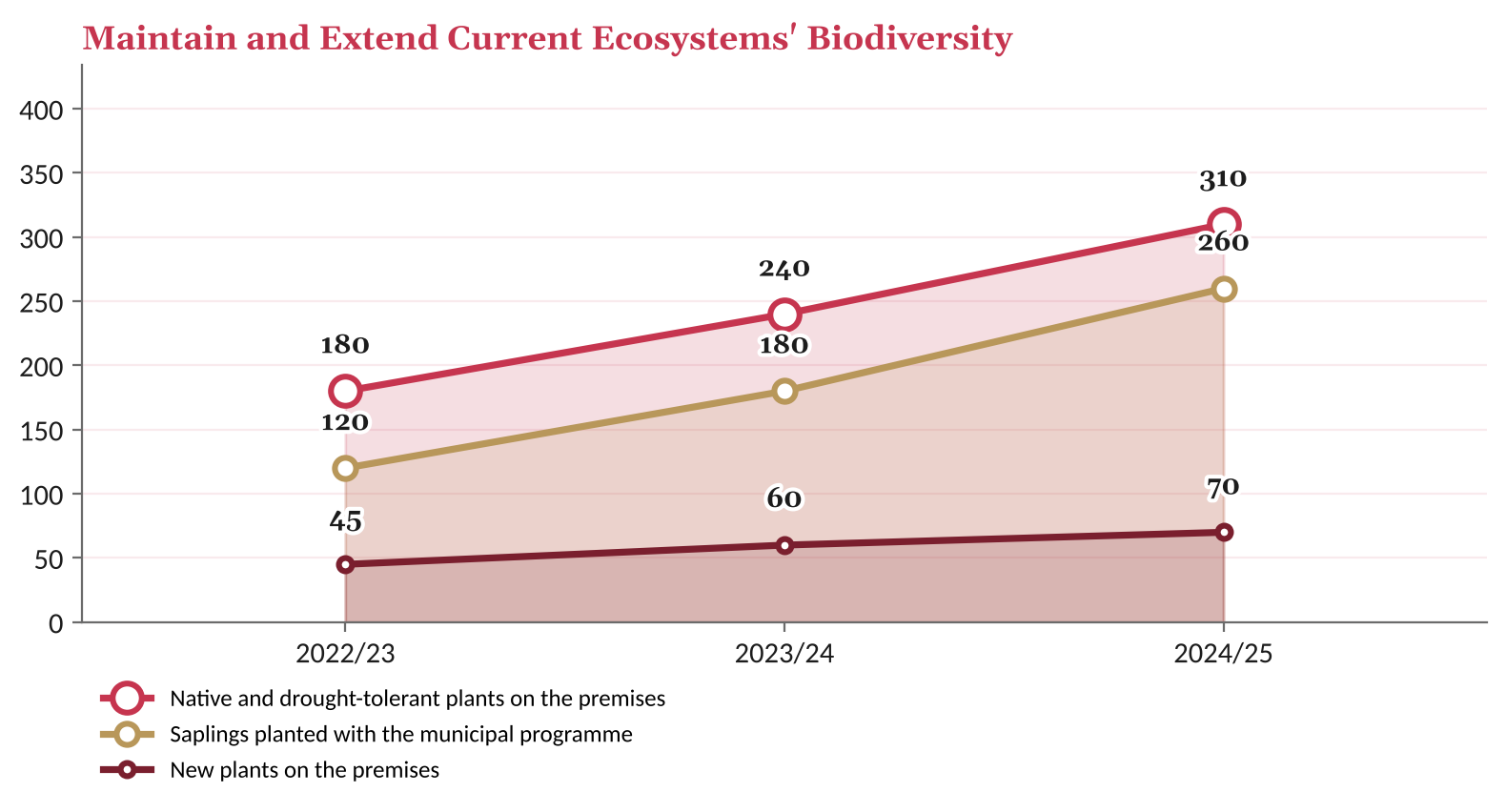
The figures are kept by calendar year, so that 2022/23 is calendar 2023, 2023/24 is 2024 and 2024/25 is 2025. At the end of 2025 the premises held 310 native and drought-tolerant plants, against 180 at the end of 2023 and 240 at the end of 2024, and the University had planted 260 saplings with the municipal programme in 2025. Over the three years it planted 175 new plants on its premises and 560 saplings on public sites.
At a glance
Element of the question
| Maintain existing ecosystems | Standing activity or document: Care of the planted landscape of the premises and the planting register Owner: Facilities and Maintenance Latest dated instance in 2025: Register count, Wednesday 3 December 2025 Three-year figure: 310 plants at the end of 2025 |
|---|---|
| Extend ecosystems on the premises | Standing activity or document: New native and drought-tolerant plants Owner: Facilities and Maintenance; Sustainability Club Latest dated instance in 2025: Planting, Sunday 9 November 2025 Three-year figure: 175 new plants |
| Extend ecosystems beyond the premises | Standing activity or document: Native saplings planted on public sites with the municipal programme Owner: Student Council; Facilities and Maintenance Latest dated instance in 2025: Planting day, Sunday 23 November 2025 Three-year figure: 560 saplings |
| Plants and animals | Standing activity or document: Native and flowering species that give food and shelter to pollinators and birds; no chemical pesticide Owner: Facilities and Maintenance; College of Engineering Latest dated instance in 2025: Species list review, Sunday 2 February 2025 Three-year figure: 8 species on the palette |
| Ecosystems under threat | Standing activity or document: Native dry-land trees and plants, planted and checked after planting Owner: Student Council; Sustainability Club Latest dated instance in 2025: Survival check, Sunday 16 February 2025 Three-year figure: 160 of 180 saplings alive |
▪ Evidence for each element is cited in its own section below.
1. Maintaining the planted landscape of the premises
The University does not own the building, so its planting is limited to the places that the lease allows: the entrance garden, the terraces and the planters at roof level, which together measured 860 m2 at the end of 2025, against 700 m2 in 2023 and 780 m2 in 2024. Facilities and Maintenance owns the landscape and keeps a planting register in which each plant is entered with its species, place and date. It was counted on Wednesday 3 December 2025, when the register held 310 native and drought-tolerant plants: 180 of them native species and 130 adapted drought-tolerant species. The Climate Action Policy of the University records the practice: the plants used within the campus are those that consume a lower quantity of water, and spray irrigation is used to minimise consumption.
A plant that dies is replaced in the next planting round, with a native species where one will grow in the place. The irrigation and the area under drought-tolerant species are reported in detail under indicator 6.3.5 and are not described again here.
▪ Evidence: planting register, count of 3 December 2025, Facilities and Maintenance [1]; Climate Action Policy page, plants of low water consumption.
2. Extending the ecosystem: new plants on the premises
The University planted 45 new plants in 2023, 60 in 2024 and 70 in 2025, which is 175 in three years and raised the stock from 135 at the end of 2022 to 310 at the end of 2025. Of the 175, 120 (69%) were native species, namely sidr and date palm, and 55 were adapted drought-tolerant species. Of the 70 new plants of 2025, 50 (71%) were native species, and the minimum of 60% native species in the planted area, set under indicator 15.3.3, applies to each new project. The two rounds of 2025 were made on Sunday 9 February 2025, when Facilities and Maintenance planted 30 plants in the entrance garden together with students of the Sustainability Club, the student-led society of the University, and on Sunday 9 November 2025, when it planted 40 more in the roof-level planters.
The palette of species is the list of the Landscape Water Plan, issued under the Biodiversity and Landscape Stewardship Policy, and it is reviewed once a year; the review of Sunday 2 February 2025 confirmed the 8 species of the list. Thirsty turf and annual bedding are not planted, so that the plants that are added can live on little water.
▪ Evidence: planting register, rounds of 9 February and 9 November 2025, Facilities and Maintenance [1]; Ahlia Sustainability Club page [3].
3. Extending the ecosystem beyond the premises: community planting days
With the municipal planting programme of the Capital Governorate, students and staff of the University planted 120 saplings in 2023, 180 in 2024 and 260 in 2025, on 2, 3 and 4 planting days organised by the Student Council and the Sustainability Club under the Community Planting Scheme (President's Decision No. 930/2022 of 16 November 2022). The 2025 days were Thursday 23 January (60 saplings, 28 volunteers), Sunday 23 February (60, 30), Sunday 2 November (70, 32) and Sunday 23 November 2025 (70, 30). The programme supplies the saplings, which are native and well-adapted trees such as sidr and ghaf, and the public site; the volunteers plant, stake and water them; Facilities and Maintenance supplies tools, water and transport.
The University also looks after what it plants. The Student Council and the Sustainability Club visit each site after planting, replace the saplings that did not take at the next planting day and count the survivors once a year. At the check of Sunday 16 February 2025, 160 of the 180 saplings planted in 2024 were alive, which is 89%. The planting days as events are reported in detail under indicator 15.2.1, and the work with the community is reported under indicator 15.3.5.
▪ Evidence: planting day registers and sapling counts, Student Council, 2023 to 2025 [4]; survival check sheet, 16 February 2025 [4].
4. Plants, animals and ecosystems under threat
The University is exact about what it does for animals. It does not keep or survey animals, and it does not claim to have counted birds or insects on its premises. What it does is to plant species that give food and shelter: flowering species whose blossom feeds pollinators, and fruiting and shade trees, such as sidr, that birds use on public sites. It uses no chemical pesticide on the planted areas of the premises, and pests are removed by hand or by washing the leaves. The ecosystem under threat that the work is aimed at is the native dry-land vegetation of Bahrain, which the growth of the city has reduced; the University plants it back in small places, and it teaches why it matters.
The teaching is in the College of Engineering, whose course Environmental Design and Sustainable Materials, taken by 48, 55 and 61 students in the three years, builds on the environmental course documentation of 2022 and treats the landscape as part of the building, and in the public talks reported under indicator 15.2.1. The Climate Action Plan of the University lists drought-resistant planting among its actions and gives oversight to the Sustainability Committee, which reviewed the 2025 results on Monday 8 December 2025.
▪ Evidence: Climate Action Plan page; course register, UC/P 619/2023 with its reviews [6]; Committee minutes, 8 December 2025 [7].
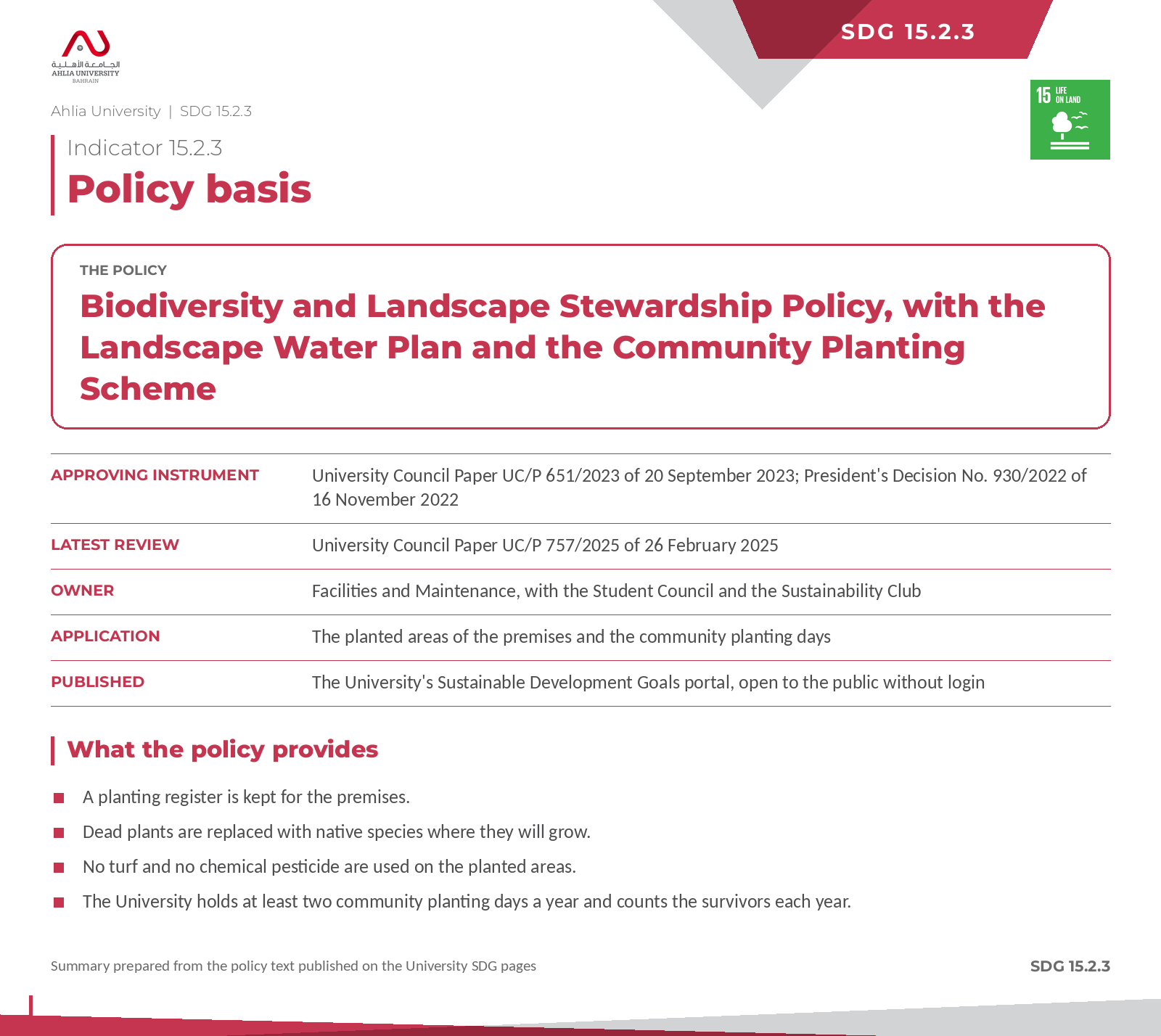
Policy basis
Title: Biodiversity and Landscape Stewardship Policy, with the Landscape Water Plan and the Community Planting Scheme. Approving instruments: University Council Paper UC/P 651/2023 of 20 September 2023; President's Decision No. 930/2022 of 16 November 2022; latest review: University Council Paper UC/P 757/2025 of 26 February 2025. Owner: Facilities and Maintenance, with the Student Council and the Sustainability Club. The clauses that answer the question require a planting register for the premises, replacement of dead plants with native species where they will grow, no turf and no chemical pesticide on the planted areas, at least two community planting days a year and a yearly count of the survivors. Application in 2024/25: 310 plants on the premises, 70 new plants, 260 saplings on 4 planting days. The Policy is published on the University's Sustainable Development Goals portal.
▪ Evidence: Biodiversity and Landscape Stewardship Policy, UC/P 651/2023, with its review UC/P 757/2025 [8].
Results by academic year
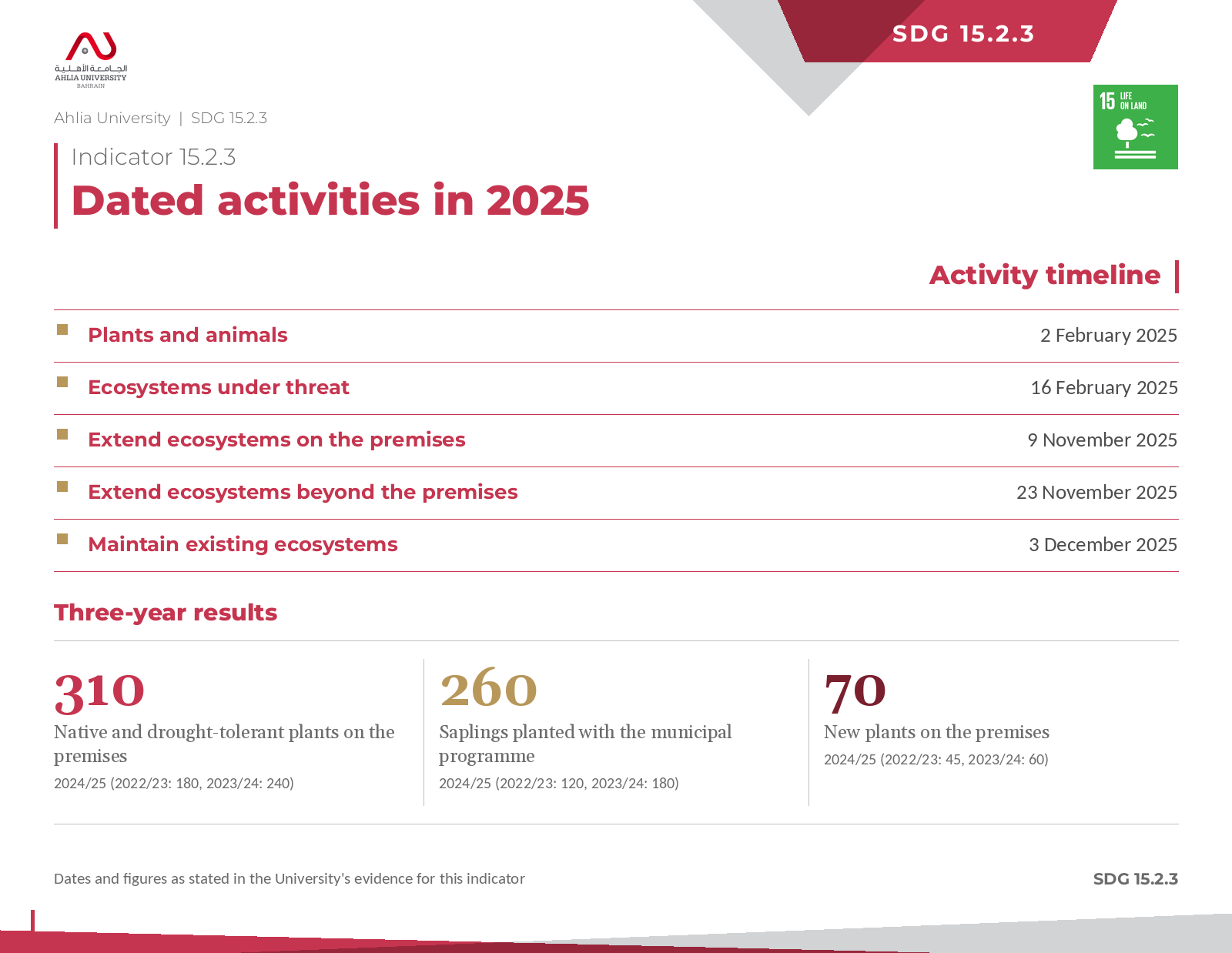
Plants on the premises are the native and drought-tolerant plants in the planting register at the end of the calendar year (2023, 2024 and 2025, read as 2022/23, 2023/24 and 2024/25): 135 + 45 = 180, 180 + 60 = 240 and 240 + 70 = 310, where 135 is the stock at the end of 2022. New plants are the plants added in the year: 45 + 60 + 70 = 175. Saplings are those planted on public sites with the municipal programme: 120 + 180 + 260 = 560. Volunteers are the students and staff on the registers of the planting days: 60 + 85 + 120 = 265, on 2 + 3 + 4 = 9 days. The share of native species among the new plants is 30 / 45, 40 / 60 and 50 / 70, which are 67%, 67% and 71%.
| Indicator | 2022/23 | 2023/24 | 2024/25 |
|---|---|---|---|
| Native and drought-tolerant plants on the premises | 180 | 240 | 310 |
| Saplings planted with the municipal programme | 120 | 180 | 260 |
| New plants on the premises | 45 | 60 | 70 |
| Community planting days | 2 | 3 | 4 |
| Student and staff volunteers at planting days | 60 | 85 | 120 |
| Share of native species among new plants | 67% | 67% | 71% |
Publication and verification
This document, which is the University's evidence for indicator 15.2.3 and is kept by Facilities and Maintenance, with the Student Council and the Sustainability Club, was approved by University Council Paper UC/P 830/2026 of 14 January 2026 together with the 2025 edition of the SDG reports (University Council Paper UC/P 829/2026 of the same day, published 21 January 2026) and published on the University's Sustainable Development Goals portal on 28 January 2026, open to the public without login. The underlying registers, which are the planting register, the planting day registers, the survival check sheet and the minutes of the University Sustainability Committee, are held by Facilities and Maintenance, the Student Council and the Sustainability Club and are quoted in the text above.
Evidence and references
- Planting register, species list and count of 3 December 2025, Facilities and Maintenance
- Ahlia University: Climate Action Policy (plants on campus consume a lower quantity of water; spray irrigation; page modified 24 May 2024) https://www.ahlia.edu.bh/climate-action-policy/
- Ahlia University: Ahlia Sustainability Club, student-led society (page modified 28 April 2025)
- Planting day registers, sapling counts and survival check sheet, Student Council, 2023 to 2025; Community Planting Scheme, President's Decision No. 930/2022 of 16 November 2022
- Ahlia University: Climate Action Plan (drought-resistant planting, Sustainability Committee; page modified 28 April 2025) https://www.ahlia.edu.bh/climate-action-plan/
- Register of SDG courses, University Council Paper UC/P 619/2023 of 22 February 2023, reviewed by UC/P 679/2024 of 28 February 2024 and UC/P 757/2025 of 26 February 2025; course Environmental Design and Sustainable Materials, College of Engineering
- Minutes of the University Sustainability Committee, 17 February, 19 May, 29 September and 8 December 2025, SDG Unit within CAQA
- Biodiversity and Landscape Stewardship Policy, University Council Paper UC/P 651/2023 of 20 September 2023, reviewed by UC/P 757/2025 of 26 February 2025; owner Facilities and Maintenance