
Ahlia University, the first private university licensed in the Kingdom of Bahrain, housed in the Gosi Complex in Manama, has, as a body, a policy, a process and a practice on waste disposal covering hazardous materials. The policy is the Waste, Hazardous Waste and Single-Use Plastics Policy (University Council Paper UC/P 627/2023 of 22 March 2023), reviewed by University Council Paper UC/P 757/2025 of 26 February 2025. The process is the Laboratory Hazardous Waste and E-waste Procedure (Administrative Circular No. 368/2023 of 4 May 2023), and the practice is the separate collection of laboratory chemicals, clinical and sharps waste, batteries, toner cartridges and electronic waste in labelled containers, their storage in a locked room and their removal by licensed contractors against a signed consignment note. Hazardous materials never go to the general waste containers that the University's specialised waste management companies empty for recycling.
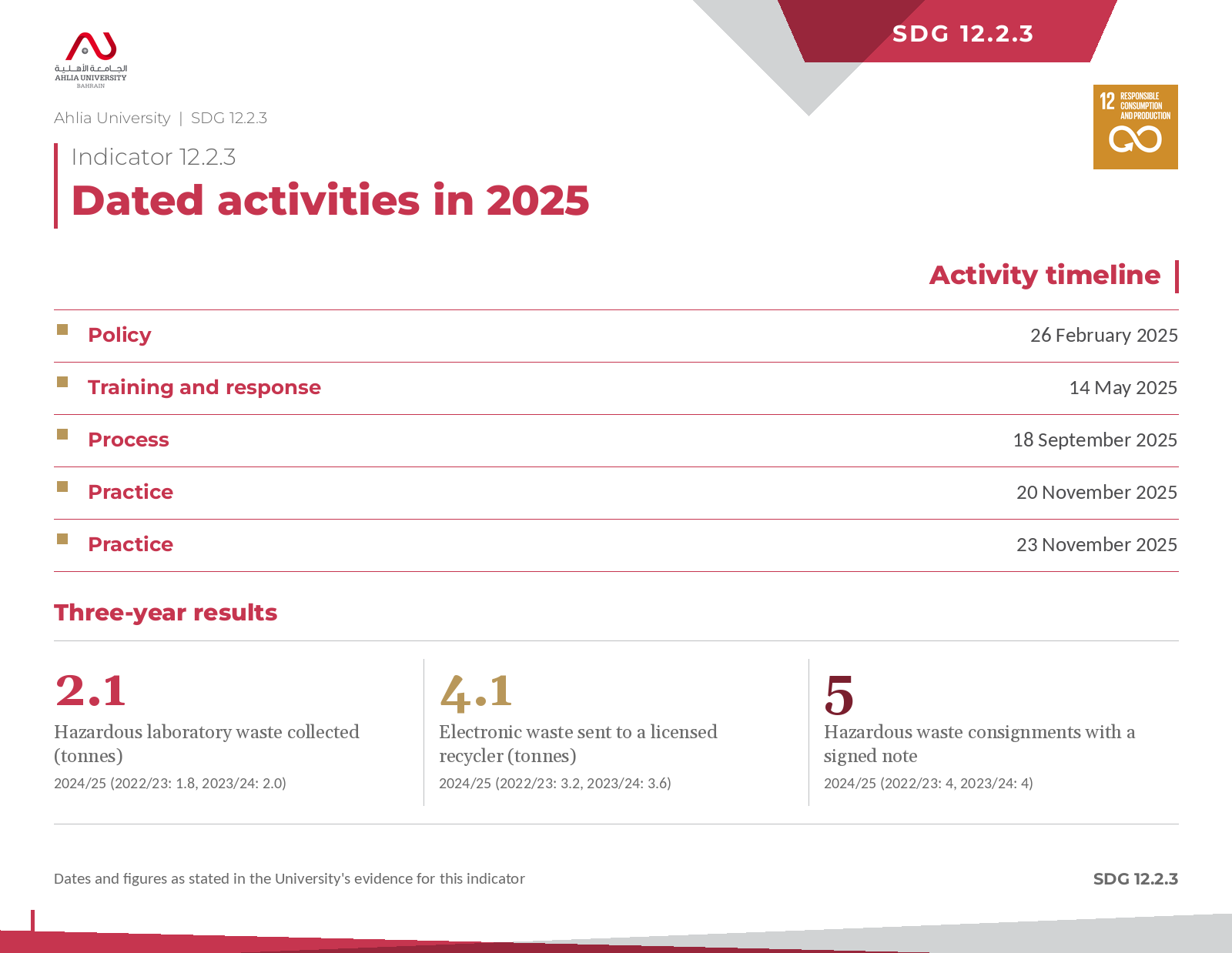
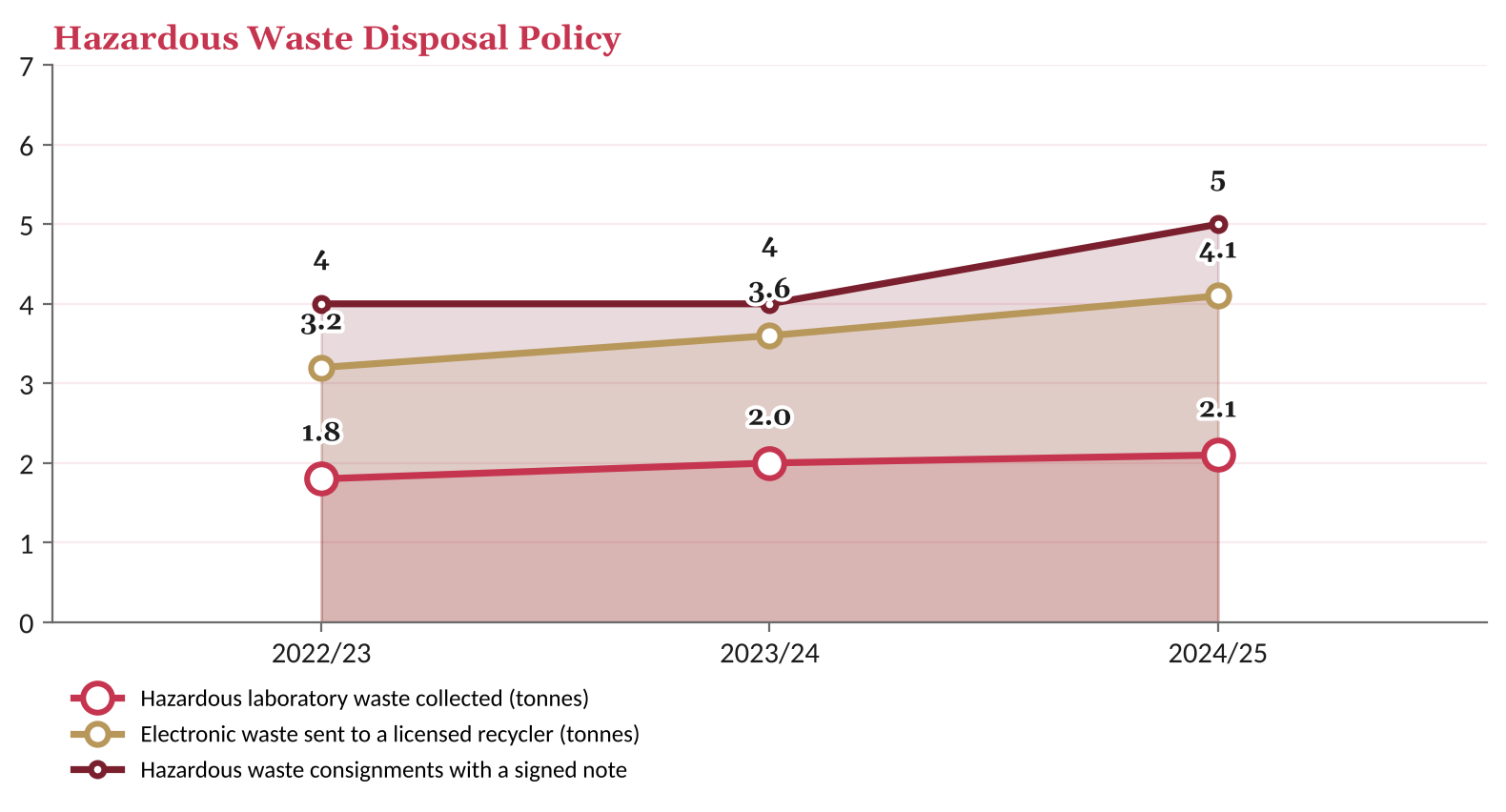
In 2025 the laboratories and studios of the University produced 2.1 tonnes of hazardous waste and 4.1 tonnes of electronic waste, all removed by licensed contractors. Over the three academic years 2022/23 to 2024/25 the totals were 5.9 tonnes of hazardous waste (1.8, 2.0 and 2.1) and 10.9 tonnes of electronic waste (3.2, 3.6 and 4.1).
At a glance
Element of the question
| Policy | Standing document or practice: Waste, Hazardous Waste and Single-Use Plastics Policy Owner: University Council; Facilities and Maintenance Latest dated instance in 2025: Review, UC/P 757/2025 of 26 February 2025 Three-year figure: 1 policy |
|---|---|
| Process | Standing document or practice: Laboratory Hazardous Waste and E-waste Procedure: identify, label, separate, store, hand over, certify, record Owner: Facilities and Maintenance; college laboratory supervisors Latest dated instance in 2025: Laboratory inspection round, Thursday 18 September 2025 Three-year figure: 12 laboratories and studios |
| Practice: hazardous waste | Standing document or practice: Separate containers, locked store, collection by a licensed contractor with a signed consignment note Owner: Facilities and Maintenance Latest dated instance in 2025: Collection, Sunday 23 November 2025 Three-year figure: 13 consignments; 5.9 tonnes |
| Practice: electronic waste | Standing document or practice: Collection of IT equipment, displays and other electrical items by a licensed recycler with data wiping Owner: Information and Communication Technology Centre; Facilities and Maintenance Latest dated instance in 2025: Collection, Thursday 20 November 2025 Three-year figure: 7 consignments; 10.9 tonnes |
| Training and response | Standing document or practice: Briefing for laboratory staff and a spill drill each year Owner: Facilities and Maintenance; Colleges Latest dated instance in 2025: Spill drill, Wednesday 14 May 2025 Three-year figure: 66 staff trained |
▪ Evidence for each element is cited in its own section below.
1. The policy
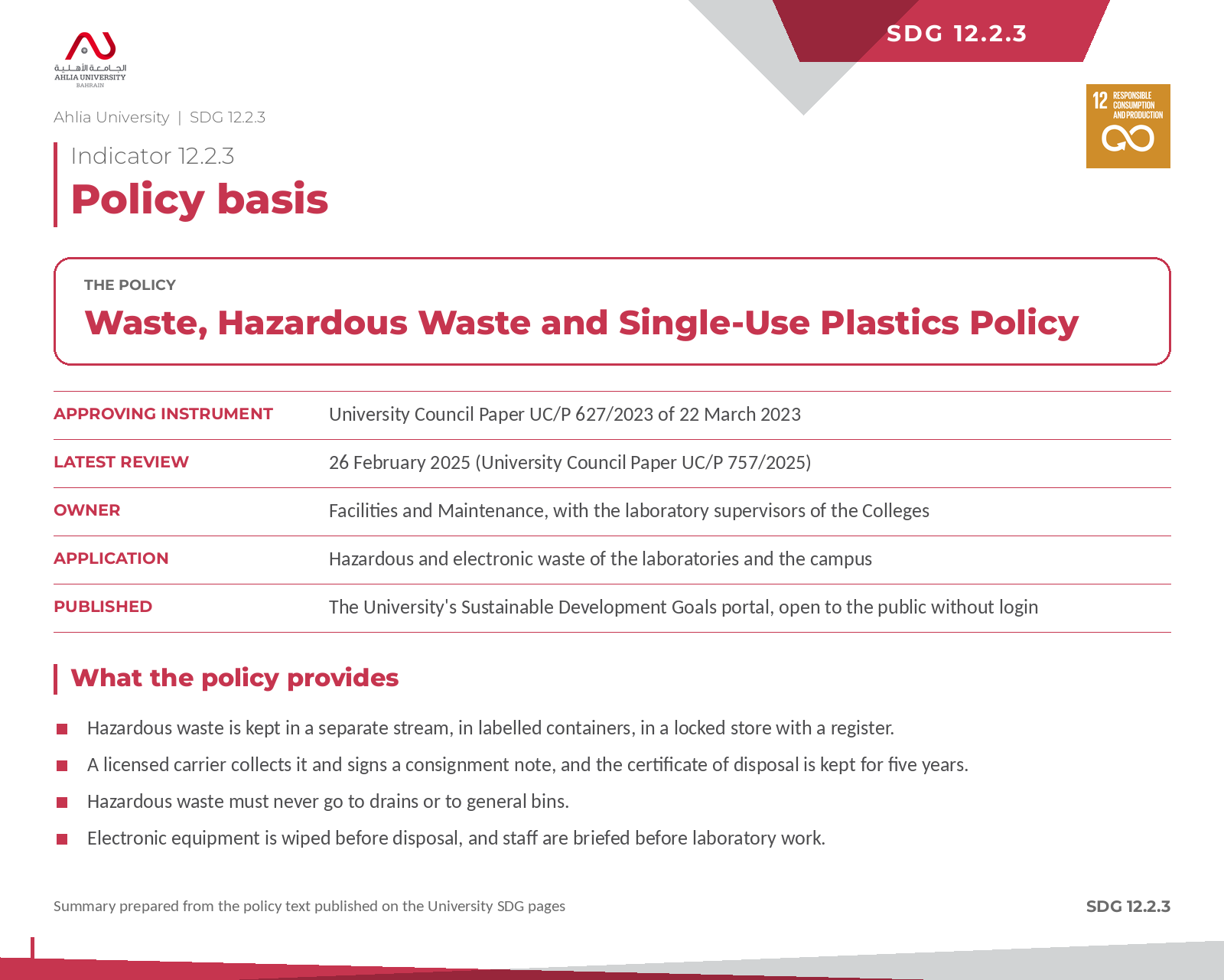
The Waste, Hazardous Waste and Single-Use Plastics Policy was approved by the University Council on 22 March 2023. Its hazardous waste part says that waste from laboratories, studios and clinical skills rooms that is toxic, flammable, corrosive, infectious, sharp or otherwise dangerous must be kept apart from every other waste stream, must be held only in labelled containers, must be collected only by a carrier licensed for that class of waste, and must not be poured into a drain or put in a general bin. It also requires that consignment notes and certificates of disposal are kept for five years and that nobody works in a laboratory before being briefed. It builds on the University Policy on Healthy Environment, which commits the University to reduce the release of substances harmful to the biosphere, and on the statement of the Climate Action Policy page that wastes of different types are collected in special containers and delivered to the recycling companies [1].
▪ Evidence: Climate Action Policy page, Waste Management and Recycling; Waste, Hazardous Waste and Single-Use Plastics Policy, UC/P 627/2023, with its review UC/P 757/2025 [2].
2. The process
The Laboratory Hazardous Waste and E-waste Procedure was issued by Administrative Circular No. 368/2023 of 4 May 2023, and it applies to the laboratories of the Colleges of Engineering, Information Technology and Medical and Health Sciences and to the studios of the College of Arts and Science that use paints, inks and solvents, which are 12 places in all. It has six steps. The laboratory supervisor identifies and labels the waste with its hazard class and the date. The waste is placed in the separate container for that class at the place where it is produced. A technician moves full containers to the locked hazardous waste store within one working day and enters them in the store register. Facilities and Maintenance orders the collection when the store reaches its limit or after 90 days, whichever comes first. The contractor signs the consignment note and later returns a certificate of disposal. The record is entered in the waste register of the Sustainability Data Register Procedure (Administrative Circular No. 820/2022 of 13 October 2022), which the SDG Unit within the Centre for Accreditation and Quality Assurance (CAQA) consolidates each quarter.
Facilities and Maintenance inspects every laboratory and studio once a quarter with the college supervisor, and the round of the third quarter of 2025 was made on Thursday 18 September 2025. It looks at labelling, container condition, the store register and the spill kit. The inspections of the three years were 12 in each quarter, so 144 in all, and open findings were closed within 10 working days.
▪ Evidence: Laboratory Hazardous Waste and E-waste Procedure, Administrative Circular No. 368/2023 [3]; store register and inspection sheets, Facilities and Maintenance, 2023 to 2025 [4]; Sustainability Data Register Procedure [5].
3. The practice for hazardous waste
Hazardous laboratory waste was 1.8 tonnes in 2023, 2.0 in 2024 and 2.1 in 2025. It has three kinds, shown below. Laboratory chemicals, which are reagents, solvents and spent solutions from the engineering, health sciences and studio work, were 1.0, 1.1 and 1.2 tonnes. Clinical and sharps waste from the health sciences laboratories was 0.5 tonnes in each year. Batteries, toner cartridges and other hazardous items were 0.3, 0.4 and 0.4 tonnes.
| Kind of hazardous waste (tonnes) | 2023 | 2024 | 2025 |
|---|---|---|---|
| Laboratory chemicals | 1.0 | 1.1 | 1.2 |
| Clinical and sharps waste | 0.5 | 0.5 | 0.5 |
| Batteries, toner cartridges and other items | 0.3 | 0.4 | 0.4 |
| Total hazardous waste | 1.8 | 2.0 | 2.1 |
A contractor licensed by the Supreme Council for Environment for hazardous waste collected it in 4 consignments in 2023, 4 in 2024 and 5 in 2025, each with a signed consignment note and a certificate of disposal. The last consignment of 2025 was collected on Sunday 23 November 2025. No hazardous waste was sent to the general waste containers in the three years, and no spill left the laboratory in which it happened.
▪ Evidence: consignment notes and certificates of disposal, Facilities and Maintenance, 2023 to 2025 [4]; hazardous waste store register [4].
4. The practice for electronic waste
Electronic waste was 3.2 tonnes in 2023, 3.6 in 2024 and 4.1 in 2025. IT equipment, which is computers, servers and network devices retired by the Information and Communication Technology Centre, was 2.3, 2.5 and 2.8 tonnes. Displays and screens were 0.6, 0.8 and 0.9 tonnes, and other electrical items such as printers and small appliances were 0.3, 0.3 and 0.4 tonnes. The Centre wipes every storage device before it leaves the premises and records the serial number. A licensed e-waste recycler collected the equipment in 2 consignments in 2023, 2 in 2024 and 3 in 2025, the last on Thursday 20 November 2025, and returned a certificate for each. Electronic waste is counted apart from the 92 tonnes of solid waste reported in detail under indicator 12.3.1.
▪ Evidence: e-waste register and recycler certificates, Information and Communication Technology Centre and Facilities and Maintenance, 2023 to 2025 [4].
5. Training and response
Before a person works in a laboratory, the supervisor briefs them on the hazard classes, the containers and the store. In 2023, 18 laboratory staff, who are technicians, lecturers in charge and studio staff, were briefed, 22 in 2024 and 26 in 2025, which is 66 in three years. Students in laboratory courses receive a safety briefing at their first session. Each year the laboratories hold a spill drill, and the drill of 2025 was held on Wednesday 14 May 2025 in the Building 2 laboratories with 9 staff, using the spill kits kept on each floor. The University Sustainability Committee received the hazardous waste and e-waste figures at its meeting of Monday 8 December 2025.
▪ Evidence: briefing and drill records, Facilities and Maintenance and the Colleges, 2023 to 2025 [4]; minutes of the University Sustainability Committee, 8 December 2025 [6].
Policy basis
Title: Waste, Hazardous Waste and Single-Use Plastics Policy. Approving instrument: University Council Paper UC/P 627/2023 of 22 March 2023, reviewed by University Council Paper UC/P 757/2025 of 26 February 2025. Process: Laboratory Hazardous Waste and E-waste Procedure, Administrative Circular No. 368/2023 of 4 May 2023. Owner: Facilities and Maintenance with the laboratory supervisors of the Colleges. The clauses that answer the question are the separate stream and labelled containers, the locked store with a register, the licensed carrier with a signed consignment note and certificate of disposal kept for five years, the ban on drains and general bins, the wiping of electronic equipment and the briefing before laboratory work. Application in 2024/25: 2.1 tonnes of hazardous waste in 5 consignments, 4.1 tonnes of electronic waste in 3 consignments and 26 staff briefed. The Policy and the Procedure are published on the University's Sustainable Development Goals portal.
▪ Evidence: policy text and review record [2]; Procedure [3].
Results by academic year
Registers are kept by calendar year, so the 2022/23 column is calendar 2023, 2023/24 is 2024 and 2024/25 is 2025. Hazardous waste is the weight in tonnes handed to the licensed contractor and is the sum of chemicals, clinical and sharps waste and other items: 1.0 + 0.5 + 0.3 = 1.8, 1.1 + 0.5 + 0.4 = 2.0 and 1.2 + 0.5 + 0.4 = 2.1. Electronic waste is the weight handed to the licensed recycler: 2.3 + 0.6 + 0.3 = 3.2, 2.5 + 0.8 + 0.3 = 3.6 and 2.8 + 0.9 + 0.4 = 4.1. Consignments are collections with a signed note, and staff trained are those briefed in the year.
| Indicator | 2022/23 | 2023/24 | 2024/25 |
|---|---|---|---|
| Hazardous laboratory waste collected (tonnes) | 1.8 | 2.0 | 2.1 |
| Electronic waste sent to a licensed recycler (tonnes) | 3.2 | 3.6 | 4.1 |
| Hazardous waste consignments with a signed note | 4 | 4 | 5 |
| Electronic waste consignments | 2 | 2 | 3 |
| Laboratory staff briefed | 18 | 22 | 26 |
Publication and verification
This document, which is the University's evidence for indicator 12.2.3 and is kept by Facilities and Maintenance and the SDG Unit within CAQA, was approved by University Council Paper UC/P 830/2026 of 14 January 2026 together with the 2025 edition of the SDG reports (University Council Paper UC/P 829/2026 of the same day, published 21 January 2026) and published on the University's Sustainable Development Goals portal on 28 January 2026, open to the public without login. The underlying registers, which are the store register, the consignment notes and certificates of disposal, the e-waste register and the briefing records, are held by Facilities and Maintenance and the SDG Unit within CAQA and are quoted in the text above.
Evidence and references
- Ahlia University: Climate Action Policy page (Waste Management and Recycling; University Policy on Healthy Environment; page modified 24 May 2024) https://www.ahlia.edu.bh/climate-action-policy/
- Waste, Hazardous Waste and Single-Use Plastics Policy, University Council Paper UC/P 627/2023 of 22 March 2023, reviewed by UC/P 757/2025 of 26 February 2025, Facilities and Maintenance
- Laboratory Hazardous Waste and E-waste Procedure, Administrative Circular No. 368/2023 of 4 May 2023, Facilities and Maintenance
- Hazardous waste store register, consignment notes, certificates of disposal, e-waste register and inspection, briefing and drill records, 2023 to 2025, Facilities and Maintenance and the Information and Communication Technology Centre
- Sustainability Data Register Procedure, Administrative Circular No. 820/2022 of 13 October 2022, SDG Unit, CAQA
- Minutes of the University Sustainability Committee, Monday 8 December 2025, SDG Unit