
Ahlia University (Ahlia), the first private university licensed in the Kingdom of Bahrain, as a body applies building standards to minimise water use, in the premises it occupies and in the campus it is planning. The University is housed in the Gosi Complex, Exhibition Road, Al-Hoora, Manama, a leased complex of two buildings with 10,386.35 m2 of built area, and a new campus is planned in Northern City. Its standard is the Water-Conscious Building and Fit-out Standard (University Council Paper UC/P 656/2023 of 25 October 2023), which sets limits on the flow of taps, the flush of toilets and urinals, the controls of rest rooms and the monitoring of water in every fit-out, refurbishment and new design, and which sits beside the Design Standards that the University already applies in its project management.
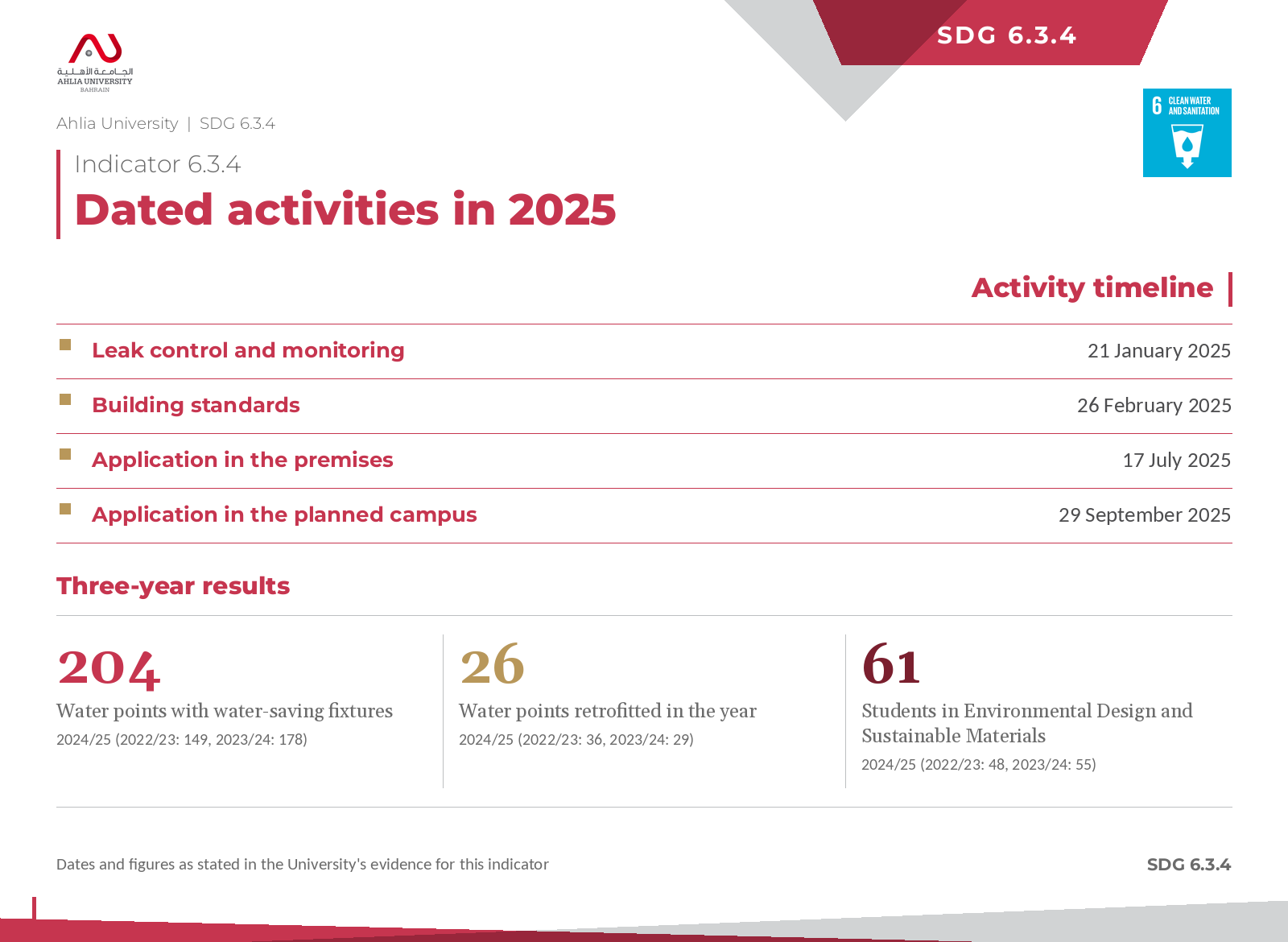
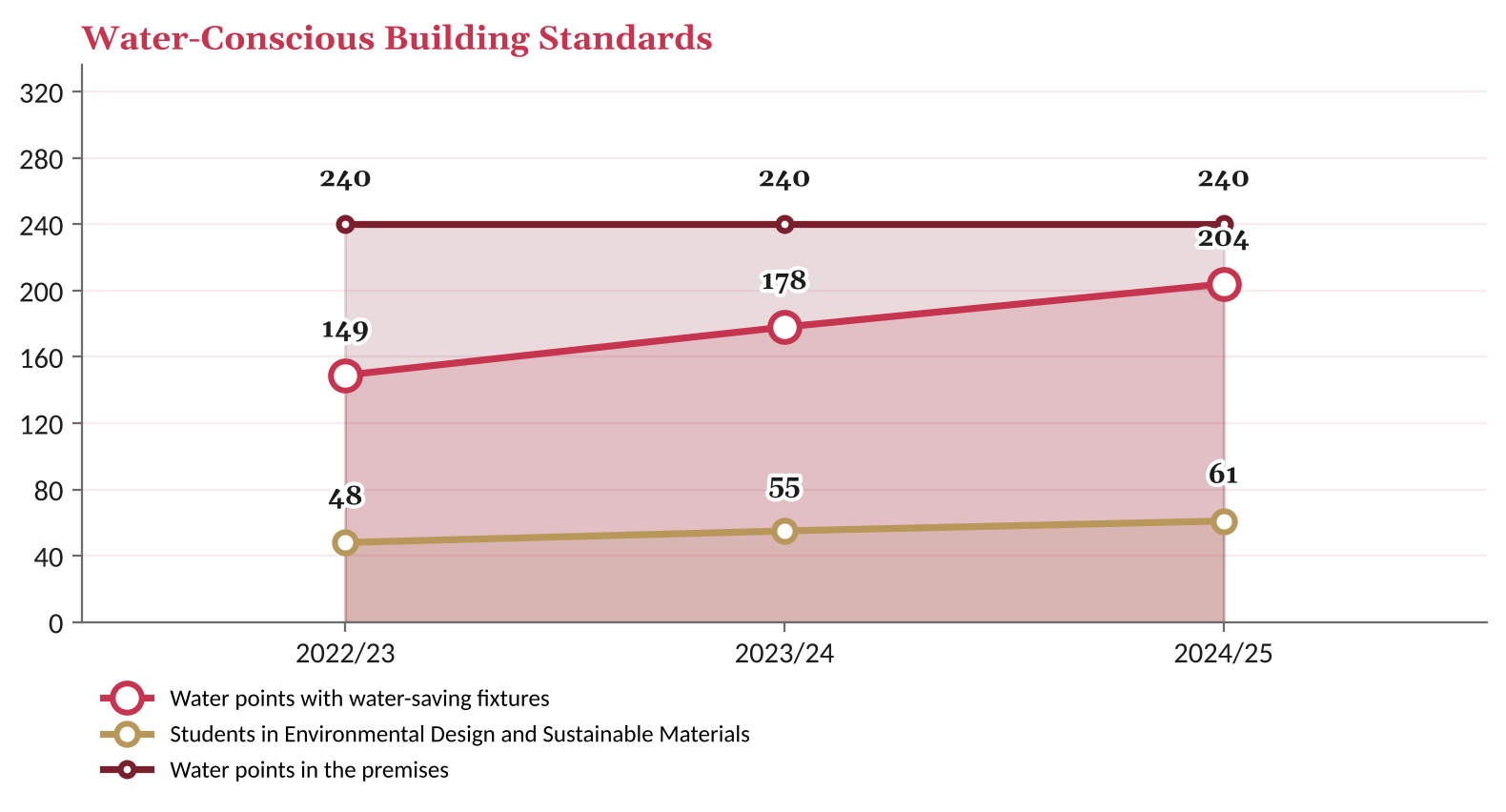
The effect is measured in the rest rooms. The premises have 240 water points (taps, toilets and urinals), and 204 of them, which is 85%, were fitted with water-saving fixtures at the end of calendar 2025, against 149 (62%) at the end of 2023 and 178 (74%) at the end of 2024. The University retrofitted 36 points in 2023, 29 in 2024 and 26 in 2025, which is 91 points in three years.
At a glance
Element of the question
| Building standards | Standing activity or document: Water-Conscious Building and Fit-out Standard (UC/P 656/2023) and the University's Design Standards Owner: Facilities and Maintenance; College of Engineering Latest dated instance in 2025: Review, Wednesday 26 February 2025 Three-year figure: 1 standard |
|---|---|
| Application in the premises | Standing activity or document: Water-saving taps, toilets and urinals in rest rooms Owner: Facilities and Maintenance; Financial Affairs Directorate Latest dated instance in 2025: Retrofit, Sunday 13 to Thursday 17 July 2025 Three-year figure: 91 points retrofitted |
| Application in the planned campus | Standing activity or document: Master Plan and design brief for Northern City: minimum water use, rainwater harvesting, recycled water Owner: Vice President for Administrative and Financial Affairs; Facilities and Maintenance Latest dated instance in 2025: Committee review, Monday 29 September 2025 Three-year figure: 1 design brief |
| Leak control and monitoring | Standing activity or document: Floor sub-meters and quick repair of leaks Owner: Facilities and Maintenance Latest dated instance in 2025: Calibration check, Tuesday 21 January 2025 Three-year figure: 10 floors metered |
| Teaching of water-conscious design | Standing activity or document: Environmental Design and Sustainable Materials course Owner: College of Engineering Latest dated instance in 2025: Course register, UC/P 757/2025 of 26 February 2025 Three-year figure: 164 enrolments |
▪ Evidence for each element is cited in its own section below.
1. The standards
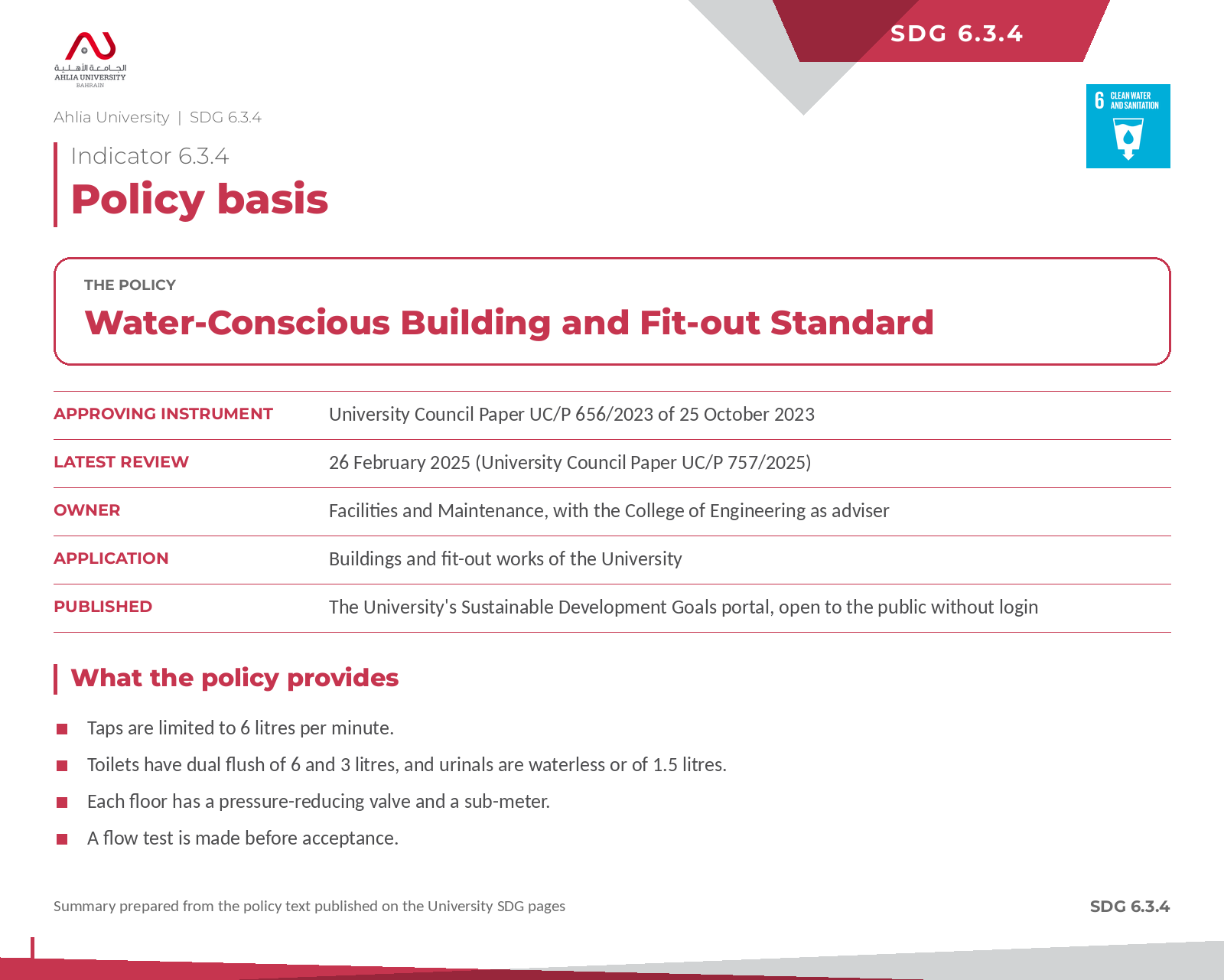
The University has a standard at two levels. At the level of the institution, the Climate Action Policy states that sustainability is a core commitment of the University's Master Plan and is taken into account in all infrastructure decisions for the new campus in Northern City, and that the University has a comprehensive set of Design Standards which it adheres to in its project management. At the level of water, the Water-Conscious Building and Fit-out Standard turns that commitment into figures. For taps in rest rooms and pantries it requires sensor or push-timer control, an aerator and a flow of 6 litres per minute at most. For toilets it requires dual flush of 6 and 3 litres. For urinals it requires waterless units or a flush of 1.5 litres at most, activated by sensor. It requires a pressure-reducing valve on each floor, no hose connection on floors except for maintenance, and a sub-meter on every floor. Fit-outs are accepted only after a flow test by Facilities and Maintenance.
The Standard applies to every fit-out and refurbishment of the leased premises that the University commissions, and the Financial Affairs Directorate may buy a fixture only if its datasheet shows that it meets the Standard. It was reviewed with the shared policies by University Council Paper UC/P 757/2025 of 26 February 2025.
▪ Evidence: Climate Action Policy, building sustainability paragraph; Water-Conscious Building and Fit-out Standard, UC/P 656/2023 of 25 October 2023, and fixture datasheets and flow-test sheets, Facilities and Maintenance and the Financial Affairs Directorate [2].
2. The premises: water-saving fixtures
The premises have 240 water points. The Climate Action Policy records that automatic devices are used in the rest rooms to minimise the quantity of water used in flushing, and the Standard extends the same rule to taps and urinals. Facilities and Maintenance retrofits points in phases. In 2025 it retrofitted 26 points: 14 in the rest rooms of floors 3 to 5 of Building 2 in the week of Sunday 26 January to Thursday 30 January 2025, and 12 in the pantries and rest rooms of Building 1 in the week of Sunday 13 July to Thursday 17 July 2025, when no classes are held. The flow test of the first phase was made on Tuesday 25 February 2025 and gave 5.4 litres per minute on average at the taps, within the limit of 6.
At the end of 2025, 204 of the 240 points had water-saving fixtures. The 36 that remain are in the oldest rest rooms of Building 1 and are scheduled in the same order of priority, which the University Sustainability Committee confirmed on Monday 19 May 2025. The Climate Action Policy also records that the Gosi Complex offers efficient use of water.
▪ Evidence: fixture register with date of installation and flow-test sheets, 2023 to 2025, Facilities and Maintenance [2]; Committee minutes, 19 May 2025 [3].
3. The planned campus in Northern City
The new campus is designed to consume the minimum quantity of water, to save water in watering plants and cleaning premises, and to be eco-friendly, as the Climate Action Policy states. The design brief of the campus applies the Standard in full, and it adds two requirements: rainwater harvesting and recycled water for irrigation and for toilet flushing. The Gulf Daily News has reported the foundation stone ceremony for the new campus, a project of BD 45 million. The Vice President for Administrative and Financial Affairs reports the brief to the University Sustainability Committee, which reviewed it on Monday 29 September 2025. Because the campus is at the design stage, the University reports no water figure for it.
▪ Evidence: Climate Action Policy; Gulf Daily News report of the foundation stone ceremony [4]; Committee minutes, 29 September 2025 [3].
4. Monitoring and teaching
A standard is only worth what is checked. The ten floor sub-meters, whose reading is reported in detail under indicator 6.2.1, show a leak as a rise in night-time flow, and the maintenance team repairs leaks quickly, in line with the Climate Action Policy. The calibration of the ten sub-meters was checked by the operator's technician with Facilities and Maintenance on Tuesday 21 January 2025, and all ten were within the 2% tolerance. The College of Engineering teaches the same standards. Its course Environmental Design and Sustainable Materials, three credits, is listed in the register of SDG courses (University Council Paper UC/P 619/2023 of 22 February 2023, reviewed by UC/P 679/2024 of 28 February 2024 and UC/P 757/2025 of 26 February 2025) and enrolled 48 students in 2022/23, 55 in 2023/24 and 61 in 2024/25. The University's report on SDG 6 records that environmental course documentation of 2022 evidenced sustainability content in design education and building practice, and that Interior Design study is mapped to SDG 6.
▪ Evidence: register of SDG courses and enrolment extract, University Registrar [2]; SDG 6 institutional report 2021 to 2025 [5].
Policy basis
Title: Water-Conscious Building and Fit-out Standard, issued under the Water Management, Reuse and Pollution Prevention Policy (University Council Paper UC/P 626/2023 of 22 March 2023). Approving instrument: University Council Paper UC/P 656/2023 of 25 October 2023, approved on that date and reviewed by University Council Paper UC/P 757/2025 of 26 February 2025. The clauses that answer the question fix the limits of 6 litres per minute at taps, dual flush of 6 and 3 litres, waterless or 1.5-litre urinals, a pressure-reducing valve and a sub-meter on every floor, and the flow test before acceptance. Owner: Facilities and Maintenance, with the College of Engineering as adviser. In 2024/25 the Standard produced 26 retrofitted points and 85% of points with water-saving fixtures. It is published on the University's Sustainable Development Goals portal with this indicator.
▪ Evidence: policy text and review record [6], [2].
Results by academic year
Registers are kept by calendar year, so the 2022/23 column is calendar 2023, the 2023/24 column is 2024 and the 2024/25 column is 2025. A water point is a tap, a toilet or a urinal in a rest room or pantry; the premises have 240 in each year. Points with water-saving fixtures are the points that meet the Standard at the end of the year, and points retrofitted are those converted during the year: 149 + 29 = 178 and 178 + 26 = 204, and the three-year retrofits are 36 + 29 + 26 = 91. The share is points with fixtures divided by 240: 149 / 240, 178 / 240 and 204 / 240, which are 62%, 74% and 85%. Course enrolments are 48 + 55 + 61 = 164. Percentages are rounded to whole numbers.
| Indicator | 2022/23 | 2023/24 | 2024/25 |
|---|---|---|---|
| Water points with water-saving fixtures | 149 | 178 | 204 |
| Water points retrofitted in the year | 36 | 29 | 26 |
| Students in Environmental Design and Sustainable Materials | 48 | 55 | 61 |
| Water points in the premises | 240 | 240 | 240 |
| Share of water points with water-saving fixtures | 62% | 74% | 85% |
▪ Evidence: fixture register and course enrolment extract listed in the references [2], [7].
Publication and verification
The evidence for this indicator was approved by University Council Paper UC/P 830/2026 of 14 January 2026 together with the 2025 edition of the SDG reports (University Council Paper UC/P 829/2026 of the same day, published 21 January 2026) and was published on the University's Sustainable Development Goals portal on 28 January 2026, open to the public without login. The underlying registers are held by Facilities and Maintenance, with the SDG Unit within CAQA, and are quoted in the text above.
Evidence and references
- Ahlia University, Climate Action Policy page, Water section (page modified 24 May 2024): water-efficient cleaning machines, mopping only, no hoses, automatic devices in rest rooms, spray irrigation, low-water plants, a maintenance team that fixes leaks quickly https://www.ahlia.edu.bh/climate-action-policy/
- Water-Conscious Building and Fit-out Standard, University Council Paper UC/P 656/2023 of 25 October 2023; fixture register, datasheets and flow-test sheets; register of SDG courses, UC/P 619/2023 of 22 February 2023
- Minutes of the University Sustainability Committee, 17 February, 19 May, 29 September and 8 December 2025 (SDG Unit, CAQA)
- Gulf Daily News, report of the foundation stone ceremony for Ahlia University's new campus, BD 45 million (GDN online, article 69175)
- Ahlia University, SDG 6 Clean Water and Sanitation institutional report 2021 to 2025 (Sustainable Development Goals pages, page of 17 November 2024)
- Water Management, Reuse and Pollution Prevention Policy, University Council Paper UC/P 626/2023 of 22 March 2023, reviewed by UC/P 757/2025 of 26 February 2025; owner Facilities and Maintenance
- Sustainability Data Register Procedure, Administrative Circular No. 820/2022 of 13 October 2022; water register kept by Facilities and Maintenance, consolidated each quarter by the SDG Unit, CAQA