
Ahlia University (Ahlia), the first private university licensed in the Kingdom of Bahrain, as a body has a policy on preventing and reducing marine pollution of all kinds, in particular from land-based activities. It is the Policy on the Prevention and Reduction of Marine Pollution from Land-based Activities (University Council Paper UC/P 646/2023 of 21 June 2023). It builds on the University's published environmental policies, which require the University community to reduce waste and to avoid the release of substances harmful to the biosphere, and on the Water Management, Reuse and Pollution Prevention Policy (University Council Paper UC/P 626/2023 of 22 March 2023) and the Waste, Hazardous Waste and Single-Use Plastics Policy (University Council Paper UC/P 627/2023 of 22 March 2023). The University is housed in the Gosi Complex, Exhibition Road, Al-Hoora, Manama, a leased complex of two buildings; it has no discharge of its own to the sea, the ground or storm drains, and it is a land-based source of marine pollution only through what leaves its premises. Facilities and Maintenance owns the policy, with the Dean of Student Affairs and the Sustainability Club, the student-led society of the University.
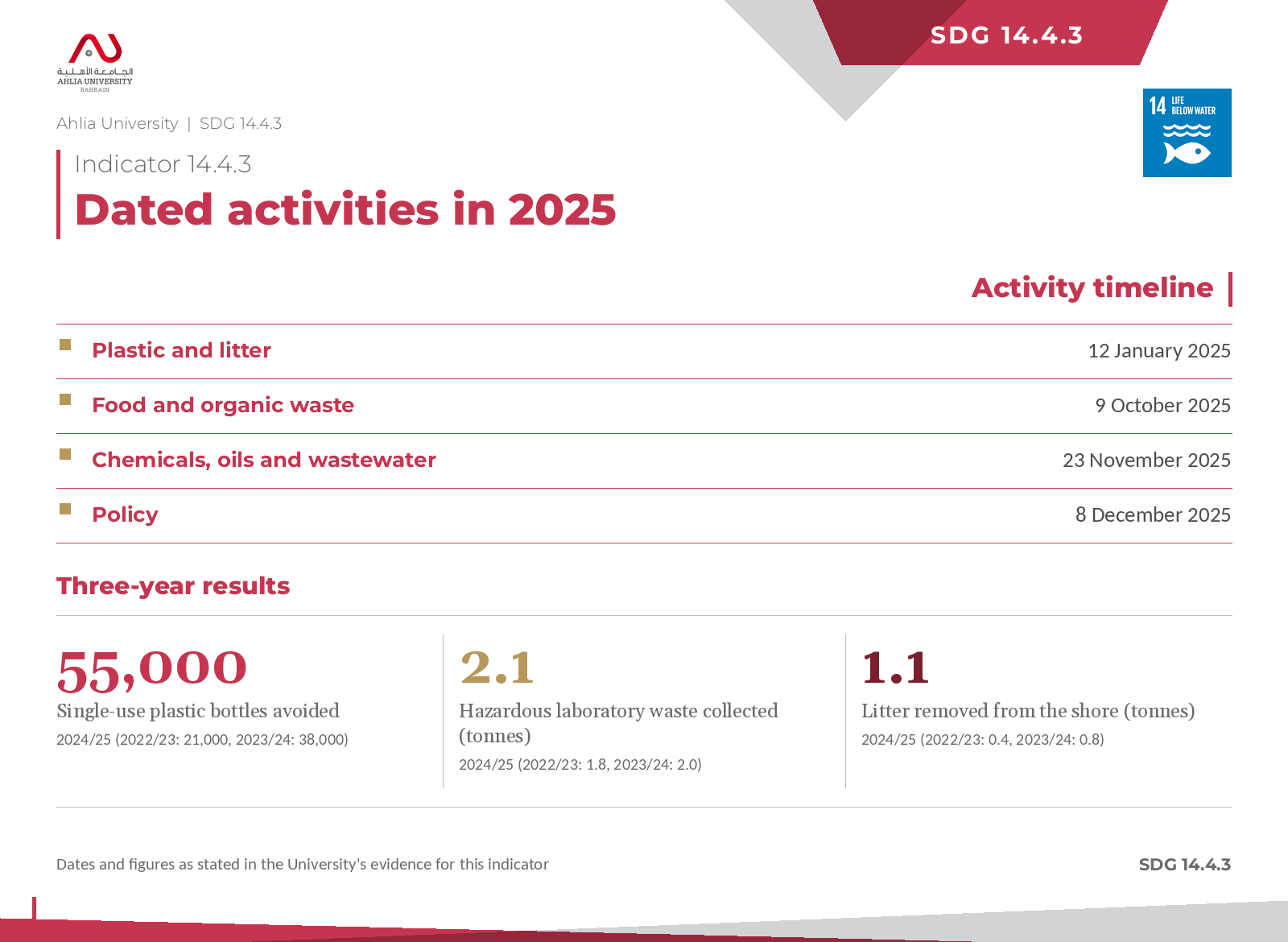
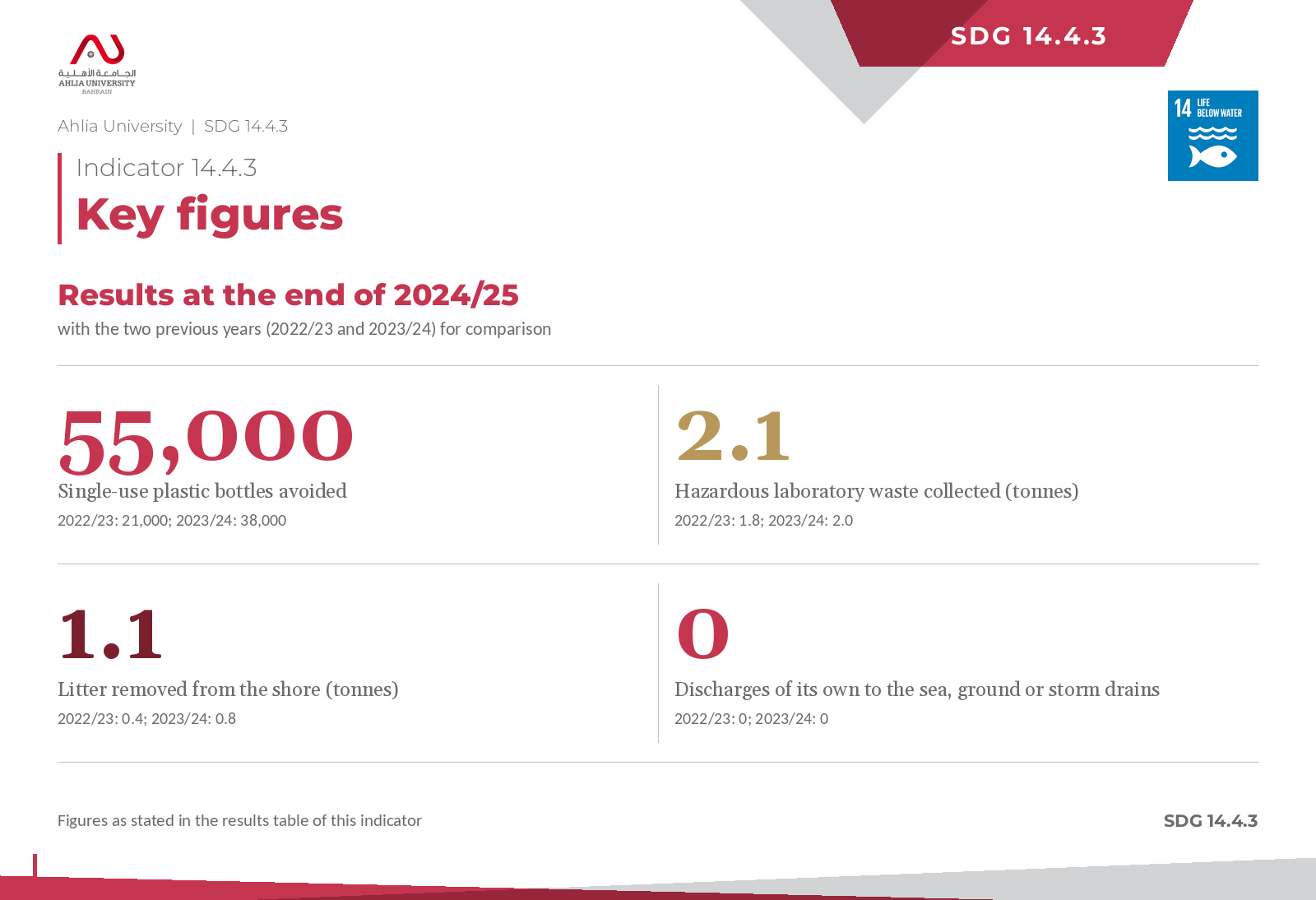
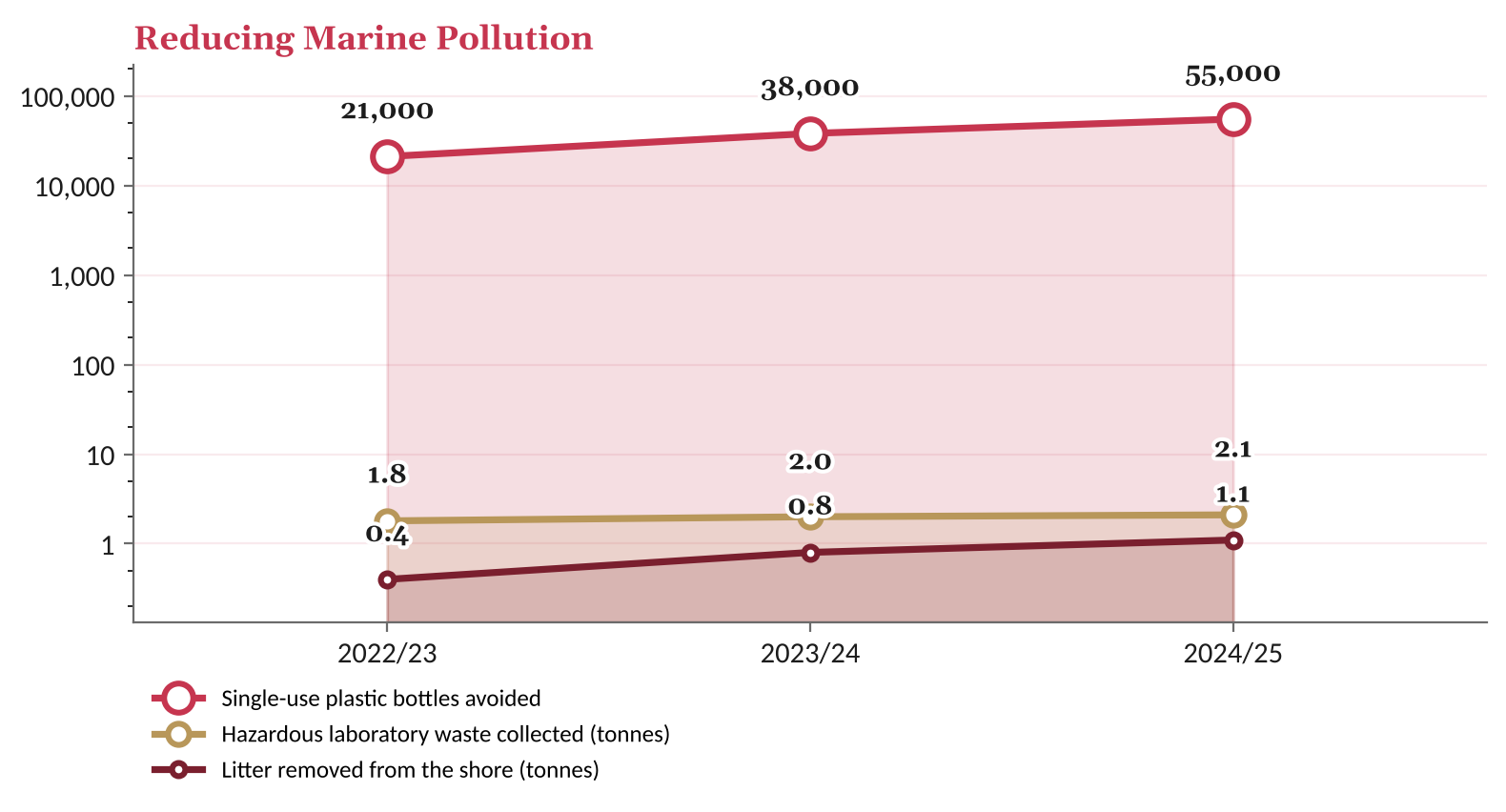
In calendar 2025, which is the 2024/25 column, the University had no discharge of its own, avoided 55,000 single-use plastic bottles, had 2.1 tonnes of hazardous laboratory waste collected by licensed contractors, donated or composted off site 50% of its food waste, and removed 1.1 tonnes of litter from the Gulf shore. The same measures in 2024 were 38,000 bottles, 2.0 tonnes, 38% and 0.8 tonnes, and in 2023 21,000 bottles, 1.8 tonnes, 25% and 0.4 tonnes.
At a glance
Element of the question
| Policy | Standing activity or document: Policy on the Prevention and Reduction of Marine Pollution from Land-based Activities Owner: Facilities and Maintenance Latest dated instance in 2025: Review by the University Sustainability Committee, Monday 8 December 2025 Three-year figure: 1 policy, 6 clauses |
|---|---|
| Plastic and litter | Standing activity or document: Plastic Waste Reduction Action Plan; shore clean-ups Owner: Facilities and Maintenance; Sustainability Club Latest dated instance in 2025: Four refill stations installed, Sunday 12 January 2025; 55,000 bottles avoided in 2025 Three-year figure: 114,000 bottles avoided; 2.3 tonnes of shore litter |
| Chemicals, oils and wastewater | Standing activity or document: Water Discharge Standards and Guidelines; licensed contractors for hazardous liquids Owner: Facilities and Maintenance; Colleges with laboratories Latest dated instance in 2025: Last hazardous waste collection of 2025, Sunday 23 November 2025 Three-year figure: 5.9 tonnes collected |
| Food and organic waste | Standing activity or document: Weighing and donation or composting off site by partners Owner: Facilities and Maintenance; catering operator Latest dated instance in 2025: Food Waste Week, Sunday 5 to Thursday 9 October 2025; 12 tonnes in 2025, 50% donated or composted Three-year figure: 39 tonnes weighed |
▪ Evidence for each element is cited in its own section below.
1. The policy and the pollution it covers
The University's environmental policies, which the Climate Action Policy page names, include the Policy on Healthy Environment and the Environmental Policy; the University's report on SDG 14 records that they require the community to reduce waste and to avoid the release of substances harmful to the biosphere. The Policy on the Prevention and Reduction of Marine Pollution from Land-based Activities takes the next step: it says that what leaves the premises must not become pollution of the sea, and it names the kinds of pollution that a university in a coastal city can cause. These are litter and plastics, chemicals and hazardous liquids, oils and grease, nutrients and organic waste from food, and cleaning products. It also commits the University to take litter already on the shore away.
▪ Evidence: Policy on the Prevention and Reduction of Marine Pollution from Land-based Activities, University Council Paper UC/P 646/2023 of 21 June 2023 [1]; Climate Action Policy page; University report on SDG 14, 2021 to 2025 [3].
2. The six clauses and how each is applied
| Kind of pollution | Clause | Applied through | 2025 figure |
|---|---|---|---|
| Litter and plastics | Reduce single-use plastic and keep plastic out of drains and landfill | Plastic Waste Reduction Action Plan | 55,000 bottles avoided |
| Chemicals and hazardous liquids | Never pour solvents, reagents or chemical waste to a drain | Licensed contractors; discharge standards | 2.1 tonnes collected |
| Oils and grease | Pass kitchen effluent through grease traps | Four grease traps | 48 cleanings |
| Nutrients and organic waste | Weigh food waste and donate or compost it off site | Catering operator; partners | 50% donated or composted |
| Cleaning products | Use approved products in measured doses with water-efficient machines | Cleaning log | No incident |
| Litter already on the shore | Take litter from the Gulf shore with students and the Capital Governorate | Coastal and Waterfront Clean-up Scheme | 1.1 tonnes removed |
▪ Evidence: policy clauses and application registers, Facilities and Maintenance and Dean of Student Affairs, 2023 to 2025 [1].
3. Land-based sources: what the premises send out
Wastewater from the premises goes to the public sewerage network and is not discharged to the sea; the standards that keep the network safe are the Water Discharge Standards and Guidelines (Administrative Circular No. 149/2024 of Thursday 15 February 2024), reported in detail under indicator 14.4.1. Laboratory rinse water is neutralised in batches, 32 in 2025, and kitchen effluent passes through grease traps cleaned 48 times in 2025. Hazardous laboratory waste, 1.8 tonnes in 2023, 2.0 in 2024 and 2.1 in 2025, goes to licensed contractors under the series reported in detail under indicator 12.2.3; the last collection of 2025 was on Sunday 23 November 2025.
▪ Evidence: batch logs, service sheets and contractor receipts, Facilities and Maintenance [1].
4. Plastics, food waste and the shore
The plastic plan, reported in detail under indicator 14.4.2, avoided 114,000 bottles over three years; its four refill stations were installed on Sunday 12 January 2025. Food waste is weighed at the three outlets of the premises and was 14, 13 and 12 tonnes, which is 39 tonnes, of which 25%, 38% and 50% were donated or composted off site by partners; the series is reported in detail under indicator 2.2.1, and the Food Waste Week of 2025 ran from Sunday 5 to Thursday 9 October 2025. The College of Business and Finance held the session Green Solutions for Leftovers on Wednesday 3 May 2023, which argued for waste prevention in environmental, economic and social terms. On the shore, students removed 0.4, 0.8 and 1.1 tonnes of litter in 2023, 2024 and 2025, with 1, 2 and 3 clean-ups, reported in detail under indicator 14.3.1; the last was on Sunday 26 October 2025.
▪ Evidence: food waste register and clean-up register, 2023 to 2025 [1]; Green Solutions for Leftovers event page.
5. Ownership, review and reporting
Facilities and Maintenance owns the policy and reports each quarter to the SDG Unit within CAQA, which consolidates the registers under the Sustainability Data Register Procedure. The policy was approved by University Council Paper UC/P 646/2023 of 21 June 2023 and reviewed by University Council Paper UC/P 759/2025 of 26 February 2025; the University Sustainability Committee reviewed it on Monday 8 December 2025. The University publishes the figures of this indicator in its SDG report each year.
▪ Evidence: review record and minutes of the University Sustainability Committee, 8 December 2025 [1].
Policy basis
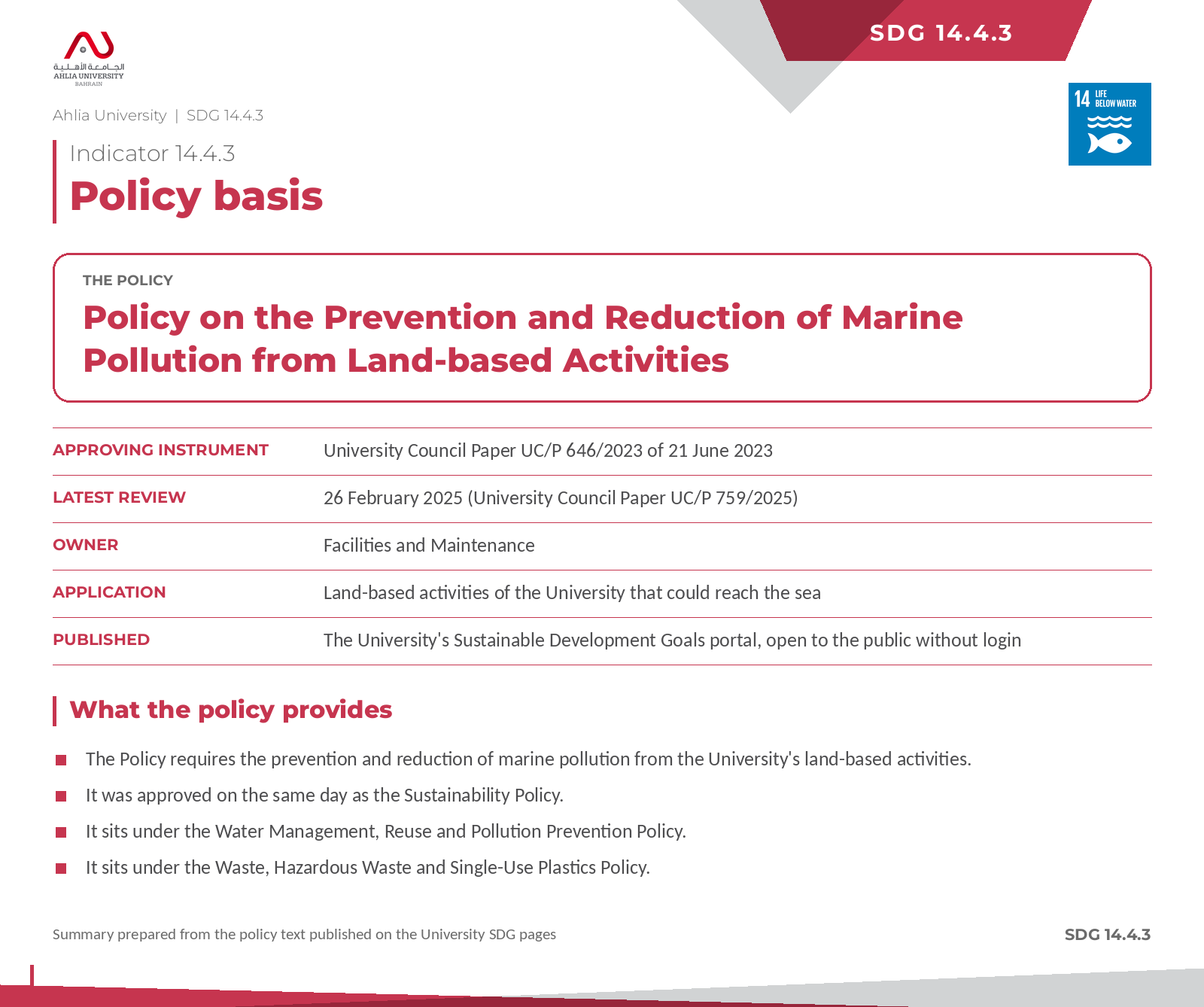
Title: Policy on the Prevention and Reduction of Marine Pollution from Land-based Activities. Approving instrument: University Council Paper UC/P 646/2023 of 21 June 2023, approved on that date and latest reviewed by University Council Paper UC/P 759/2025 of 26 February 2025. It was approved on the same day as the Sustainability Policy (UC/P 647/2023) and sits under the Water Management, Reuse and Pollution Prevention Policy and the Waste, Hazardous Waste and Single-Use Plastics Policy. Its clauses are the six of section 2. Owner: Facilities and Maintenance. In 2024/25 it produced no discharge of its own, 55,000 bottles avoided, 2.1 tonnes of hazardous waste collected, 50% of food waste donated or composted and 1.1 tonnes of shore litter removed. It is published on the University's Sustainable Development Goals portal with this document.
▪ Evidence: policy text and review record [1].
Results by academic year
Registers are kept by calendar year, so the 2022/23 column is calendar 2023, the 2023/24 column is 2024 and the 2024/25 column is 2025; events of September to December 2025 are counted in 2024/25. Bottles avoided are as in indicator 14.4.2, 21,000 + 38,000 + 55,000 = 114,000. Hazardous waste is the weight collected by licensed contractors, 1.8 + 2.0 + 2.1 = 5.9 tonnes. Shore litter is the weight of the bags of the clean-ups, 0.4 + 0.8 + 1.1 = 2.3 tonnes. Food waste is the weight weighed at the outlets, 14 + 13 + 12 = 39 tonnes. The share is the food waste donated or composted off site divided by the food waste. Percentages are rounded to whole numbers.
| Indicator | 2022/23 | 2023/24 | 2024/25 |
|---|---|---|---|
| Single-use plastic bottles avoided | 21,000 | 38,000 | 55,000 |
| Hazardous laboratory waste collected (tonnes) | 1.8 | 2.0 | 2.1 |
| Litter removed from the shore (tonnes) | 0.4 | 0.8 | 1.1 |
| Discharges of its own to the sea, ground or storm drains | 0 | 0 | 0 |
| Food waste donated or composted off site | 25% | 38% | 50% |
▪ Evidence: registers listed in the references [1].
Publication and verification
This document, which is the University's evidence for indicator 14.4.3 and is kept by Facilities and Maintenance, with the SDG Unit within CAQA, was approved by University Council Paper UC/P 830/2026 of 14 January 2026 together with the 2025 edition of the SDG reports (University Council Paper UC/P 829/2026 of the same day, published 21 January 2026) and published on the University's Sustainable Development Goals portal on 28 January 2026, open to the public without login. The underlying registers, which are the batch logs, the grease-trap sheets, the hazardous waste receipts, the bottle and refill counters, the food weighing sheets and the clean-up sheets, are held by Facilities and Maintenance and the Dean of Student Affairs and are quoted in the text above.
Evidence and references
- Policy on the Prevention and Reduction of Marine Pollution from Land-based Activities, University Council Paper UC/P 646/2023 of 21 June 2023, reviewed by UC/P 759/2025 of 26 February 2025; Water Management, Reuse and Pollution Prevention Policy, UC/P 626/2023 of 22 March 2023; Waste, Hazardous Waste and Single-Use Plastics Policy, UC/P 627/2023 of 22 March 2023; application registers and review sheets, Facilities and Maintenance and Dean of Student Affairs
- Ahlia University, Climate Action Policy page (page modified 24 May 2024): the University Policy on Healthy Environment, the Environmental Policy and the University Policy on Efficient Use of Paper are named there; water-efficient cleaning machines, automatic flush devices, spray irrigation, low-water plants and waste collected in separate containers by specialised waste management companies https://www.ahlia.edu.bh/climate-action-policy/
- University report on SDG 14, 2021 to 2025, CAQA: the environmental policy requires the University community to reduce waste and avoid the release of substances harmful to the biosphere; the carbon-footprint framework tracked waste as a Scope 3 source in 2022
- Ahlia University, event page: Green Solutions for Leftovers, College of Business and Finance, Wednesday 3 May 2023, 12:00 PM to 1:30 PM, Ahlia University Theatre https://www.ahlia.edu.bh/events/green-solutions-for-leftovers/