Ahlia University, the first private university licensed in the Kingdom of Bahrain, housed in the Gosi Complex in Manama, has, as a body, a policy on reducing plastic waste on campus. The policy is the Waste, Hazardous Waste and Single-Use Plastics Policy (University Council Paper UC/P 627/2023 of 22 March 2023, reviewed by University Council Paper UC/P 757/2025 of 26 February 2025). It gives force to the Plastic-Free Campus Pledge that the University made in October 2022, which banned the sale of single-use plastic bags and bottles on campus and provided water refill stations and tote bags, and to the plastic collection that the University runs with the Bahrain Association for Parents and Friends of the Disabled, under a memorandum of understanding reported in April 2023. Its rules reach every user of the Gosi Complex premises: no sale of single-use plastic bags and bottles in the three food outlets, free drinking water at refill stations, separate collection of plastic for recycling, and a discount for customers who bring a reusable container.
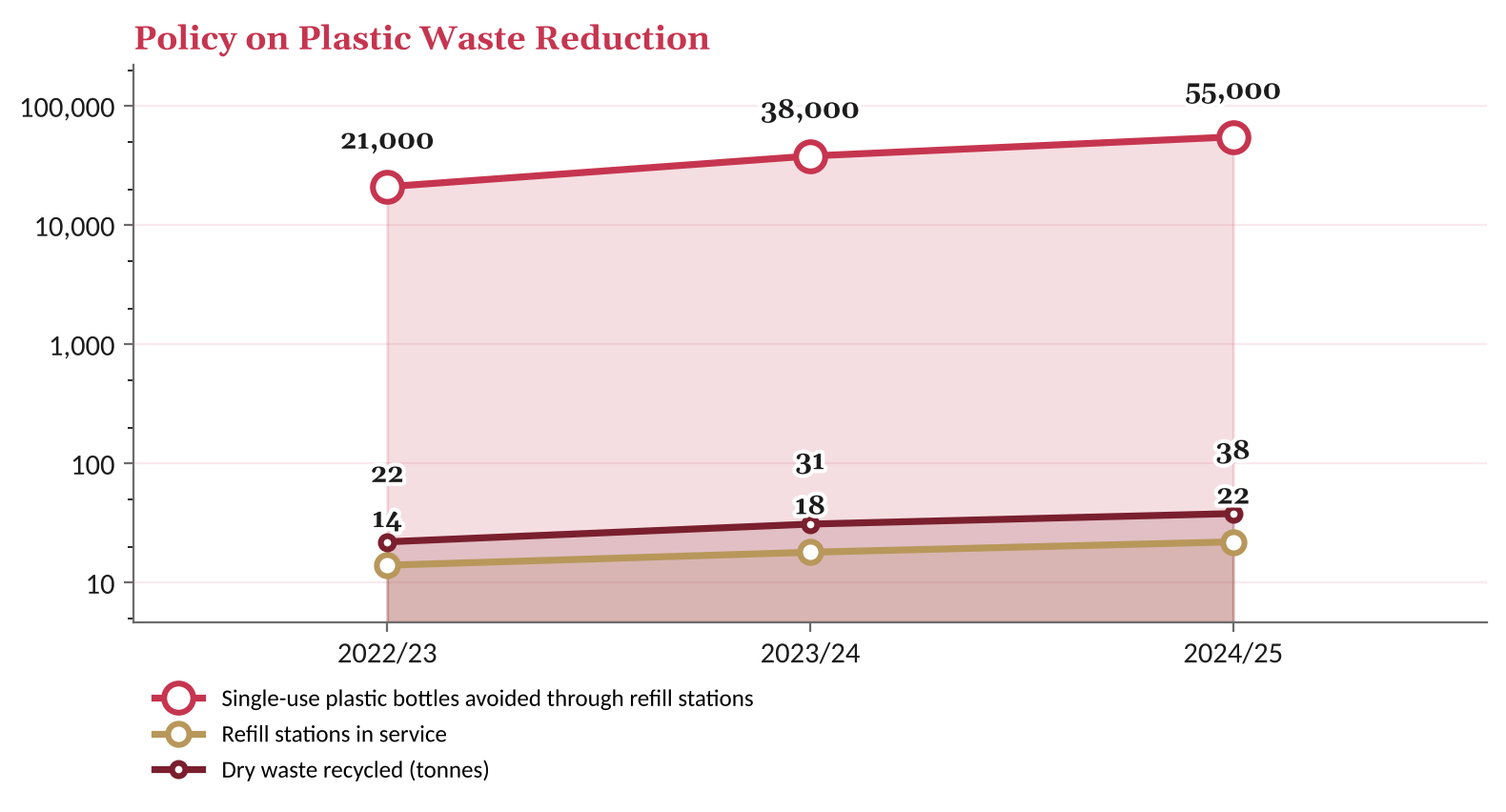
The figures are kept by calendar year, so that 2022/23 is calendar 2023, 2023/24 is 2024 and 2024/25 is 2025. The refill stations rose from 14 to 18 and then 22, and the single-use plastic bottles that they avoided rose from 21,000 in 2022/23 to 38,000 in 2023/24 and 55,000 in 2024/25, which is 114,000 in three years. The share of solid waste that was recycled as dry waste rose from 22% to 33% and then 41%.
At a glance
Element of the question
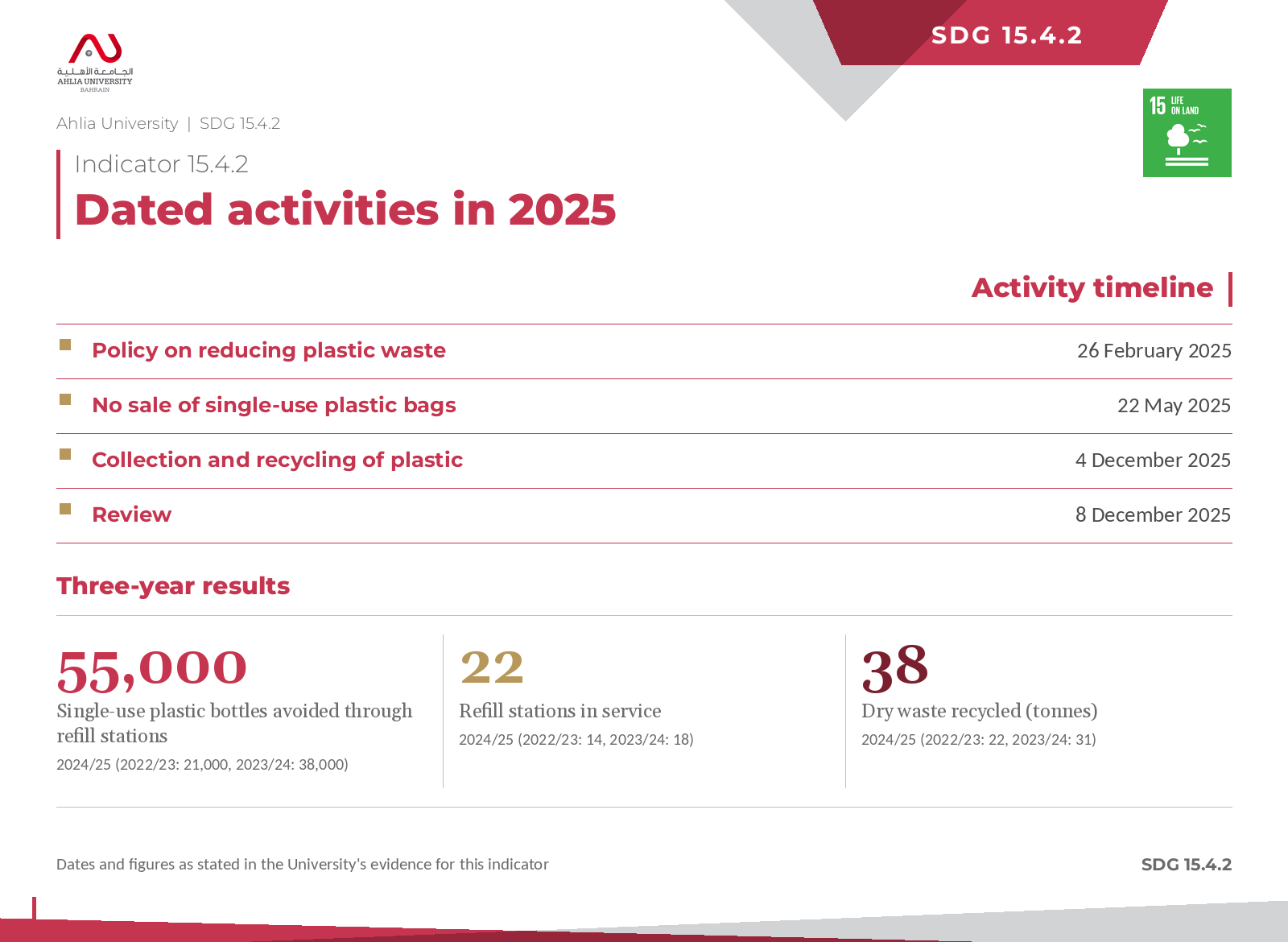
| Policy on reducing plastic waste | Standing activity or document: Waste, Hazardous Waste and Single-Use Plastics Policy (UC/P 627/2023) Owner: Facilities and Maintenance Latest dated instance in 2025: Review, UC/P 757/2025 of 26 February 2025 Three-year figure: 1 policy |
|---|---|
| No sale of single-use plastic bags and bottles | Standing activity or document: Plastic-Free Campus Pledge of October 2022, applied in the three food outlets Owner: Facilities and Maintenance; catering operator Latest dated instance in 2025: Menu and outlet audit, Thursday 22 May 2025 Three-year figure: 3 of 3 outlets |
| Refill stations instead of bottles | Standing activity or document: Free drinking-water refill stations in the two buildings Owner: Facilities and Maintenance Latest dated instance in 2025: Counter reading, Thursday 4 December 2025 Three-year figure: 22 stations; 114,000 bottles avoided |
| Collection and recycling of plastic | Standing activity or document: Collection in all facilities for the Bahrain Association for Parents and Friends of the Disabled Owner: Sustainability Club; Facilities and Maintenance Latest dated instance in 2025: Dry waste weighing, Thursday 4 December 2025 Three-year figure: 91 tonnes of dry waste recycled in three years |
| Review | Standing activity or document: Pledge renewed in June 2025; counts reviewed by the Committee Owner: SDG Unit within CAQA Latest dated instance in 2025: Committee review, Monday 8 December 2025 Three-year figure: 3 annual counts |
▪ Evidence for each element is cited in its own section below.
1. The policy and what it requires
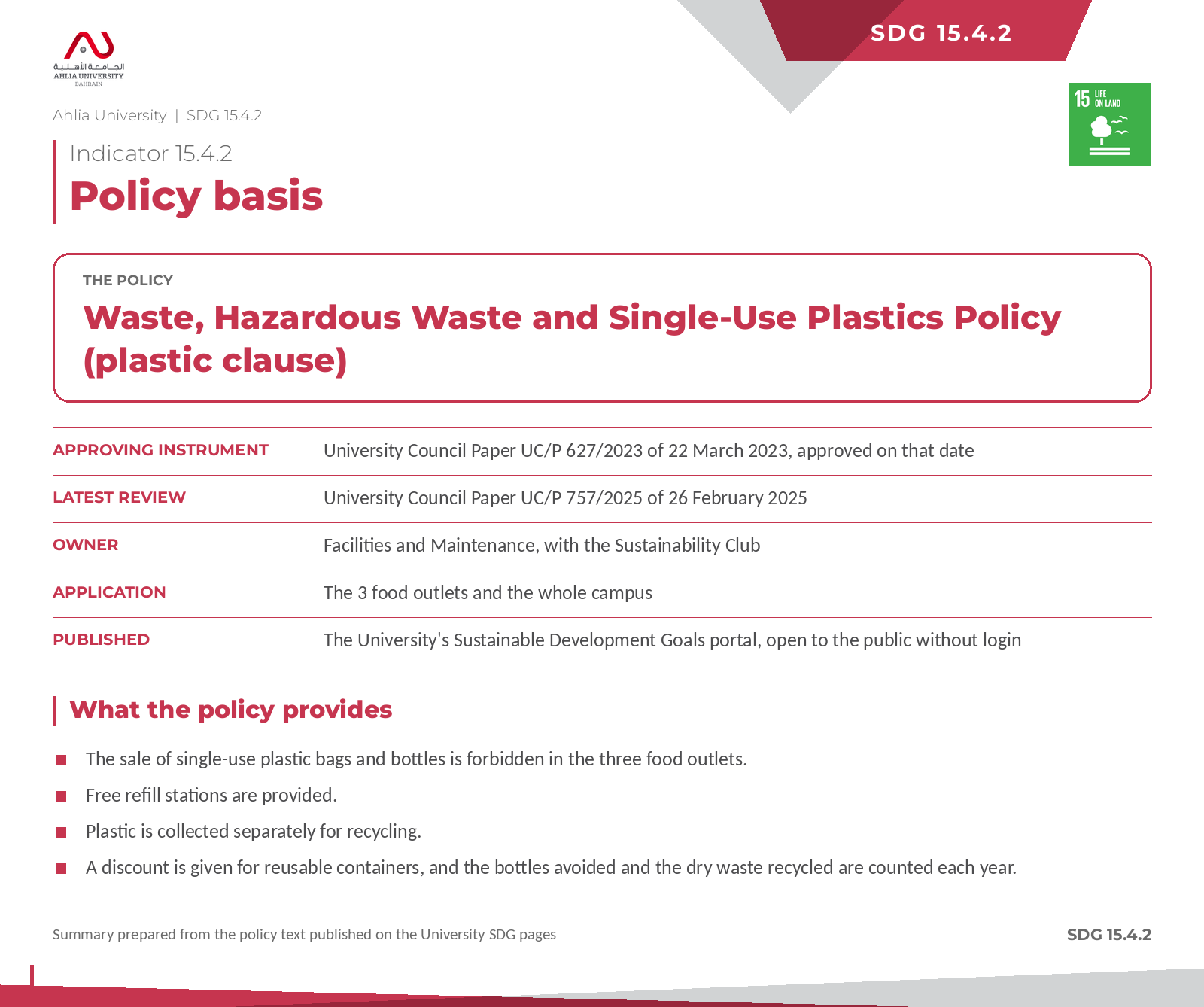
The Waste, Hazardous Waste and Single-Use Plastics Policy has a plastic clause that sets four rules. The first is that single-use plastic bags and bottles are not sold on the premises, and that the catering operator of the three food outlets (the cafeteria, the Food Court on the second floor and the coffee and snack counter) may not offer them. The second is that drinking water is free at refill stations, the number of which the Policy asks Facilities and Maintenance to increase. The third is that plastic is collected separately in all facilities and sent for recycling. The fourth is that a customer who brings a reusable container receives a discount, which the Standard for Food Outlets on the Premises, reported under indicator 2.3.3, applies in each outlet. The Policy also asks the University to count the bottles avoided and the dry waste recycled each year.
▪ Evidence: Waste, Hazardous Waste and Single-Use Plastics Policy, UC/P 627/2023 with its review UC/P 757/2025 [1].
2. The Plastic-Free Campus Pledge
The University's page on SDG 14 records that the Plastic-Free Campus Pledge was made in October 2022 with a ban on the sale of single-use plastic bags and bottles on campus, water refill stations and tote bags, and a student-led awareness week. It records a decrease of 40% in the consumption of single-use plastic by 2025 against the start of the programme in 2022, and a renewal of the pledge in June 2025 with the target of no single-use plastic on campus by 2027. The three food outlets applied the ban in each of the three years, and the menu and outlet audit of Thursday 22 May 2025 found no single-use plastic bag or bottle on sale in any of them.
▪ Evidence: University page on SDG 14, Plastic-Free Campus Pledge [2]; outlet audit, Facilities and Maintenance and the Financial Affairs Directorate, 22 May 2025 [3].
3. Refill stations and the bottles avoided
The University had 14 refill stations in 2023, 18 in 2024 and 22 in 2025, free to everyone, with a counter on each. The counters showed that the stations avoided 21,000 single-use plastic bottles in 2023, 38,000 in 2024 and 55,000 in 2025, which is 114,000 in three years; the counter of each station was read on Thursday 4 December 2025 for the last time in the year. The stations and the bottles are reported in detail under indicators 6.3.3 and 12.2.6. They are the main way in which the University reduces plastic waste at the source, because a bottle that is not bought is a bottle that is not thrown away.
▪ Evidence: refill station counter readings, Facilities and Maintenance, 2023 to 2025 [3].
4. Collecting plastic and giving it a use
The University collects plastic in all its facilities for recycling. In April 2023 it signed a memorandum of understanding with the Bahrain Association for Parents and Friends of the Disabled, for the University by its President and for the Association by its Chairman, under which the plastic collected is given to the Association for recycling and the money it raises helps to buy wheelchairs; the agreement was reported at the time. The Recycle and Donate campaign collected 1,675.3 kg of plastic to the end of 2022/23; the Centre for Accreditation and Quality Assurance (CAQA) SDG Commitment 2020 to 2023 reports 1,619.7 kg donated under the campaign Do not bin it, donate it. The University's page states the collection to be equivalent to 139.6 kg of carbon emissions and records lectures on environmental sustainability by specialists from Kuwait and Bahrain, and the Commitment equates the donation to two specially designed wheelchairs. In November 2023 the Executive Director for Strategy, Sustainability and Quality told University World News that the initiative benefits both the environment and society.
The dry waste that the University recycles, which includes plastic, was 22 tonnes in 2023, 31 in 2024 and 38 in 2025, as reported under indicator 12.3.1, and it was weighed again on Thursday 4 December 2025.
▪ Evidence: memorandum of understanding news item, April 2023; CAQA SDG Commitment 2020 to 2023; dry waste register, Facilities and Maintenance, 2023 to 2025 [3].
5. Review and record
Facilities and Maintenance enters the bottles avoided and the dry waste in the waste register of the Sustainability Data Register Procedure (Administrative Circular No. 820/2022 of 13 October 2022), and the SDG Unit within CAQA consolidates it each quarter. The University Sustainability Committee reviewed the plastic counts on Monday 8 December 2025.
▪ Evidence: register, Administrative Circular No. 820/2022 [6]; Committee minutes, 8 December 2025 [6].
Policy basis
Title: Waste, Hazardous Waste and Single-Use Plastics Policy (plastic clause). Approving instrument: University Council Paper UC/P 627/2023 of 22 March 2023, approved on that date; latest review: University Council Paper UC/P 757/2025 of 26 February 2025. Owner: Facilities and Maintenance, with the Sustainability Club. The clauses that answer the question forbid the sale of single-use plastic bags and bottles in the three food outlets, provide free refill stations, require the separate collection of plastic for recycling, provide the discount for reusable containers and require a yearly count of the bottles avoided and the dry waste recycled. Application in 2024/25: 3 of 3 outlets, 22 refill stations, 55,000 bottles avoided, 38 tonnes of dry waste recycled. The Policy is published on the University's Sustainable Development Goals portal.
▪ Evidence: policy text and review record [1].
Results by academic year
Registers are kept by calendar year (2023, 2024 and 2025, read as 2022/23, 2023/24 and 2024/25) for the Gosi Complex premises. Bottles avoided are the readings of the counters of the refill stations: 21,000 + 38,000 + 55,000 = 114,000. Recycled dry waste is the weight of dry waste sent for recycling: 22 + 31 + 38 = 91 tonnes. Refill stations are those in service at the end of the year. Outlets applying the ban are the outlets of the three that sold no single-use plastic bag or bottle. The share of solid waste recycled is the dry waste recycled divided by the solid waste, which is 22 / 98, 31 / 95 and 38 / 92, or 22%, 33% and 41%.
| Indicator | 2022/23 | 2023/24 | 2024/25 |
|---|---|---|---|
| Single-use plastic bottles avoided through refill stations | 21,000 | 38,000 | 55,000 |
| Refill stations in service | 14 | 18 | 22 |
| Dry waste recycled (tonnes) | 22 | 31 | 38 |
| Food outlets applying the plastic ban (of 3) | 3 | 3 | 3 |
| Share of solid waste recycled as dry waste | 22% | 33% | 41% |
Publication and verification
This document, which is the University's evidence for indicator 15.4.2 and is kept by Facilities and Maintenance, with the Sustainability Club and the SDG Unit within CAQA, was approved by University Council Paper UC/P 830/2026 of 14 January 2026 together with the 2025 edition of the SDG reports (University Council Paper UC/P 829/2026 of the same day, published 21 January 2026) and published on the University's Sustainable Development Goals portal on 28 January 2026, open to the public without login. The underlying registers, which are the refill station counter readings, the dry waste register, the outlet audit and the minutes of the University Sustainability Committee, are held by the offices named above and are quoted in the text.
Evidence and references
- Waste, Hazardous Waste and Single-Use Plastics Policy, University Council Paper UC/P 627/2023 of 22 March 2023, reviewed by UC/P 757/2025 of 26 February 2025; owner Facilities and Maintenance
- Ahlia University: SDG 14 page, Plastic-Free Campus Pledge of October 2022 and its renewal in June 2025
- Refill station counter readings, dry waste register and outlet audit of 22 May 2025, Facilities and Maintenance and Financial Affairs Directorate, 2023 to 2025
- Ahlia University: memorandum of understanding with the Bahrain Association for Parents and Friends of the Disabled, news item of 9 April 2023 https://www.ahlia.edu.bh/ahlia-university-signs-an-mou-with-the-bahraini-association-for-parents-of-the-disabled/
- Ahlia University, Centre for Accreditation and Quality Assurance: SDG Commitment 2020 to 2023 (Do not bin it, donate it: 1,619.7 kg of plastics, two wheelchairs; uploaded July 2023) https://www.ahlia.edu.bh/cms4/wp-content/uploads/2023/07/CAQA-SDG-Commitment-2020-2023.pdf
- Sustainability Data Register Procedure, Administrative Circular No. 820/2022 of 13 October 2022; Minutes of the University Sustainability Committee, 17 February, 19 May, 29 September and 8 December 2025, SDG Unit within CAQA