
Ahlia University, the first private university licensed in the Kingdom of Bahrain, housed in the Gosi Complex in Manama, has, as a body, policies to ensure that food on campus is sustainably farmed. Two instruments apply. The Sustainable Procurement, Food and Ethical Sourcing Policy (University Council Paper UC/P 649/2023 of 20 September 2023, built on the Procurement and Purchasing Policy and reviewed by University Council Paper UC/P 757/2025 of 26 February 2025) sets the rule, and the Standard for Food Outlets on the Premises (Administrative Circular No. 901/2022 of 10 November 2022) applies it to all the food served on campus, which is the cafeteria service of the Gosi Complex with three outlets: the cafeteria, the Food Court on the second floor and the coffee and snack counter, all run by one licensed catering operator under contract. The University does not farm and owns no farmland, so its policy works through what it buys: fruit and vegetables come from registered Bahraini farms where they are available.
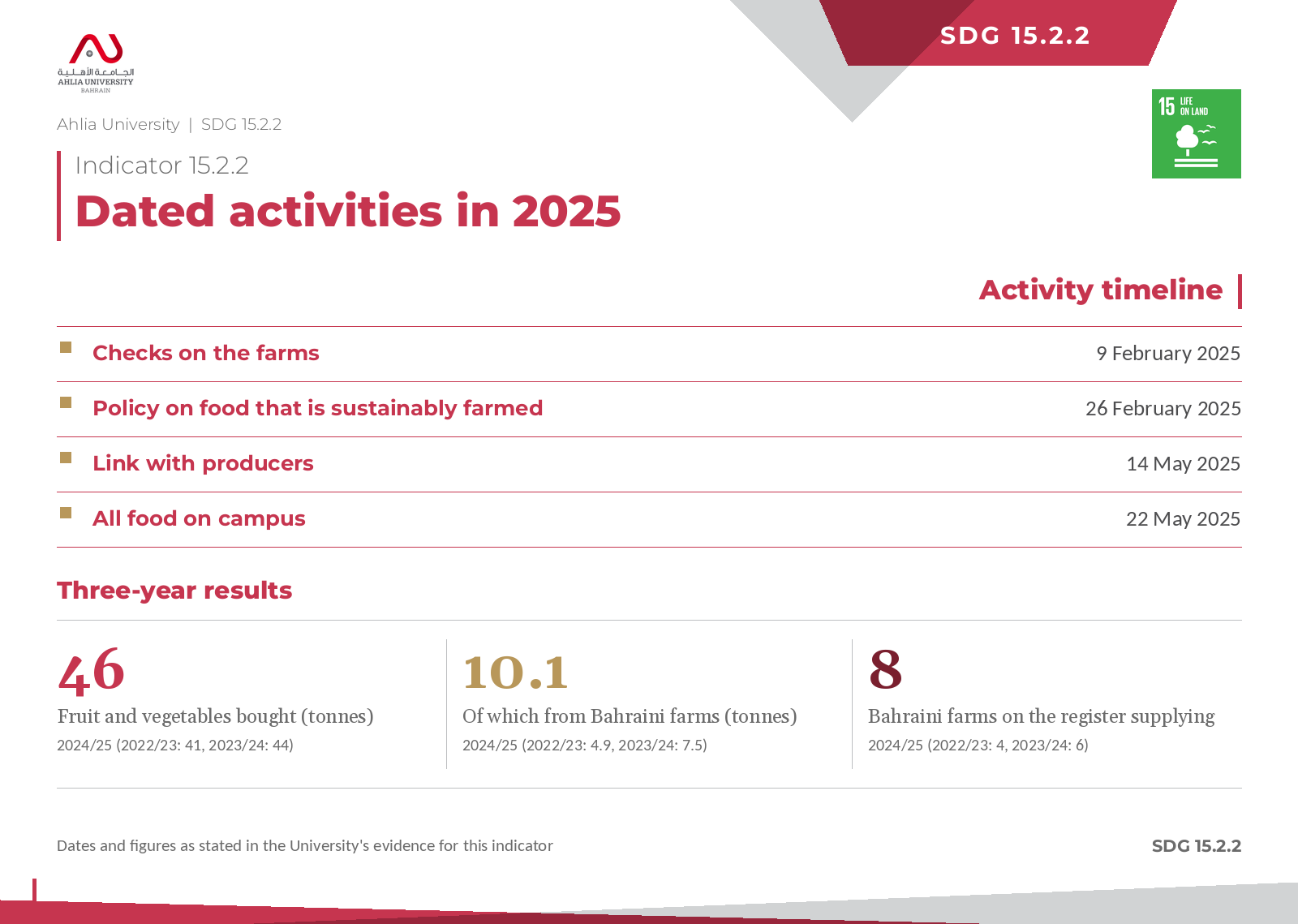
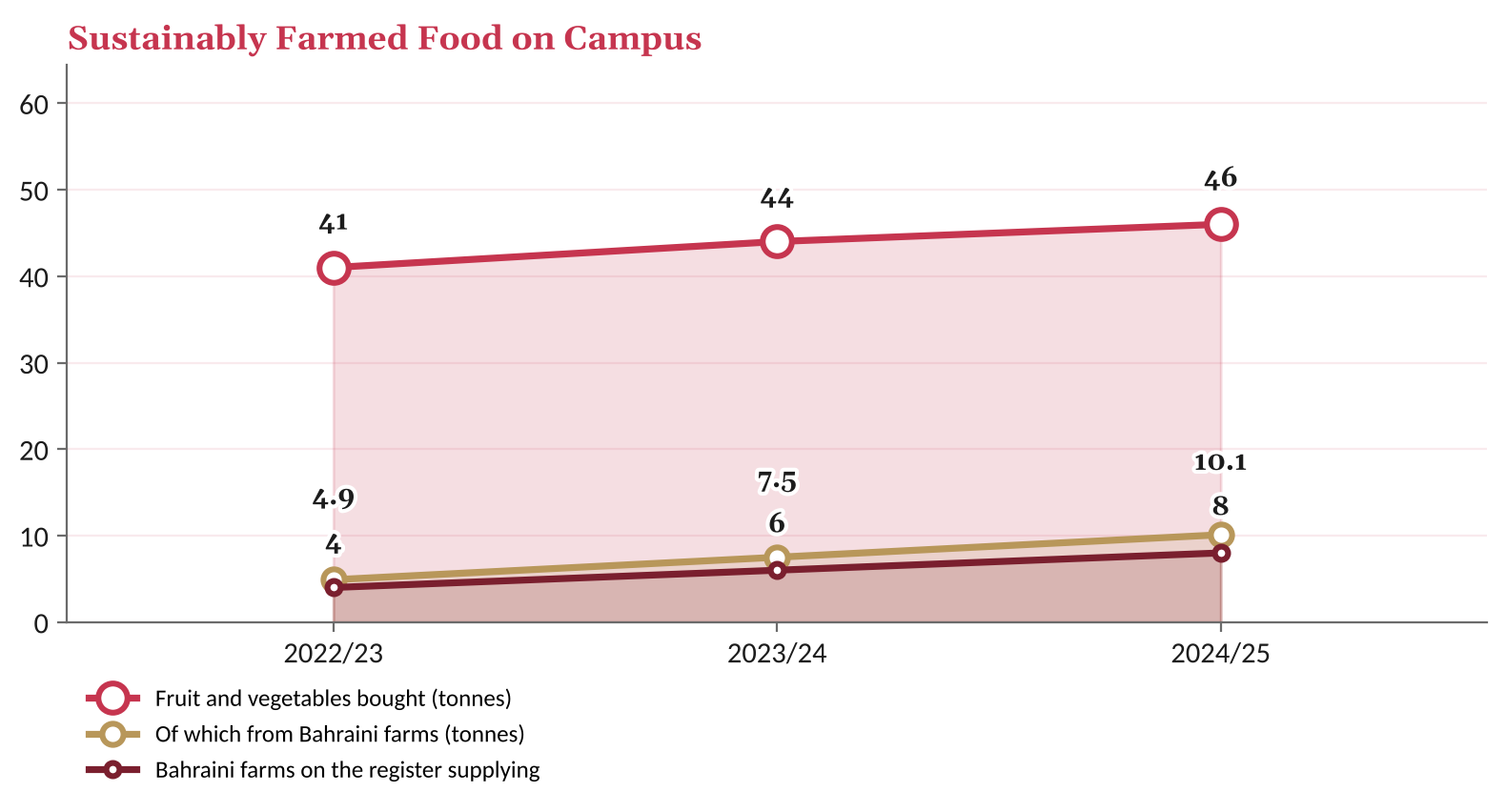
The University reads sustainably farmed food as food from farms that look after the land and the water they use, and it checks this on the farms themselves. The figures are kept by calendar year, so that 2022/23 is calendar 2023, 2023/24 is 2024 and 2024/25 is 2025. In 2025 the outlets bought 46 tonnes of fruit and vegetables, of which 10.1 tonnes, or 22%, came from 8 Bahraini farms. Over the three years the outlets bought 131 tonnes, of which 22.5 tonnes came from Bahraini farms.
At a glance
Element of the question
| Policy on food that is sustainably farmed | Standing activity or document: Sustainable Procurement, Food and Ethical Sourcing Policy (UC/P 649/2023) Owner: Facilities and Maintenance; Financial Affairs Directorate Latest dated instance in 2025: Review, UC/P 757/2025 of 26 February 2025 Three-year figure: 1 policy |
|---|---|
| All food on campus | Standing activity or document: Standard for Food Outlets on the Premises (Administrative Circular No. 901/2022) Owner: Facilities and Maintenance; catering operator Latest dated instance in 2025: Menu audit, Thursday 22 May 2025 Three-year figure: 3 of 3 outlets |
| Produce from sustainably farmed sources | Standing activity or document: Fruit and vegetables from registered Bahraini farms Owner: Facilities and Maintenance Latest dated instance in 2025: Supplier review, Thursday 22 May 2025 Three-year figure: 22.5 tonnes from farms |
| Checks on the farms | Standing activity or document: Register of farms, yearly farm statement and visit Owner: Facilities and Maintenance Latest dated instance in 2025: Farm visit, Sunday 9 February 2025 Three-year figure: 18 farm visits |
| Link with producers | Standing activity or document: Local Food Producers Engagement Programme (UC/P 624/2023) Owner: Community Engagement office Latest dated instance in 2025: Market, Wednesday 14 May 2025 Three-year figure: Reported under indicators 2.5.1 to 2.5.3 |
▪ Evidence for each element is cited in its own section below.
1. What the policy requires
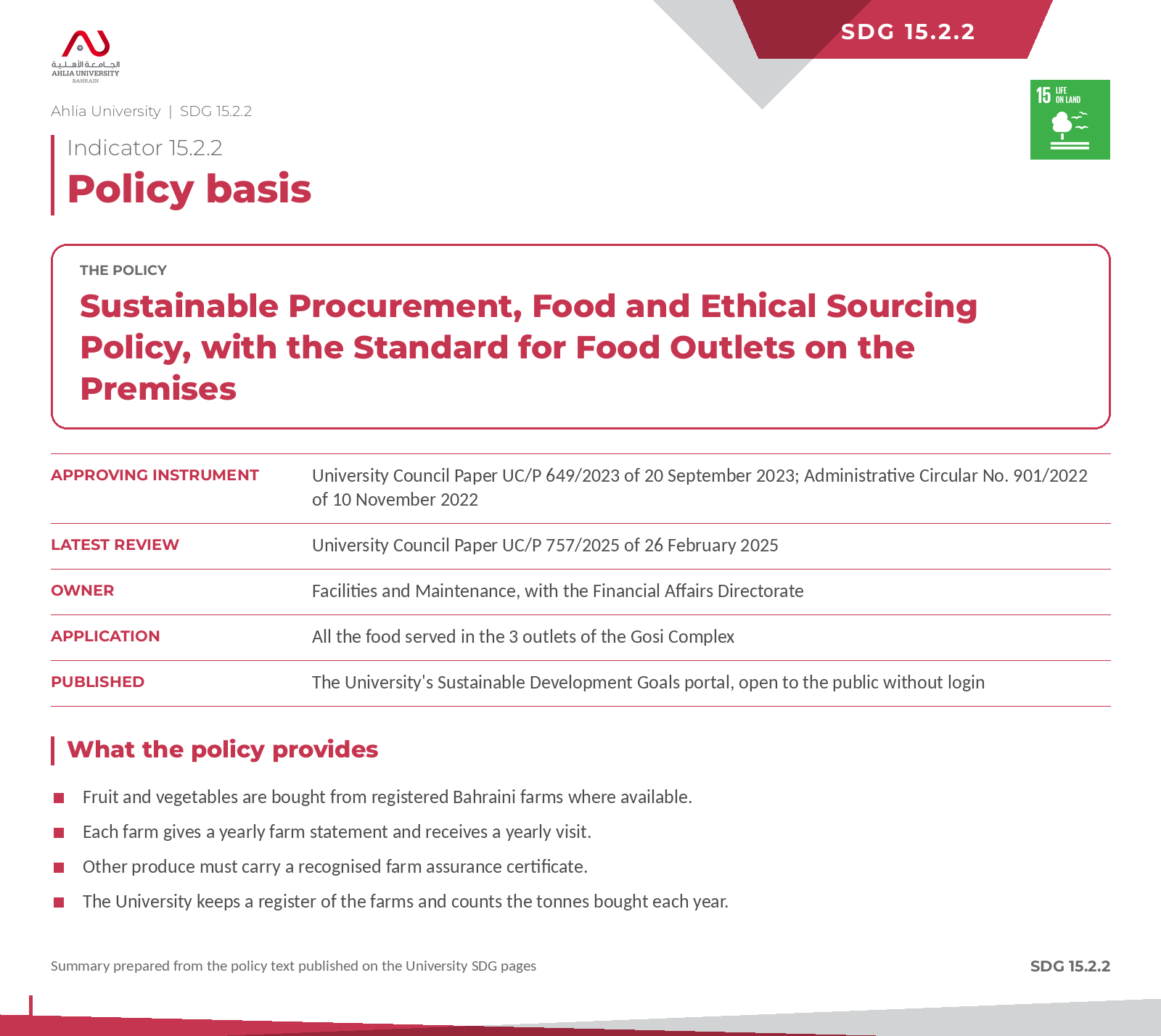
The Sustainable Procurement, Food and Ethical Sourcing Policy is the University's rule for what it buys, and its food clauses have three parts. The first is the sourcing rule: fruit and vegetables for the outlets are bought from Bahraini farms where they are available in season and meet the safety rules, because produce that travels a short distance and comes from a known farm can be inspected. The second is the standard for the farm: a farm may supply the outlets only when it is entered in the register of farms kept by Facilities and Maintenance, which requires a valid licence for the farm, a written statement each year of how it uses fertiliser, pesticide and irrigation water, and acceptance of a yearly visit. The third is the fallback: where Bahraini produce is not available, the operator must supply the producer's certificate of a recognised farm assurance scheme for the imported produce, and Facilities and Maintenance keeps the certificates.
The Policy is built on the Procurement and Purchasing Policy of the University, which already requires fair, documented purchasing, and it adds the sourcing rule, the register and the yearly count. It sets a target of 25% Bahraini produce, which the outlets have not yet reached.
▪ Evidence: Procurement and Purchasing Policy page; Sustainable Procurement, Food and Ethical Sourcing Policy, UC/P 649/2023 [2].
2. All food on campus: the three outlets
The Standard for Food Outlets on the Premises binds the catering operator in all three outlets, so that the rule covers all the food served on campus and not only the cafeteria. The operator must buy from traceable suppliers, label dishes that are made with local produce, keep the invoices that name the farm and report each year the tonnes of fruit and vegetables bought and the tonnes that came from Bahraini farms. The menu audit of Thursday 22 May 2025 found the rule applied in 3 of the 3 outlets, as in 2023 and 2024.
The Standard also requires the operator to weigh food waste and to offer vegetarian and vegan dishes, which are reported in detail under indicators 2.2.1 and 2.3.3. They matter here because wasting less food and serving more plant-based food both reduce the pressure that food puts on land.
▪ Evidence: Standard for Food Outlets on the Premises, Administrative Circular No. 901/2022 [3]; menu audit, 22 May 2025, Facilities and Maintenance [4].
3. The farms: register, statement and visit
The register held 4 farms in 2023, 6 in 2024 and 8 in 2025. Staff of Facilities and Maintenance visit each farm on the register once a year, which gives 4, 6 and 8 visits and 18 in three years. On Sunday 9 February 2025 they made the last round, checking the hygiene of the produce, its source and the farm's own statement on fertiliser, pesticide and irrigation water. A farm that cannot give the statement, or whose statement does not agree with what the visit shows, is taken off the register, and its produce is bought from another farm or from a certified source.
The farms that supply the outlets are also invited to the Knowledge Series and the Market of the Local Food Producers Engagement Programme (University Council Paper UC/P 624/2023 of 22 February 2023), which are reported in detail under indicators 2.5.1 and 2.5.2. A farm that sells to the outlets can therefore also learn and sell on campus; the Market of 2025 was held on Wednesday 14 May 2025.
▪ Evidence: register of farms, farm statements and visit notes, Facilities and Maintenance, 2023 to 2025 [4]; Knowledge Exchange and Community Engagement Plan page.
4. Checking the policy
The Financial Affairs Directorate checks the invoices of the operator against the register of farms each May, so that the tonnes reported as Bahraini are tonnes that a registered farm invoiced. The supplier review of Thursday 22 May 2025 confirmed the 10.1 tonnes of 2025, which are 22% of the 46 tonnes bought. The University Sustainability Committee reviewed the count on Monday 8 December 2025, noted that the share had risen from 12% to 17% and then 22%, and kept the target of 25% for the next year. The University does not claim that all the food on campus is sustainably farmed: 78% of the fruit and vegetables bought in 2025 came from other sources, for which the certificate rule applies.
▪ Evidence: invoice check and supplier review, Financial Affairs Directorate and Facilities and Maintenance, 22 May 2025 [4]; Committee minutes, 8 December 2025 [6].
Policy basis
Title: Sustainable Procurement, Food and Ethical Sourcing Policy, with the Standard for Food Outlets on the Premises. Approving instruments: University Council Paper UC/P 649/2023 of 20 September 2023; Administrative Circular No. 901/2022 of 10 November 2022; latest review: University Council Paper UC/P 757/2025 of 26 February 2025. Owner: Facilities and Maintenance, with the Financial Affairs Directorate. The clauses that answer the question require fruit and vegetables to be bought from registered Bahraini farms where available, a yearly farm statement and visit, a recognised farm assurance certificate for other produce, a register of the farms and a yearly count of the tonnes. Application in 2025: 3 of 3 outlets, 46 tonnes bought, 10.1 tonnes from 8 Bahraini farms. The Policy and the Standard are published on the University's Sustainable Development Goals portal.
▪ Evidence: policy text and review record [2]; Standard, Administrative Circular No. 901/2022 [3].
Results by academic year
Fruit and vegetables bought are those bought for the three outlets in the calendar year (2023, 2024 and 2025, read as 2022/23, 2023/24 and 2024/25): 41 + 44 + 46 = 131 tonnes. Tonnes from Bahraini farms come from the invoices that name a registered farm: 4.9 + 7.5 + 10.1 = 22.5. Farms are those on the register that supplied in the year. The share is the tonnes from Bahraini farms divided by the tonnes bought, rounded to a whole number: 4.9 / 41, 7.5 / 44 and 10.1 / 46, which are 12%, 17% and 22%. All three outlets follow the rule in each year.
| Indicator | 2022/23 | 2023/24 | 2024/25 |
|---|---|---|---|
| Fruit and vegetables bought (tonnes) | 41 | 44 | 46 |
| Of which from Bahraini farms (tonnes) | 4.9 | 7.5 | 10.1 |
| Bahraini farms on the register supplying | 4 | 6 | 8 |
| Outlets applying the rule (of 3) | 3 | 3 | 3 |
| Share of produce from Bahraini farms | 12% | 17% | 22% |
Publication and verification
This document, which is the University's evidence for indicator 15.2.2 and is kept by Facilities and Maintenance, with the Financial Affairs Directorate, was approved by University Council Paper UC/P 830/2026 of 14 January 2026 together with the 2025 edition of the SDG reports (University Council Paper UC/P 829/2026 of the same day, published 21 January 2026) and published on the University's Sustainable Development Goals portal on 28 January 2026, open to the public without login. The underlying registers, which are the menu audit sheets, the supplier and farm registers, the farm statements, the visit sheets and the market register, are held by Facilities and Maintenance, the Financial Affairs Directorate and the Community Engagement office and are quoted in the text above.
Evidence and references
- Ahlia University: Procurement / Purchasing Policy page https://www.ahlia.edu.bh/procurement-purchasing-policy/
- Sustainable Procurement, Food and Ethical Sourcing Policy, University Council Paper UC/P 649/2023 of 20 September 2023, reviewed by UC/P 757/2025 of 26 February 2025; owner Facilities and Maintenance
- Standard for Food Outlets on the Premises, Administrative Circular No. 901/2022 of 10 November 2022; owner Facilities and Maintenance
- Register of farms, farm statements, visit notes, invoices of the catering operator and menu audit, Facilities and Maintenance and Financial Affairs Directorate, 2023 to 2025
- Ahlia University: Knowledge Exchange and Community Engagement Plan 2021 to 2025 https://www.ahlia.edu.bh/knowledge-exchange/
- Minutes of the University Sustainability Committee, 17 February, 19 May, 29 September and 8 December 2025, SDG Unit within CAQA