
Ahlia University (Ahlia), the first private university licensed in the Kingdom of Bahrain, as a body has a process in place to treat wastewater. The University is housed in the Gosi Complex, Exhibition Road, Al-Hoora, Manama, a leased complex of two buildings. It has no discharge of its own to the sea, to the ground or to storm drains: all wastewater from the premises goes through the complex's connection to the public sewerage network of the Kingdom, where it is treated by the national wastewater treatment plants operated for the Ministry of Works. Before it leaves the premises, kitchen effluent passes through grease traps and laboratory effluent is neutralised, under a written procedure, so that what enters the network is domestic-quality wastewater that the national plants are built to treat.
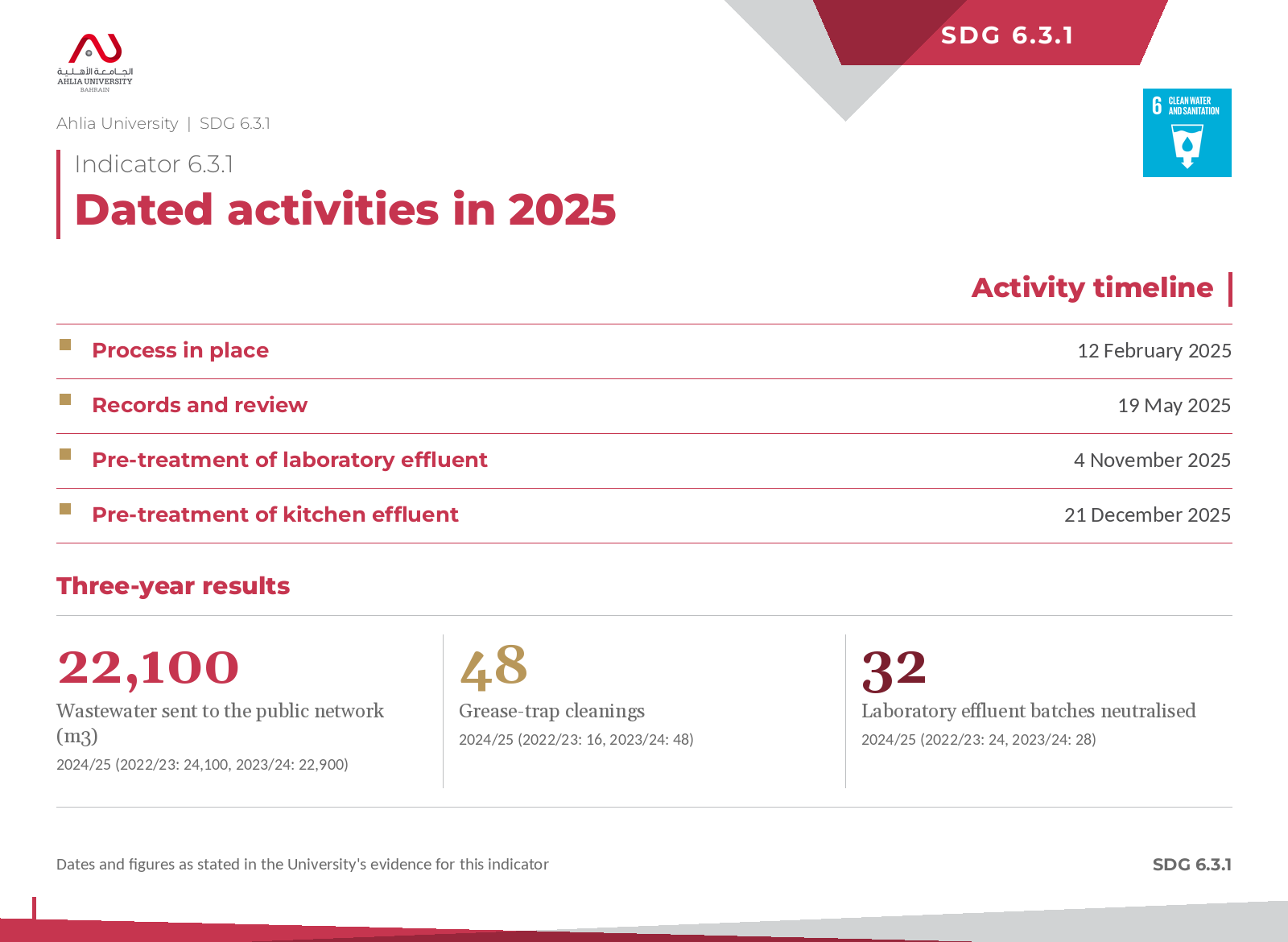
In calendar 2025, which is the 2024/25 column, 22,100 cubic metres (m3) of wastewater went to the public network, which is 91% of the 24,300 m3 of mains water the University used. The grease traps were cleaned 48 times in 2025 and 32 batches of laboratory effluent were neutralised before discharge. Over the three years 2023 to 2025 the premises sent 69,100 m3 to the network.
At a glance
Element of the question
| Process in place | Standing activity or document: Procedure for Discharge to the Public Sewerage Network and Pre-treatment of Kitchen and Laboratory Effluent (Administrative Circular No. 384/2023) Owner: Facilities and Maintenance Latest dated instance in 2025: Annual discharge statement, Wednesday 12 February 2025 Three-year figure: 1 procedure |
|---|---|
| Treatment of the wastewater | Standing activity or document: All wastewater to the public network and the national treatment plants; no discharge of its own Owner: Facilities and Maintenance; the complex operator Latest dated instance in 2025: Monthly volume check, Sunday 21 December 2025 Three-year figure: 69,100 m3 |
| Pre-treatment of kitchen effluent | Standing activity or document: Four grease traps cleaned by a licensed contractor Owner: Facilities and Maintenance; Financial Affairs Directorate Latest dated instance in 2025: Cleaning, Sunday 21 December 2025 Three-year figure: 112 cleanings |
| Pre-treatment of laboratory effluent | Standing activity or document: Neutralisation in the laboratories before discharge, with a batch log Owner: Colleges with laboratories; Facilities and Maintenance Latest dated instance in 2025: Batch of Tuesday 4 November 2025 Three-year figure: 84 batches |
| Records and review | Standing activity or document: Discharge statement and register under Administrative Circular No. 820/2022 Owner: SDG Unit, CAQA Latest dated instance in 2025: Committee review, Monday 19 May 2025 Three-year figure: 3 annual statements |
▪ Evidence for each element is cited in its own section below.
1. The process: connection, procedure and statement
The process is fixed in the Procedure for Discharge to the Public Sewerage Network and Pre-treatment of Kitchen and Laboratory Effluent (Administrative Circular No. 384/2023 of 11 May 2023), issued by the Vice President for Administrative and Financial Affairs and applied by Facilities and Maintenance. It has four steps. First, all drains of the premises, in rest rooms, pantries, the cafeteria and the laboratories, are connected to the sewerage network through the connection of the Gosi Complex, and no drain leads to the storm-water system. Second, kitchen and pantry effluent passes through grease traps and laboratory effluent is neutralised before it reaches the drain. Third, Facilities and Maintenance enters the monthly volume of wastewater in the water register. Fourth, it signs an annual discharge statement that says the University has no discharge of its own. The statement for 2024 was signed and sent to the complex operator on Wednesday 12 February 2025.
The University does not own the building, and the connection to the network belongs to the complex operator. The University therefore documents what it controls, which is the quality of what leaves its drains and the volume that it sends. The Climate Action Policy of the University supports this with practices that keep contaminated runoff out of the drains: no hoses are used to clean floors, debris is brushed and not washed away, and a maintenance team repairs leaks quickly.
▪ Evidence: Administrative Circular No. 384/2023 of 11 May 2023 and the annual discharge statements, Facilities and Maintenance [1]; Climate Action Policy, Water section; Water Management, Reuse and Pollution Prevention Policy [3].
2. Treatment by the public network and the national plants
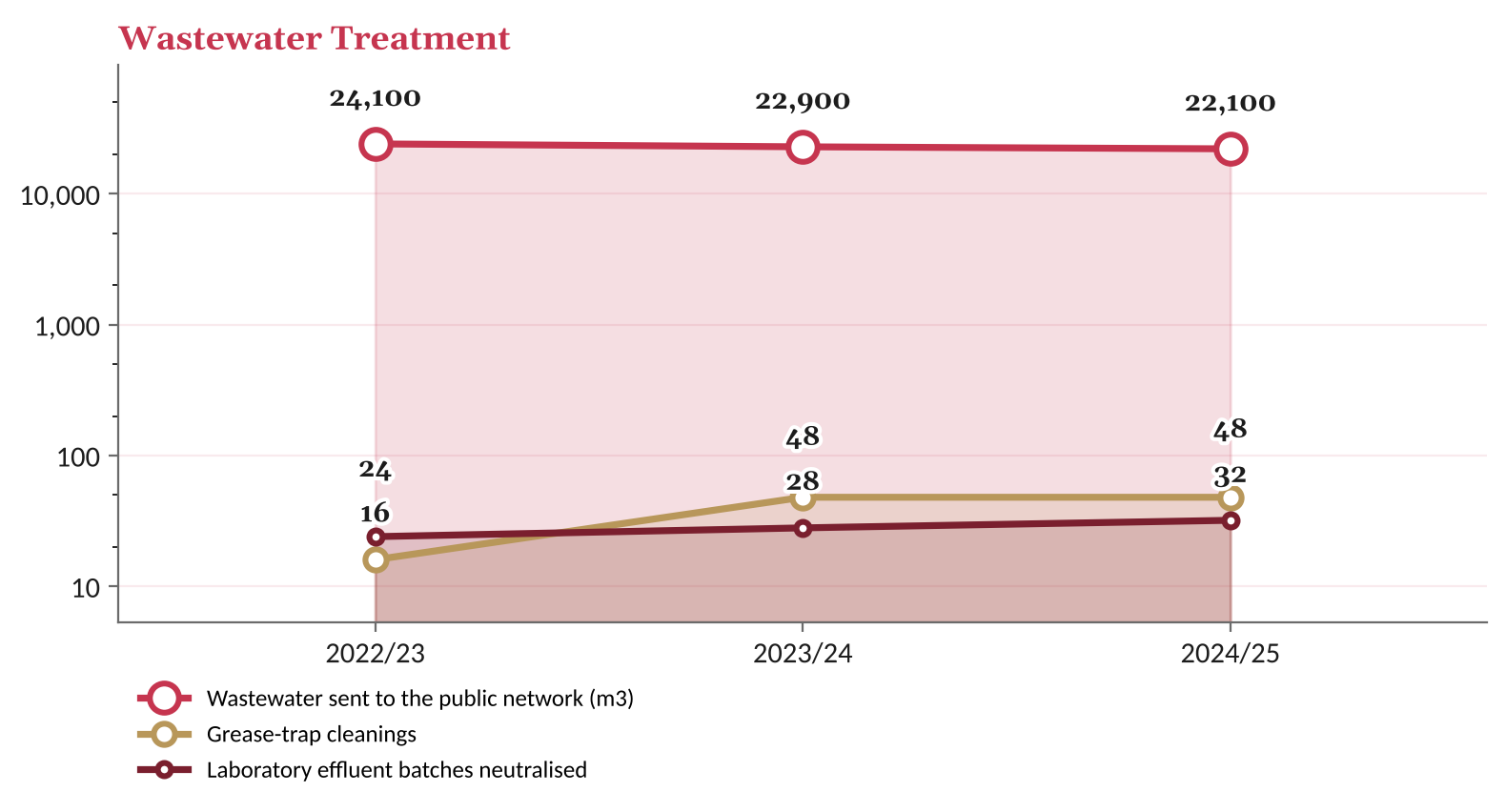
Wastewater that leaves the premises is treated by the national plants, which receive the wastewater of Manama and of the other governorates through the public network. The University does not treat the water itself and does not claim the treatment as its own: it claims the process that makes sure that its wastewater can be treated there, and the measurement of what it sends. The volume sent is the mains volume less the water that is consumed on the premises in irrigation, in cleaning and by evaporation, and less the condensate that is reused. The register gives 24,100 m3 for 2023 (91% of 26,400), 22,900 m3 for 2024 (91% of 25,100) and 22,100 m3 for 2025 (91% of 24,300), which add to 69,100 m3. Facilities and Maintenance checked the 2025 figure each month against the mains readings reported in detail under indicator 6.2.1; the last check was made on Sunday 21 December 2025.
▪ Evidence: water register, monthly wastewater volumes, 2023 to 2025, Facilities and Maintenance [4]; discharge statement of 12 February 2025 [1].
3. Kitchen effluent: grease traps
The cafeteria kitchen, the cafeteria counter and two staff pantries each have a grease trap, four in all. Since January 2024 a licensed contractor, engaged through the Financial Affairs Directorate, cleans each trap every month, and the contractor's service sheet is signed by Facilities and Maintenance. In 2023 the traps were cleaned every quarter, which gave 16 cleanings, and since 2024 the monthly round gives 48 cleanings a year, so that the three years show 16 + 48 + 48 = 112 cleanings. Grease and sludge are taken away by the contractor and are not washed into the drain. The last round of 2025 was made on Sunday 21 December 2025.
▪ Evidence: grease-trap service sheets, 2023 to 2025, Facilities and Maintenance and the Financial Affairs Directorate [1].
4. Laboratory effluent: neutralisation
The laboratories of the College of Engineering, the College of Information Technology and the College of Medical and Health Sciences keep a batch log. Rinse water that may be acid or alkaline is collected in a container at the sink, its acidity is measured with indicator strips and it is neutralised to between pH 6 and 9 before it is poured to the drain. Chemical waste, solvents and reagents are never poured to the drain: a licensed contractor collects them, and the tonnage is reported in detail under indicator 12.2.3. The laboratories neutralised 24 batches in 2023, 28 in 2024 and 32 in 2025, and the last batch of 2025 was recorded on Tuesday 4 November 2025.
▪ Evidence: laboratory batch logs of the three colleges, 2023 to 2025, held by the colleges and Facilities and Maintenance [1].
5. Records and review
The wastewater volumes, the grease-trap sheets and the batch logs are part of the water register under the Sustainability Data Register Procedure (Administrative Circular No. 820/2022 of 13 October 2022), which the SDG Unit within the Centre for Accreditation and Quality Assurance (CAQA) consolidates every quarter. The University Sustainability Committee reviewed the discharge statement and the pre-treatment records on Monday 19 May 2025 and the full-year volume on Monday 8 December 2025. The statement of each year is kept for five years.
▪ Evidence: Administrative Circular No. 820/2022 [4]; University Sustainability Committee minutes, 19 May and 8 December 2025 [5].
Policy basis
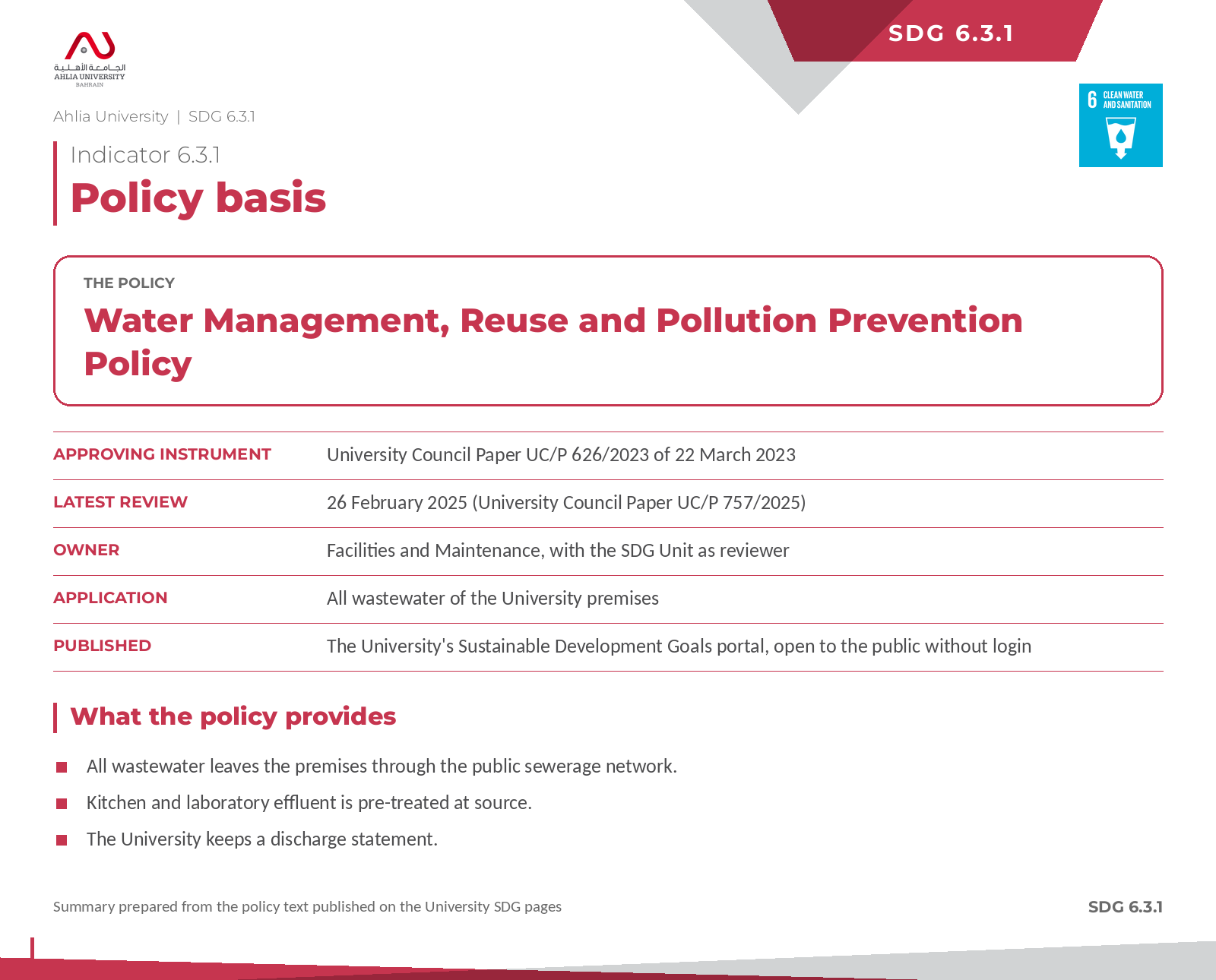
Title: Water Management, Reuse and Pollution Prevention Policy. Approving instrument: University Council Paper UC/P 626/2023 of 22 March 2023, approved on that date and reviewed by University Council Paper UC/P 757/2025 of 26 February 2025. The clause on wastewater requires that all wastewater leave the premises through the public sewerage network, that kitchen and laboratory effluent be pre-treated at source, and that the University keep a discharge statement. The clause is applied through Administrative Circular No. 384/2023 of 11 May 2023, which fixes the four steps of section 1. Owner: Facilities and Maintenance, with the SDG Unit as reviewer. In 2024/25 the policy produced 22,100 m3 of wastewater to the network, 48 grease-trap cleanings and 32 neutralised laboratory batches. It is published on the University's Sustainable Development Goals portal with this indicator.
▪ Evidence: policy text and review record [3]; Administrative Circular No. 384/2023 [1].
Results by academic year
Registers are kept by calendar year, so the 2022/23 column is calendar 2023, the 2023/24 column is 2024 and the 2024/25 column is 2025; the scope is the Gosi Complex premises. Wastewater to the public network is the volume that Facilities and Maintenance records each month. Grease-trap cleanings are the cleanings of the four traps, 4 x 4 = 16 in 2023 and 4 x 12 = 48 in 2024 and 2025. Neutralised laboratory batches are the lines of the batch logs. The three-year volume is 24,100 + 22,900 + 22,100 = 69,100 m3. The share is the volume sent divided by the mains water used: 24,100 / 26,400, 22,900 / 25,100 and 22,100 / 24,300, which are 91% in each year. Percentages are rounded to whole numbers.
| Indicator | 2022/23 | 2023/24 | 2024/25 |
|---|---|---|---|
| Wastewater sent to the public network (m3) | 24,100 | 22,900 | 22,100 |
| Grease-trap cleanings | 16 | 48 | 48 |
| Laboratory effluent batches neutralised | 24 | 28 | 32 |
| Discharges of its own to the sea, ground or storm drains | 0 | 0 | 0 |
| Share of mains water sent to the public network | 91% | 91% | 91% |
▪ Evidence: register, service sheets and batch logs listed in the references [4], [1].
Publication and verification
The evidence for this indicator was approved by University Council Paper UC/P 830/2026 of 14 January 2026 together with the 2025 edition of the SDG reports (University Council Paper UC/P 829/2026 of the same day, published 21 January 2026) and was published on the University's Sustainable Development Goals portal on 28 January 2026, open to the public without login. The underlying registers are held by Facilities and Maintenance, with the SDG Unit within CAQA, and are quoted in the text above.
Evidence and references
- Procedure for Discharge to the Public Sewerage Network and Pre-treatment of Kitchen and Laboratory Effluent, Administrative Circular No. 384/2023 of 11 May 2023; annual discharge statements, grease-trap service sheets and laboratory batch logs, Facilities and Maintenance
- Ahlia University, Climate Action Policy page, Water section (page modified 24 May 2024): water-efficient cleaning machines, mopping only, no hoses, automatic devices in rest rooms, spray irrigation, low-water plants, a maintenance team that fixes leaks quickly https://www.ahlia.edu.bh/climate-action-policy/
- Water Management, Reuse and Pollution Prevention Policy, University Council Paper UC/P 626/2023 of 22 March 2023, reviewed by UC/P 757/2025 of 26 February 2025; owner Facilities and Maintenance
- Sustainability Data Register Procedure, Administrative Circular No. 820/2022 of 13 October 2022; water register kept by Facilities and Maintenance, consolidated each quarter by the SDG Unit, CAQA
- Minutes of the University Sustainability Committee, 17 February, 19 May, 29 September and 8 December 2025 (SDG Unit, CAQA)