Ahlia University (Ahlia), the first private university licensed in the Kingdom of Bahrain, as a body extracts no water from aquifers, lakes, rivers or the sea on its associated grounds, on or off campus, and it has a standard that requires sustainable extraction technologies wherever water might be extracted on those grounds. The University is housed in the Gosi Complex, Exhibition Road, Al-Hoora, Manama, a leased complex of two buildings, and all of the water that it uses, 24,300 cubic metres (m3) in calendar 2025, is metered mains water from the Electricity and Water Authority of the Kingdom of Bahrain (EWA). The Standard for Water Sources and Extraction on University Grounds (University Council Paper UC/P 667/2023 of 27 December 2023) fixes the rule, and every year the University signs a declaration of its extraction points. The declaration of each of the three years is a nil return, so that no extraction technology is installed and none has to be assessed. The year-end reading of the mains meter was made on Wednesday 31 December 2025 and gave 75,800 m3 for the three years.
In 2025 the University withdrew 100% of its water from the public mains, 0 m3 from its own sources, and it held 0 extraction points, as in 2023 and 2024. This indicator reports that position and the rule that keeps it sustainable if it ever changes.
At a glance
Element of the question
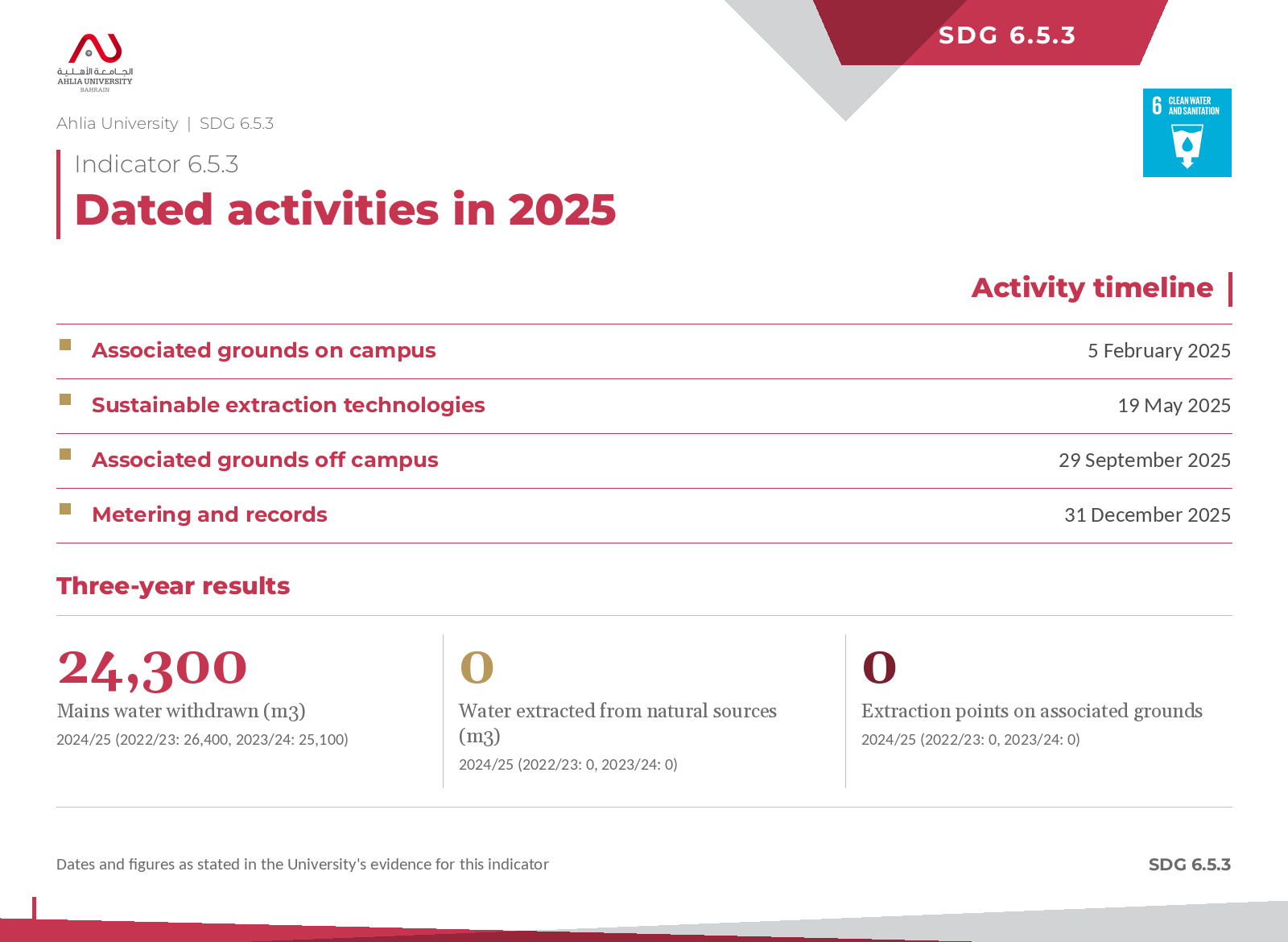
| Water extracted by the University | Standing activity or document: None: no borehole, well, desalination unit, river or lake intake Owner: Facilities and Maintenance Latest dated instance in 2025: Register of water sources, Wednesday 5 February 2025 Three-year figure: 0 m3 extracted |
|---|---|
| Associated grounds on campus | Standing activity or document: Gosi Complex premises: one source, the EWA mains connection Owner: Facilities and Maintenance Latest dated instance in 2025: Annual declaration, Wednesday 5 February 2025 Three-year figure: 3 nil declarations |
| Associated grounds off campus | Standing activity or document: None used; the planned campus in Northern City is at the design stage Owner: Vice President for Administrative and Financial Affairs Latest dated instance in 2025: Committee review, Monday 29 September 2025 Three-year figure: 0 off-campus extraction points |
| Sustainable extraction technologies | Standing activity or document: Standard for Water Sources and Extraction on University Grounds (UC/P 667/2023) Owner: SDG Unit, CAQA; Facilities and Maintenance Latest dated instance in 2025: Committee review, Monday 19 May 2025 Three-year figure: 0 proposals assessed |
| Metering and records | Standing activity or document: All water metered under Administrative Circular No. 820/2022 Owner: SDG Unit, CAQA Latest dated instance in 2025: Year-end reading, Wednesday 31 December 2025 Three-year figure: 75,800 m3 from the mains |
▪ Evidence for each element is cited in its own section below.
1. Where the University's water comes from
The register of water sources, kept by Facilities and Maintenance, lists one source: the mains connection of the Gosi Complex, supplied by EWA and measured by the monthly bills and the floor sub-meters reported in detail under indicator 6.2.1. The University does not run a borehole, a well, a desalination unit, a river or lake intake or a tank filled from a natural source. It also has no right to do so, because it does not own the building and the lease does not give it one. The mains volume was 26,400 m3 in 2023, 25,100 m3 in 2024 and 24,300 m3 in 2025, which is 75,800 m3 in three years and 100% of the water that the University used in each year.
The Climate Action Policy of the University describes the practices through which it keeps its use of this water low, among them efficient cleaning machines, mopping, spray irrigation and the quick repair of leaks. Because the University draws nothing from nature on its own account, the way in which it limits its effect on water sources is to limit its use of mains water and to reuse water, as reported in detail under indicators 6.2.1 and 6.4.2.
▪ Evidence: register of water sources and annual declaration of 5 February 2025, Facilities and Maintenance [1]; EWA monthly bills and sub-meter readings, 2023 to 2025 [2]; Climate Action Policy.
2. The Standard for any extraction
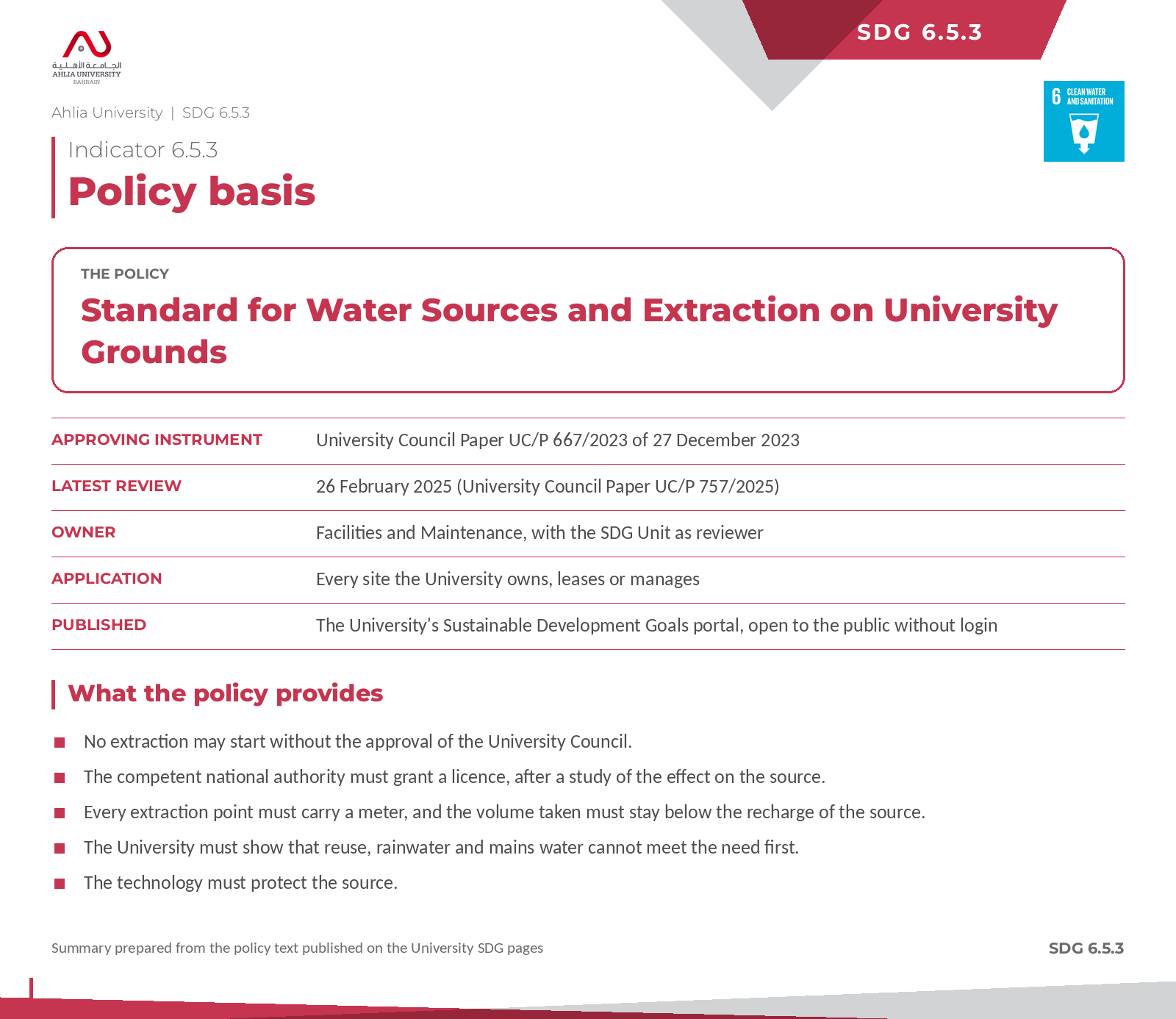
The University did not wait for a plan to extract water before it wrote a rule. The Standard for Water Sources and Extraction on University Grounds (University Council Paper UC/P 667/2023 of 27 December 2023) applies to every site that the University owns, leases or manages, on or off campus, and it sets seven conditions for extracting water from an aquifer, a lake, a river or the sea. First, no extraction may start without the approval of the University Council. Second, the competent national authority must grant a licence. Third, a study of the effect on the source and on neighbouring users must be made before the licence is requested. Fourth, every extraction point must carry a meter. Fifth, the volume taken must stay below the recharge of the source. Sixth, the University must show that reuse, harvesting of rainwater and mains water cannot meet the need first. Seventh, the technology must protect the source: pumps with variable speed and low drawdown, no diversion of surface water through built channels that alters the natural flow, and a monitoring well where groundwater is used.
The Standard is checked every year. Facilities and Maintenance lists the water sources of all associated grounds and signs a declaration that says which extraction points exist. The declaration for 2024 was signed on Wednesday 5 February 2025 and it says that there are none, as in the two earlier years. The University Sustainability Committee reviewed the Standard and the declaration on Monday 19 May 2025.
▪ Evidence: Standard for Water Sources and Extraction on University Grounds, UC/P 667/2023 of 27 December 2023, and the annual declarations, Facilities and Maintenance [1]; Committee minutes, 19 May 2025 [4].
3. Associated grounds off campus: Northern City
The University plans a new campus in Northern City, and the Climate Action Policy states that the campus is designed to consume the minimum quantity of water. The University's report on SDG 6 records rainwater harvesting and recycled water for irrigation and toilets at the design stage. Neither is an extraction from a natural source: they are the reuse of water that has already been supplied. The design brief applies the Standard of 2023, so that a borehole or an intake would need the approval of the University Council and the seven conditions above. No such extraction is planned, and the University reports no volume for the site. The Vice President for Administrative and Financial Affairs reported the brief to the University Sustainability Committee on Monday 29 September 2025.
▪ Evidence: Climate Action Policy; SDG 6 institutional report 2021 to 2025 [5]; Committee minutes, 29 September 2025 [4].
4. Records and the position for the THE questionnaire
The water register of the Sustainability Data Register Procedure (Administrative Circular No. 820/2022 of 13 October 2022) holds the source register and the declarations, and the SDG Unit within the Centre for Accreditation and Quality Assurance (CAQA) consolidates the register every quarter. The University states plainly that it has no extraction on its grounds and therefore no extraction technology to describe. It reports instead the Standard that would govern any extraction and the nil return that shows that none exists.
▪ Evidence: Administrative Circular No. 820/2022 [6].
Policy basis
Title: Standard for Water Sources and Extraction on University Grounds, issued under the Water Management, Reuse and Pollution Prevention Policy (University Council Paper UC/P 626/2023 of 22 March 2023). Approving instrument: University Council Paper UC/P 667/2023 of 27 December 2023, approved on that date and reviewed by University Council Paper UC/P 757/2025 of 26 February 2025. The clauses that answer the question are the seven conditions of section 2, which require Council approval, a licence, an impact study, metering, an abstraction below recharge, the priority of reuse and protective technology. Owner: Facilities and Maintenance, with the SDG Unit as reviewer. In 2024/25 it produced one declaration, a nil return, and no extraction proposal. It is published on the University's Sustainable Development Goals portal with this indicator.
▪ Evidence: Standard text and review record [1], [7].
Results by academic year
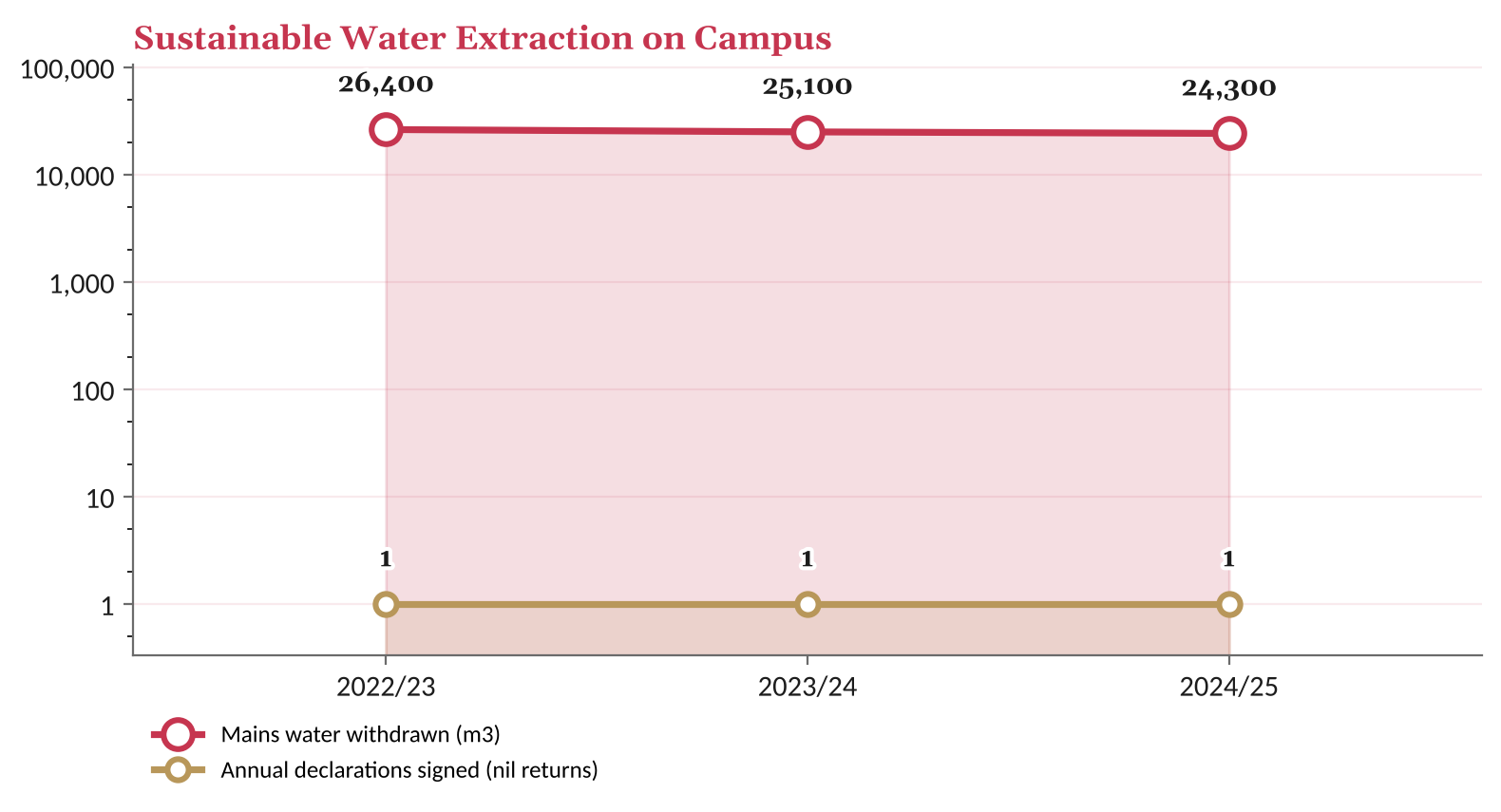
Registers are kept by calendar year, so the 2022/23 column is calendar 2023, the 2023/24 column is 2024 and the 2024/25 column is 2025; the scope is the Gosi Complex premises and any associated ground on or off campus. Mains water withdrawn is the EWA volume reported under indicator 6.2.1, and its three-year sum is 26,400 + 25,100 + 24,300 = 75,800 m3. Water extracted from natural sources is the volume metered at an extraction point, and extraction points are the points listed in the register of water sources; both are zero in each year. Declarations signed are the annual nil returns. The share of water from the public mains is the mains volume divided by all water used, 100% in each year.
| Indicator | 2022/23 | 2023/24 | 2024/25 |
|---|---|---|---|
| Mains water withdrawn (m3) | 26,400 | 25,100 | 24,300 |
| Water extracted from natural sources (m3) | 0 | 0 | 0 |
| Extraction points on associated grounds | 0 | 0 | 0 |
| Annual declarations signed (nil returns) | 1 | 1 | 1 |
| Share of water used that comes from the public mains | 100% | 100% | 100% |
▪ Evidence: register of water sources, declarations and EWA bills listed in the references [1], [2].
Publication and verification
The evidence for this indicator was approved by University Council Paper UC/P 830/2026 of 14 January 2026 together with the 2025 edition of the SDG reports (University Council Paper UC/P 829/2026 of the same day, published 21 January 2026) and was published on the University's Sustainable Development Goals portal on 28 January 2026, open to the public without login. The underlying registers are held by Facilities and Maintenance, with the SDG Unit within CAQA, and are quoted in the text above.
Evidence and references
- Standard for Water Sources and Extraction on University Grounds, University Council Paper UC/P 667/2023 of 27 December 2023; register of water sources and annual declarations (nil returns), Facilities and Maintenance
- Electricity and Water Authority monthly bills for the Gosi Complex premises, 2023 to 2025, and the operator's sub-meter readings, 2024 and 2025, Facilities and Maintenance
- Ahlia University, Climate Action Policy page, Water section (page modified 24 May 2024): water-efficient cleaning machines, mopping only, no hoses, automatic devices in rest rooms, spray irrigation, low-water plants, a maintenance team that fixes leaks quickly https://www.ahlia.edu.bh/climate-action-policy/
- Minutes of the University Sustainability Committee, 17 February, 19 May, 29 September and 8 December 2025 (SDG Unit, CAQA)
- Ahlia University, SDG 6 Clean Water and Sanitation institutional report 2021 to 2025 (Sustainable Development Goals pages, page of 17 November 2024)
- Sustainability Data Register Procedure, Administrative Circular No. 820/2022 of 13 October 2022; water register kept by Facilities and Maintenance, consolidated each quarter by the SDG Unit, CAQA
- Water Management, Reuse and Pollution Prevention Policy, University Council Paper UC/P 626/2023 of 22 March 2023, reviewed by UC/P 757/2025 of 26 February 2025; owner Facilities and Maintenance