Ahlia University (Ahlia), the first private university licensed in the Kingdom of Bahrain, delivers, as a body, projects to record and preserve intangible cultural heritage such as local folklore, traditions, language and knowledge, and it claims two of the three options of the question: local or regional cultural heritage and national cultural heritage. It does not claim heritage of displaced communities. Its main project is the Bahrain Living Heritage Recording Project, run by the College of Arts and Science with the Library and ICT Centre, which records interviews with residents of Manama and craftspeople, transcribes them and keeps them in the Library archive; it is joined by public sessions such as the symposium on the financial heritage of a Bahraini banker held on 30 April 2025 and by the call for research on Gulf folklore of 30 November 2024. The project is governed by the Cultural Heritage Recording and Archiving Policy (University Council Paper UC/P 618/2023 of 25 January 2023).
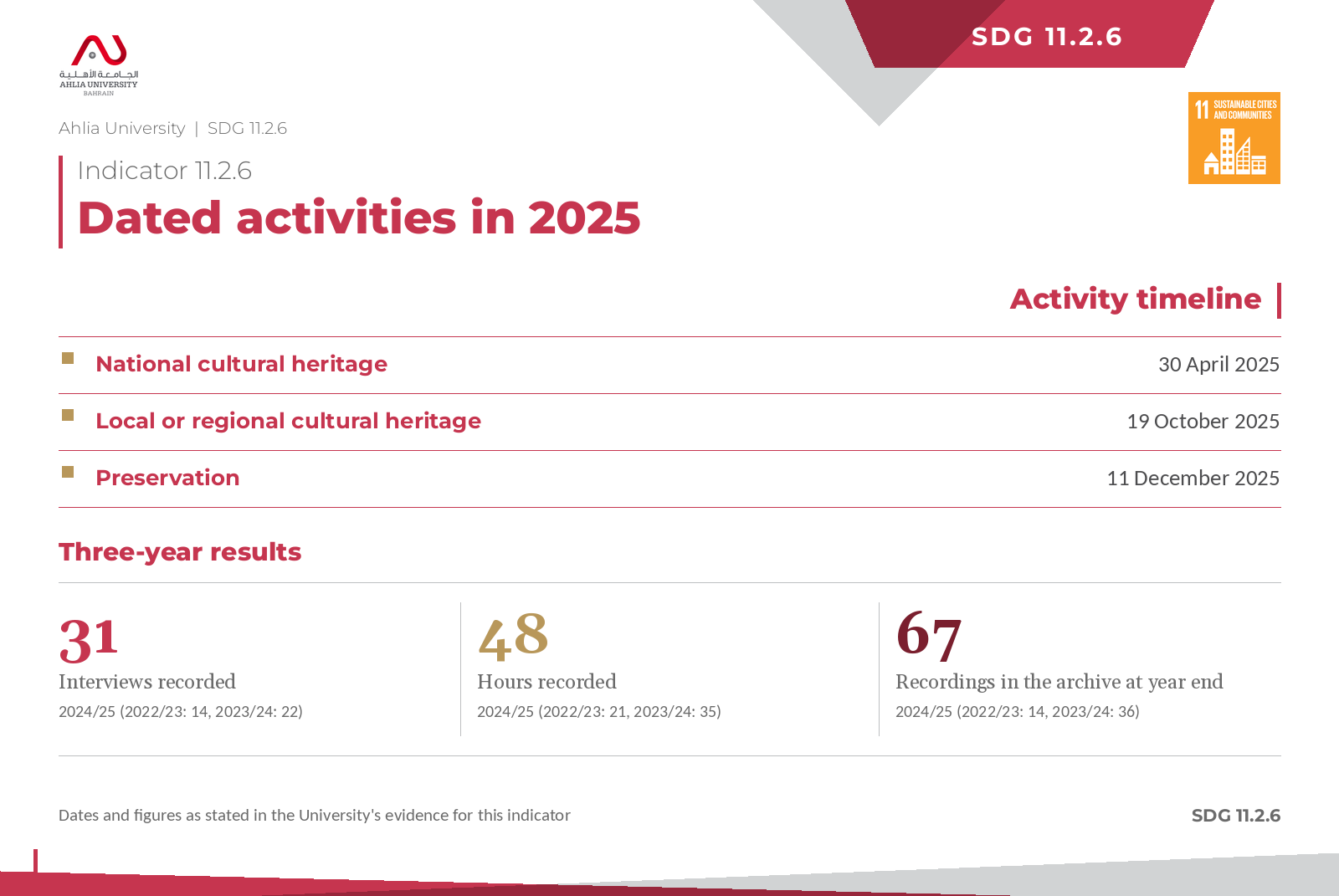
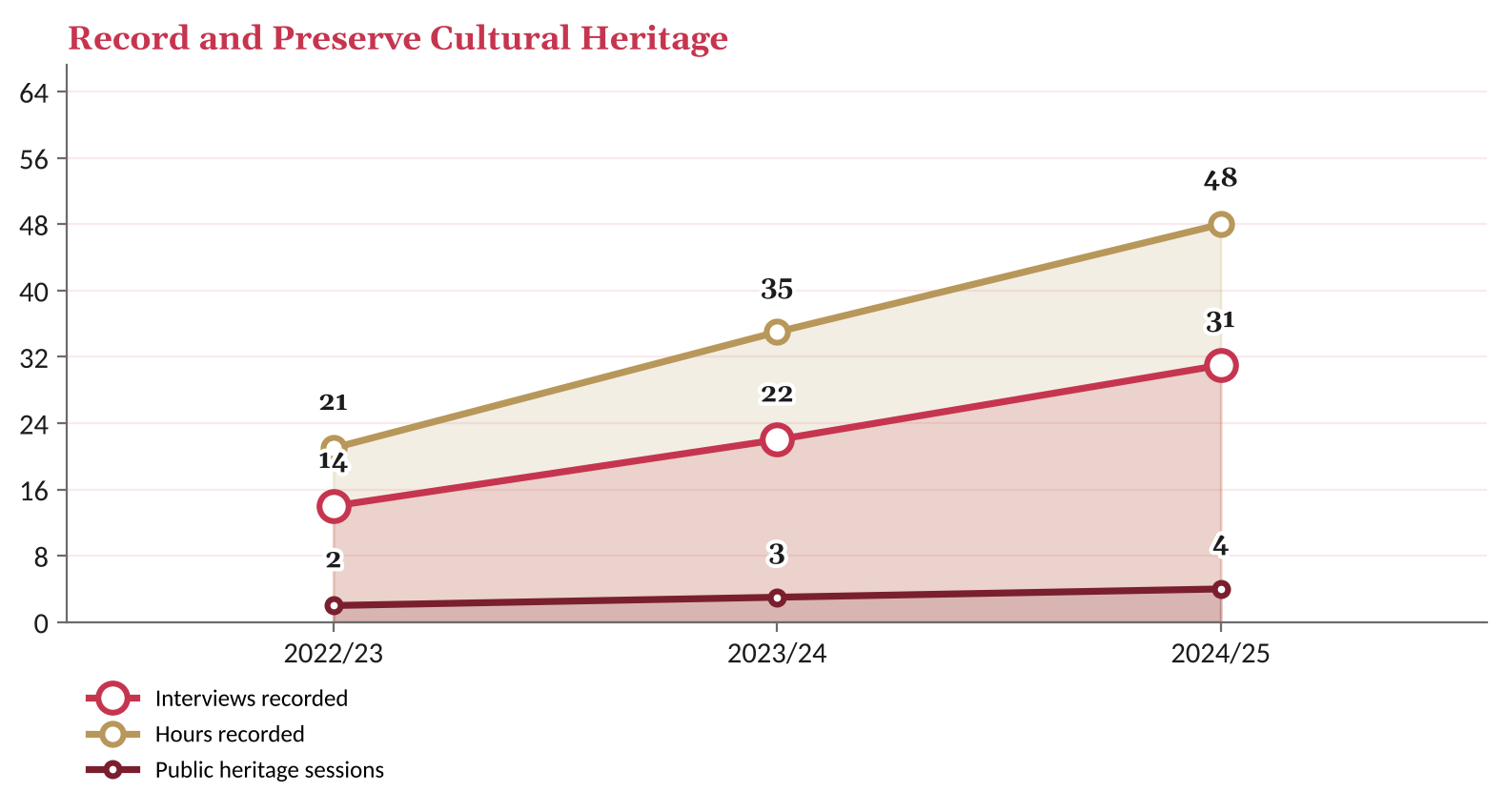
In calendar-year registers read as academic years 2022/23, 2023/24 and 2024/25, the project recorded 14, 22 and 31 interviews (67 in all) amounting to 21, 35 and 48 hours (104 in all), of which 8, 12 and 17 concerned local or regional heritage and 6, 10 and 14 national heritage; the Library archive held 14, 36 and 67 recordings at the end of the years, 10, 18 and 28 of them transcribed in the years; and 2, 3 and 4 public heritage sessions were held (9 in all).
At a glance: projects to record and preserve intangible heritage
Element of the question
| Local or regional cultural heritage | Project or activity: Interviews on Manama neighbourhoods, crafts, proverbs and songs; research on Gulf folklore Owner: College of Arts and Science; Library and ICT Centre Latest dated instance in 2025: Recording day, Sunday 19 October 2025 Three-year figure: 37 interviews |
|---|---|
| National cultural heritage | Project or activity: Interviews and sessions on Bahraini civilisation and national knowledge Owner: College of Arts and Science; Community Engagement Committee Latest dated instance in 2025: Symposium on financial heritage, Wednesday 30 April 2025 Three-year figure: 30 interviews; 9 public sessions |
| Preservation | Project or activity: Library archive with transcripts and catalogue records Owner: Library and ICT Centre Latest dated instance in 2025: Transcripts completed, Thursday 11 December 2025 Three-year figure: 67 recordings in the archive |
▪ Evidence for each element is cited in its own section below.
1. Local or regional cultural heritage
The Bahrain Living Heritage Recording Project asks residents, craftspeople and older members of the community to talk about the life of Manama's neighbourhoods, traditional crafts, proverbs, songs and the Bahraini dialect. Students of the College of Arts and Science do the interviews in pairs under a member of staff, each interviewee signs a consent form that states how the recording will be kept and used, and the audio is stored in the Library archive. Interviews on local or regional heritage were 8 in 2022/23, 12 in 2023/24 and 17 in 2024/25 (37 in all). On 30 November 2024 the University published a call for research on Gulf folklore with the researcher Ali Abdulla Khalifa, which invites studies of the folklore of the Gulf region, and the project's recording days of 2025 were held on Sunday 26 January, Tuesday 13 May and Sunday 19 October [1].
▪ Evidence: interview register and consent forms, College of Arts and Science, 2023 to 2025; the University's notice of 30 November 2024 [1].
2. National cultural heritage
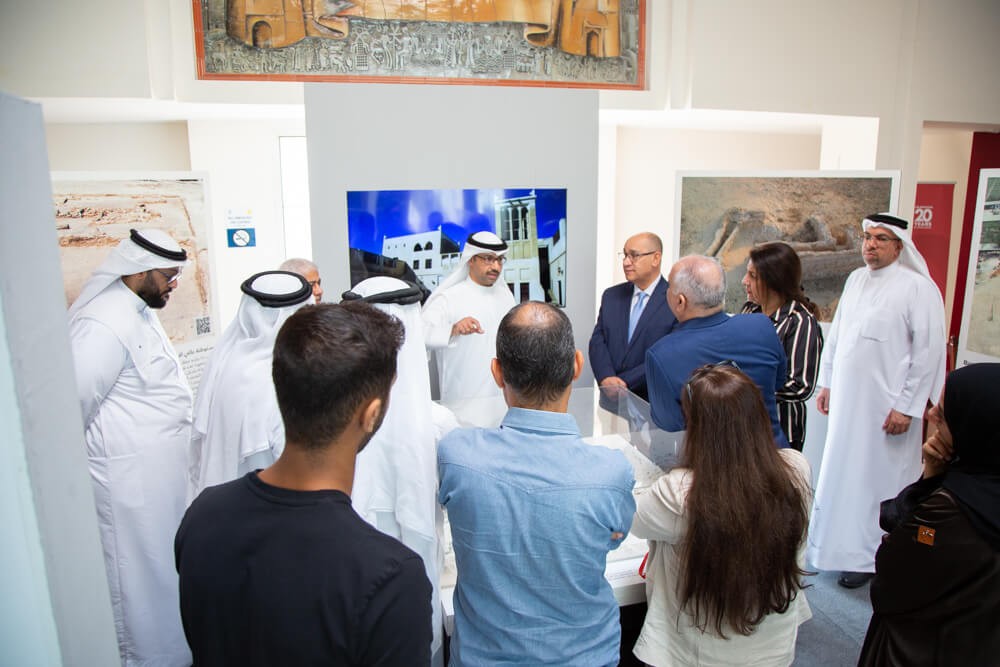
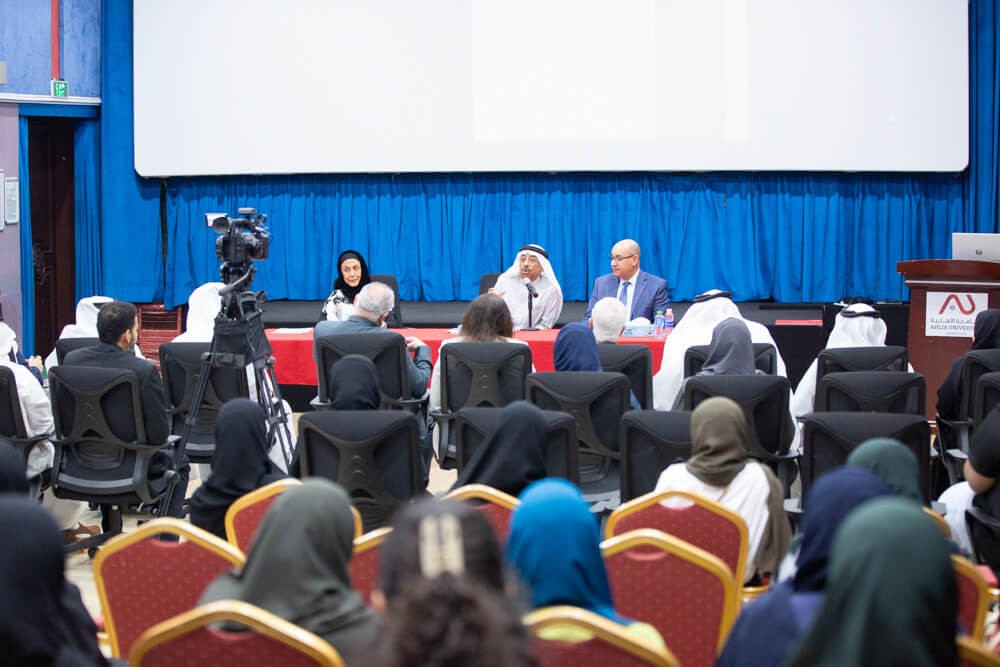
National heritage is recorded in two ways. The first is the interviews on national crafts, history and knowledge, which were 6 in 2022/23, 10 in 2023/24 and 14 in 2024/25 (30 in all). The second is public sessions that bring national heritage onto the campus and into the record. The exhibition Features from Bahrain's Civilization, held at Ahlia from 11 November 2023 for one week in cooperation with the Bahrain Authority for Culture and Antiquities, presented artefacts and lectures on Bahraini civilisation, with a lecture by Dr Salman Al Mahari. On Wednesday 30 April 2025 the University held a symposium honouring Adnan Yousef's financial heritage, which documented his leadership of Al Baraka Banking Group from 2004 to 2020, a period in which the group's assets passed USD 40 billion (about BD 15 billion), it had more than 700 branches and it provided more than 13,200 jobs. The proceedings of the symposium were recorded and filed in the archive. Public heritage sessions numbered 2, 3 and 4, among them the sessions of Tuesday 20 May, Tuesday 11 November and Thursday 27 November 2025 [2].
▪ Evidence: news items on the exhibition of November 2023 and the symposium of 30 April 2025; session register, Community Engagement Committee, 2023 to 2025 [3].
3. Preservation and access
Recording is not preservation unless the material is kept. The Library and ICT Centre receives each recording with its consent form, stores two copies on separate servers, writes a catalogue record with the interviewee, place, date, topic and language, and asks the interviewing students to deliver a transcript. The archive held 14 recordings at the end of 2022/23, 36 at the end of 2023/24 and 67 at the end of 2024/25. Transcripts completed were 10, 18 and 28 in the years, which is 71%, 82% and 90% of the interviews recorded. The last transcripts of 2025 were closed on Thursday 11 December 2025. Interviewees who consented may be heard in the Library on request, and the University reports the project to the Community Engagement Committee each year.
▪ Evidence: archive catalogue and transcript register, Library and ICT Centre, 2023 to 2025 [1].
4. Displaced communities
The University has not carried out a project on the heritage of displaced communities and does not claim that option.
▪ Evidence: Cultural Heritage Recording and Archiving Policy and interview register, which list no project on displaced communities [1].
Policy basis
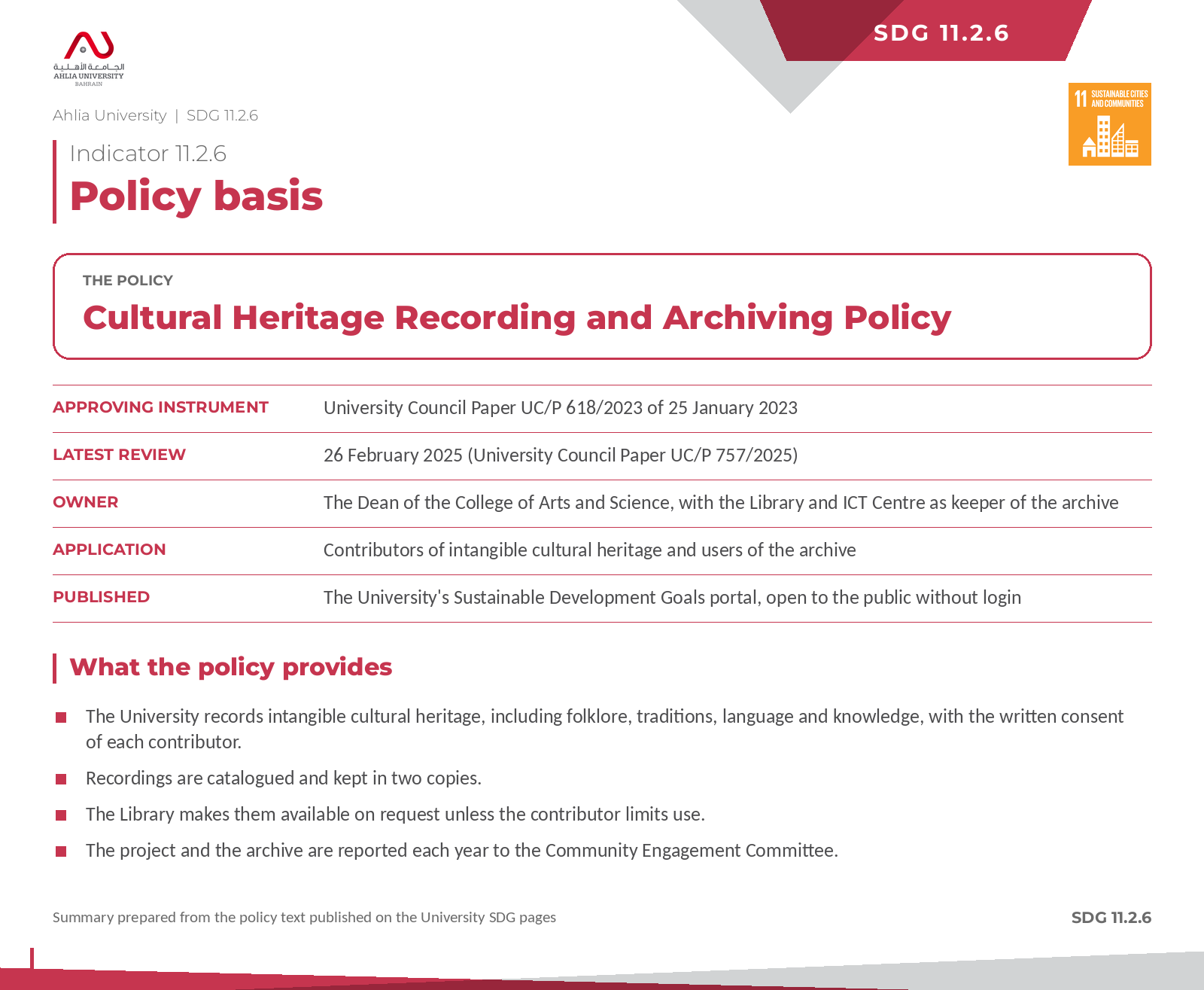
Title: Cultural Heritage Recording and Archiving Policy. Approving instrument: University Council Paper UC/P 618/2023 of 25 January 2023, approved on that date and reviewed by University Council Paper UC/P 757/2025 of 26 February 2025. Owner: the Dean of the College of Arts and Science, with the Library and ICT Centre as keeper of the archive. The clauses that answer the question state that the University records intangible cultural heritage, including folklore, traditions, language and knowledge, with the written consent of each contributor; that recordings are catalogued and kept in two copies; that the Library makes them available on request unless the contributor limits use; and that the project and the archive are reported each year to the Community Engagement Committee. Application in 2024/25: 31 interviews and 67 recordings in the archive. It is published on the University's Sustainable Development Goals portal with this document.
Results by academic year
Interviews recorded counts interviews with contributors entered in the interview register in the calendar year (2023, 2024 and 2025 read as 2022/23, 2023/24 and 2024/25): 8 + 6 = 14, 12 + 10 = 22 and 17 + 14 = 31, which is 67 in all; hours recorded are the recorded time (21 + 35 + 48 = 104). Recordings in the archive is the stock at the end of the year (14, 14 + 22 = 36 and 36 + 31 = 67). Public heritage sessions counts the sessions open to the public (2 + 3 + 4 = 9). The share transcribed is the interviews transcribed in the year divided by the interviews recorded in it (10 of 14, 18 of 22 and 28 of 31).
| Indicator | 2022/23 | 2023/24 | 2024/25 |
|---|---|---|---|
| Interviews recorded | 14 | 22 | 31 |
| Hours recorded | 21 | 35 | 48 |
| Recordings in the archive at year end | 14 | 36 | 67 |
| Public heritage sessions | 2 | 3 | 4 |
| Interviews transcribed in the year | 71% | 82% | 90% |
Publication and verification
This document, which is the University's evidence for indicator 11.2.6 and is kept by the College of Arts and Science, with the Library and ICT Centre, was approved by University Council Paper UC/P 830/2026 of 14 January 2026 together with the 2025 edition of the SDG reports (University Council Paper UC/P 829/2026 of the same day, published 21 January 2026) and published on the University's Sustainable Development Goals portal on 28 January 2026, open to the public without login. The underlying registers, the interview register, the consent forms, the archive catalogue and the session register, are held by the College of Arts and Science, with the Library and ICT Centre and are quoted in the text above.
Evidence and references
- Interview register, consent forms, archive catalogue and transcript register, College of Arts and Science and Library and ICT Centre, 2023 to 2025; Cultural Heritage Recording and Archiving Policy, University Council Paper UC/P 618/2023 of 25 January 2023, reviewed by UC/P 757/2025 of 26 February 2025 (text only)
- Ahlia University news item: Adnan Yousef symposium, 30 April 2025; news item on the exhibition Features from Bahrain's Civilization, reported 12 November 2023 https://www.ahlia.edu.bh/adnan-yousef-symposium/
- Session register, Community Engagement Committee, 2023 to 2025 (text only)