


Ahlia University, a private university in Manama, Kingdom of Bahrain, as a body informs and supports local government in local climate change disaster and risk early warning and monitoring, at the Local level. Since President's Decision No. 145/2025 of 10 February 2025 it runs the Campus Climate Monitoring and Early Warning Service, which records heat, humidity and dust at three points of the Gosi Complex, sends a quarterly bulletin to the Capital Governorate and sends an early report when a reading passes a set threshold. It does not claim the Regional level.
In 2024/25 the Service sent 2 quarterly bulletins and 3 early reports to the Governorate, on the basis of 203 days of readings. The two earlier years show 0, because the Service began on 10 February 2025. The Sustainable Development Goals are written SDGs.
At a glance
Element
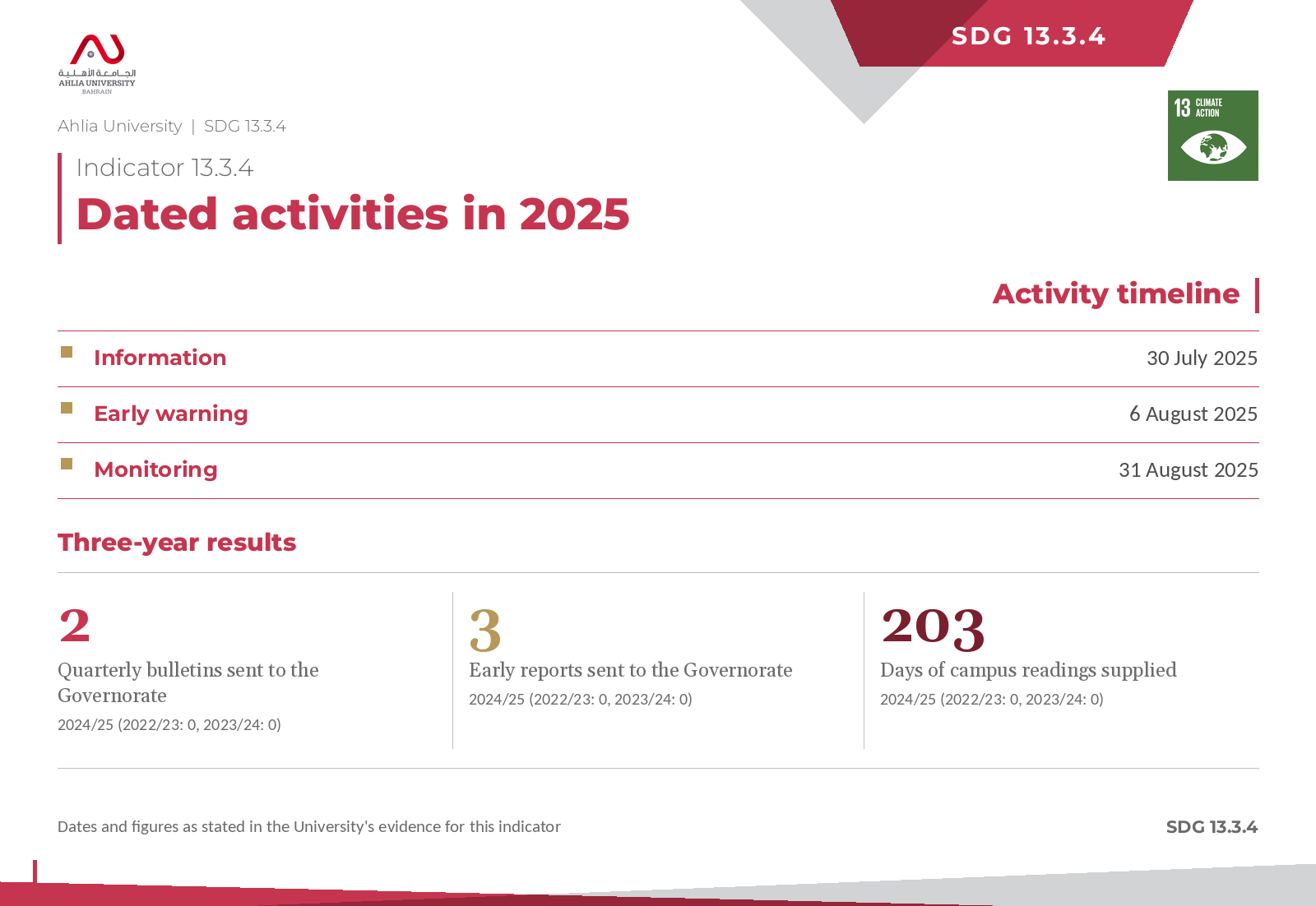
| Monitoring | Standing provision: Readings of temperature, humidity and dust from three points of the campus, every 15 minutes, kept in a register Owner: Facilities and Maintenance; SDG Unit within CAQA Latest dated instance in 2025: Readings from Monday 10 February to Sunday 31 August 2025 (203 days) Three-year figure: 203 days of readings |
|---|---|
| Information | Standing provision: Quarterly bulletin to the Capital Governorate: highest readings, days above 40 degrees, comparison with the governorate's own readings Owner: Facilities and Maintenance Latest dated instance in 2025: Bulletin of Wednesday 30 July 2025 Three-year figure: 2 bulletins |
| Early warning | Standing provision: Early report to the Governorate's duty officer when a threshold is passed (heat index above 45, or dust above the set limit) Owner: Facilities and Maintenance Latest dated instance in 2025: Early report of Wednesday 6 August 2025 Three-year figure: 3 early reports |
▪ Each row is developed below with its evidence.
1. Monitoring on campus
President's Decision No. 145/2025 puts the Service under the head of Facilities and Maintenance, with the College of Engineering as technical adviser and the SDG Unit within the Centre for Accreditation and Quality Assurance (CAQA) as keeper of the register. Three sensors record temperature, humidity and dust every 15 minutes: one on the roof terrace, one in the main entrance hall and one in the car park. The readings are checked each month against a reference instrument and the register is kept for five years. The same readings drive the University's own response set in its Campus Climate Emergency and Resilience Plan (UC/P 754/2025 of 22 January 2025), which is reported under indicator 13.3.3.
Monitoring is also a teaching resource. Students of the College of Engineering use the register for a yearly project on urban heat, and their results are given to Facilities and Maintenance for the next bulletin. The sensors cost BD 1,350 in all, paid from the Facilities and Maintenance budget, and the yearly running cost, mainly the monthly check, is BD 400.
▪ Evidence: President's Decision No. 145/2025 and register of readings [1]; Campus Climate Emergency and Resilience Plan [2].
2. Bulletins and early reports to the Capital Governorate
The bulletin of Wednesday 30 April 2025 covered February to April and the bulletin of Wednesday 30 July 2025 covered May to July. Each states the highest and the average readings, the number of days above 40 degrees and the days of dust above the limit, and compares them with the governorate's published readings for the same days. In the first bulletin the campus was 1.2 degrees warmer on average at midday than the governorate's station; the Governorate asked for the roof-terrace readings to be kept separate so that it could use them as a measure of urban heat, and the University now does so.
Early reports go by e-mail and telephone to the duty officer of the Governorate when a threshold is passed. The three of 2024/25 were sent on Wednesday 4 June 2025 (dust), Tuesday 8 July 2025 (heat index above 45) and Wednesday 6 August 2025 (heat index above 45). Each went within one hour of the reading, and the first after-hours contact was added to the plan after the table-top exercise of 20 February 2025 (indicator 13.3.3).
The thresholds were set with the College of Engineering from the University's own readings and from the warning levels that the national weather authority publishes. A heat index above 45 means that outdoor work and sport are unsafe; a dust reading above the limit means that people with asthma should stay indoors. The University does not issue public warnings itself. It passes its readings to the Governorate, which decides what to tell residents, and it uses the thresholds only to close its own roof terrace and car park walkways and to move classes online.
The bulletins and the early reports were reviewed with the duty officer of the Governorate at the University on Wednesday 3 September 2025 (counted in 2025/26), after the register of 203 days had closed on Sunday 31 August 2025. The review checked the register of readings against the two bulletins and found 58,080 valid readings of the 58,464 expected from three sensors over 203 days, which is 99%; the missing 384 readings came from 4 days in June when the car park sensor lost power. The duty officer asked that each bulletin add one page with a map of the three points and the unit of each reading, and the University agreed to add it from the next bulletin. The notes of the review are kept with the acknowledgements.
▪ Evidence: bulletins of 30 April and 30 July 2025, early reports and the Governorate's acknowledgements [3].
3. A channel that the University already uses with government
The University already shares findings with government bodies. Its page on SDG 14 states that its water-quality research findings were shared with the Electricity and Water Authority and contributed to discussions on improving effluent treatment to protect coastal waters. The Government and Policy Engagement Protocol (UC/P 742/2024 of 25 December 2024) applies the same rules to climate data: each bulletin is approved by the Executive Director for Strategy, Sustainability and Quality, states the data it rests on, and is summarised on the University's Sustainable Development Goals portal. The policy inputs on energy of 2025 are reported under indicator 7.4.4.
▪ Evidence: SDG 14 page of the University's website; Protocol [5].
Policy basis
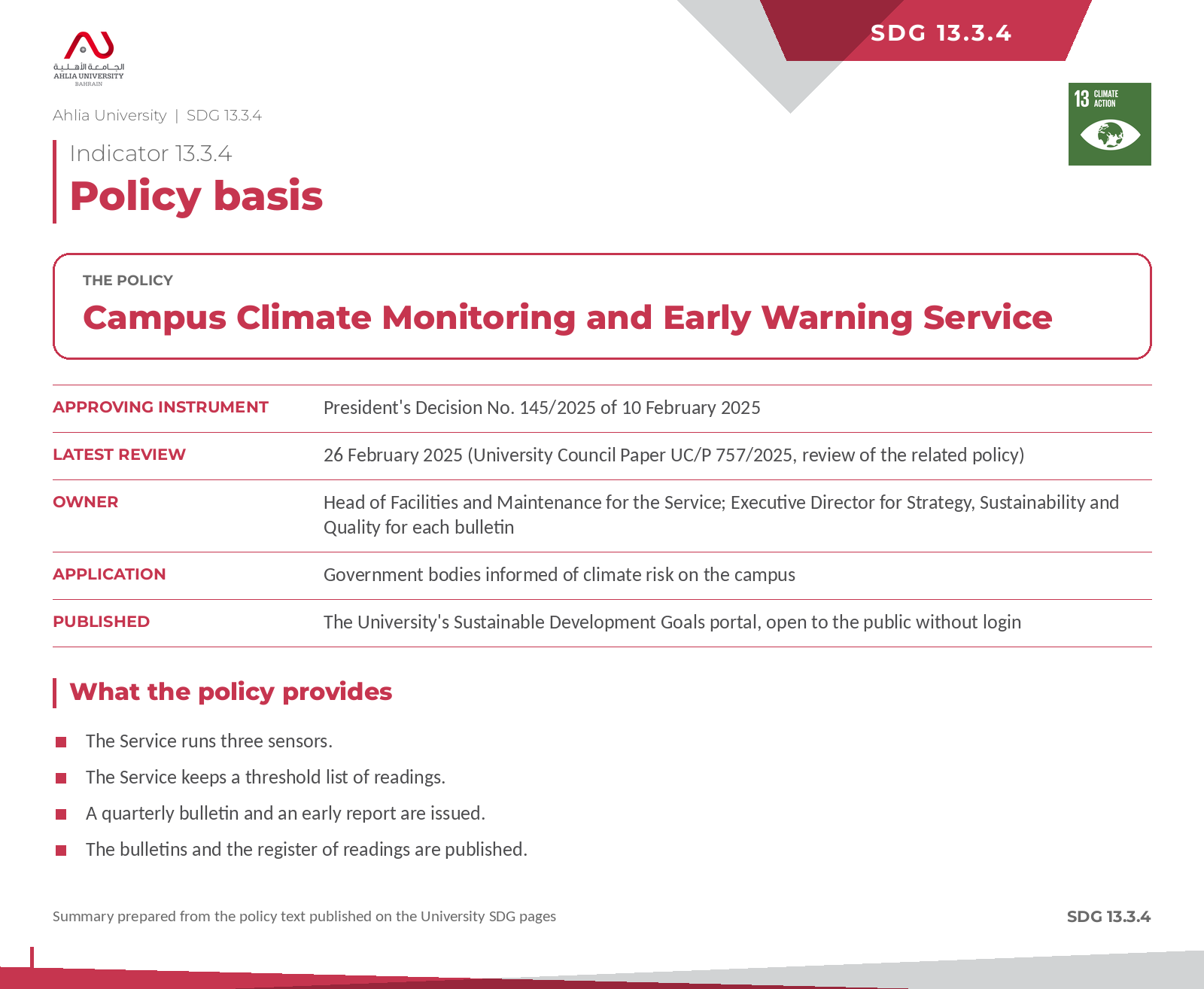
Scheme: Campus Climate Monitoring and Early Warning Service, President's Decision No. 145/2025 of 10 February 2025. Policies: Government and Policy Engagement Protocol, UC/P 742/2024 of 25 December 2024; Campus Climate Emergency and Resilience Plan, UC/P 754/2025 of 22 January 2025; Climate Action Plan 2025 to 2030 and Carbon Neutrality Commitment, UC/P 733/2024 of 27 November 2024; Stakeholder Engagement and Public Disclosure Policy, UC/P 590/2022 of 28 September 2022, reviewed by UC/P 757/2025 of 26 February 2025. Owner: the head of Facilities and Maintenance for the Service, the Executive Director for Strategy, Sustainability and Quality for each bulletin. Application: three sensors, a threshold list, a quarterly bulletin and an early report. Publication: the bulletins and the register of readings are published on the University's Sustainable Development Goals portal.
▪ Evidence: decision and policy papers [1] [5].
Results by academic year
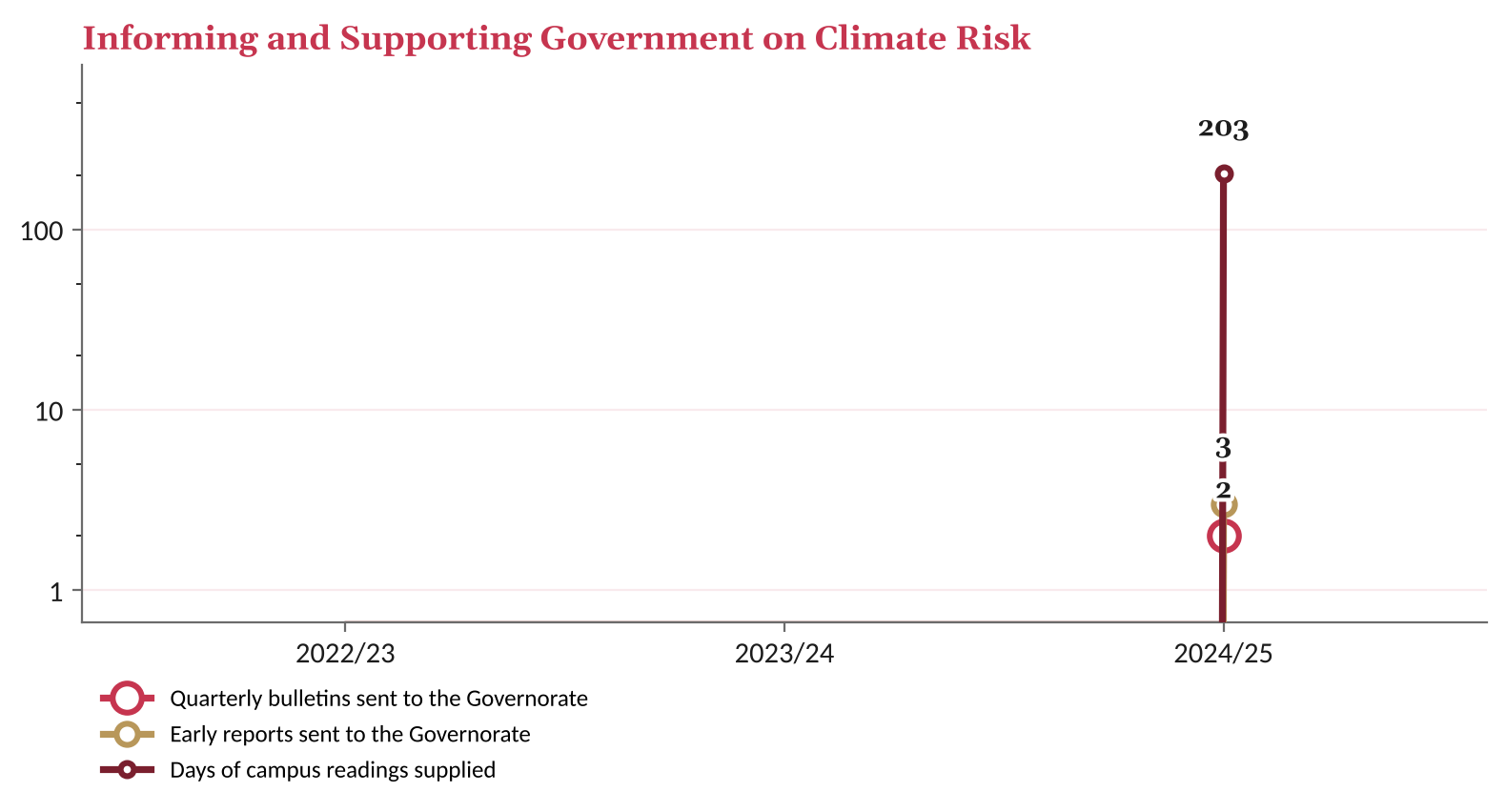
Bulletins and early reports are the items sent to the Governorate in the academic year of their date. Days of readings are the days of the register that were supplied to the Governorate with a bulletin: 203 days from 10 February to 31 August 2025. The earlier years show 0 because the Service began in 2024/25.
| Indicator | 2022/23 | 2023/24 | 2024/25 |
|---|---|---|---|
| Quarterly bulletins sent to the Governorate | 0 | 0 | 2 |
| Early reports sent to the Governorate | 0 | 0 | 3 |
| Days of campus readings supplied | 0 | 0 | 203 |
▪ Evidence: bulletins and early reports [3]; register of readings [1].
Publication and verification
This document, which is the University's evidence for indicator 13.3.4 and is kept by the head of Facilities and Maintenance, was approved by University Council Paper UC/P 830/2026 of 14 January 2026 together with the 2025 edition of the SDG reports (University Council Paper UC/P 829/2026 of the same day, published 21 January 2026) and published on the University's Sustainable Development Goals portal on 28 January 2026, open to the public without login. The underlying registers, which are the decision, the register of readings, the bulletins, the early reports and the acknowledgements, are held by the SDG Unit within CAQA and are quoted in the text above.
Evidence and references
- President's Decision No. 145/2025 (Campus Climate Monitoring and Early Warning Service); register of readings from 10 February 2025
- University Council Papers UC/P 754/2025 and UC/P 733/2024; Campus Climate Emergency and Resilience Plan
- Facilities and Maintenance: bulletins of 30 April and 30 July 2025; early reports of 4 June, 8 July and 6 August 2025; acknowledgements of the Capital Governorate
- Ahlia University: SDG 14 page (findings shared with the Electricity and Water Authority) https://www.ahlia.edu.bh/sustainable-development-goals/sdg-14/
- University Council Papers UC/P 742/2024, UC/P 590/2022 and UC/P 757/2025