
Ahlia University (Ahlia), the first private university licensed in the Kingdom of Bahrain, as a body has a policy to ensure that food on campus that comes from aquatic ecosystems is sustainably harvested. The policy is the Sustainable Procurement, Food and Ethical Sourcing Policy (University Council Paper UC/P 649/2023 of 20 September 2023), applied to fish and shellfish by the Cafeteria Seafood Sourcing Standard (Administrative Circular No. 949/2024 of Thursday 21 November 2024). The University does not catch or farm fish; all food on its premises is served by one licensed catering operator under contract, so the policy works through what the University lets its operator buy. Seafood may come only from licensed suppliers who sign a declaration of species, origin and method, species listed as threatened by the competent Bahraini authority are excluded, and closed seasons and legal sizes are respected. Facilities and Maintenance owns the Standard, and the Financial Affairs Directorate enforces it in the contract.
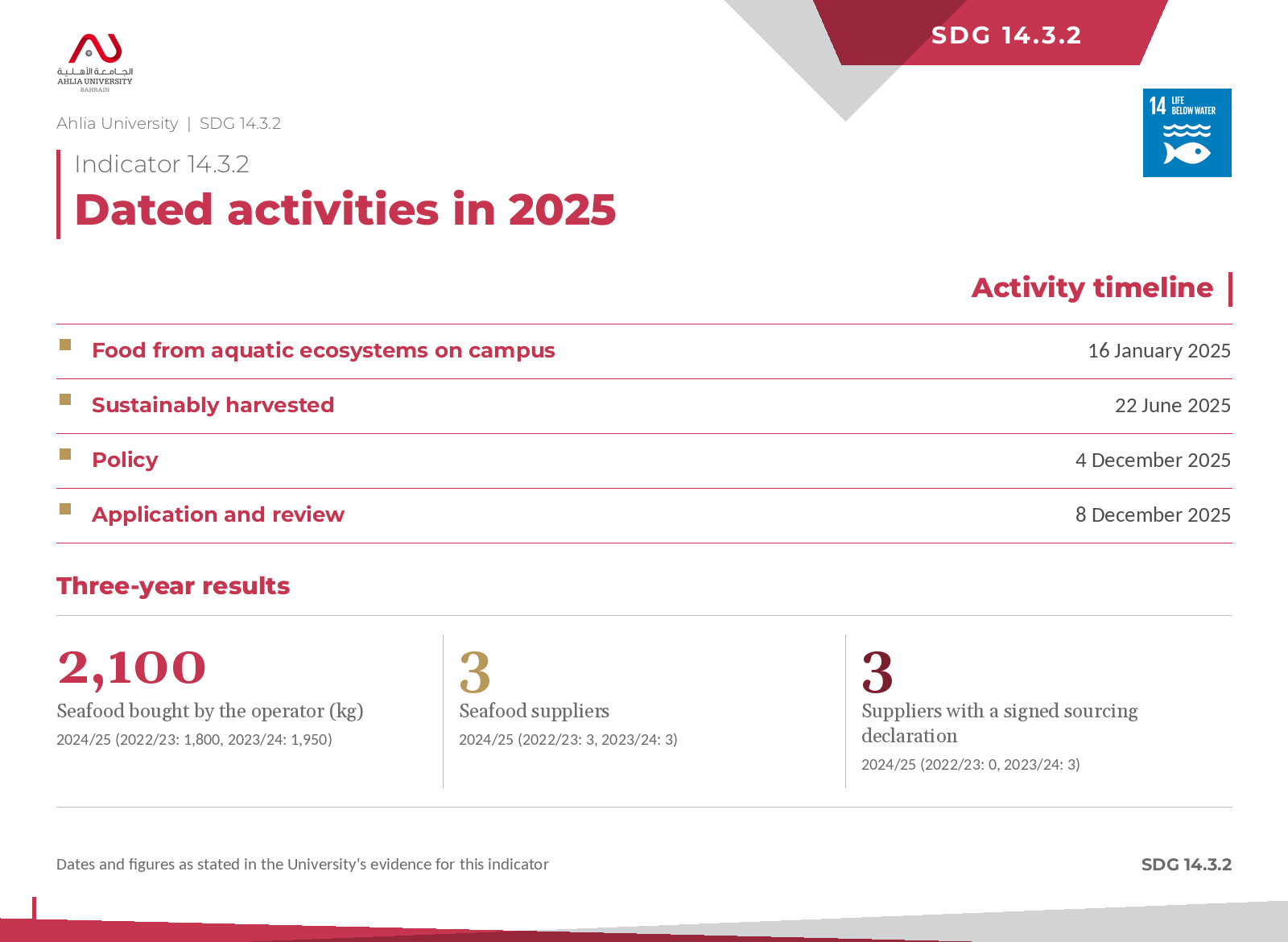
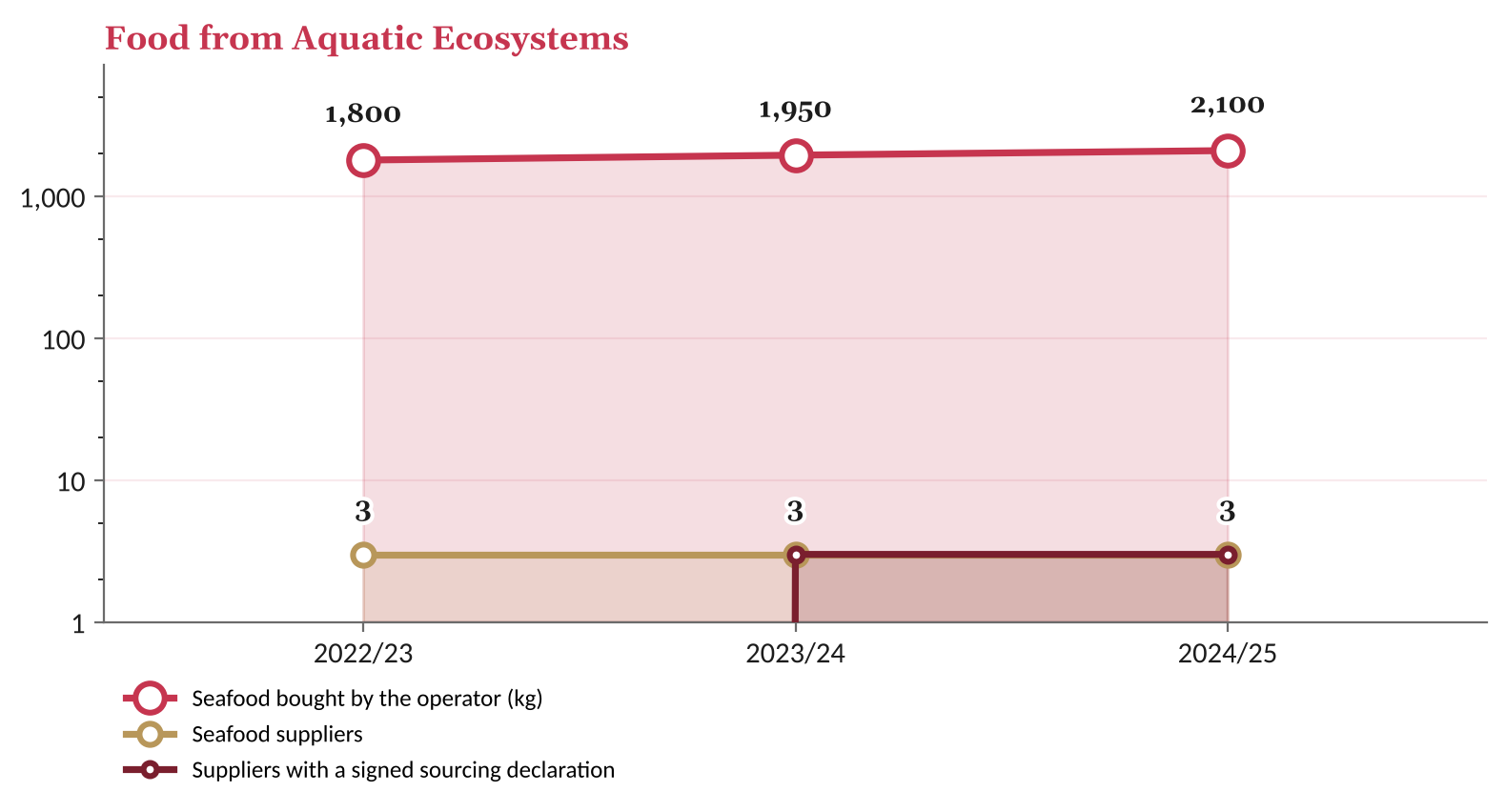
In calendar 2025, which is the 2024/25 column, the operator bought 2,100 kg of seafood from 3 suppliers, all 3 held a signed declaration, 100% of the seafood by weight came from declared suppliers, and the lists were checked 3 times against the national list of threatened species. The Standard took effect in December 2024, when the three suppliers signed, and 6% of the 1,950 kg bought in 2024 came from declared suppliers; the three years hold 1,800 + 1,950 + 2,100 = 5,850 kg of seafood.
At a glance
Element of the question
| Policy | Standing activity or document: Sustainable Procurement, Food and Ethical Sourcing Policy; Cafeteria Seafood Sourcing Standard Owner: Facilities and Maintenance; Financial Affairs Directorate Latest dated instance in 2025: Check of the suppliers' lists, Thursday 4 December 2025 Three-year figure: 2 instruments |
|---|---|
| Food from aquatic ecosystems on campus | Standing activity or document: Fish and shellfish dishes in the cafeteria and the Food Court, bought by the licensed catering operator Owner: Catering operator; Facilities and Maintenance Latest dated instance in 2025: Declarations renewed Thursday 16 January 2025; 2,100 kg bought in 2025 Three-year figure: 5,850 kg |
| Sustainably harvested | Standing activity or document: Signed declaration of species, origin and method from each supplier; no species listed as threatened; closed seasons and legal sizes Owner: Facilities and Maintenance Latest dated instance in 2025: Declarations in force for 3 of 3 suppliers; check of Sunday 22 June 2025 Three-year figure: 3 declarations |
| Application and review | Standing activity or document: Menu information, three list checks a year, review by the University Sustainability Committee Owner: Facilities and Maintenance; SDG Unit within CAQA Latest dated instance in 2025: Review, Monday 8 December 2025 Three-year figure: 3 checks in 2025 |
▪ Evidence for each element is cited in its own section below.
1. Food from aquatic ecosystems on the premises
The University serves food at three outlets in the Gosi Complex: the cafeteria, the Food Court on the second floor and the coffee and snack counter. One licensed catering operator runs all three under contract, and the operator is the only buyer of food for the premises, as the Standard for Food Outlets on the Premises records. Fish and shellfish appear on the menu of the cafeteria and the Food Court, and the operator bought 1,800 kg in 2023, 1,950 kg in 2024 and 2,100 kg in 2025 from 3 suppliers each year. The University has no kitchen of its own that buys outside the operator. Its public Procurement / Purchasing Policy, with the documents on purchasing and the Procurement section of the Climate Action Policy, already ask for sustainable procurement and life-cycle thinking; the Standard states what this means for fish and shellfish.
▪ Evidence: purchase register of the catering operator and Facilities and Maintenance, 2023 to 2025 [1]; Procurement / Purchasing Policy page; Climate Action Policy page.
2. The Standard: what the operator must do
The Cafeteria Seafood Sourcing Standard (Administrative Circular No. 949/2024 of Thursday 21 November 2024), issued by the Vice President for Administrative and Financial Affairs, has seven rules. Seafood is bought only from suppliers licensed to sell it. Species listed as threatened by the competent Bahraini authority are never bought or served. Fish below the legal size, or taken in a closed season, is not bought. Every supplier signs a declaration with the species, the area of origin, whether it was wild or farmed and the method of catch or farming, and every invoice carries the species and the origin. Where a supplier can show a recognised third-party certificate for responsible fishing or farming, its product is preferred. The menu shows the species and the origin of each fish dish. A supplier that breaks a rule is suspended until it corrects the fault.
▪ Evidence: Cafeteria Seafood Sourcing Standard and the contract schedule of the catering operator, Facilities and Maintenance and Financial Affairs Directorate [4].
3. Species excluded: the national list
The Standard uses one reference for species: the list of species that the competent Bahraini authority has listed as threatened. Facilities and Maintenance checks the suppliers' lists and the menu against the current list three times a year, in January, June and December. The checks of 2025 were made on Thursday 16 January 2025, Sunday 22 June 2025 and Thursday 4 December 2025; none of the species bought was on the list, and the three checks add to 3. The University does not draw up its own list of species and does not claim any survey of fish stocks.
▪ Evidence: check sheets of 16 January, 22 June and 4 December 2025, Facilities and Maintenance [4].
4. Supplier declarations
The operator accepted the Standard as a schedule to its contract on Thursday 12 December 2024, and the three suppliers signed their declarations by Thursday 19 December 2024. Each declaration is one page and lists the species supplied, the area, wild or farmed, the method, the licence of the supplier and a promise to tell the operator of any change. The purchases from declared suppliers were 120 kg of the 1,950 kg bought in 2024, which is 6%, and the whole 2,100 kg of 2025, which is 100%. Declarations are renewed each January; those of 2025 were renewed on Thursday 16 January 2025.
▪ Evidence: signed declarations of the three suppliers and the contract schedule, Financial Affairs Directorate and Facilities and Maintenance [4].
5. Information to diners and review
Each fish dish on the menu of the cafeteria and the Food Court carries its species and origin, and the Sustainability Club checks the menu cards during its spot audits. The University Sustainability Committee reviewed the Standard and the checks on Monday 8 December 2025. The guidance given to the public on buying fish sustainably, which uses the same national list, is reported in detail under indicator 14.2.3.
▪ Evidence: menu cards and audit notes of the Sustainability Club, 2025; minutes of the University Sustainability Committee, 8 December 2025 [5].
Policy basis
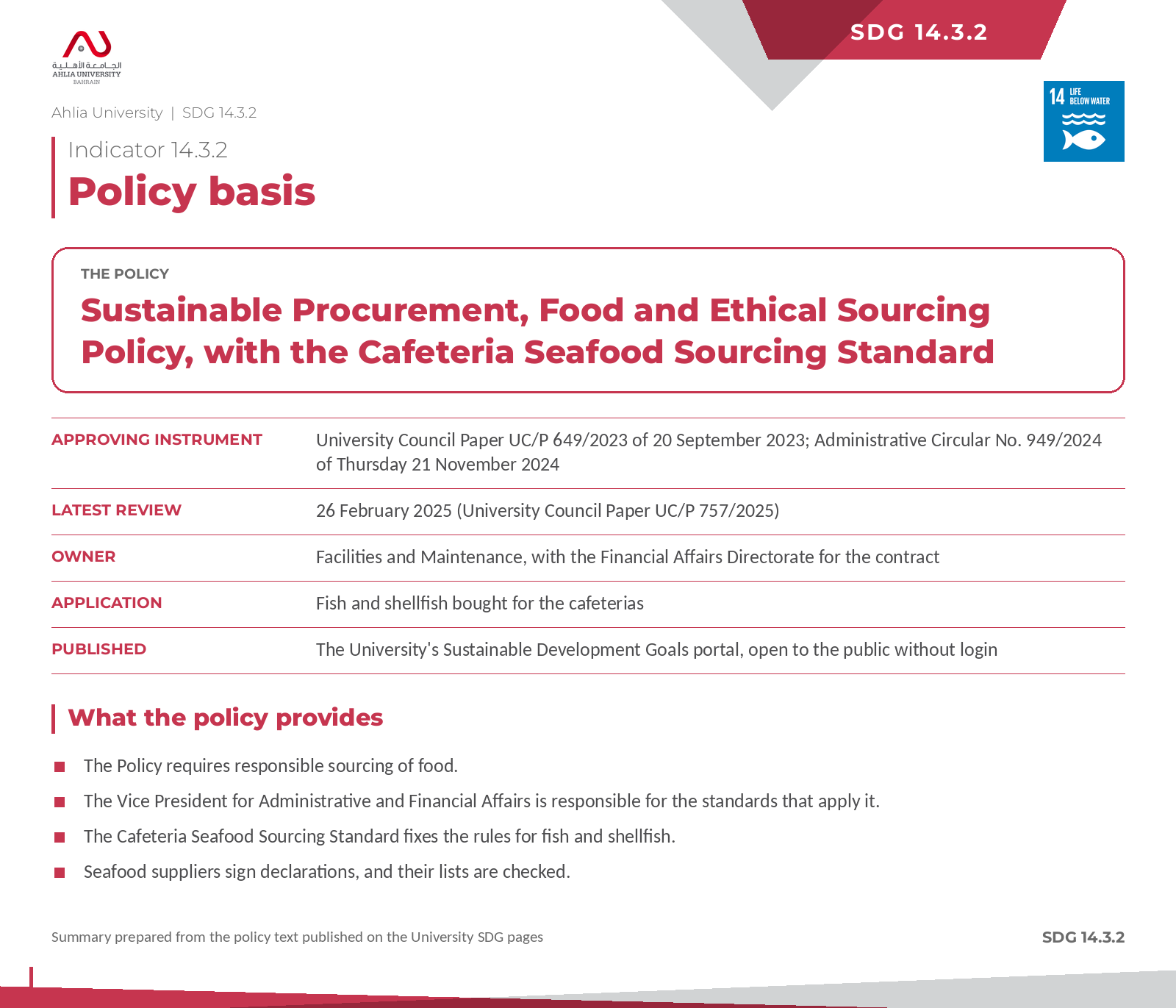
Title: Sustainable Procurement, Food and Ethical Sourcing Policy. Approving instrument: University Council Paper UC/P 649/2023 of 20 September 2023, approved on that date and reviewed by University Council Paper UC/P 757/2025 of 26 February 2025; it is built on the University's published Procurement / Purchasing Policy. Its clause on food requires responsible sourcing of food and makes the Vice President for Administrative and Financial Affairs responsible for the standards that apply it. The standard for fish and shellfish is the Cafeteria Seafood Sourcing Standard, Administrative Circular No. 949/2024 of Thursday 21 November 2024, which fixes the seven rules of section 2. Owner: Facilities and Maintenance, with the Financial Affairs Directorate for the contract. In 2024/25 it produced 3 signed declarations, 3 list checks and 100% of seafood by weight from declared suppliers. It is published on the University's Sustainable Development Goals portal with this document.
▪ Evidence: policy text and review record [6]; Standard [4].
Results by academic year
Registers are kept by calendar year, so the 2022/23 column is calendar 2023, the 2023/24 column is 2024 and the 2024/25 column is 2025; the scope is the three outlets of the Gosi Complex. Seafood bought is the weight on the purchase register, 1,800 + 1,950 + 2,100 = 5,850 kg in three years. Suppliers are those that sold seafood in the year. Suppliers with a declaration are those holding a signed declaration at the end of the year. The share is the weight bought from declared suppliers divided by the weight bought: 0 / 1,800, 120 / 1,950 and 2,100 / 2,100. Percentages are rounded to whole numbers.
| Indicator | 2022/23 | 2023/24 | 2024/25 |
|---|---|---|---|
| Seafood bought by the operator (kg) | 1,800 | 1,950 | 2,100 |
| Seafood suppliers | 3 | 3 | 3 |
| Suppliers with a signed sourcing declaration | 0 | 3 | 3 |
| Seafood bought from declared suppliers | 0% | 6% | 100% |
▪ Evidence: purchase register, declarations and check sheets listed in the references [1], [4].
Publication and verification
This document, which is the University's evidence for indicator 14.3.2 and is kept by Facilities and Maintenance, with the SDG Unit within CAQA, was approved by University Council Paper UC/P 830/2026 of 14 January 2026 together with the 2025 edition of the SDG reports (University Council Paper UC/P 829/2026 of the same day, published 21 January 2026) and published on the University's Sustainable Development Goals portal on 28 January 2026, open to the public without login. The underlying registers, which are the purchase register of the catering operator, the signed declarations of the three suppliers, the check sheets and the menu cards, are held by Facilities and Maintenance and the Financial Affairs Directorate and are quoted in the text above.
Evidence and references
- Seafood purchase register of the catering operator, signed declarations of the three suppliers, check sheets and menu cards, 2023 to 2025, Facilities and Maintenance and Financial Affairs Directorate
- Ahlia University, Procurement / Purchasing Policy page (documents SM11 Purchasing Policy and ES4 Purchasing Policy and Procedures; page modified 28 April 2025) https://www.ahlia.edu.bh/procurement-purchasing-policy/
- Ahlia University, Climate Action Policy page (page modified 24 May 2024): the University Policy on Healthy Environment, the Environmental Policy and the University Policy on Efficient Use of Paper are named there; water-efficient cleaning machines, automatic flush devices, spray irrigation, low-water plants and waste collected in separate containers by specialised waste management companies https://www.ahlia.edu.bh/climate-action-policy/
- Cafeteria Seafood Sourcing Standard, Administrative Circular No. 949/2024 of Thursday 21 November 2024, issued by the Vice President for Administrative and Financial Affairs; contract schedule of the catering operator
- Minutes of the University Sustainability Committee, 8 December 2025 (SDG Unit, CAQA)
- Sustainable Procurement, Food and Ethical Sourcing Policy, University Council Paper UC/P 649/2023 of 20 September 2023, reviewed by UC/P 757/2025 of 26 February 2025; owner Facilities and Maintenance