
Ahlia University (Ahlia), the first private university licensed in the Kingdom of Bahrain, as a body has processes in place to prevent polluted water entering the water system, including pollution caused by accidents and incidents at the University. The University is housed in the Gosi Complex, Exhibition Road, Al-Hoora, Manama, a leased complex of two buildings. Its processes are written in the Water Pollution Prevention and Spill Response Procedure (University Council Paper UC/P 641/2023 of 24 May 2023). They cover prevention in daily operations (cleaning practice, safe storage of chemicals, protection of drains), the response to accidents and incidents (spill kits, a call and report chain, an incident register) and the training of the staff who handle chemicals, oil and cleaning products.
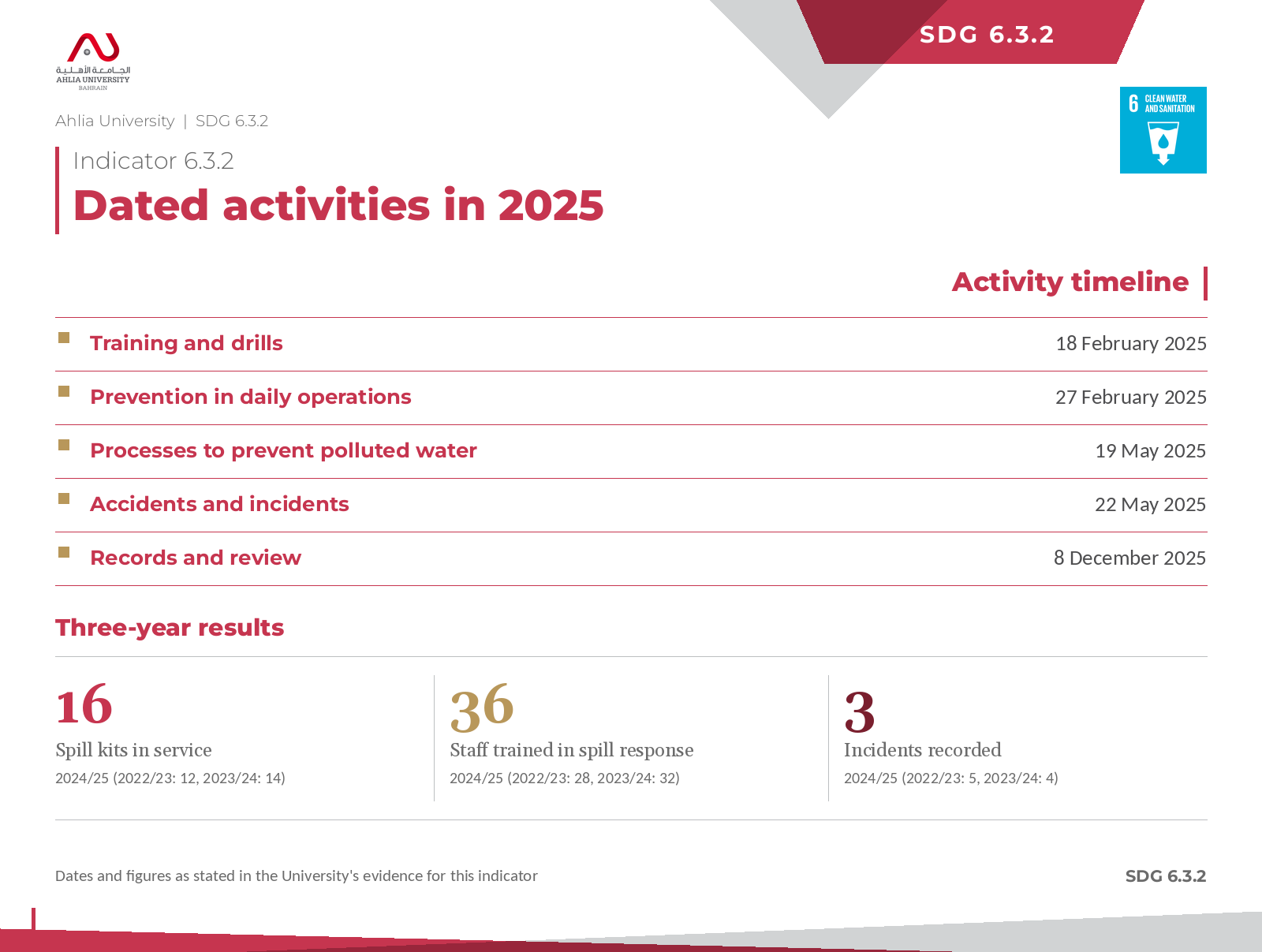
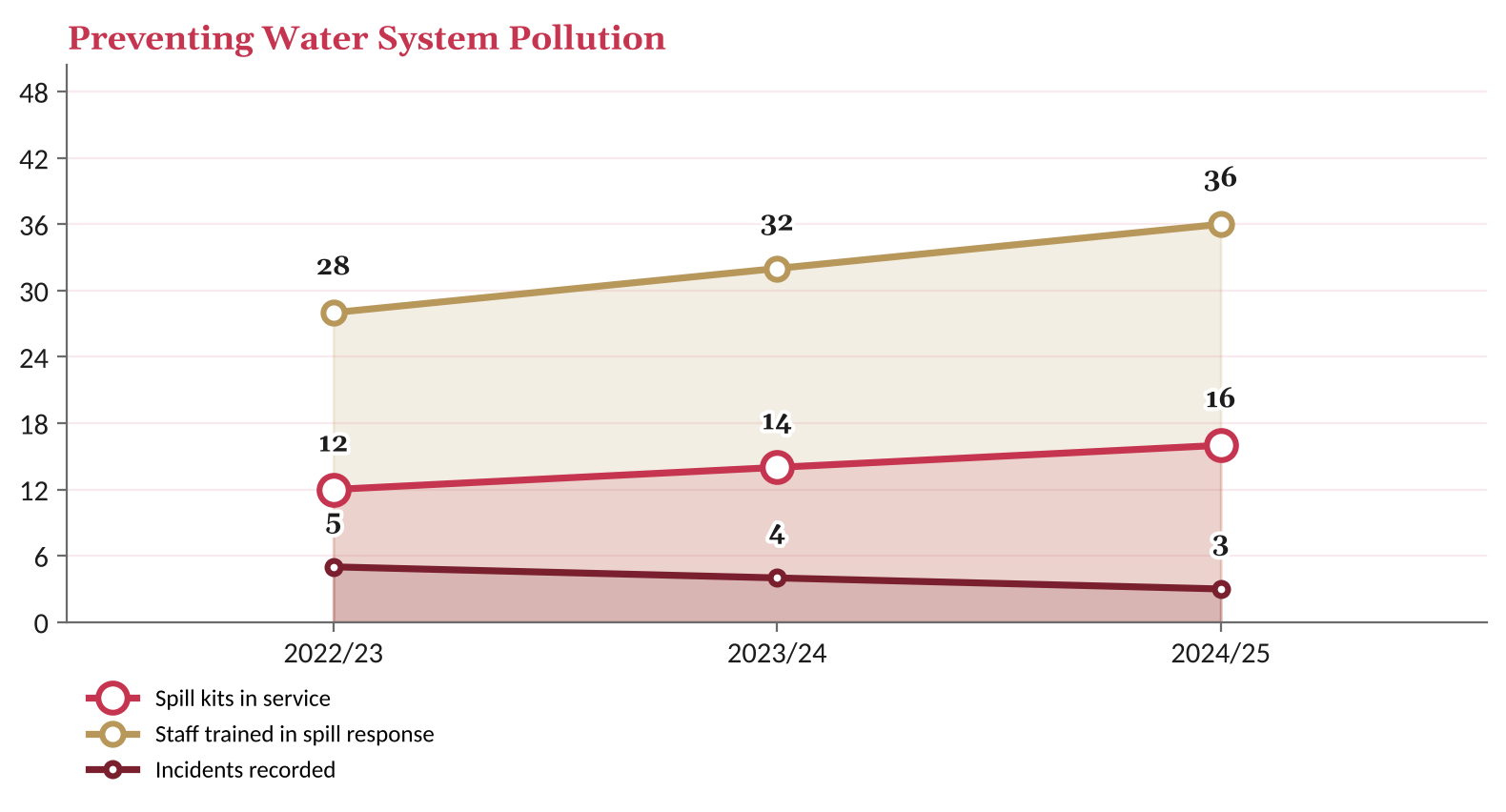
In calendar 2025, which is the 2024/25 column, the University recorded 3 minor incidents, against 5 in 2023 and 4 in 2024, and all three were contained at the place where they happened: none reached a drain or the public network. It held 16 spill kits at the end of 2025, and 36 staff were trained in 2025. Over the three years the register holds 12 incidents and none of them polluted the water system.
At a glance
Element of the question
| Processes to prevent polluted water entering the water system | Standing activity or document: Water Pollution Prevention and Spill Response Procedure (UC/P 641/2023) Owner: Facilities and Maintenance; SDG Unit, CAQA Latest dated instance in 2025: Review, Monday 19 May 2025 Three-year figure: 1 procedure |
|---|---|
| Prevention in daily operations | Standing activity or document: Cleaning practice, chemical store, drain covers, safety data sheets Owner: Facilities and Maintenance; colleges with laboratories Latest dated instance in 2025: Chemical store inspection, Thursday 27 February 2025 Three-year figure: 6 inspections |
| Accidents and incidents | Standing activity or document: Spill kits, call chain, incident register Owner: Facilities and Maintenance; University clinic and health services Latest dated instance in 2025: Incident of Thursday 22 May 2025 Three-year figure: 12 incidents, none to a drain |
| Training and drills | Standing activity or document: Spill-response training for staff who handle chemicals, oil and cleaning products Owner: Human Resources Directorate; Facilities and Maintenance Latest dated instance in 2025: Drill, Tuesday 18 February 2025 Three-year figure: 96 staff trained |
| Records and review | Standing activity or document: Incident register under Administrative Circular No. 820/2022 Owner: SDG Unit, CAQA Latest dated instance in 2025: Committee review, Monday 8 December 2025 Three-year figure: 3 annual reviews |
▪ Evidence for each element is cited in its own section below.
1. Processes in daily operations
Prevention starts with how the premises are cleaned and maintained. The Climate Action Policy of the University records that floors are cleaned by efficient machines and by mopping only, that no hoses are used on floors and parts of the building, that debris is brushed and water is seldom used to clean it, and that a full maintenance team addresses any leakage of water quickly. These practices keep dirty water, detergents and washed-off material away from the drains. Facilities and Maintenance adds three controls under the Procedure of 2023. Cleaning concentrates and other chemicals are kept in one locked store with safety data sheets on the door, and the store is inspected twice a year. Floor drains in the cafeteria and in the laboratories carry covers that can be closed in an emergency. Cleaning products are bought through the Financial Affairs Directorate only with a safety data sheet, and products that are marked as hazardous to the aquatic environment are not accepted.
The chemical store was inspected on Thursday 27 February 2025 and again on Thursday 18 September 2025, with no finding on storage or labelling; the three years hold 6 inspections. The laboratories of the colleges apply the same rule to reagents, and chemical waste is collected by licensed contractors and never poured to a drain, as reported in detail under indicator 12.2.3, where 2.1 tonnes of hazardous laboratory waste are recorded for 2025. Kitchen and laboratory effluent that does enter the drains is pre-treated as reported in detail under indicator 6.3.1.
▪ Evidence: Climate Action Policy, Water section; Water Pollution Prevention and Spill Response Procedure, UC/P 641/2023 of 24 May 2023, and chemical store inspection sheets, 2023 to 2025, Facilities and Maintenance [2].
2. Accidents and incidents: response and register
Under the Procedure, anyone who sees a spill or a burst pipe calls the Facilities and Maintenance control room on the number posted in every corridor, and the control room sends the nearest trained person with a spill kit. A spill kit holds absorbent pads, a drain cover, gloves, bags for contaminated material and the report form. The University had 12 kits at the end of 2023, 14 at the end of 2024 and 16 at the end of 2025, placed at the cafeteria, the laboratories, the cleaning store, the plant rooms and every floor of the two buildings that has a drain. Where a person is hurt or exposed, the University clinic and health services, which has a full-time nurse on the third floor, is called as well. Every incident is entered in the register with the time, place, material, quantity, action and result, and the Head of Facilities and Maintenance signs it within one working day.
The register of 2025 holds three incidents. On Sunday 26 January 2025 about two litres of cleaning concentrate were spilled in the cleaning store and were taken up with absorbent pads. On Thursday 22 May 2025 about five litres of cooking oil were spilled near a floor drain in the cafeteria, the drain cover was closed and the oil was absorbed. On Monday 13 October 2025 a laboratory bottle containing 200 millilitres of dilute acid broke inside a spill tray and was neutralised. None of the three reached a drain, and the register shows the same for the 5 incidents of 2023 and the 4 incidents of 2024.
▪ Evidence: incident register, spill-kit inventory and call log, 2023 to 2025, Facilities and Maintenance [2]; University clinic and health services, third-floor clinic with a full-time nurse [3].
3. Training and drills
the Human Resources Directorate and Facilities and Maintenance train every person who handles chemicals, oil or cleaning products, namely the cleaning contractor's supervisors, the maintenance technicians, the cafeteria staff, the laboratory technicians and the security staff who are first on the scene at night. The half-day course covers the safety data sheet, the use of the spill kit, the closing of drain covers and the report chain. The last drill of 2025 was held on Tuesday 18 February 2025, in which a simulated oil spill in the cafeteria was contained in 6 minutes, and 36 staff were trained during 2025, against 28 in 2023 and 32 in 2024, which makes 96 in three years.
▪ Evidence: training attendance sheets and drill report of 18 February 2025, the Human Resources Directorate and Facilities and Maintenance [2].
4. Records and review
The incident register and the inspection sheets belong to the water register of the Sustainability Data Register Procedure (Administrative Circular No. 820/2022 of 13 October 2022). The SDG Unit within the Centre for Accreditation and Quality Assurance (CAQA) consolidates them each quarter. The University Sustainability Committee reviewed the Procedure on Monday 19 May 2025 and the incidents and training of the year on Monday 8 December 2025.
▪ Evidence: Administrative Circular No. 820/2022 [4]; University Sustainability Committee minutes, 19 May and 8 December 2025 [5].
Policy basis
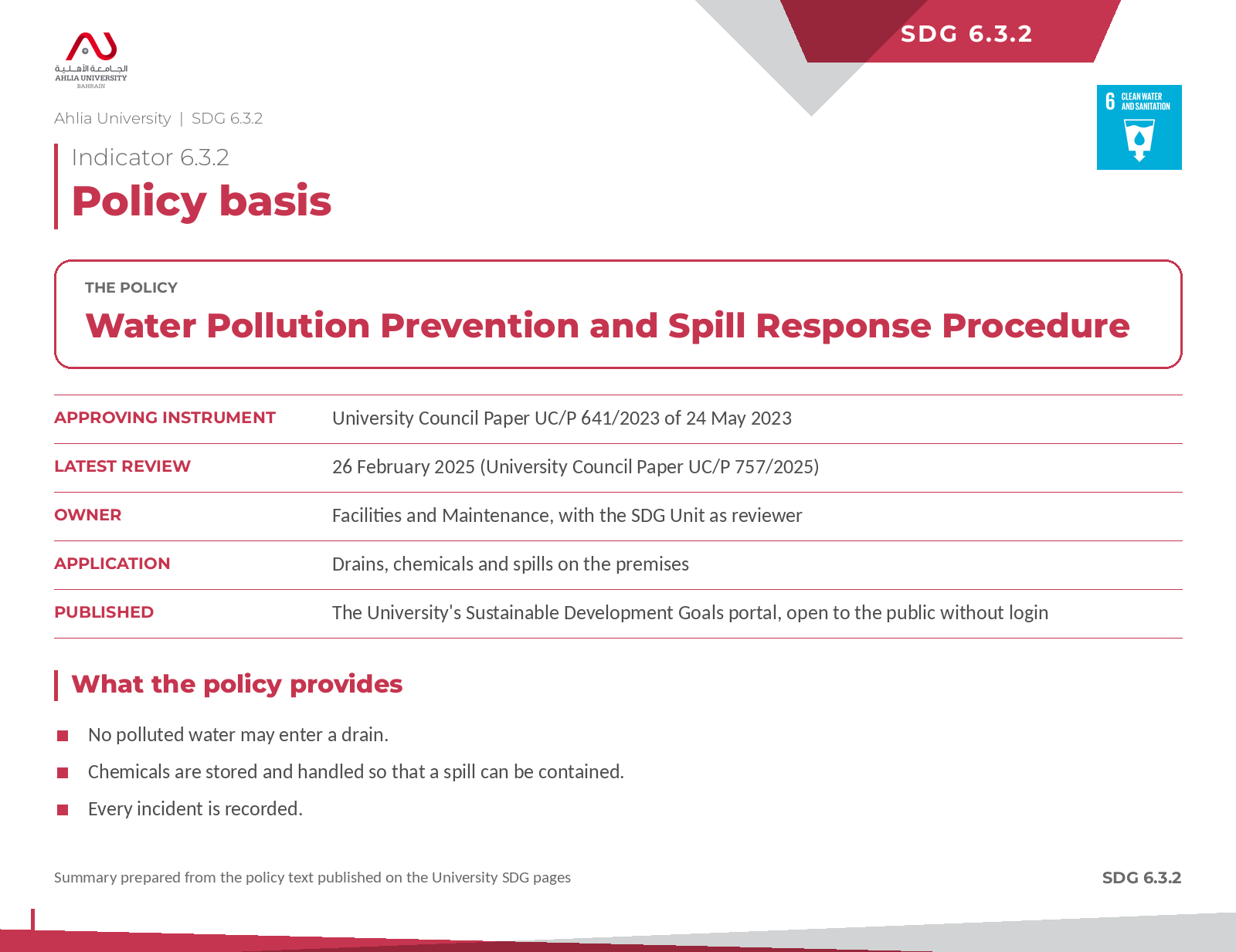
Title: Water Management, Reuse and Pollution Prevention Policy. Approving instrument: University Council Paper UC/P 626/2023 of 22 March 2023, reviewed by University Council Paper UC/P 757/2025 of 26 February 2025. The clause on pollution prevention requires that no polluted water enter a drain, that chemicals be stored and handled so that a spill can be contained, and that every incident be recorded. It is applied through the Water Pollution Prevention and Spill Response Procedure (University Council Paper UC/P 641/2023 of 24 May 2023), approved on that date and reviewed on Wednesday 26 February 2025 with the shared policies. Owner: Facilities and Maintenance, with the SDG Unit as reviewer. In 2024/25 the procedure produced 3 recorded incidents, all contained, 16 spill kits and 36 trained staff. It is published on the University's Sustainable Development Goals portal with this indicator.
▪ Evidence: policy text and review records [6], [2].
Results by academic year
Registers are kept by calendar year, so the 2022/23 column is calendar 2023, the 2023/24 column is 2024 and the 2024/25 column is 2025. Spill kits are the kits in service at the end of the year. Staff trained are the staff who attended the course in the year. Incidents recorded are the entries of the register, and incidents that reached a drain are those entries whose material entered a drain or the public network. The three-year totals are 28 + 32 + 36 = 96 staff trained and 5 + 4 + 3 = 12 incidents. Contained at source means the share of incidents whose material did not reach a drain, 5 of 5, 4 of 4 and 3 of 3.
| Indicator | 2022/23 | 2023/24 | 2024/25 |
|---|---|---|---|
| Spill kits in service | 12 | 14 | 16 |
| Staff trained in spill response | 28 | 32 | 36 |
| Incidents recorded | 5 | 4 | 3 |
| Incidents that reached a drain or the network | 0 | 0 | 0 |
| Incidents contained at source | 100% | 100% | 100% |
▪ Evidence: register, inventory and attendance sheets listed in the references [2], [4].
Publication and verification
The evidence for this indicator was approved by University Council Paper UC/P 830/2026 of 14 January 2026 together with the 2025 edition of the SDG reports (University Council Paper UC/P 829/2026 of the same day, published 21 January 2026) and was published on the University's Sustainable Development Goals portal on 28 January 2026, open to the public without login. The underlying registers are held by Facilities and Maintenance, with the SDG Unit within CAQA, and are quoted in the text above.
Evidence and references
- Ahlia University, Climate Action Policy page, Water section (page modified 24 May 2024): water-efficient cleaning machines, mopping only, no hoses, automatic devices in rest rooms, spray irrigation, low-water plants, a maintenance team that fixes leaks quickly https://www.ahlia.edu.bh/climate-action-policy/
- Water Pollution Prevention and Spill Response Procedure, University Council Paper UC/P 641/2023 of 24 May 2023; chemical store inspection sheets, incident register, spill-kit inventory and training attendance sheets, Facilities and Maintenance
- Ahlia University, Health and Wellbeing Services page: health clinic on the third floor with a full-time nurse
- Sustainability Data Register Procedure, Administrative Circular No. 820/2022 of 13 October 2022; water register kept by Facilities and Maintenance, consolidated each quarter by the SDG Unit, CAQA
- Minutes of the University Sustainability Committee, 17 February, 19 May, 29 September and 8 December 2025 (SDG Unit, CAQA)
- Water Management, Reuse and Pollution Prevention Policy, University Council Paper UC/P 626/2023 of 22 March 2023, reviewed by UC/P 757/2025 of 26 February 2025; owner Facilities and Maintenance