
Ahlia University, a private university in Manama, Kingdom of Bahrain, housed in the leased Gosi Complex, undergoes, as a body, energy reviews to identify the areas where energy waste is highest. An Energy Review Team formed by President's Decision No. 385/2023 of 8 May 2023 carries out the reviews under the Energy Review Procedure (Administrative Circular No. 405/2023 of 18 May 2023). Each review is an on-site check of a defined part of the premises, with day and evening readings, that ends in a ranked list of where energy is wasted and a numbered list of findings with an owner and a closing date. The Climate Action Plan page of the University commits it to implement regular energy audits to identify and address inefficiencies.
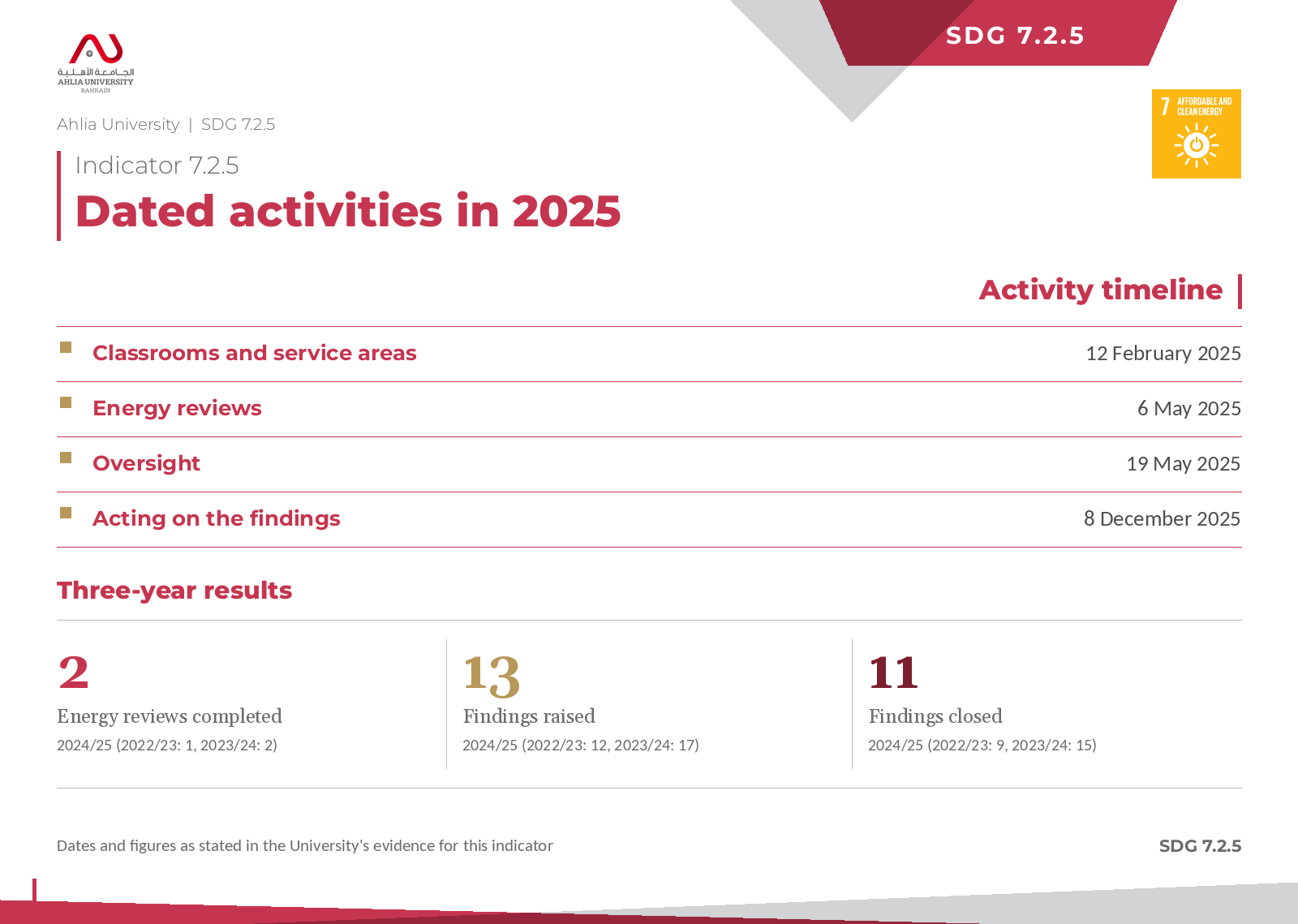
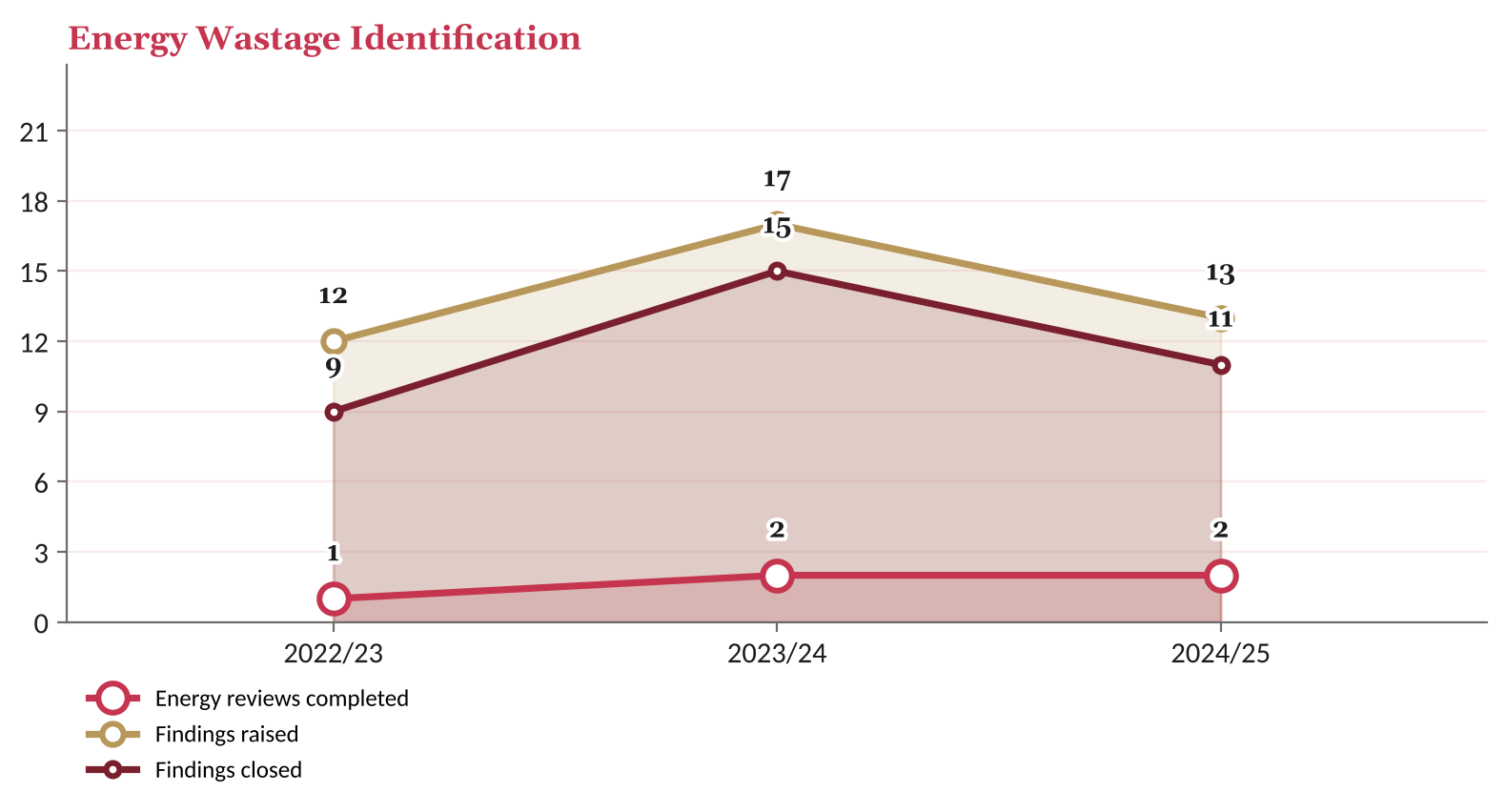
The University completed 5 energy reviews in three years, 1 in 2022/23, 2 in 2023/24 and 2 in 2024/25. They raised 42 findings (12, 17 and 13), closed 35 of them (9, 15 and 11), and identified 505 MWh a year of avoidable electricity use (240, 165 and 100 MWh), of which the largest part was cooling that ran outside teaching hours. The Centre for Accreditation and Quality Assurance is written CAQA, a megawatt hour MWh and a kilowatt hour kWh.
At a glance
Element of the question
| Energy reviews | Standing activity or document: Energy Review Procedure; reviews of defined zones with day and evening readings Owner: Energy Review Team, led by Facilities and Maintenance Latest dated instance in 2025: Laboratories and server room review, 6 May 2025 Three-year figure: 5 reviews |
|---|---|
| Identifying where waste is highest | Standing activity or document: Ranked list of waste by area and cause in each review Owner: Energy Review Team Latest dated instance in 2025: Review of classrooms and service areas, 12 February 2025 Three-year figure: 505 MWh a year identified |
| Acting on the findings | Standing activity or document: Numbered findings with owner and closing date, followed up each quarter Owner: Facilities and Maintenance; SDG Unit Latest dated instance in 2025: Quarterly follow-up report approved 8 December 2025 Three-year figure: 42 raised, 35 closed |
| Oversight | Standing activity or document: Review results presented to the University Sustainability Committee Owner: CAQA, SDG Unit Latest dated instance in 2025: Committee meeting, 19 May 2025 Three-year figure: 4 meetings in 2025 |
▪ Each row is developed below with its evidence.
1. The Energy Review Team and the procedure
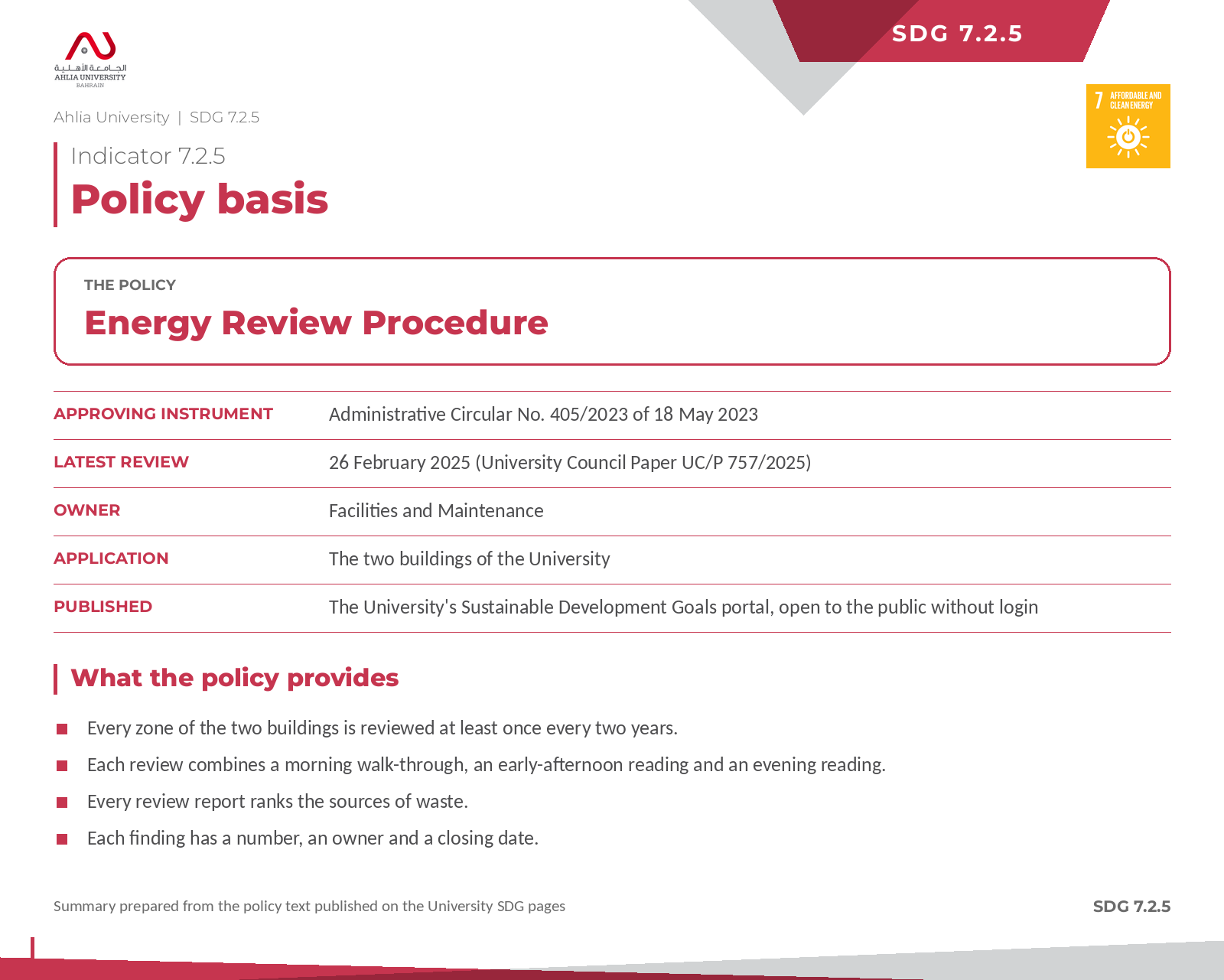
The Energy Review Team has five members: the Facilities and Maintenance engineer who leads it, an academic of the College of Engineering, two students of the Sustainability Club, and the secretary from the SDG Unit; its membership is confirmed each September when the University Sustainability Committee is re-formed (President's Decision No. 780/2024 of 22 September 2024 and No. 780/2025 of 21 September 2025). The procedure of Administrative Circular No. 405/2023 sets three rules. Every zone of the two buildings is reviewed at least once every two years. A review combines a walk-through at the opening of the working day, an early-afternoon reading and an evening reading at about 7 pm, so that loads left on after the teaching day are visible. Every review report ranks the sources of waste and gives each finding a number, an owner and a closing date. The University already instructs its security staff to check unattended rooms and to switch off air-conditioners and lamps that are not controlled automatically; the reviews turn those checks into measured findings.
▪ Evidence: President's Decision No. 385/2023 and Administrative Circular No. 405/2023 [1]; Climate Action Plan page on regular energy audits; Climate Action Policy page on checks by security staff.
2. The five reviews and where waste is highest
| Date | Zone reviewed | Findings | Avoidable use identified |
|---|---|---|---|
| Tuesday 23 May 2023 | Whole premises, floors 1 to 5 of Buildings 1 and 2 (baseline review) | 12 | 240 MWh a year |
| Wednesday 14 February 2024 | Floors 1 to 3 and the library | 9 | 95 MWh a year |
| Tuesday 4 June 2024 | Floors 4 and 5 and the laboratories | 8 | 70 MWh a year |
| Wednesday 12 February 2025 | Classrooms and service areas | 7 | 60 MWh a year |
| Tuesday 6 May 2025 | Laboratories, server room and re-check of earlier findings | 6 | 40 MWh a year |
The baseline review of 23 May 2023 ranked the sources of waste in the whole premises. Cooling that ran outside teaching hours came first at 110 MWh a year (46% of the 240 MWh identified): fan-coil units on floors 2 and 3 ran from early morning until late evening on teaching days although classes end at 5 pm. Lighting left on outside the corridor timers came second at 70 MWh (29%), mostly in stores, stairwells and rest rooms. Equipment left on standby in offices and laboratories came third at 40 MWh (17%), and other causes made up 20 MWh (8%). These three findings led directly to the measures of June and July 2023 and January 2024 reported under indicator 7.2.2: the cooling schedule fixed to the timetable, the monthly floor sub-meter reading and the motion sensors.
The later reviews went zone by zone. The review of the library on 14 February 2024 found cooling running when the hall was empty, which led to occupancy-linked thermostats; the review of floors 4 and 5 and the laboratories on 4 June 2024 found equipment left on overnight, which led to the timed power strips of June 2025; the review of classrooms on 12 February 2025 found thermostats set below 24 degrees Celsius, which led to the locked caps on 120 rooms; and the review of 6 May 2025 re-checked the laboratories and the server room and confirmed the earlier corrections. Each report lists the findings that remain open: 3 at the end of 2023, 5 at the end of 2024 and 7 at the end of 2025, which move into the plan of the Climate Action Plan 2025 to 2030.
▪ Evidence: the five review reports with readings, ranked lists and numbered findings, kept by Facilities and Maintenance [4]; the measures that closed the findings, reported under indicator 7.2.2 [5].
3. Following up and reporting
Facilities and Maintenance closes each finding by a signed note, and the SDG Unit checks the closing dates each quarter. The University Sustainability Committee received the review results on Monday 17 February, Monday 19 May, Monday 29 September and Monday 8 December 2025, and approved the follow-up report of the year on 8 December. The count of findings is by calendar year, read as 2022/23 = 2023, 2023/24 = 2024 and 2024/25 = 2025; 9 of 12, 15 of 17 and 11 of 13 findings were closed within the year they were raised or carried over from earlier years, as the results table shows.
▪ Evidence: quarterly follow-up reports and University Sustainability Committee minutes, 2025 [6].
Policy basis
Procedure: Energy Review Procedure, Administrative Circular No. 405/2023 of 18 May 2023, issued by the Vice President for Administrative and Financial Affairs. Team: Energy Review Team, President's Decision No. 385/2023 of 8 May 2023. Policy: Energy and Carbon Management Policy, University Council Paper UC/P 625/2023 of 22 March 2023, reviewed by UC/P 757/2025 of 26 February 2025, whose clause on energy reviews requires on-site reviews of the premises with a ranked list of waste and a closing date for each finding; Energy Efficiency Plan 2023 to 2025, UC/P 631/2023 of 26 April 2023, reviewed by UC/P 719/2024 of 25 September 2024. Owner: Facilities and Maintenance. Application: the three rules of section 1. Publication: the procedure, the review summaries and the follow-up reports are published on the University's Sustainable Development Goals portal, and the Climate Action Plan page of the University's website states the commitment to regular energy audits.
▪ Evidence: procedure, decision and policy papers [1]; Climate Action Plan page.
Results by academic year
Reviews are the on-site energy reviews of the table in section 2, counted by calendar year read as 2022/23 = 2023, 2023/24 = 2024 and 2024/25 = 2025; all five took place between January and August, so the academic-year reading is the same. Findings raised add the findings of the reviews: 12; 9 + 8 = 17; 7 + 6 = 13, which is 42. Avoidable use identified adds the reviews of each year: 240; 95 + 70 = 165; 60 + 40 = 100, which is 505 MWh a year. Findings open at the end of a year are the findings open at the start, plus those raised, less those closed: 0 + 12 - 9 = 3; 3 + 17 - 15 = 5; 5 + 13 - 11 = 7.
| Indicator | 2022/23 | 2023/24 | 2024/25 |
|---|---|---|---|
| Energy reviews completed | 1 | 2 | 2 |
| Findings raised | 12 | 17 | 13 |
| Findings closed | 9 | 15 | 11 |
| Avoidable electricity use identified (MWh a year) | 240 | 165 | 100 |
| Findings open at the end of the year | 3 | 5 | 7 |
▪ Evidence: review reports and follow-up reports [4] [6].
Publication and verification
This document, which is the University's evidence for indicator 7.2.5 and is kept by Facilities and Maintenance, was approved by University Council Paper UC/P 830/2026 of 14 January 2026 together with the 2025 edition of the SDG reports (University Council Paper UC/P 829/2026 of the same day, published 21 January 2026) and published on the University's Sustainable Development Goals portal on 28 January 2026, open to the public without login. The underlying registers, the review reports with their readings and ranked lists, the numbered findings and closing notes, and the quarterly follow-up reports, are held by Facilities and Maintenance and are quoted in the text above.
Evidence and references
- President's Decision No. 385/2023 (Energy Review Team) and Administrative Circular No. 405/2023 (Energy Review Procedure); University Council Papers UC/P 625/2023, UC/P 757/2025, UC/P 631/2023 and UC/P 719/2024
- Ahlia University: Climate Action Plan page (implement regular energy audits to identify and address inefficiencies) https://www.ahlia.edu.bh/climate-action-plan/
- Ahlia University: Climate Action Policy page (security staff instructed to check unattended rooms and to switch off air-conditioners and lamps not controlled automatically) https://www.ahlia.edu.bh/climate-action-policy/
- Facilities and Maintenance: review reports of 23 May 2023, 14 February 2024, 4 June 2024, 12 February 2025 and 6 May 2025, with readings, ranked lists and numbered findings
- Facilities and Maintenance: completion notes of the upgrade measures that closed the findings, 2023 to 2025
- SDG Unit and University Sustainability Committee: quarterly follow-up reports and minutes, 2025