
Ahlia University (Ahlia), the first private university licensed in the Kingdom of Bahrain, as a body has implemented a watershed management strategy in the only form that its setting allows. Bahrain is an island country with no rivers or streams, so the University has no watershed in the sense of a connected set of waterways, and it does not claim one. What it has is a drainage path that leads from its premises and forecourt to the Gulf, and a strategy for that path, the Drainage and Shore Catchment Strategy (University Council Paper UC/P 735/2024 of 27 November 2024), reviewed by University Council Paper UC/P 814/2025 of 26 November 2025. Ahlia is an urban university housed in the Gosi Complex, Exhibition Road, Al-Hoora, Manama, a leased complex of two buildings with 10,386 m2 of built area. Its premises are not on the shore. It has no marine laboratory, aquarium, boat or fisheries programme, and it claims none: what it does for the sea is done through what leaves its premises, through what its students and the public learn, and through what its students do on the shore with partners. The strategy keeps water from the premises clean at each step of the path, and for its species reference it uses the national list of species that the competent Bahraini authority has listed as threatened, because the University holds no survey of the aquatic species of the Gulf off Manama. Facilities and Maintenance owns the strategy, with the Dean of Student Affairs and the Sustainability Club.
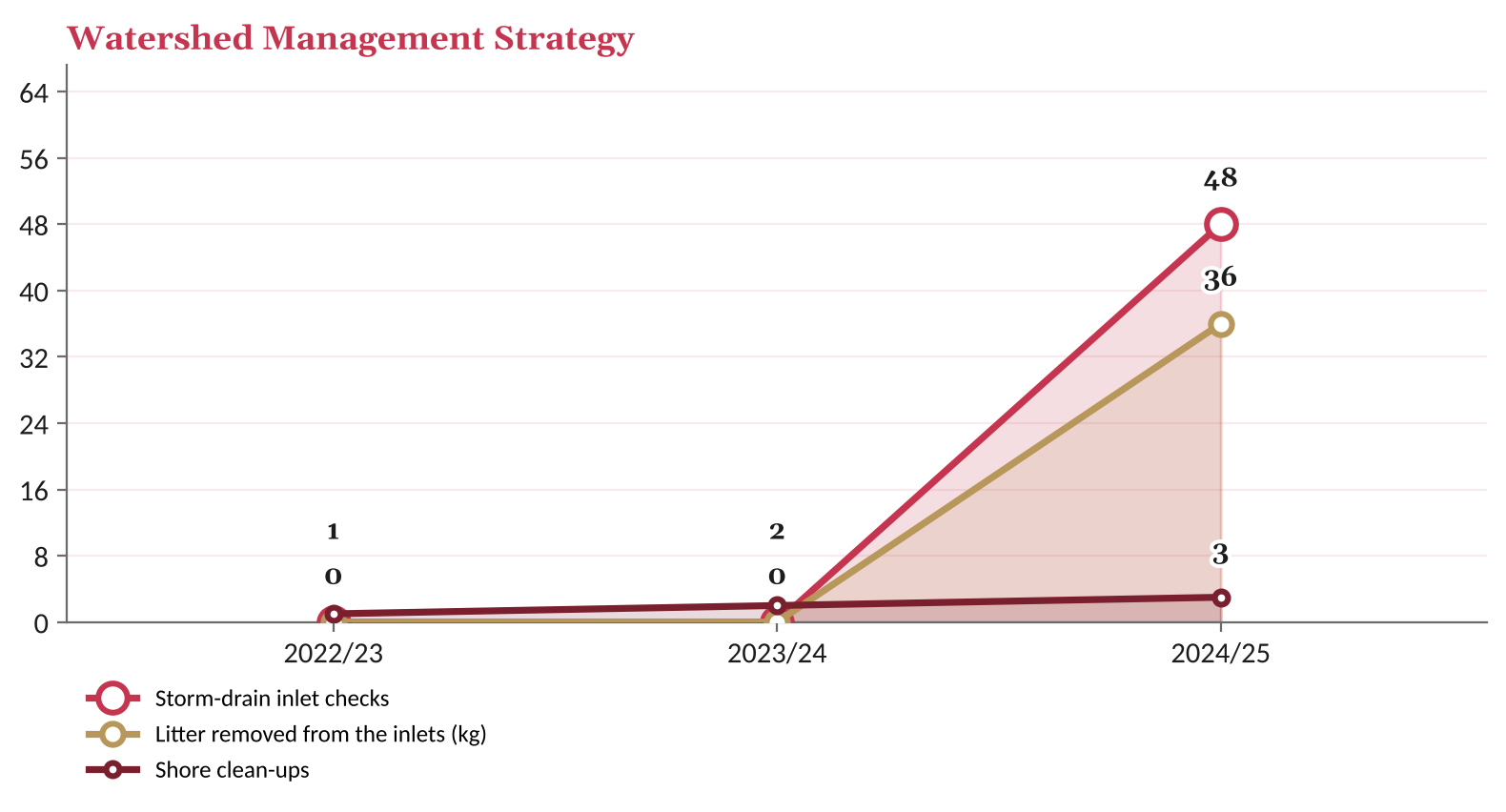
In calendar 2025, which is the 2024/25 column, the strategy was applied in the form of 48 monthly checks of the 4 storm-drain inlets at the forecourt of the Gosi Complex, which removed 36 kg of litter, 1 drain survey, and 3 shore clean-ups with 1.1 tonnes of litter. The strategy was adopted in November 2024 and its first checks were in January 2025, so the figures of 2023 and 2024 are those of the shore clean-ups only.
At a glance
Element of the question
| Strategy | Standing activity or document: Drainage and Shore Catchment Strategy, adopted 27 November 2024, reviewed 26 November 2025 Owner: Facilities and Maintenance Latest dated instance in 2025: Review by the University Sustainability Committee, Monday 8 December 2025 Three-year figure: 1 strategy, 1 review |
|---|---|
| The catchment: premises and forecourt | Standing activity or document: Drain survey: all indoor drains to the sewer; four storm-drain inlets at the forecourt Owner: Facilities and Maintenance; complex operator Latest dated instance in 2025: Survey, Thursday 13 February 2025 Three-year figure: 1 survey |
| Keeping the path clean | Standing activity or document: Monthly checks of the inlets; forecourt brushed and not hosed; cleaning products in measured doses Owner: Facilities and Maintenance Latest dated instance in 2025: Last monthly inlet check of 2025, Monday 1 December 2025: 48 checks in 2025, 36 kg removed Three-year figure: 48 checks |
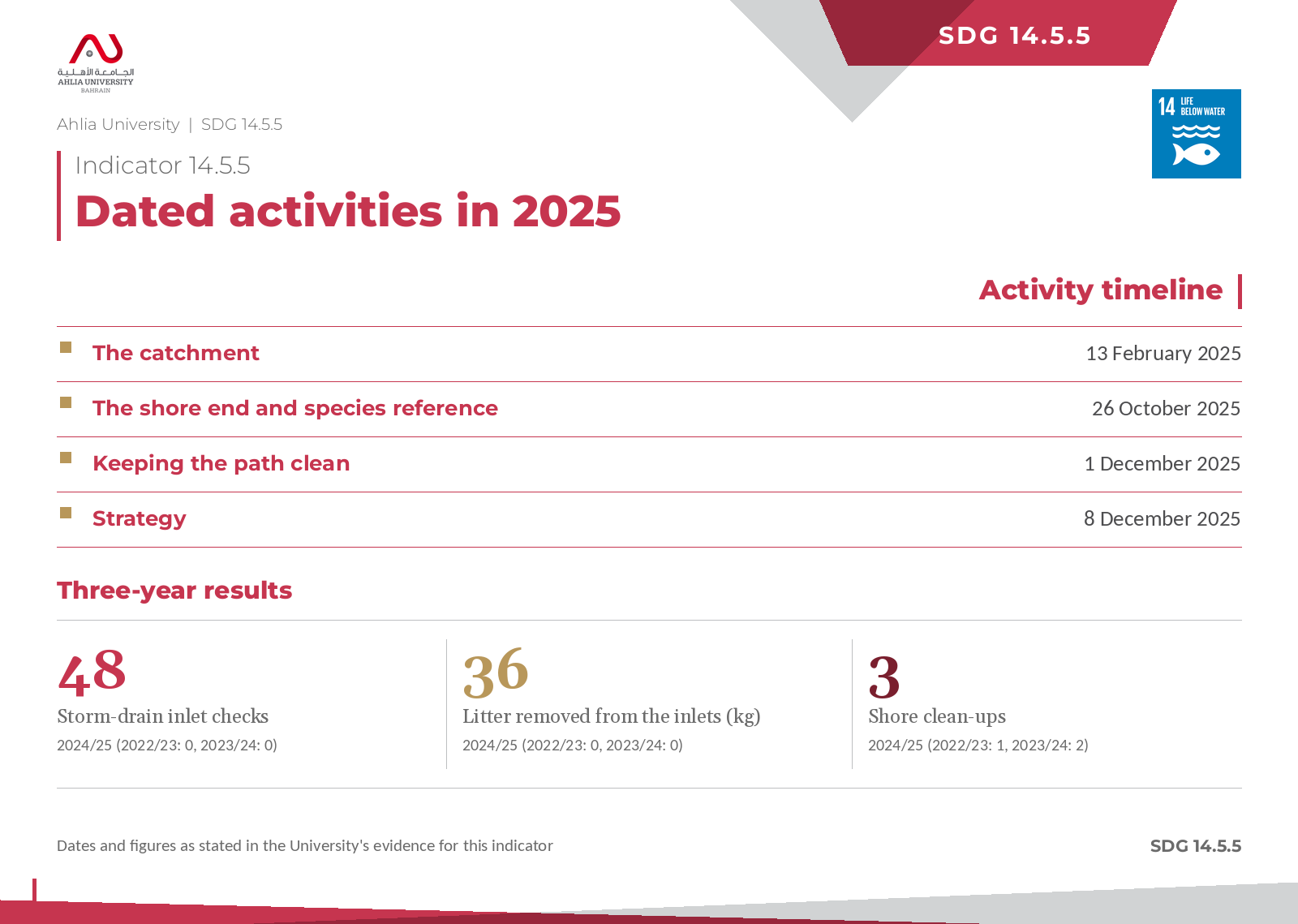
| The shore end and species reference | Standing activity or document: Clean-ups and condition record; national list of threatened species used for seafood and outreach Owner: Dean of Student Affairs; Sustainability Club Latest dated instance in 2025: Sunday 26 October 2025 Three-year figure: 6 clean-ups, 2.3 tonnes |
▪ Evidence for each element is cited in its own section below.
1. What watershed means for an island city
A watershed is a connected set of waterways, such as streams and rivers, that forms one ecological unit. Bahrain has none, and its rain falls on streets and roofs and runs to the sea through public drains. The University's equivalent is the drainage path of its own site: the roof and forecourt of the Gosi Complex, the public storm-drain inlets in front of it, the sewerage network that receives its wastewater and, at the end, the Gulf shore at Manama. The strategy treats that path as its catchment, assigns an owner to each step and sets what is checked. It does not claim a catchment beyond the University's own site and its shore work.
▪ Evidence: Drainage and Shore Catchment Strategy, University Council Paper UC/P 735/2024 of 27 November 2024 [1].
2. The path from the premises
The first step is that no drain of the University leads to the storm-water system. The annual drain survey of Thursday 13 February 2025 found every drain of the laboratories, kitchens, pantries and rest rooms connected to the public sewerage network, as reported in detail under indicator 6.3.1. Rain from the roof and forecourt is the only water that reaches the storm drains. The Water Discharge Standards and Guidelines (Administrative Circular No. 149/2024 of Thursday 15 February 2024), reported under indicator 14.4.1, keep what the sewer receives within limits.
▪ Evidence: drain survey of 13 February 2025, Facilities and Maintenance and the complex operator [1].
3. The forecourt and the storm-drain inlets
The forecourt in front of the Gosi Complex has four storm-drain inlets. The inlets belong to the complex, and Facilities and Maintenance checks them on the first working day of every month, takes out litter and reports oil, sediment or cleaning residues to the complex operator. In 2025 it made 12 checks of each inlet, which is 4 x 12 = 48 checks, the last on Monday 1 December 2025, and removed 36 kg of litter. The forecourt is brushed and not hosed, as the Climate Action Policy page records of the University's cleaning, so that cleaning water does not run to the inlets. The strategy was adopted on 27 November 2024 and the first checks were made in January 2025.
▪ Evidence: inlet check sheets, 2025, Facilities and Maintenance [1]; Climate Action Policy page.
4. The shore end
What passes the inlets reaches the shore, where students remove it. The clean-ups of the Coastal and Waterfront Clean-up Scheme (President's Decision No. 829/2024 of Tuesday 8 October 2024), reported in detail under indicator 14.3.1, removed 0.4, 0.8 and 1.1 tonnes in 2023, 2024 and 2025, and the Shoreline Condition Record, reported under indicator 14.5.2, notes the condition of each section. The last clean-up of 2025 was on Sunday 26 October 2025.
▪ Evidence: clean-up register and condition sheets, Dean of Student Affairs [1].
5. Species: the limits of what the University knows
The question asks for a strategy based on the location-specific diversity of aquatic species. The University holds no survey of the aquatic species of the Gulf off Manama and employs no marine biologist. It therefore uses the one reference that the country provides, the list of threatened species of the competent Bahraini authority: its cafeteria excludes those species, as reported under indicator 14.3.2, and its public outreach teaches the same list, as reported under indicator 14.2.3. If the national authority publishes a species survey of the Manama shore, the strategy requires the University to read it at the next review. The strategy does not claim more. The University Sustainability Committee reviewed it on Monday 8 December 2025, after its review by University Council Paper UC/P 814/2025 of 26 November 2025.
▪ Evidence: strategy text, section on species reference; check sheets of the suppliers' lists, 2025, Facilities and Maintenance [1].
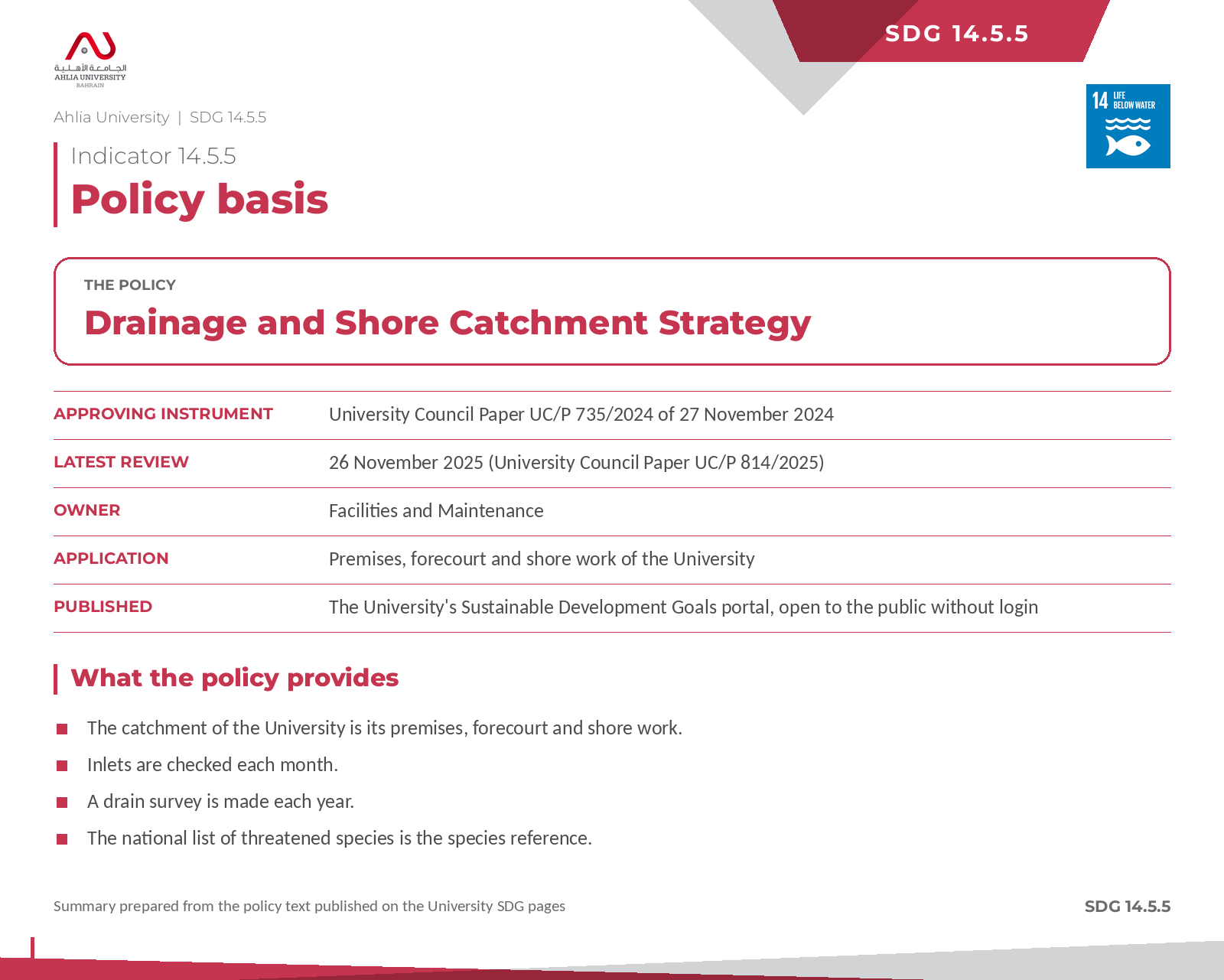
Policy basis
Title: Drainage and Shore Catchment Strategy. Approving instrument: University Council Paper UC/P 735/2024 of 27 November 2024, approved on that date and reviewed by University Council Paper UC/P 814/2025 of 26 November 2025. It is issued under the Water Management, Reuse and Pollution Prevention Policy (University Council Paper UC/P 626/2023 of 22 March 2023). Its clauses define the University's catchment as its premises, forecourt and shore work, require the monthly inlet checks and the annual drain survey, and require the national list of threatened species to be used as the species reference. Owner: Facilities and Maintenance. In 2024/25 it produced 48 inlet checks, 36 kg of litter removed from the inlets, 1 drain survey and 3 clean-ups. It is published on the University's Sustainable Development Goals portal with this document.
▪ Evidence: strategy text and review record [1].
Results by academic year
Registers are kept by calendar year, so the 2022/23 column is calendar 2023, the 2023/24 column is 2024 and the 2024/25 column is 2025; the strategy was adopted in November 2024 and its first checks were made in 2025. An inlet check is one visit to one inlet, 4 inlets x 12 months = 48. Litter is the weight taken out of the inlets. A drain survey is the annual survey of the drains of the premises. Clean-ups and shore litter are those of indicator 14.3.1, 0.4 + 0.8 + 1.1 = 2.3 tonnes in three years.
| Indicator | 2022/23 | 2023/24 | 2024/25 |
|---|---|---|---|
| Storm-drain inlet checks | 0 | 0 | 48 |
| Litter removed from the inlets (kg) | 0 | 0 | 36 |
| Shore clean-ups | 1 | 2 | 3 |
| Litter removed from the shore (tonnes) | 0.4 | 0.8 | 1.1 |
| Drain surveys | 0 | 0 | 1 |
▪ Evidence: registers listed in the references [1].
Publication and verification
This document, which is the University's evidence for indicator 14.5.5 and is kept by Facilities and Maintenance, with the SDG Unit within CAQA, was approved by University Council Paper UC/P 830/2026 of 14 January 2026 together with the 2025 edition of the SDG reports (University Council Paper UC/P 829/2026 of the same day, published 21 January 2026) and published on the University's Sustainable Development Goals portal on 28 January 2026, open to the public without login. The underlying registers, which are the drain survey sheet, the monthly inlet check sheets, the clean-up sheets and the condition sheets, are held by Facilities and Maintenance and the Dean of Student Affairs and are quoted in the text above.
Evidence and references
- Drainage and Shore Catchment Strategy, University Council Paper UC/P 735/2024 of 27 November 2024, reviewed by UC/P 814/2025 of 26 November 2025; drain survey of 13 February 2025, inlet check sheets, check sheets of the suppliers' lists, clean-up register and condition sheets, Facilities and Maintenance and Dean of Student Affairs
- Ahlia University, Climate Action Policy page (page modified 24 May 2024): the University Policy on Healthy Environment, the Environmental Policy and the University Policy on Efficient Use of Paper are named there; water-efficient cleaning machines, automatic flush devices, spray irrigation, low-water plants and waste collected in separate containers by specialised waste management companies https://www.ahlia.edu.bh/climate-action-policy/