
Ahlia University (Ahlia), the first private university licensed in the Kingdom of Bahrain, as a body works directly, through hands-on engagement with public bodies and with the industries that serve it, to maintain the shore ecosystem of the Gulf at Manama and the animals and plants that live in it, and it does so within a narrow scope. Ahlia is an urban university housed in the Gosi Complex, Exhibition Road, Al-Hoora, Manama, a leased complex of two buildings with 10,386 m2 of built area. Its premises are not on the shore. It has no marine laboratory, aquarium, boat or fisheries programme, and it claims none: what it does for the sea is done through what leaves its premises, through what its students and the public learn, and through what its students do on the shore with partners. It carries out no research on marine plants or animals, it names no species or habitat that it has surveyed, and it does not claim to extend an ecosystem. What it does directly is remove litter from the shore with students and the Capital Governorate, and keep species listed as threatened out of its cafeteria by working with its catering operator and the operator's three seafood suppliers.
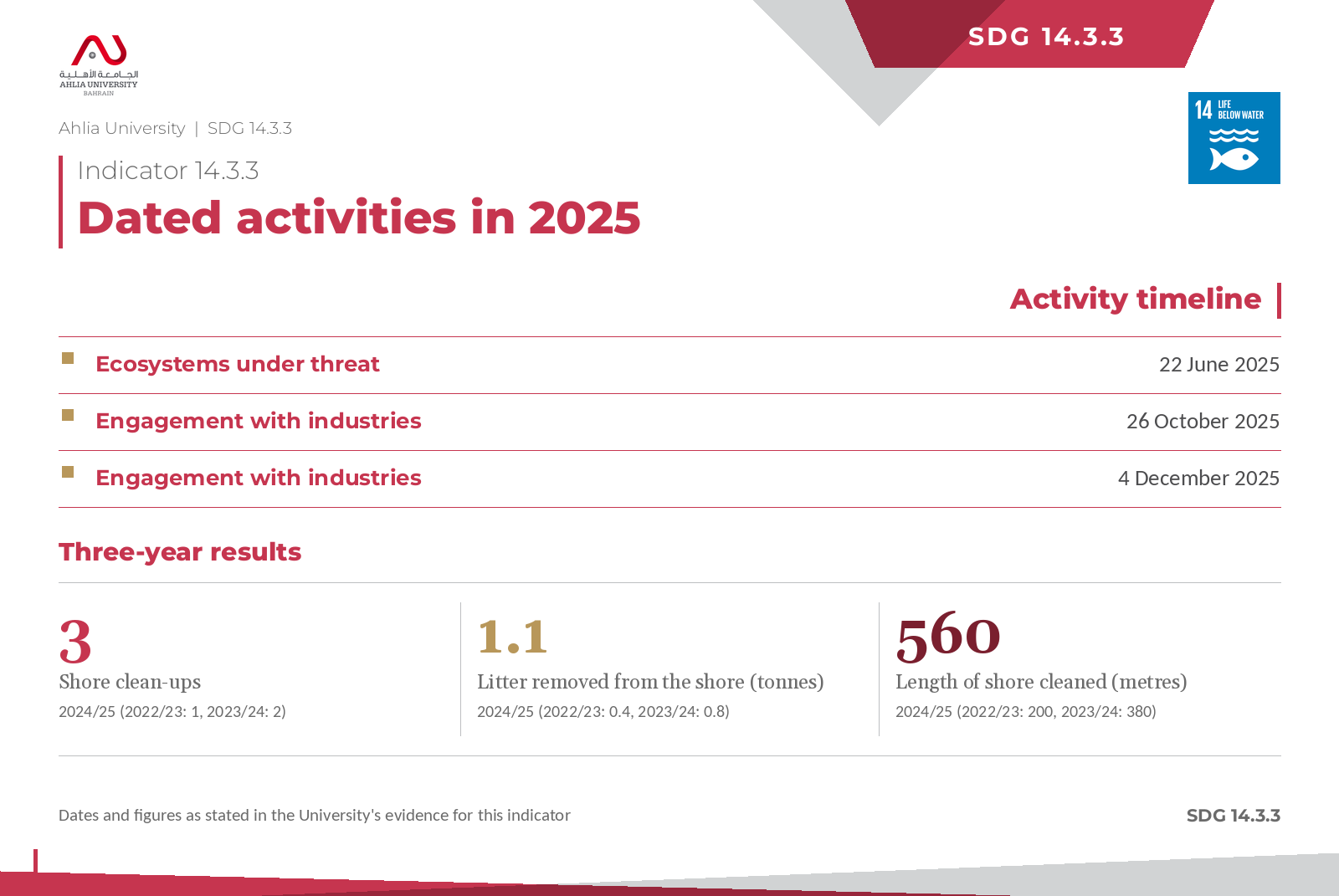
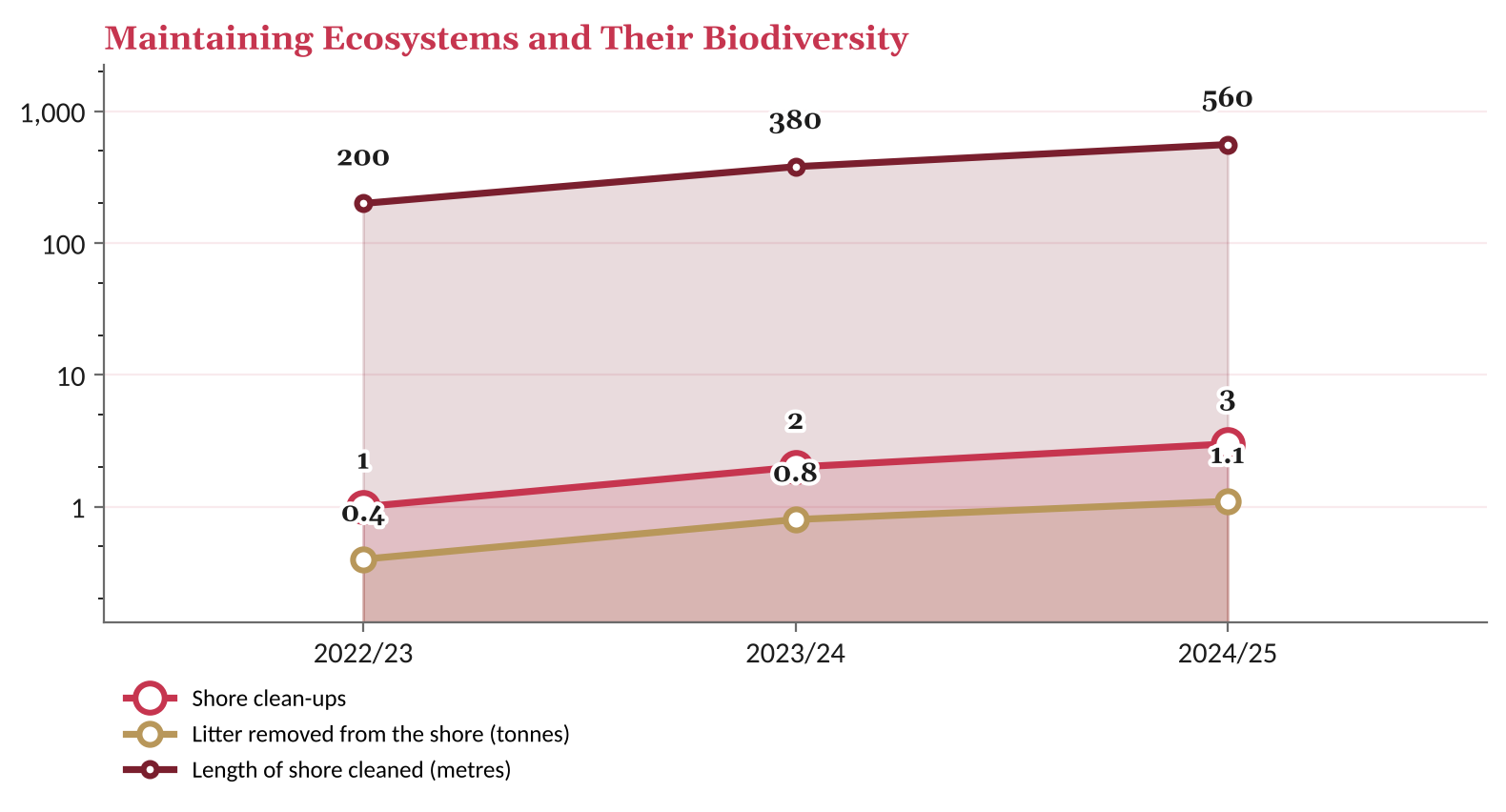
In calendar 2025, which is the 2024/25 column, students removed 1.1 tonnes of litter from 560 m of shore in 3 clean-ups, and 3 suppliers of the cafeteria held signed declarations that exclude species listed as threatened. In 2024 the figures were 0.8 tonnes from 380 m in 2 clean-ups and 3 suppliers with a declaration, and in 2023 0.4 tonnes from 200 m in 1 clean-up. The three years hold 2.3 tonnes of litter and 1,140 m of shore cleaned.
At a glance
Element of the question
| Work directly to maintain ecosystems | Standing activity or document: Shore clean-ups under the Coastal and Waterfront Clean-up Scheme Owner: Dean of Student Affairs; Sustainability Club Latest dated instance in 2025: Sunday 26 October 2025 (220 m, 0.6 tonnes) Three-year figure: 6 clean-ups, 2.3 tonnes, 1,140 m |
|---|---|
| Engagement with industries: food | Standing activity or document: Declarations of the three seafood suppliers of the cafeteria, excluding threatened species Owner: Facilities and Maintenance; catering operator Latest dated instance in 2025: Check of the suppliers' lists, Thursday 4 December 2025 Three-year figure: 3 suppliers engaged |
| Engagement with industries: waste | Standing activity or document: Crew of the Capital Governorate and the University's specialised waste management companies Owner: Facilities and Maintenance Latest dated instance in 2025: Clean-up bags of Sunday 26 October 2025 collected by the Governorate Three-year figure: 6 collections |
| Research | Standing activity or document: No research on aquatic plants or animals is claimed Owner: Graduate Studies and Research Latest dated instance in 2025: Condition sheet of the clean-up of Sunday 26 October 2025; no research claimed Three-year figure: 0 papers claimed |
| Ecosystems under threat | Standing activity or document: Species listed as threatened by the competent Bahraini authority are excluded from purchases Owner: Facilities and Maintenance Latest dated instance in 2025: List check of Sunday 22 June 2025 Three-year figure: 3 checks in 2025 |
▪ Evidence for each element is cited in its own section below.
1. What the University does and does not claim
The question asks for direct work on ecosystems and their biodiversity, plants and animals, especially under threat. The University has no ecologists on its staff, no marine laboratory and no permit to survey or restore habitat, and it therefore says what it can show: it reduces two pressures on the shore ecosystem that any institution in a city can reduce, litter from land and demand for threatened species. It does not name a habitat under restoration and it does not state species counts. The University also plants native and drought-tolerant plants on its own premises, which is reported under indicator 15.2.3 and is land biodiversity; it is not counted here.
▪ Evidence: Coastal and Waterfront Clean-up Scheme, President's Decision No. 829/2024 of Tuesday 8 October 2024 [1]; Biodiversity and Landscape Stewardship Policy [2].
2. Hands-on work on the shore
Under the Scheme the Sustainability Club and the Student Council clean sections of the Gulf shore at Manama, and on Sunday 20 October 2024 at Amwaj Islands, in agreement with the Capital Governorate or, at Amwaj Islands, the Amwaj Islands Municipality. Litter on a shore is carried into the water by the tide, is swallowed or tangled round by animals and covers the plants and the sand where shore life lives, so removing it at the line of the tide protects the shore ecosystem directly. The Governorate marks the sections and the University keeps out of any area that the Governorate has fenced or protected. The clean-ups are reported in detail under indicator 14.3.1; Sunday 26 October 2025 had 48 volunteers, 220 m of shore and 0.6 tonnes of litter. The three years hold 1,140 m of shore cleaned, 200 + 380 + 560 m.
▪ Evidence: clean-up plans, volunteer lists and weighing sheets, 2023 to 2025, Dean of Student Affairs and Facilities and Maintenance [1].
3. Engagement with industries: the seafood trade
The cafeteria's operator and its three seafood suppliers are the University's contact with the fishing and fish farming trade. Under the Cafeteria Seafood Sourcing Standard (Administrative Circular No. 949/2024 of Thursday 21 November 2024), reported in detail under indicator 14.3.2, each supplier signs a declaration of species, origin and method, and no species listed as threatened by the competent Bahraini authority is bought. This protects threatened species by cutting one source of demand. Three suppliers held declarations at the end of 2024 and of 2025, the lists were checked 3 times in 2025 (on Thursday 16 January, Sunday 22 June and Thursday 4 December 2025), and seafood from declared suppliers was 100% of the 2,100 kg bought in 2025.
▪ Evidence: signed declarations, check sheets and purchase register, Facilities and Maintenance and Financial Affairs Directorate [3].
4. Engagement with industries: waste
Waste that is separated on the premises is collected by specialised waste management companies in separate containers, as the Climate Action Policy of the University records, and the plastic that the University collects goes to recycling under its agreement with the Bahrain Association for Parents and Friends of the Disabled. The bags from the shore clean-ups are collected by the Capital Governorate (at Amwaj Islands, by the Amwaj Islands Municipality), which is the body that treats the litter of the public shore. In 2025 the Governorate collected the bags of 3 clean-ups, and 6 collections were made in three years.
▪ Evidence: Climate Action Policy page; collection notes of the Capital Governorate, 2023 to 2025, Dean of Student Affairs [1].
5. Research
The University does not claim research on aquatic ecosystems or biodiversity, and no count of papers on the subject is stated. It reports the knowledge that it uses: the national list of threatened species for its purchases, and the litter weights and shoreline condition sheets that its own students record, reported under indicator 14.5.2; the latest sheet is that of the clean-up of Sunday 26 October 2025.
▪ Evidence: shoreline condition sheets, Dean of Student Affairs [1].
Policy basis
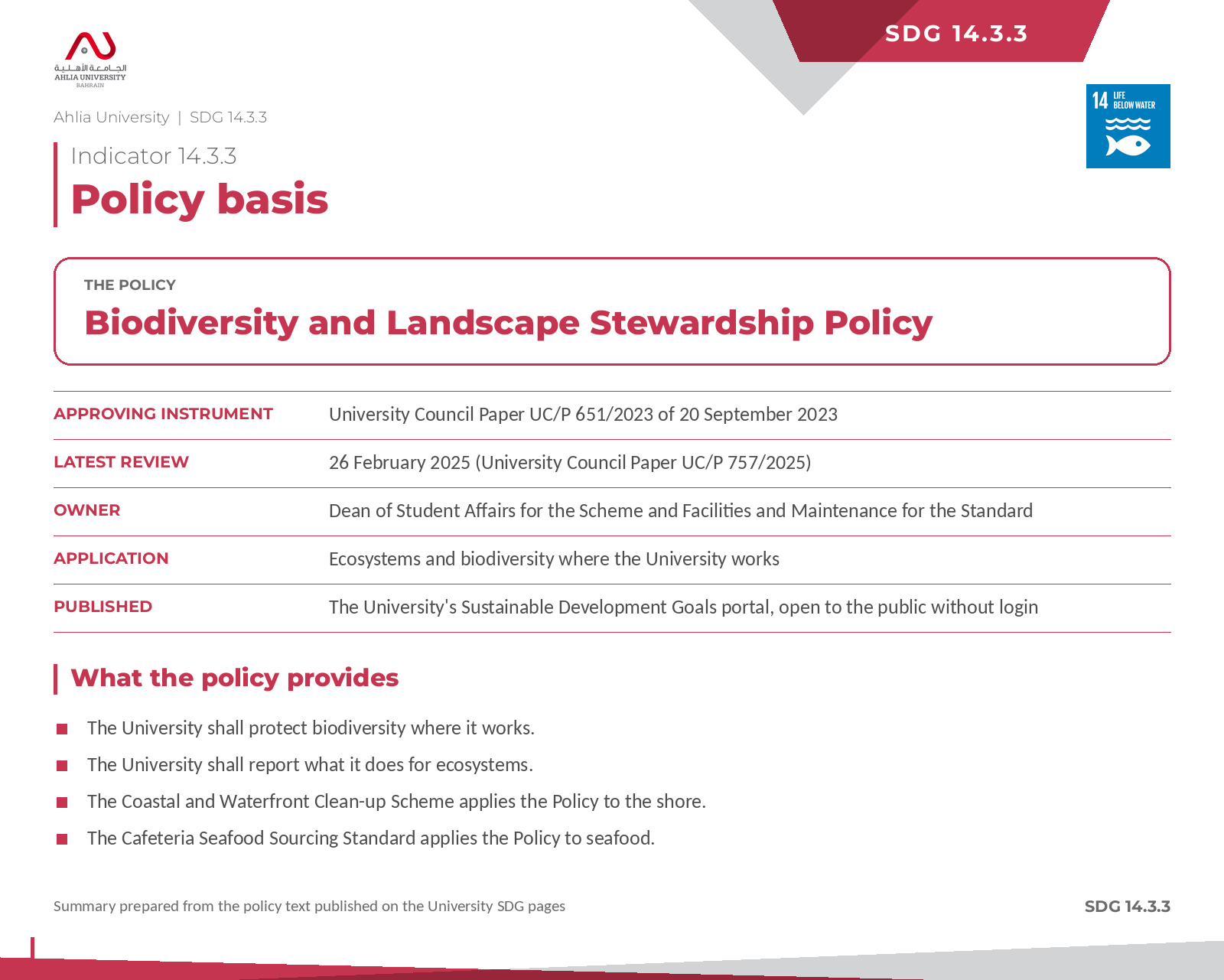
Title: Biodiversity and Landscape Stewardship Policy. Approving instrument: University Council Paper UC/P 651/2023 of 20 September 2023, approved on that date and reviewed by University Council Paper UC/P 757/2025 of 26 February 2025. Its clauses state that the University shall protect biodiversity where it works and shall report what it does for ecosystems; the Coastal and Waterfront Clean-up Scheme (President's Decision No. 829/2024 of Tuesday 8 October 2024) and the Cafeteria Seafood Sourcing Standard apply them to the shore and to seafood. Owner: the Dean of Student Affairs for the Scheme and Facilities and Maintenance for the Standard. In 2024/25 they produced 3 clean-ups, 1.1 tonnes of litter and 3 suppliers with declarations. It is published on the University's Sustainable Development Goals portal with this document.
▪ Evidence: policy text and review record [2]; Scheme [1].
Results by academic year
Registers are kept by calendar year, so the 2022/23 column is calendar 2023, the 2023/24 column is 2024 and the 2024/25 column is 2025; events of September to December 2025 are counted in 2024/25. A clean-up is one dated activity of indicator 14.3.1. Shore cleaned is the length of the sections, 200 + 180 = 380 m in 2024 and 200 + 140 + 220 = 560 m in 2025. Litter is the weight of the bags. Suppliers engaged are the seafood suppliers holding a declaration at the end of the year. The share is the weight of seafood bought from declared suppliers divided by the weight bought. Percentages are rounded to whole numbers.
| Indicator | 2022/23 | 2023/24 | 2024/25 |
|---|---|---|---|
| Shore clean-ups | 1 | 2 | 3 |
| Litter removed from the shore (tonnes) | 0.4 | 0.8 | 1.1 |
| Length of shore cleaned (metres) | 200 | 380 | 560 |
| Seafood suppliers engaged with a declaration | 0 | 3 | 3 |
| Seafood bought from declared suppliers | 0% | 6% | 100% |
▪ Evidence: registers and sheets listed in the references [1], [3].
Publication and verification
This document, which is the University's evidence for indicator 14.3.3 and is kept by the Dean of Student Affairs, with the SDG Unit within CAQA, was approved by University Council Paper UC/P 830/2026 of 14 January 2026 together with the 2025 edition of the SDG reports (University Council Paper UC/P 829/2026 of the same day, published 21 January 2026) and published on the University's Sustainable Development Goals portal on 28 January 2026, open to the public without login. The underlying registers, which are the clean-up plans, the volunteer lists, the weighing sheets, the shoreline condition sheets, the collection notes of the Capital Governorate, the supplier declarations and the check sheets, are held by the Dean of Student Affairs and Facilities and Maintenance and are quoted in the text above.
Evidence and references
- Coastal and Waterfront Clean-up Scheme, President's Decision No. 829/2024 of Tuesday 8 October 2024; clean-up plans, volunteer lists, weighing sheets, shoreline condition sheets and collection notes, 2023 to 2025, Dean of Student Affairs and Facilities and Maintenance
- Biodiversity and Landscape Stewardship Policy, University Council Paper UC/P 651/2023 of 20 September 2023, reviewed by UC/P 757/2025 of 26 February 2025; owner Facilities and Maintenance
- Cafeteria Seafood Sourcing Standard, Administrative Circular No. 949/2024 of Thursday 21 November 2024; signed declarations of the three suppliers, check sheets and purchase register, 2024 and 2025, Facilities and Maintenance and Financial Affairs Directorate
- Ahlia University, Climate Action Policy page (page modified 24 May 2024): the University Policy on Healthy Environment, the Environmental Policy and the University Policy on Efficient Use of Paper are named there; water-efficient cleaning machines, automatic flush devices, spray irrigation, low-water plants and waste collected in separate containers by specialised waste management companies https://www.ahlia.edu.bh/climate-action-policy/