
Ahlia University, the first private university licensed in the Kingdom of Bahrain, housed in the Gosi Complex in Manama, has, as a body, systematically set and publicly stated targets to admit students who fall into the bottom 20% of household income group in the country. The University Council fixed them in the Student Financial Inclusion and Access Policy (University Council Paper UC/P 613/2023 of 25 January 2023), which sets the share of new students from the bottom financial quintile at 6% for 2022/23, the base year measured on the entry records, 7% for 2023/24 and 8% for 2024/25. The policy was reviewed by University Council Paper UC/P 757/2025 of 26 February 2025, which kept all three targets. Because the University may not discriminate at the point of admission, the targets are pursued through outreach to schools, publicly announced scholarships and instalment plans, not through quotas.
In academic year 2024/25 the University enrolled 455 new students, of whom 37 (8%) came from the bottom quintile, which meets the target. Over the three academic years 2022/23 to 2024/25 it enrolled 1,315 new students, of whom 94 (7%) came from the bottom quintile (26, 31 and 37). All counts come from the University's own admission and financial aid registers.
At a glance
Element of the question
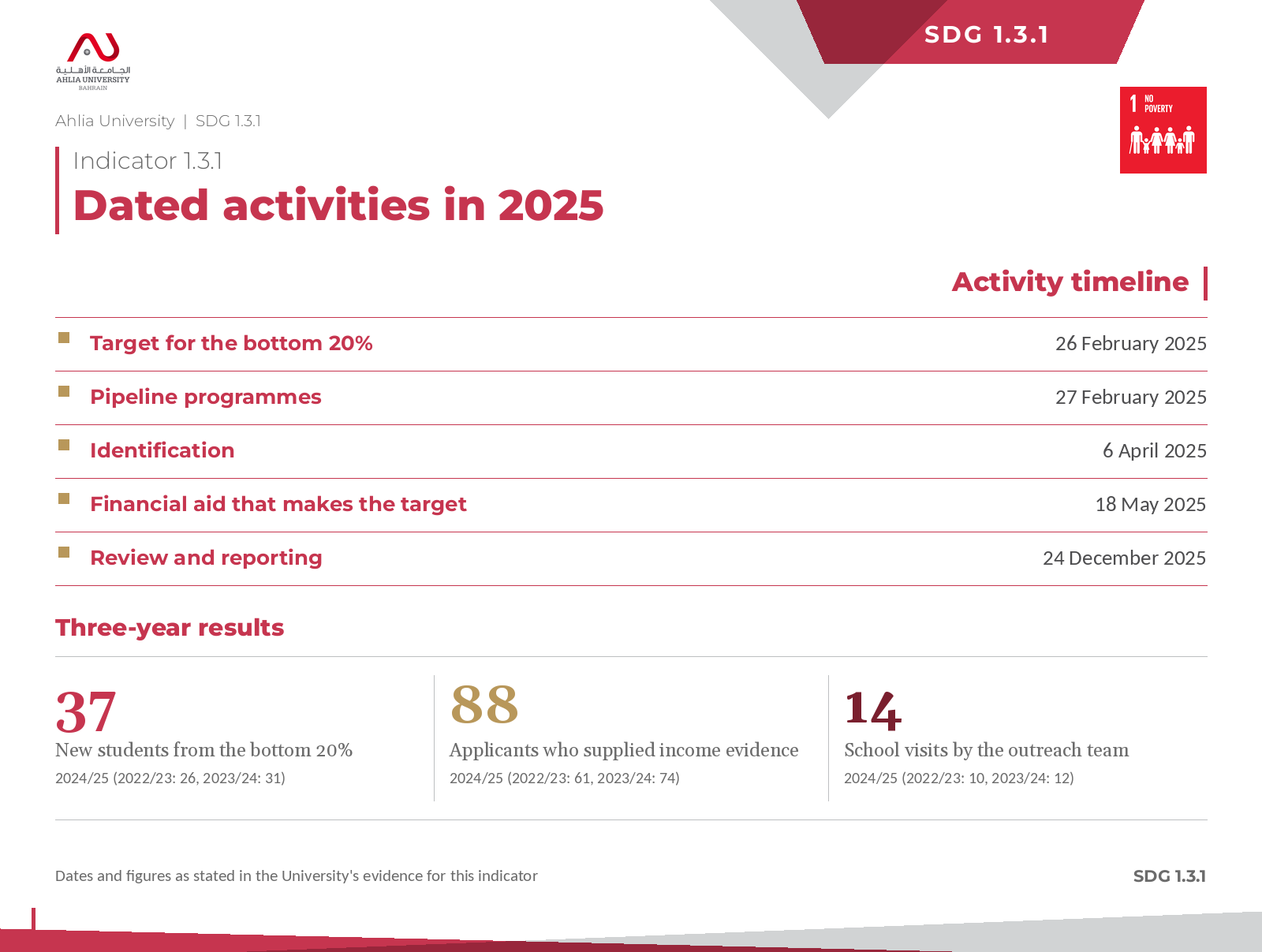
| Target for the bottom 20% | Standing activity or document: Share of new students from the bottom quintile: 6%, 7%, 8% Owner: Dean of Student Affairs; University Council Latest dated instance in 2025: Review, UC/P 757/2025 of 26 February 2025 Three-year figure: 94 new students |
|---|---|
| Identification | Standing activity or document: Household income band confirmed with Ministry of Social Development records the student supplies Owner: Financial Aid and Scholarships office Latest dated instance in 2025: Applications for 2025/26 opened Sunday 6 April 2025 Three-year figure: 223 applicants |
| Pipeline programmes | Standing activity or document: School visits and a public admissions platform presenting scholarships Owner: Admission and Registration office; Student Services and Activities Latest dated instance in 2025: School visits, 9 to 27 February 2025 Three-year figure: 36 school visits |
| Financial aid that makes the target reachable | Standing activity or document: Published discounts, merit remission, orphan aid, instalments Owner: Student Financial Assistance Committee Latest dated instance in 2025: Meeting, Sunday 18 May 2025 Three-year figure: 440 students on aid in 2024/25 |
| Review and reporting | Standing activity or document: Annual access and completion report to the University Council Owner: Dean of Student Affairs Latest dated instance in 2025: UC/P 828/2025 of 24 December 2025 Three-year figure: 3 annual reports |
▪ Evidence for each element is cited in its own section below.
1. The targets and how they are defined
The bottom financial quintile means the 20% of households with the lowest income in the country. The Student Financial Inclusion and Access Policy is owned by the Dean of Student Affairs and applied by the Financial Aid and Scholarships office in the Deanship of Student Affairs. For each intake the University Council sets the target share of new students from the bottom quintile: 6% in 2022/23, 7% in 2023/24 and 8% in 2024/25. The share reached was 6.2% in 2022/23 (26 of 420 new students), 7.0% in 2023/24 (31 of 440) and 8.1% in 2024/25 (37 of 455), shown as 6%, 7% and 8% in the results table of this indicator.
The policy builds on the Revised Admission Policy (University Council Paper UC/P 517/2021 of 15 July 2021), which commits the University to widening access and participation through outreach and financial aid, and on the Knowledge Exchange and Community Engagement Plan 2021 to 2025, whose pillars include access, inclusion and scholarships.
▪ Evidence: Student Financial Inclusion and Access Policy, UC/P 613/2023 of 25 January 2023, and its review, UC/P 757/2025 of 26 February 2025 [1]; Revised Admission Policy, UC/P 517/2021 of 15 July 2021 [2]; Knowledge Exchange and Community Engagement Plan 2021 to 2025.
2. Identifying students in the bottom quintile
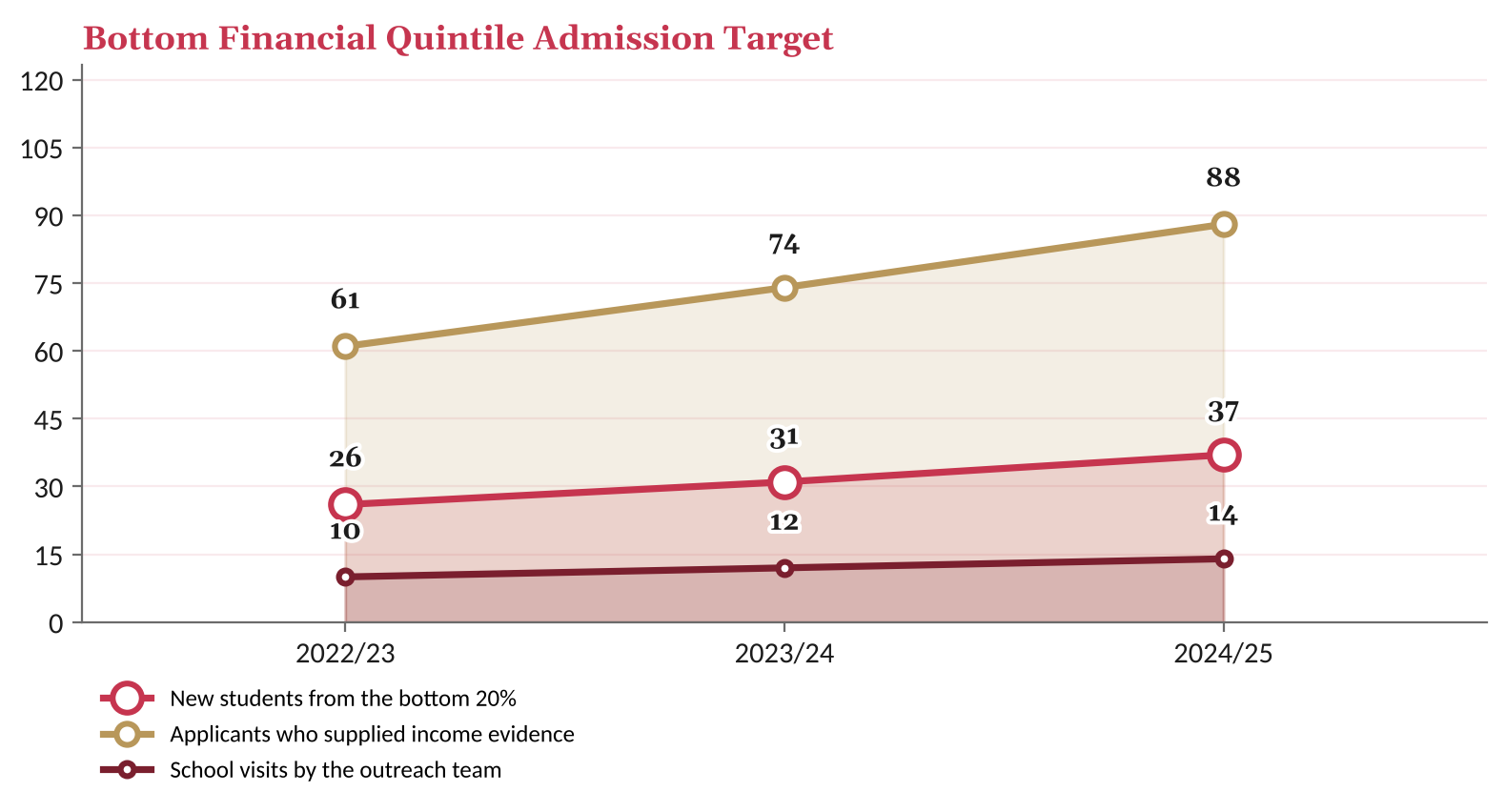
The University does not infer household income from the school a student attended. An applicant who wishes to be counted supplies a household income certificate, or a letter confirming enrolment in a social support programme, issued through the Ministry of Social Development, and the Financial Aid and Scholarships office confirms the income band against those records with the student's written consent. Supplying the evidence is voluntary: 61 applicants did so for the 2022/23 intake, 74 for 2023/24 and 88 for 2024/25, which is 223 over the three years, and 26, 31 and 37 of them enrolled as new students. Applications for the 2025/26 intake opened on Sunday 6 April 2025 under the same procedure.
A student identified as bottom quintile after enrolment, for example when a family's circumstances change, can ask the same office to add income evidence at any point in the studies, which is why the enrolled counts of 85, 98 and 110 are larger than the counts of new entrants. Only aggregate, non-identifying figures are reported to the University Council.
▪ Evidence: register of income evidence and entrants, Financial Aid and Scholarships office, 2022/23 to 2024/25, with the consent forms held by the office [4].
3. Pipeline programmes that reach pupils before they apply
The outreach team of the Admission and Registration office, with the Student Services and Activities office, visits secondary schools each spring to explain the published scholarship ladder: remission of 20% for a secondary-school average of 80 to 89.9%, 25% for 90 to 94.9% and 50% for 95% and above, a 50% discount for orphans and for applicants with a recognised disability card, a 10% sibling discount and instalment payment of fees. The team visited 10 schools in 2022/23, 12 in 2023/24 and 14 in 2024/25, which is 36 visits, reaching 520, 640 and 760 pupils. The visits of 2025 ran from Sunday 9 February to Thursday 27 February 2025.
The University also reaches families in public. In September 2024 it held a four-day public admissions platform at Bahrain City Centre, reported by the newspaper Al Ayam on 5 September 2024, where it presented all its academic programmes and offered partial scholarships of up to 50% to Bahraini citizens, Gulf nationals and residents. On 29 September 2024 the University reported that it had attracted a greater number of new students for the coming academic year and confirmed partial scholarships for high achievers, orphans, students with special needs and other eligible students.
▪ Evidence: outreach visit log and attendance sheets, 2022/23 to 2024/25 [5]; Disability Policy page with the tuition discount table; press report of the public platform, Al Ayam, 5 September 2024 [7].
4. Financial aid that makes the target reachable
The Student Financial Assistance Committee, formed by President's Decision No. 720/2022 of 4 September 2022 and re-formed by No. 720/2023 of 3 September 2023, No. 720/2024 of 1 September 2024 and No. 740/2025 of 7 September 2025, awards scholarships, discounts and hardship support under the policy. It met on Sunday 19 January, Sunday 18 May, Sunday 21 September and Sunday 7 December 2025, and at its May meeting it reviewed the aid held by students counted in the bottom quintile. The published schemes are the partial scholarships of up to 50% announced on 22 January 2021, which give 20% to 50% to several eligible groups, the merit remissions listed above, the High Achievers Discount of 25% for a cumulative grade point average of 3.50 or higher, the graduate progression discount of 20% and the employee and sibling discount of 50%. The University also offers a limited number of undergraduate scholarships each year to outstanding students who have no other means to finance their studies, awarded as a 50% grant and a 50% loan through a competitive application. Students on any published discount or aid scheme numbered 380 in 2022/23, 410 in 2023/24 and 440 in 2024/25, which is 29%, 30% and 31% of the University's own headcount.
▪ Evidence: President's Decisions forming the Committee; Committee minutes of 19 January, 18 May, 21 September and 7 December 2025 [8]; scholarship announcement of 22 January 2021 [9].
5. Review and reporting
The Dean of Student Affairs reports the share of new students from the bottom quintile against the target to the University Council once a year, with the number of applicants who supplied evidence and the aid awarded. The report for 2024/25 was received by University Council Paper UC/P 828/2025 of 24 December 2025, and the reports for 2022/23 and 2023/24 by UC/P 664/2023 of 22 November 2023 and UC/P 738/2024 of 27 November 2024.
▪ Evidence: annual access and completion report to the University Council, 2022/23 to 2024/25 [10].
Policy basis
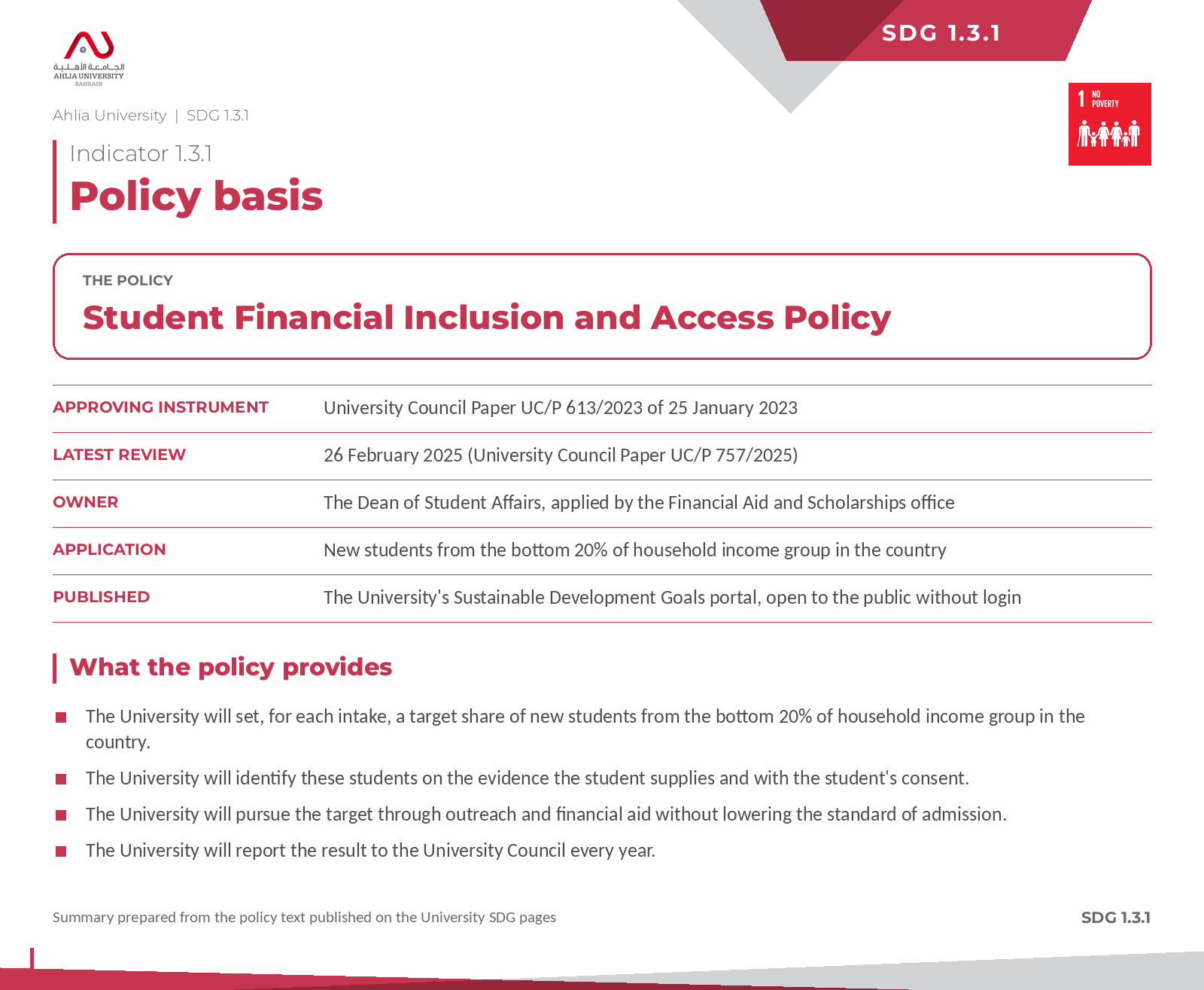
Title: Student Financial Inclusion and Access Policy. Approving instrument: University Council Paper UC/P 613/2023 of 25 January 2023; latest review: University Council Paper UC/P 757/2025 of 26 February 2025. Owner: the Dean of Student Affairs, applied by the Financial Aid and Scholarships office. The clauses that answer the question say that the University will set, for each intake, a target share of new students from the bottom 20% of household income group in the country, will identify them on the evidence the student supplies and with the student's consent, will pursue the target through outreach and financial aid without lowering the standard of admission, and will report the result to the University Council every year. Application in 2024/25: target 8%, result 8.1% (37 of 455 new students), 88 applicants with income evidence, 14 school visits, 440 students on aid. The policy is published on the University's Sustainable Development Goals portal.
Results by academic year
Counts are made on the entry register of each academic year. New students are first-time entrants of the year: 420, 440 and 455, which is 1,315 over three years. New students from the bottom 20% are those whose income band was confirmed by the Financial Aid and Scholarships office: 26 + 31 + 37 = 94. Applicants who supplied evidence: 61 + 74 + 88 = 223. School visits: 10 + 12 + 14 = 36. The share of new students is the count from the bottom 20% divided by the new students of the year and rounded to a whole number: 26 of 420, 31 of 440 and 37 of 455. The base is the University's own count of new students, not the figure of any external profile.
| Indicator | 2022/23 | 2023/24 | 2024/25 |
|---|---|---|---|
| New students from the bottom 20% | 26 | 31 | 37 |
| Applicants who supplied income evidence | 61 | 74 | 88 |
| School visits by the outreach team | 10 | 12 | 14 |
| New students in the year | 420 | 440 | 455 |
| Share of new students from the bottom 20% | 6% | 7% | 8% |
| Target set by the University Council | 6% | 7% | 8% |
Publication and verification
The evidence for this indicator was approved by University Council Paper UC/P 830/2026 of 14 January 2026 together with the 2025 edition of the SDG reports (University Council Paper UC/P 829/2026 of the same day, published 21 January 2026) and was published on the University's Sustainable Development Goals portal on 28 January 2026, open to the public without login. The underlying registers, which are the admission and financial aid registers, the register of income evidence, the outreach visit log and the minutes of the Student Financial Assistance Committee, are held by the Dean of Student Affairs and the Financial Aid and Scholarships office and are quoted in the text above.
Evidence and references
- Student Financial Inclusion and Access Policy, University Council Paper UC/P 613/2023 of 25 January 2023, reviewed by UC/P 757/2025 of 26 February 2025, Dean of Student Affairs
- Revised Admission Policy, University Council Paper UC/P 517/2021 of 15 July 2021, University Registrar
- Ahlia University: Knowledge Exchange and Community Engagement Plan 2021 to 2025 https://www.ahlia.edu.bh/knowledge-exchange/
- Register of income evidence and entrants, Financial Aid and Scholarships office, 2022/23 to 2024/25
- Outreach visit log and attendance sheets, Admission and Registration office, 2022/23 to 2024/25
- Ahlia University: Disability Policy page with the tuition discount table and the scholarship rules https://www.ahlia.edu.bh/disability-policy/
- Al Ayam, public admissions platform at Bahrain City Centre with scholarships of up to 50%, 5 September 2024
- Minutes of the Student Financial Assistance Committee, 19 January, 18 May, 21 September and 7 December 2025, Dean of Student Affairs
- Partial scholarships of up to 50% announced on 22 January 2021, Ahlia University news item
- Annual access and completion report to the University Council, UC/P 664/2023, UC/P 738/2024 and UC/P 828/2025, Dean of Student Affairs