
Ahlia University, a private university in Manama, Kingdom of Bahrain, housed in the leased Gosi Complex, informs and supports governments, as a body, in clean energy and energy-efficient technology policy development at two of the four levels of the question, Local and National. It does not claim the Regional or Global levels. At the Local level the University presented the energy design of its new campus to the technical team of the Northern Governorate on 11 February 2025; at the National level it sent a written submission to the national consultation on energy efficiency requirements for buildings on 8 May 2025 and briefed officials of the Electricity and Water Authority (EWA) on 13 May 2025 with the metered results of its own energy reviews. The work is governed by the Government and Policy Engagement Protocol (University Council Paper UC/P 742/2024 of 25 December 2024) and led by the Executive Director for Strategy, Sustainability and Quality with the College of Engineering.
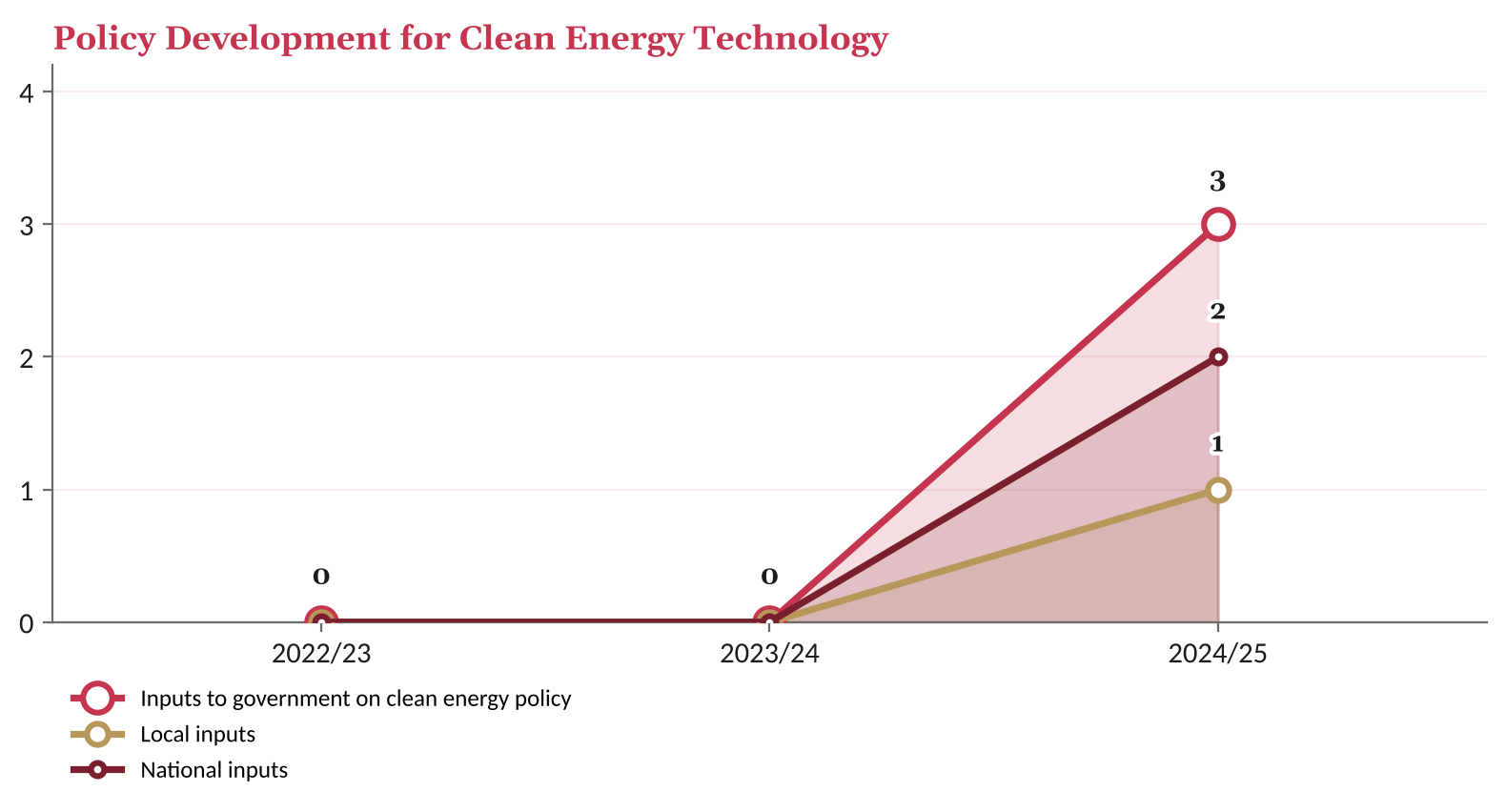
In 2024/25, the first year of the Protocol, the University made 3 inputs to government on clean energy and energy-efficient technology: 1 Local and 2 National. The Centre for Accreditation and Quality Assurance is written CAQA.
At a glance
Element of the question
| Local | Standing activity or document: Presentation of the campus energy design to the Northern Governorate technical team Owner: Executive Director for Strategy, Sustainability and Quality; Facilities and Maintenance Latest dated instance in 2025: Presentation, Tuesday 11 February 2025 Three-year figure: 1 input counted |
|---|---|
| National | Standing activity or document: Written submission to the consultation on building energy efficiency requirements; briefing to EWA officials Owner: College of Engineering; Facilities and Maintenance Latest dated instance in 2025: Briefing, 13 May 2025 Three-year figure: 2 inputs |
▪ Each claimed level is developed below with its evidence.
1. Local: the Northern Governorate and the new campus
The University's new campus in Northern City lies in the Northern Governorate, and the energy design of its buildings is a matter for local government as well as for the University (the design standards applied to it are reported under indicator 7.2.1). On Tuesday 11 February 2025 the Executive Director for Strategy, Sustainability and Quality and the head of Facilities and Maintenance presented to the Governorate's technical team the energy features of the design: use of natural light and ventilation, shading, the selection of cooling plant, lighting power and a sub-meter for each building, and answered the team's questions on the cost of each measure. The team asked for the sub-metering proposal to be sent in writing, which the University did on Thursday 20 February 2025. The University's leadership has also met the Northern Governor, who commended the campus for its alignment with Healthy Cities Program standards through sustainable design and healthy urban planning, as reported on 29 December 2025; that meeting belongs to 2025/26 and is not counted in the table of results, although indicator 11.4.7 counts it in its calendar-year register.
▪ Evidence: presentation, attendance note and covering letter of 20 February 2025 [1]; press report of the meeting with the Northern Governor, 29 December 2025 [2].
2. National: the consultation and the Electricity and Water Authority
On Thursday 8 May 2025 the University sent a written submission, prepared by the College of Engineering and Facilities and Maintenance, to the national consultation on energy efficiency requirements for buildings. It made six recommendations drawn from the University's own results: a sub-meter on every tenant floor, a locked cooling set point of 24 degrees Celsius in public buildings, LED lighting with automatic control as the minimum standard for fit-outs, a yearly energy review for every public building above a set floor area, public reporting of electricity per square metre, and reporting of the share of low-carbon electricity.
On Tuesday 13 May 2025 the College of Engineering and Facilities and Maintenance briefed officials of the EWA on the University's electricity series for 2021 to 2025, which fell from 7,220 MWh to 6,090 MWh, and on the five energy reviews of 2023 to 2025 (reported under indicator 7.2.5), and offered the data for the Authority's guidance for public buildings. The University already has a channel of this kind with the Authority: its page on SDG 14 states that the University's water-quality research findings were shared with the Authority and contributed to discussions on improving effluent treatment to protect coastal waters.
▪ Evidence: submission of 8 May 2025 and acknowledgement of receipt [3]; briefing slides and attendance note of 13 May 2025 [3]; the University's page on SDG 14 on findings shared with the Authority.
3. The Protocol that governs the engagement
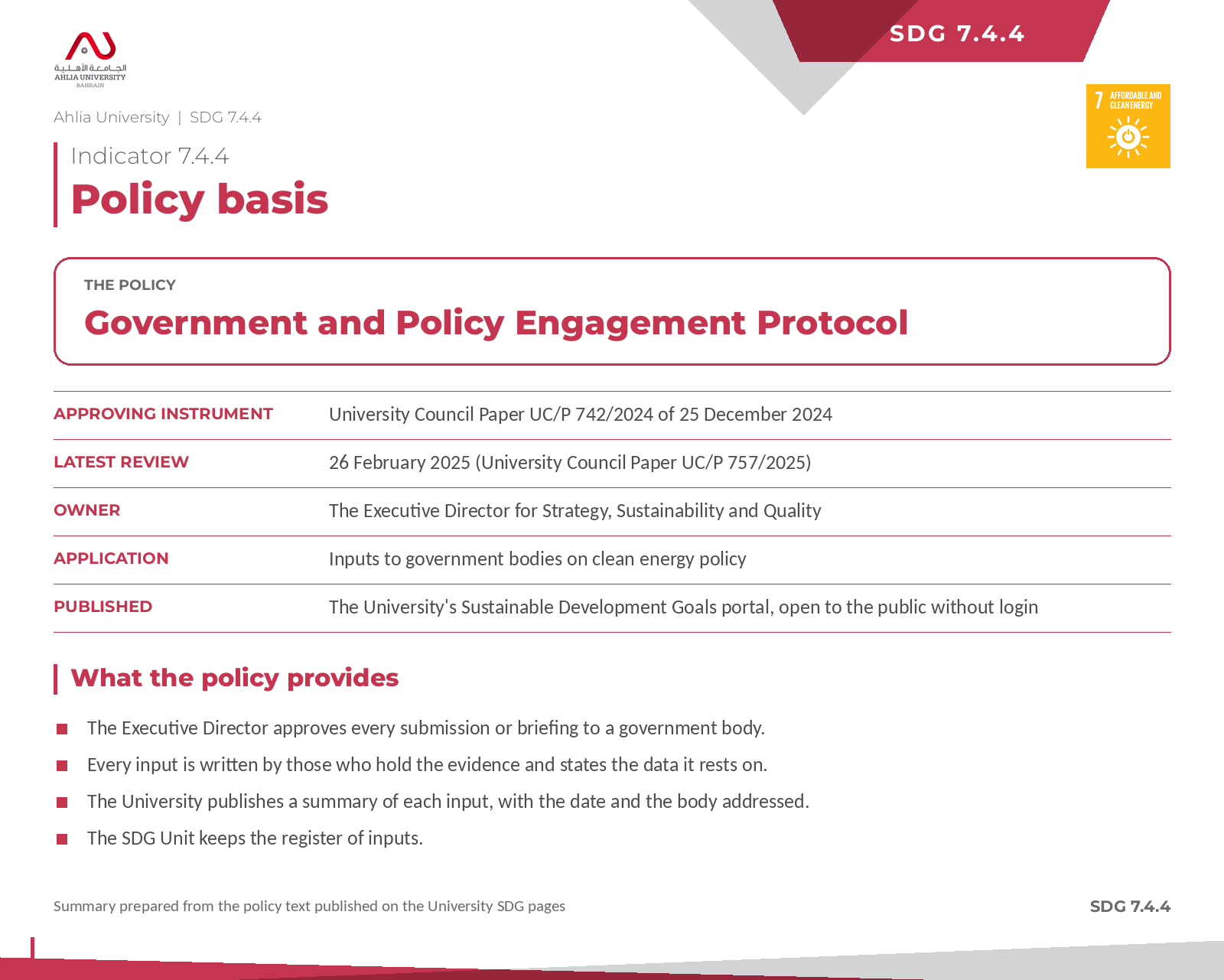
The Government and Policy Engagement Protocol (UC/P 742/2024 of 25 December 2024) sets four rules. The Executive Director for Strategy, Sustainability and Quality approves every submission or briefing to a government body. Every input is written by the academics or staff who hold the evidence and states the data it rests on. The University publishes a summary of each input on its Sustainable Development Goals portal, with the date and the body addressed. And the SDG Unit within CAQA keeps the register of inputs. The Protocol applies the University's Stakeholder Engagement and Public Disclosure Policy (UC/P 590/2022 of 28 September 2022). The same Protocol governs the inputs on climate risk reported under indicators 13.3.3 and 13.3.4. The three inputs of 2025 were entered in the register on the day they were made, and summaries of the submission and of the briefing were published on the portal on Thursday 22 May 2025, with the presentation to the Governorate's technical team published on the same day with the Governorate's agreement. The University has no joint programme with a regional or global governmental body on clean energy policy, and therefore claims neither level.
▪ Evidence: Protocol [5]; register of inputs, SDG Unit [3].
Policy basis
Policy: Government and Policy Engagement Protocol, University Council Paper UC/P 742/2024 of 25 December 2024, reviewed by UC/P 757/2025 of 26 February 2025, the latest review of the University's sustainability policies. Related policies: Stakeholder Engagement and Public Disclosure Policy, UC/P 590/2022 of 28 September 2022; Climate Action Plan 2025 to 2030, UC/P 733/2024 of 27 November 2024. Owner: the Executive Director for Strategy, Sustainability and Quality. Application: the four rules of section 3. Publication: the Protocol, the register and the summaries of inputs are published on the University's Sustainable Development Goals portal.
▪ Evidence: Protocol and policy papers [5].
Results by academic year
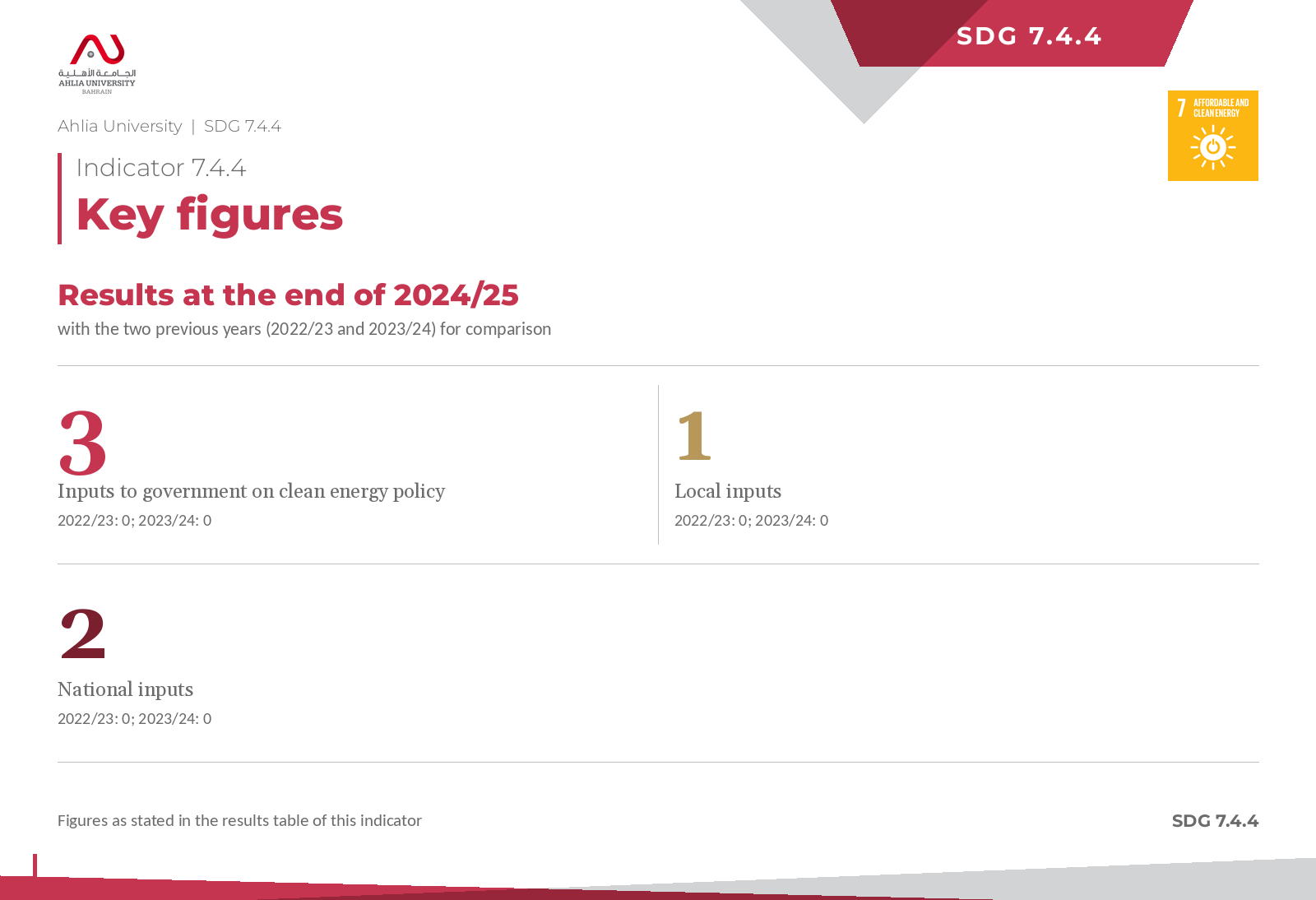
Inputs are the written submissions, presentations and briefings to a government body on clean energy or energy-efficient technology, counted by academic year of their date: 2022/23 and 2023/24 have none, because the Protocol was adopted on 25 December 2024, and 2024/25 has three: the Local presentation of 11 February 2025, the National submission of 8 May 2025 and the National briefing of 13 May 2025, so 1 + 2 = 3. The meeting with the Northern Governor reported on 29 December 2025 belongs to 2025/26. The levels not claimed, Regional and Global, have no inputs.
| Indicator | 2022/23 | 2023/24 | 2024/25 |
|---|---|---|---|
| Inputs to government on clean energy policy | 0 | 0 | 3 |
| Local inputs | 0 | 0 | 1 |
| National inputs | 0 | 0 | 2 |
▪ Evidence: register of inputs [3].
Publication and verification
This document, which is the University's evidence for indicator 7.4.4 and is kept by the SDG Unit within CAQA, for the Executive Director for Strategy, Sustainability and Quality, was approved by University Council Paper UC/P 830/2026 of 14 January 2026 together with the 2025 edition of the SDG reports (University Council Paper UC/P 829/2026 of the same day, published 21 January 2026) and published on the University's Sustainable Development Goals portal on 28 January 2026, open to the public without login. The underlying registers, the register of inputs, the submissions, the briefing slides and the attendance notes, are held by the SDG Unit and are quoted in the text above.
Evidence and references
- Executive Director for Strategy, Sustainability and Quality: presentation, attendance note and covering letter to the Northern Governorate technical team, 11 and 20 February 2025
- Press report of the meeting of Ahlia University's leadership with the Northern Governor, 29 December 2025 (campus commended for sustainable design)
- College of Engineering and SDG Unit: submission of 8 May 2025 with acknowledgement of receipt; briefing slides and attendance note of 13 May 2025; register of inputs, 2024 and 2025
- Ahlia University: SDG 14 page (water-quality research findings shared with the Electricity and Water Authority) https://www.ahlia.edu.bh/sustainable-development-goals/sdg-14/
- University Council: Government and Policy Engagement Protocol (UC/P 742/2024, reviewed UC/P 757/2025); Stakeholder Engagement and Public Disclosure Policy (UC/P 590/2022); Climate Action Plan 2025 to 2030 (UC/P 733/2024)