
Ahlia University (Ahlia), the first private university licensed in the Kingdom of Bahrain, as a body has water quality standards and guidelines for water discharges, to uphold water quality in order to protect ecosystems, wildlife, and human health and welfare. They are the Water Discharge Standards and Guidelines (Administrative Circular No. 149/2024 of Thursday 15 February 2024), issued by the Vice President for Administrative and Financial Affairs under the Water Management, Reuse and Pollution Prevention Policy (University Council Paper UC/P 626/2023 of 22 March 2023), and they build on the Procedure for Discharge to the Public Sewerage Network and Pre-treatment of Kitchen and Laboratory Effluent, reported in detail under indicator 6.3.1. The University is housed in the Gosi Complex, Exhibition Road, Al-Hoora, Manama, a leased complex of two buildings, and has no discharge of its own to the sea, the ground or storm drains: all wastewater goes to the public sewerage network. The standards therefore fix what the premises may send into the network and what must never enter any drain. Facilities and Maintenance owns them, with the laboratories of the Colleges of Engineering, Information Technology and Medical and Health Sciences.
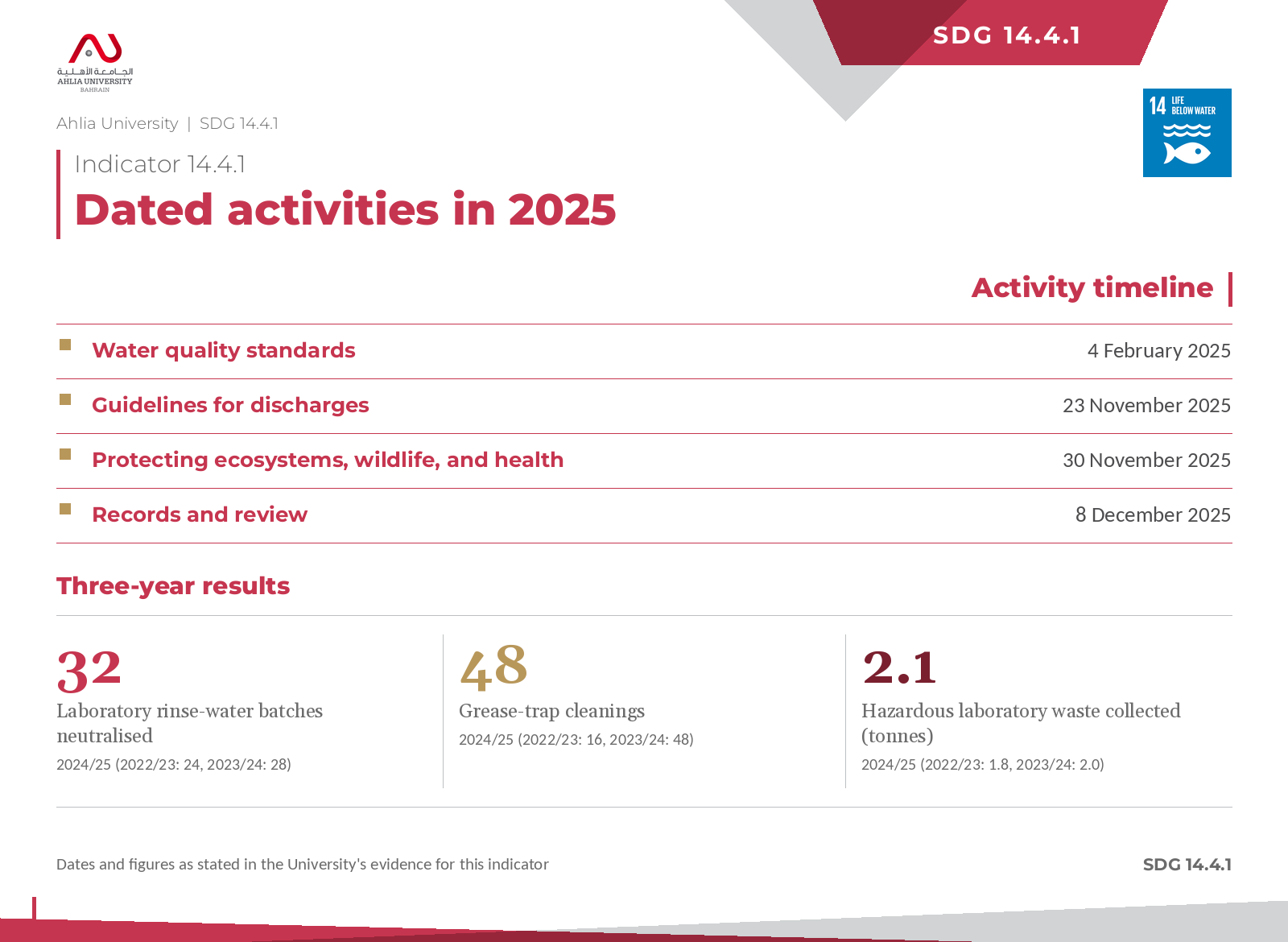
In calendar 2025, which is the 2024/25 column, the laboratories neutralised 32 batches of rinse water, all inside pH 6 to 9 before discharge, the four grease traps were cleaned 48 times, licensed contractors collected 2.1 tonnes of hazardous laboratory waste and 30 staff were briefed on the standards; there were no discharges of the University's own and no incidents. The same measures in 2024 were 28 batches, 48 cleanings, 2.0 tonnes and 26 staff, and in 2023 24 batches, 16 cleanings, 1.8 tonnes and 22 staff.
At a glance
Element of the question
| Water quality standards | Standing activity or document: Seven standards for what may leave the laboratories, kitchens and cleaning operations, including pH 6 to 9 for laboratory rinse water Owner: Facilities and Maintenance; Colleges with laboratories Latest dated instance in 2025: Staff briefing, Tuesday 4 February 2025; 32 batches in 2025 Three-year figure: 84 batches |
|---|---|
| Guidelines for discharges | Standing activity or document: Written guidelines for staff on what never goes to a drain: solvents, reagents, chemical waste, oils and paint Owner: Facilities and Maintenance Latest dated instance in 2025: Last hazardous waste collection of 2025, Sunday 23 November 2025 Three-year figure: 5.9 tonnes |
| Protecting ecosystems, wildlife, and health | Standing activity or document: No discharge of its own to the sea, ground or storm drains; grease traps; licensed contractors Owner: Facilities and Maintenance; Financial Affairs Directorate Latest dated instance in 2025: Grease-trap round, Sunday 30 November 2025 Three-year figure: 112 cleanings |
| Records and review | Standing activity or document: Annual discharge statement and incident register Owner: SDG Unit within CAQA Latest dated instance in 2025: Review, Monday 8 December 2025 Three-year figure: 3 statements, 0 incidents |
▪ Evidence for each element is cited in its own section below.
1. What the standards are for
Wastewater from the premises reaches the national treatment plants through the public sewerage network, and what the plants cannot treat can pass to the Gulf. The standards are written to protect that chain at its start. They apply to three sources: the laboratories, the cafeteria kitchen and pantries, and the cleaning of the buildings. They state a limit where one can be measured on the premises, a rule where it cannot, and a record for both. The Climate Action Policy of the University supports them with practices that keep dirty water out of drains: water-efficient cleaning machines that save at least 80% of the water, mopping only and no hoses on floors, automatic flush devices and a maintenance team that fixes leaks quickly.
▪ Evidence: Water Discharge Standards and Guidelines, Administrative Circular No. 149/2024 of Thursday 15 February 2024 [1]; Climate Action Policy page.
2. The seven standards
| Source | Standard | How it is checked |
|---|---|---|
| Destination of all water | All wastewater goes to the public sewerage network; nothing goes to storm drains, soil or the sea | Annual drain survey and discharge statement |
| Laboratory rinse water | Collected at the sink and neutralised to between pH 6 and 9 before it is poured to the drain | Batch log with the pH reading; 24, 28 and 32 batches |
| Kitchen and pantry effluent | Passes through grease traps, four in all, cleaned by a licensed contractor | Service sheets; 16, 48 and 48 cleanings |
| Hazardous liquids | Solvents, reagents, chemical waste, oils and paint never go to a drain; licensed contractors collect them | Contractor receipts; 1.8, 2.0 and 2.1 tonnes |
| Cleaning | Water-efficient machines and mopping, no hoses on floors, detergents from the approved list in measured doses | Cleaning log and product list |
| National limits | Where the competent national authority sets a limit for discharge to the public network, that limit overrides this table | Annual check by Facilities and Maintenance |
| Records and incidents | Annual discharge statement; any spill reported the same day to the Vice President for Administrative and Financial Affairs and the complex operator | Incident register; no incident in three years |
▪ Evidence: standards table, batch logs, service sheets and contractor receipts, 2023 to 2025, Facilities and Maintenance [1].
3. Laboratories: neutralisation and hazardous liquids
The laboratories keep a batch log. Rinse water that may be acid or alkaline is collected, its acidity is measured with indicator strips, and it is poured to the drain only between pH 6 and 9. The laboratories neutralised 24 batches in 2023, 28 in 2024 and 32 in 2025, which is 84 in three years, and every batch of 2025 was recorded inside the range. Chemicals, solvents and reagents are never poured to the drain; licensed contractors collected 1.8 tonnes of hazardous laboratory waste in 2023, 2.0 in 2024 and 2.1 in 2025, which is 5.9 tonnes, a series reported in detail under indicator 12.2.3; the last collection of 2025 was on Sunday 23 November 2025.
▪ Evidence: laboratory batch logs of the three colleges and contractor receipts, 2023 to 2025 [1].
4. Kitchens and cleaning
The cafeteria kitchen, the cafeteria counter and two staff pantries each have a grease trap. A licensed contractor cleaned the four traps every quarter in 2023, which gave 16 cleanings, and every month in 2024 and 2025, which gave 48 each year, 112 in all; the last round of 2025 was on Sunday 30 November 2025. Grease and sludge are taken away by the contractor and are not washed into the drain. For cleaning, the approved product list and the measured doses were introduced by the Circular, and the water-efficient machines of the Climate Action Policy page are the equipment on which they are applied.
▪ Evidence: grease-trap service sheets and cleaning log, Facilities and Maintenance and Financial Affairs Directorate [1]; Climate Action Policy page.
5. Briefing, records and review
Facilities and Maintenance briefs laboratory technicians, kitchen staff and cleaning staff on the standards each year; the briefing of Tuesday 4 February 2025 reached 30 staff, against 26 in 2024 and 22 in 2023. The annual discharge statement says that the University has no discharge of its own and lists the batches, cleanings and tonnages; the statement for 2024 was signed on Wednesday 12 February 2025. The University Sustainability Committee reviewed the standards and the records on Monday 19 May 2025 and the year to 30 November 2025 on Monday 8 December 2025. No spill or incident was recorded in the three years.
▪ Evidence: briefing attendance sheets, discharge statements and incident register, Facilities and Maintenance; minutes of the University Sustainability Committee, 19 May and 8 December 2025 [3].
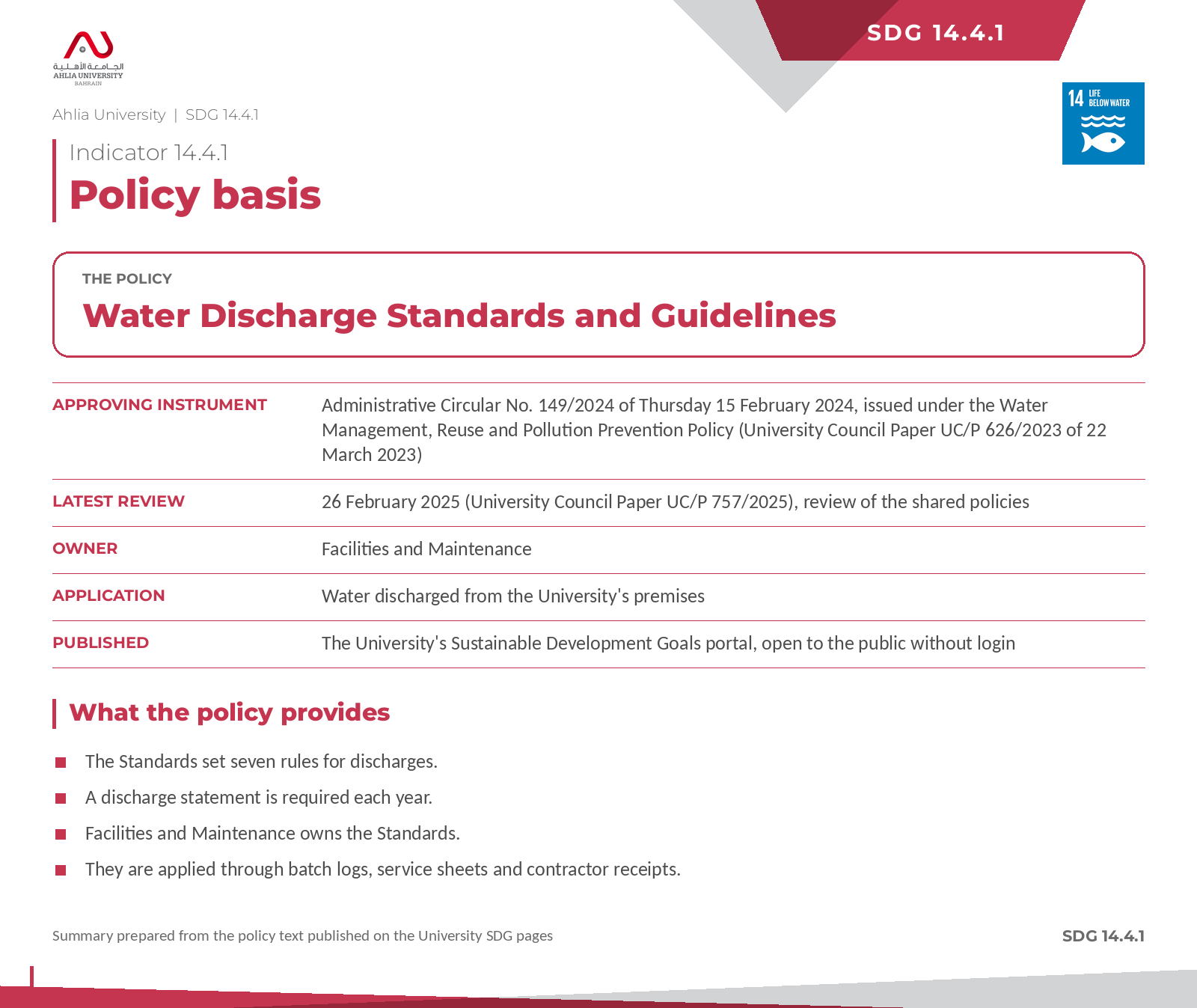
Policy basis
Title: Water Discharge Standards and Guidelines. Approving instrument: Administrative Circular No. 149/2024 of Thursday 15 February 2024, issued under the Water Management, Reuse and Pollution Prevention Policy (University Council Paper UC/P 626/2023 of 22 March 2023); the standards were approved on 15 February 2024 and last reviewed by University Council Paper UC/P 757/2025 of 26 February 2025, the review of the shared policies. The clauses state the seven standards of section 2, require a discharge statement each year and make Facilities and Maintenance the owner. They are applied through batch logs, service sheets and contractor receipts. In 2024/25 they produced 32 neutralised batches, 48 grease-trap cleanings and 2.1 tonnes of hazardous waste collected. They are published on the University's Sustainable Development Goals portal with this document.
▪ Evidence: Circular text and review record [1]; policy text [4].
Results by academic year
Registers are kept by calendar year, so the 2022/23 column is calendar 2023, the 2023/24 column is 2024 and the 2024/25 column is 2025; the scope is the Gosi Complex premises. Batches are the lines of the laboratory batch logs, 24 + 28 + 32 = 84. Cleanings are the cleanings of the four grease traps, 4 x 4 = 16 in 2023 and 4 x 12 = 48 in 2024 and 2025, 112 in all. Hazardous waste is the weight collected by licensed contractors, 1.8 + 2.0 + 2.1 = 5.9 tonnes. Staff briefed are those on the briefing sheets. The share is the batches recorded inside pH 6 to 9 divided by all batches. Percentages are rounded to whole numbers.
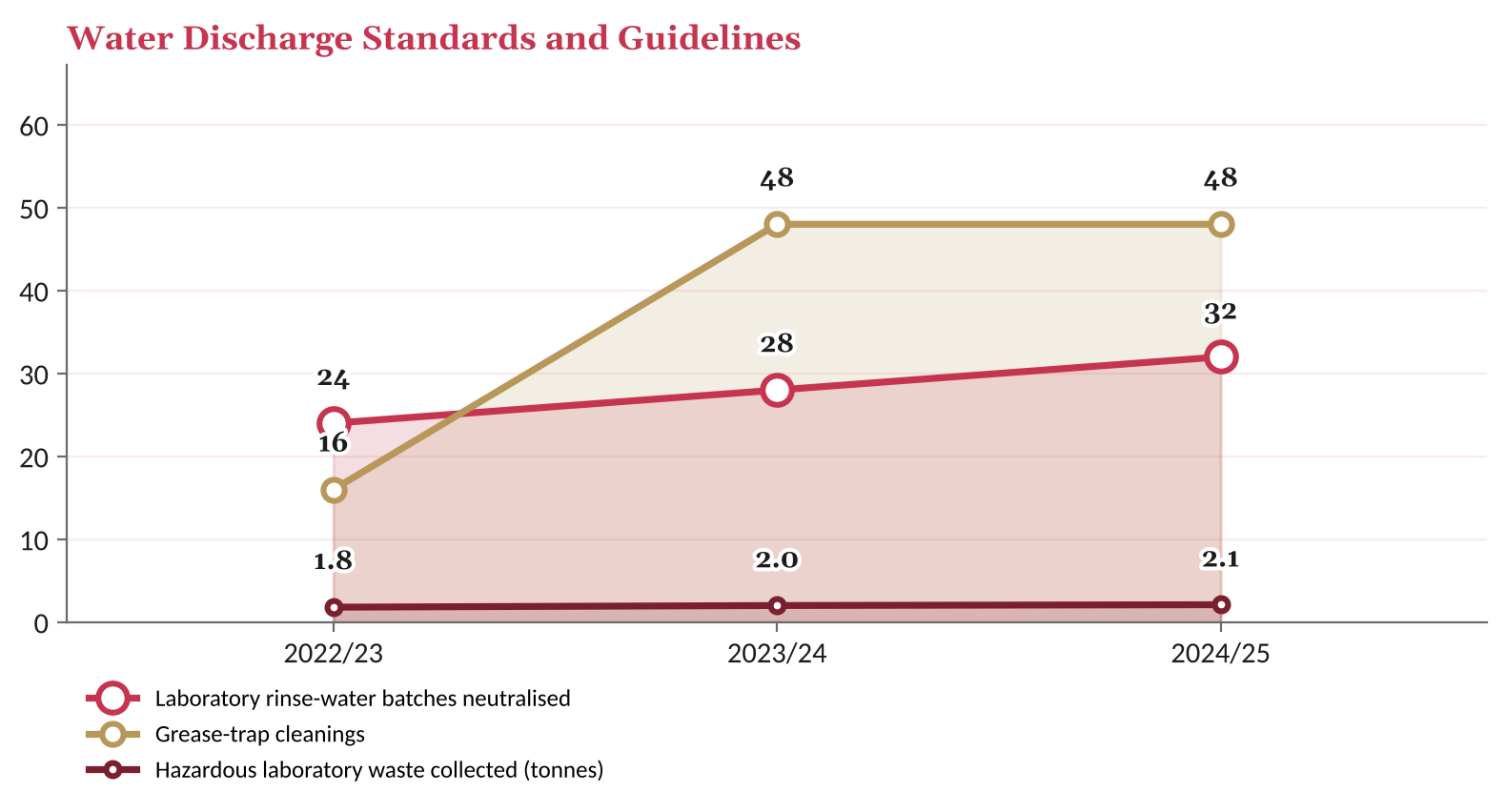
| Indicator | 2022/23 | 2023/24 | 2024/25 |
|---|---|---|---|
| Laboratory rinse-water batches neutralised | 24 | 28 | 32 |
| Grease-trap cleanings | 16 | 48 | 48 |
| Hazardous laboratory waste collected (tonnes) | 1.8 | 2.0 | 2.1 |
| Staff briefed on the standards | 22 | 26 | 30 |
| Discharges of its own to the sea, ground or storm drains | 0 | 0 | 0 |
| Batches recorded inside pH 6 to 9 | 100% | 100% | 100% |
▪ Evidence: registers listed in the references [1], [3].
Publication and verification
This document, which is the University's evidence for indicator 14.4.1 and is kept by Facilities and Maintenance, with the SDG Unit within CAQA, was approved by University Council Paper UC/P 830/2026 of 14 January 2026 together with the 2025 edition of the SDG reports (University Council Paper UC/P 829/2026 of the same day, published 21 January 2026) and published on the University's Sustainable Development Goals portal on 28 January 2026, open to the public without login. The underlying registers, which are the laboratory batch logs, the grease-trap service sheets, the contractor receipts, the cleaning log, the briefing sheets, the discharge statements and the incident register, are held by Facilities and Maintenance and are quoted in the text above.
Evidence and references
- Water Discharge Standards and Guidelines, Administrative Circular No. 149/2024 of Thursday 15 February 2024; laboratory batch logs, grease-trap service sheets, contractor receipts, cleaning log, briefing sheets, discharge statements and incident register, 2023 to 2025, Facilities and Maintenance
- Ahlia University, Climate Action Policy page (page modified 24 May 2024): the University Policy on Healthy Environment, the Environmental Policy and the University Policy on Efficient Use of Paper are named there; water-efficient cleaning machines, automatic flush devices, spray irrigation, low-water plants and waste collected in separate containers by specialised waste management companies https://www.ahlia.edu.bh/climate-action-policy/
- Minutes of the University Sustainability Committee, 19 May and 8 December 2025 (SDG Unit, CAQA)
- Water Management, Reuse and Pollution Prevention Policy, University Council Paper UC/P 626/2023 of 22 March 2023, reviewed by UC/P 757/2025 of 26 February 2025; owner Facilities and Maintenance