
Ahlia University, the first private university licensed in the Kingdom of Bahrain, housed in the Gosi Complex in Manama, has, as a body, a policy to reduce the impact of alien species on campus. The policy is the Biodiversity and Landscape Stewardship Policy (University Council Paper UC/P 651/2023 of 20 September 2023, reviewed by University Council Paper UC/P 757/2025 of 26 February 2025), whose invasive species clause is carried out by the Procedure for Species Screening, Invasive Species Control and Biodiversity Checks in Landscape and Design Projects (Administrative Circular No. 150/2024 of 15 February 2024). The University uses the definition of the International Union for Conservation of Nature (IUCN): an alien species is one that has been introduced outside its natural range, and an invasive alien species is an alien species that spreads and harms native species or the land. The campus is a planted landscape of 860 m2 in the entrance garden, the terraces and the roof-level planters of a leased complex. No invasive species has been introduced into it, the list of species planted is reviewed every year, and one species of concern is kept in pots and is being replaced.
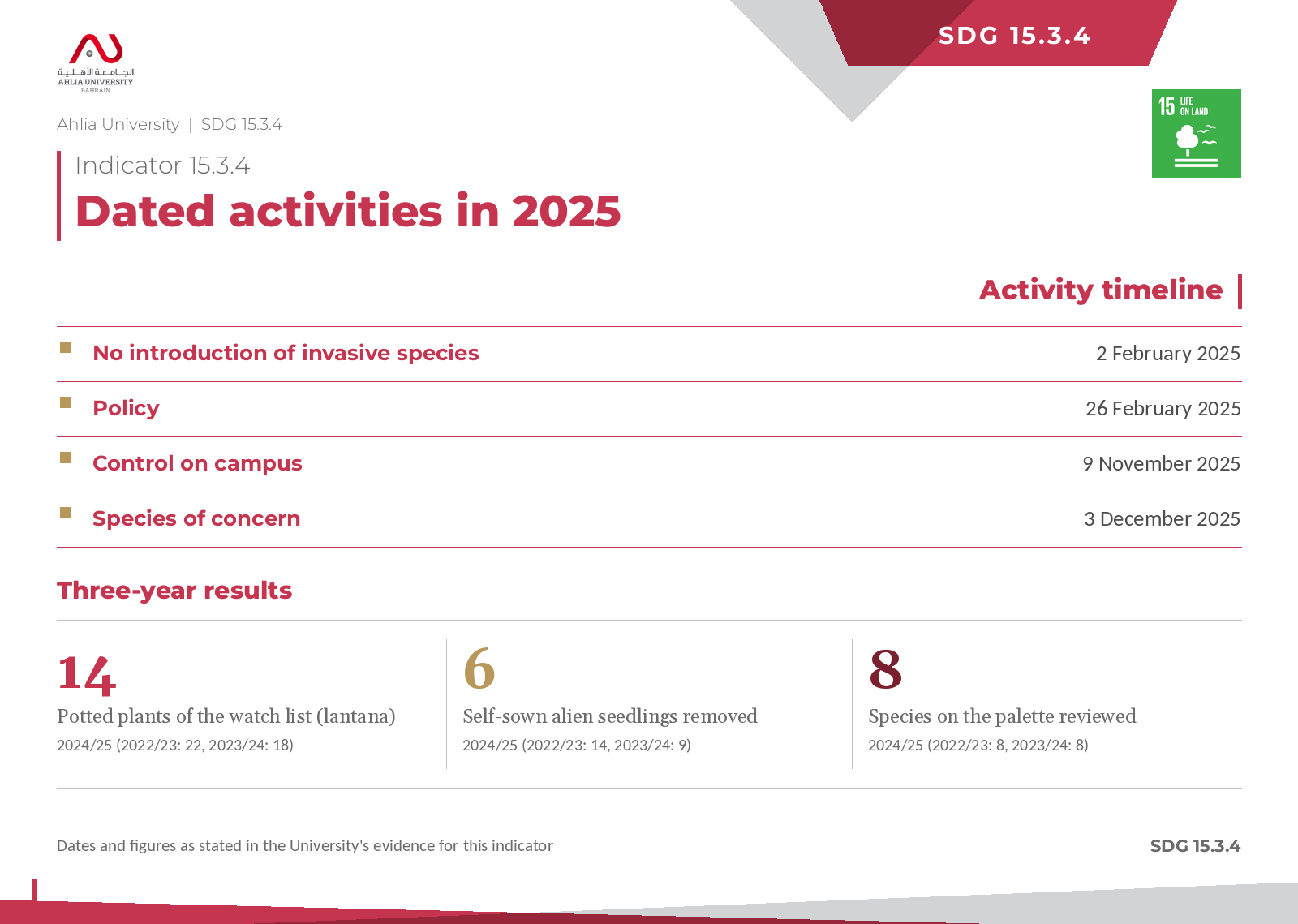
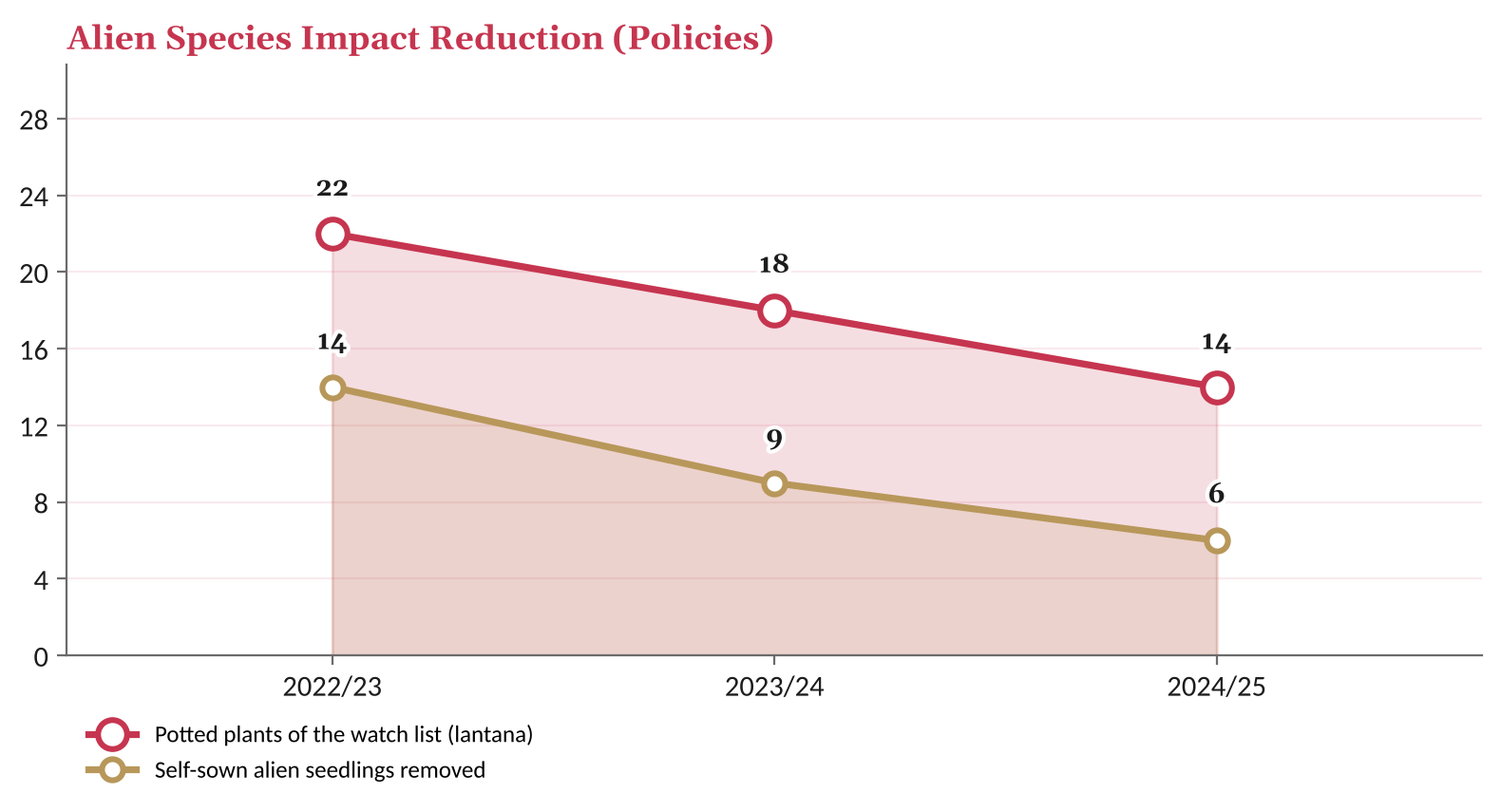
The figures are kept by calendar year, so that 2022/23 is calendar 2023, 2023/24 is 2024 and 2024/25 is 2025. The potted plants of the species of concern fell from 22 at the end of 2023 to 18 in 2024 and 14 in 2025, and the self-sown alien seedlings pulled from the planters fell from 14 to 9 and then 6. The planting palette of 8 species was reviewed in each of the three years, the latest review on Sunday 2 February 2025, and no alien species was added in any year.
At a glance
Element of the question
| Policy | Standing activity or document: Biodiversity and Landscape Stewardship Policy, invasive species clause Owner: Facilities and Maintenance Latest dated instance in 2025: Review, UC/P 757/2025 of 26 February 2025 Three-year figure: 1 policy |
|---|---|
| No introduction of invasive species | Standing activity or document: Screening of every new species before it is planted; no new alien species on the palette Owner: Facilities and Maintenance; College of Engineering Latest dated instance in 2025: Palette review, Sunday 2 February 2025 Three-year figure: 0 alien species added in three years |
| Species of concern | Standing activity or document: Watch list: lantana kept in pots only and not replanted Owner: Facilities and Maintenance Latest dated instance in 2025: Count of potted plants, Wednesday 3 December 2025 Three-year figure: 14 potted plants in 2025 |
| Control on campus | Standing activity or document: Removal of self-sown alien seedlings from planters and beds Owner: Facilities and Maintenance; Sustainability Club Latest dated instance in 2025: Seedling round, Sunday 9 November 2025 Three-year figure: 29 seedlings removed |
| Yearly list review | Standing activity or document: Palette of 8 species reviewed each February Owner: Facilities and Maintenance Latest dated instance in 2025: Palette review, Sunday 2 February 2025 Three-year figure: 3 reviews |
▪ Evidence for each element is cited in its own section below.
1. What counts as an alien species on campus
The planting palette of the Landscape Water Plan has 8 species. Two of them, sidr and date palm, are native to Bahrain, and six are drought-tolerant species from other regions that have grown in Bahraini gardens for a long time: oleander, bougainvillea, lantana, agave, aloe and desert rose. By the IUCN definition those six are alien, so the University does not say that its campus has no alien species. It says that none of them has been found to spread outside the planter or bed in which it is planted, that none has been introduced since the Policy was approved, and that the Policy now controls any addition. The Climate Action Policy of the University records that the plants used on campus are those that consume little water, which is the reason for the choice of the palette.
▪ Evidence: Landscape Water Plan, palette and species list, Facilities and Maintenance [1]; Climate Action Policy page.
2. Preventing introductions
The invasive species clause forbids the planting of any species that is not on the palette. A new species can be added only if Facilities and Maintenance and the College of Engineering have screened it under the Procedure, by reading the IUCN lists of invasive alien species, by asking the national authority and by checking that the species does not spread by seed or runner in Bahrain, and only if the Vice President for Administrative and Financial Affairs signs the change to the palette. No species was added in 2023, 2024 or 2025, so the palette stayed at 8 species. The saplings planted on public sites with the municipal planting programme, which are reported under indicator 15.2.3, are native species only, so that the community planting days add no alien species either.
▪ Evidence: Procedure, Administrative Circular No. 150/2024 of 15 February 2024, and palette change register, Facilities and Maintenance [1].
3. Reducing the impact: the watch list and the removal rounds
One species of the palette is on a watch list. The IUCN Invasive Species Specialist Group lists lantana among the world's worst invasive alien species, so the University keeps it only in the pots of the roof-level planters, where it cannot spread, removes the flower heads before they set seed, and does not replant it when a plant dies: sidr or another native species takes its place. The potted plants numbered 22 at the end of 2023, 18 at the end of 2024 and 14 at the end of 2025, counted on Wednesday 3 December 2025. Facilities and Maintenance also walks the entrance garden, the terraces and the planters each autumn and spring and pulls any self-sown seedling of an alien species. It removed 14 seedlings in 2023, 9 in 2024 and 6 in 2025, which is 29 in three years, the last round being on Sunday 9 November 2025.
▪ Evidence: watch list, potted plant counts and seedling round sheets, Facilities and Maintenance, 2023 to 2025 [1].
4. Review and record
The palette is reviewed each February against the IUCN lists and the national list, and the review of Sunday 2 February 2025 confirmed the 8 species and the watch list. The University Sustainability Committee reviewed the counts on Monday 8 December 2025, with the screening register reported under indicator 15.3.2. The Policy is published on the University's Sustainable Development Goals portal together with the Procedure.
▪ Evidence: palette review sheets, 2 February 2025, Facilities and Maintenance [1]; Committee minutes, 8 December 2025, SDG Unit, CAQA [3].
Policy basis
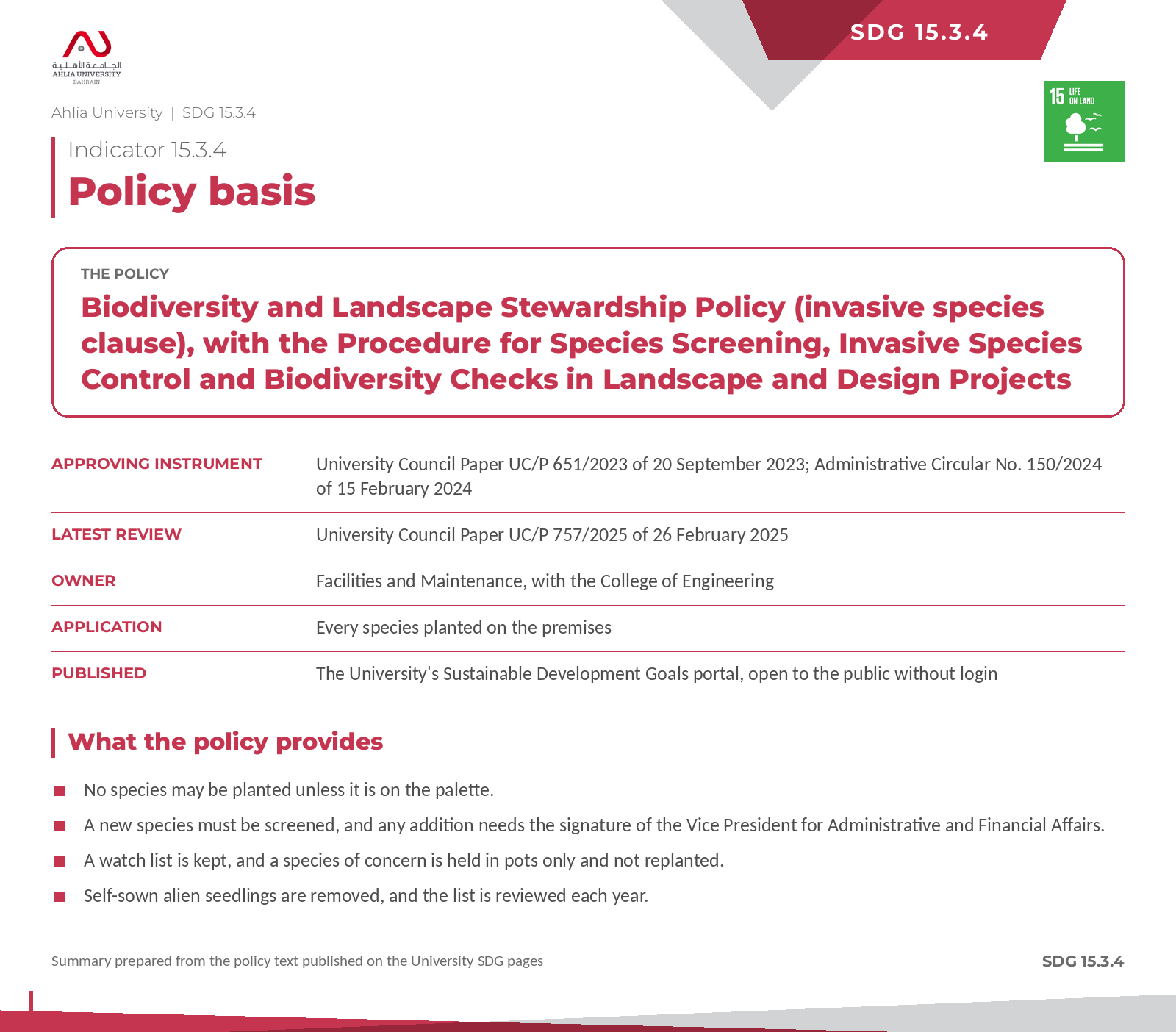
Title: Biodiversity and Landscape Stewardship Policy (invasive species clause), with the Procedure for Species Screening, Invasive Species Control and Biodiversity Checks in Landscape and Design Projects. Approving instruments: University Council Paper UC/P 651/2023 of 20 September 2023; Administrative Circular No. 150/2024 of 15 February 2024; latest review: University Council Paper UC/P 757/2025 of 26 February 2025. Owner: Facilities and Maintenance, with the College of Engineering. The clauses that answer the question forbid the planting of any species that is not on the palette, require the screening of a new species and the signature of the Vice President for Administrative and Financial Affairs for any addition, keep a watch list with the rule that a species of concern is held in pots only and not replanted, and require the removal of self-sown alien seedlings and a yearly review of the list. Application in 2024/25: 8 species on the palette, none added, 14 potted plants of the watch list, 6 seedlings removed. The Policy is published on the University's Sustainable Development Goals portal.
▪ Evidence: policy text and review record [1].
Results by academic year
Potted plants of the watch list are those held in the roof-level planters at the end of the calendar year (2023, 2024 and 2025, read as 2022/23, 2023/24 and 2024/25): 22, 18 and 14. Seedlings removed are the self-sown alien seedlings pulled at the seedling rounds of the year: 14 + 9 + 6 = 29. Species on the palette are those reviewed each February: 8 in each year. Alien species added to the palette: 0 in each year. The share is the species reviewed divided by the species on the palette, which is 100% in each year.
| Indicator | 2022/23 | 2023/24 | 2024/25 |
|---|---|---|---|
| Potted plants of the watch list (lantana) | 22 | 18 | 14 |
| Self-sown alien seedlings removed | 14 | 9 | 6 |
| Species on the palette reviewed | 8 | 8 | 8 |
| Alien species added to the palette | 0 | 0 | 0 |
| Share of palette species reviewed each year | 100% | 100% | 100% |
Publication and verification
This document, which is the University's evidence for indicator 15.3.4 and is kept by Facilities and Maintenance, with the College of Engineering, was approved by University Council Paper UC/P 830/2026 of 14 January 2026 together with the 2025 edition of the SDG reports (University Council Paper UC/P 829/2026 of the same day, published 21 January 2026) and published on the University's Sustainable Development Goals portal on 28 January 2026, open to the public without login. The underlying registers, which are the palette change register, the watch list counts, the seedling round sheets and the palette review sheets, are held by the offices named above and are quoted in the text.
Evidence and references
- Landscape Water Plan palette and species list, Procedure for Species Screening, Invasive Species Control and Biodiversity Checks in Landscape and Design Projects (Administrative Circular No. 150/2024 of 15 February 2024), palette change register, watch list counts and seedling round sheets, Facilities and Maintenance; Biodiversity and Landscape Stewardship Policy, University Council Paper UC/P 651/2023 of 20 September 2023, reviewed by UC/P 757/2025 of 26 February 2025
- Ahlia University: Climate Action Policy (plants on campus consume a lower quantity of water; page modified 24 May 2024) https://www.ahlia.edu.bh/climate-action-policy/
- Minutes of the University Sustainability Committee, 17 February, 19 May, 29 September and 8 December 2025, SDG Unit within CAQA