Ahlia University, the first private university licensed in the Kingdom of Bahrain, housed in the Gosi Complex in Manama, has, as a body, a policy on ethical sourcing of food and supplies. The University Council adopted the Sustainable Procurement, Food and Ethical Sourcing Policy (University Council Paper UC/P 649/2023 of 20 September 2023) and reviewed it by University Council Paper UC/P 757/2025 of 26 February 2025. The Policy builds on the University's Purchasing Policy (document SM11) and Purchasing Policy and Procedures (document ES4), published on the University's Procurement / Purchasing Policy page in April 2025, and on the commitment in the Climate Action Policy to Sustainable Procurement, life-cycle thinking and the triple bottom line of economic, environmental and social principles in all purchasing. Suppliers of both food and supplies are bound by the Supplier Code of Conduct (University Council Paper UC/P 595/2022 of 26 October 2022).
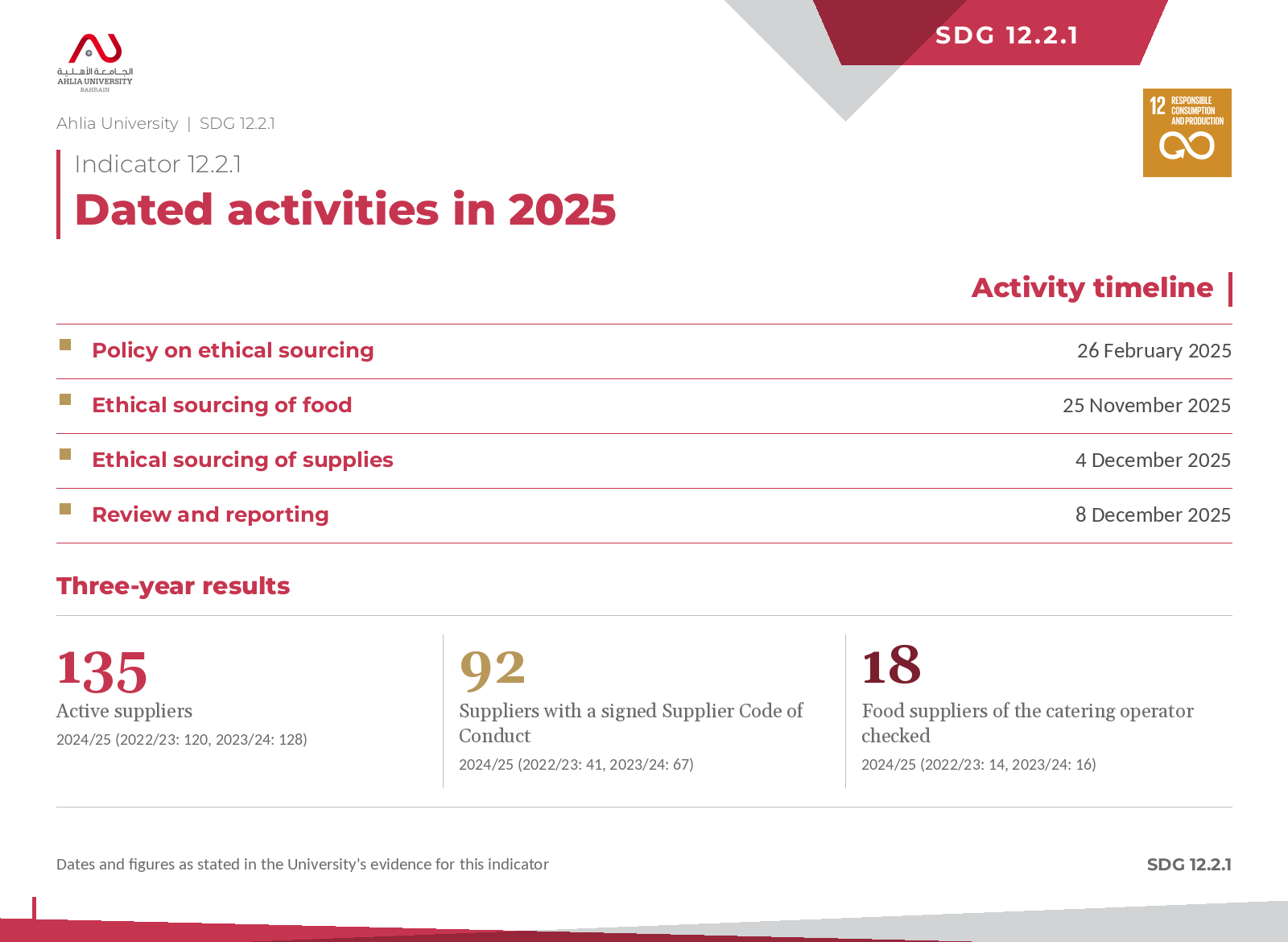
At the end of 2025 the University had 135 active suppliers, of whom 92 (68%) had signed the Supplier Code of Conduct, and the catering operator that serves all food on the premises bought from 18 food suppliers, all of whose certificates were checked on Tuesday 25 November 2025. Over the three academic years 2022/23 to 2024/25 the share of active suppliers with a signed Code rose from 34% to 52% and 68% (41, 67 and 92 suppliers).
At a glance
Element of the question
| Policy on ethical sourcing | Standing document or practice: Sustainable Procurement, Food and Ethical Sourcing Policy; Purchasing Policy (SM11); Purchasing Policy and Procedures (ES4) Owner: University Council; Procurement Latest dated instance in 2025: Review, UC/P 757/2025 of 26 February 2025; SM11 and ES4 published April 2025 Three-year figure: 3 documents |
|---|---|
| Ethical sourcing of supplies | Standing document or practice: Supplier Code of Conduct signed at registration and at each renewal; tenders scored on sustainability and ethics Owner: Procurement; Vice President for Administrative and Financial Affairs Latest dated instance in 2025: Supplier register review, Thursday 4 December 2025 Three-year figure: 92 of 135 suppliers signed in 2025 |
| Ethical sourcing of food | Standing document or practice: Food sourcing clauses in the contract of the catering operator; certificates of every food supplier checked each year Owner: Facilities and Maintenance; Procurement Latest dated instance in 2025: Certificate check, Tuesday 25 November 2025 Three-year figure: 18 food suppliers checked in 2025 |
| Review and reporting | Standing document or practice: Yearly supplier register review reported to the University Sustainability Committee Owner: Procurement; SDG Unit Latest dated instance in 2025: Committee meeting, Monday 8 December 2025 Three-year figure: 3 yearly reviews |
▪ Evidence for each element is cited in its own section below.
1. What the policy says
The Sustainable Procurement, Food and Ethical Sourcing Policy applies to every purchase made by the University of food, supplies, equipment, travel services and works. It rests on the statement in the Climate Action Policy that the University 'recognizes that its demand for goods and services can generate social, economic and environmental impacts, both locally and abroad' and is therefore committed to Sustainable Procurement, life-cycle thinking and the triple bottom line principles in all its purchasing activities [1]. The Climate Action Policy lists the goods covered: IT equipment, furniture, paper, energy-using appliances, travel services, cleaning products and laboratory equipment. The University Policy on Healthy Environment adds that purchasing practices are to be environmentally safe and responsible whenever possible [1].
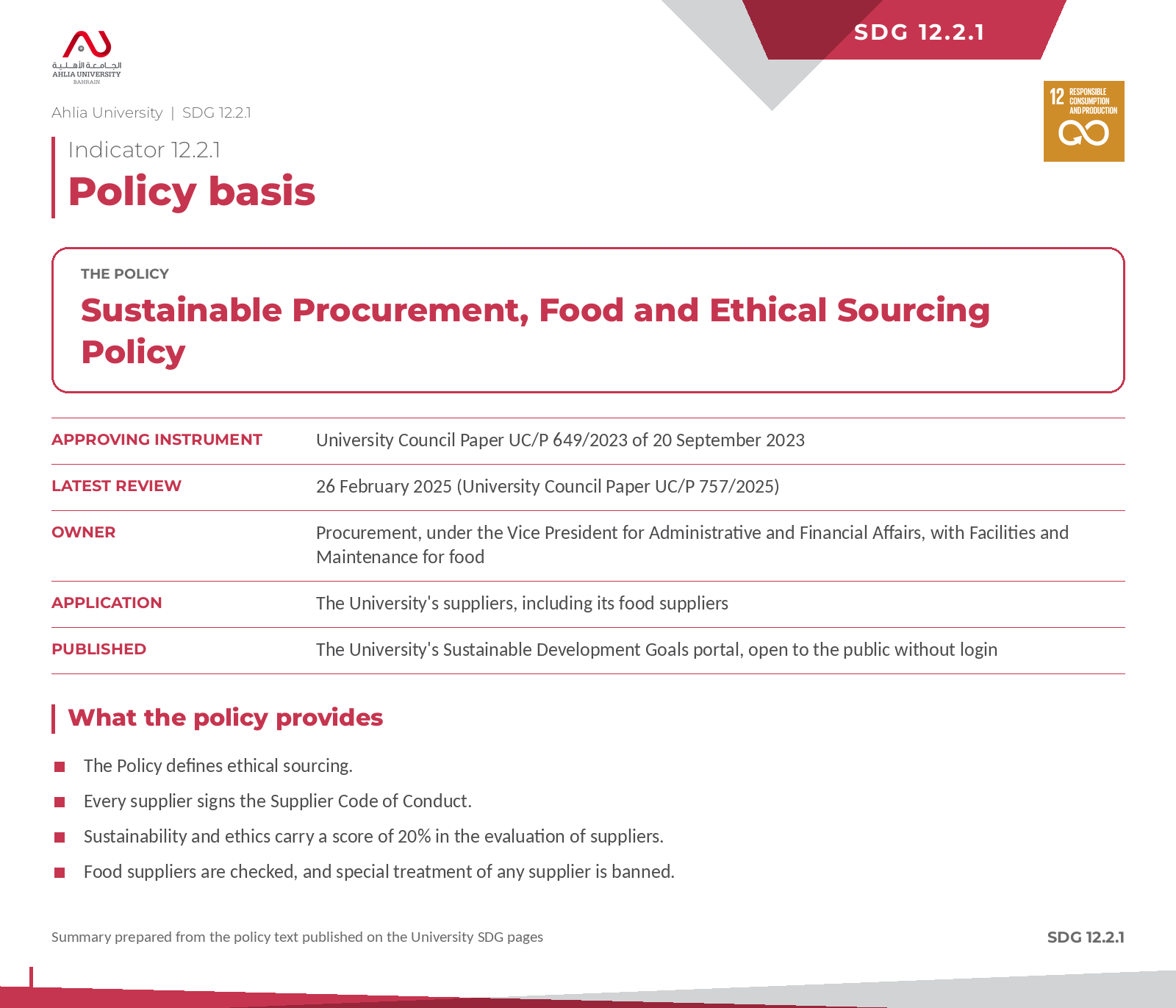
The Policy defines ethical sourcing as buying from suppliers that obey the law, treat their workers fairly, deal honestly, protect the environment and can show it. It sets four rules: every new supplier signs the Supplier Code of Conduct at registration and every supplier signs it again at each renewal of its contract; every purchase above BD 3,000 is made on three written quotations scored on price (60%), quality (20%) and sustainability and ethics (20%); food is bought only from suppliers whose licences and certificates are checked; and no employee may seek special treatment for a supplier. The last rule repeats the Fairness principle of the Staff Handbook, which says that suppliers are selected through a competitive evaluation process [2].
▪ Evidence: Climate Action Policy page, Sustainable Procurement and Healthy Environment sections; Sustainable Procurement, Food and Ethical Sourcing Policy, UC/P 649/2023 and its review UC/P 757/2025 [2]; Staff Handbook, Fairness principle [3].
2. Ethical sourcing of supplies
The Supplier Code of Conduct was approved by University Council Paper UC/P 595/2022 of 26 October 2022, so that it applied to the whole of 2023. It has five commitments: lawful employment with no forced or child labour and with the minimum wage paid; safe and healthy working conditions; honest dealing with no bribes, in line with the University's Anti-Bribery and Corruption Policy; compliance with environmental rules and the waste, plastic and paper requirements reported in detail under indicator 12.2.8; and open records that the University may inspect. Procurement asks each supplier to sign the Code when it is first registered and again at each renewal of its contract, and keeps the signed copy in the supplier register.
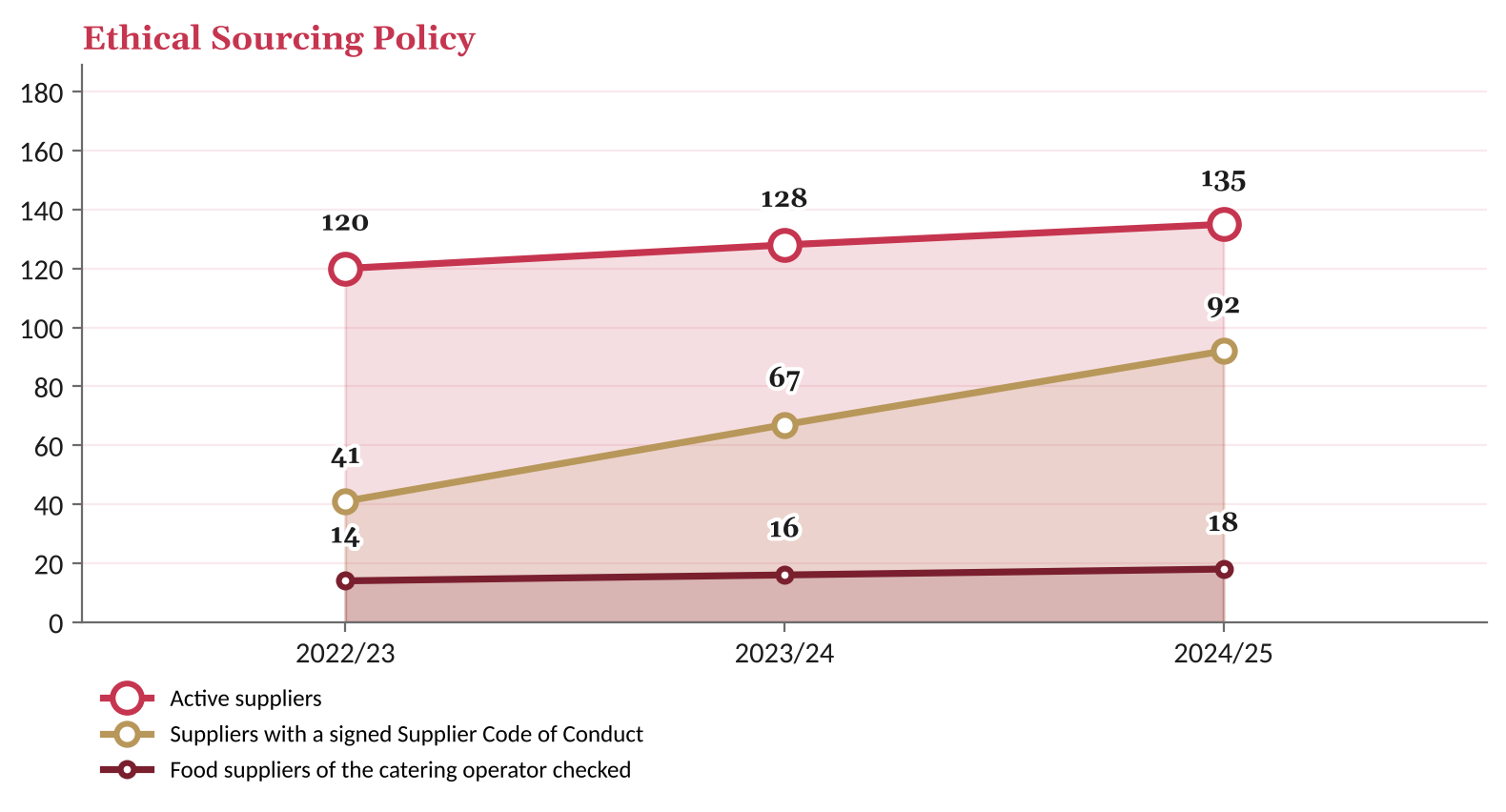
The register held 120 active suppliers in 2023, 128 in 2024 and 135 in 2025. Signed Codes numbered 41 (34%), 67 (52%) and 92 (68%), because contracts are renewed in rotation and suppliers are asked to sign at renewal. A supplier that refuses to sign is not given a new order. The register was reviewed by Procurement on Thursday 4 December 2025 and reported to the Vice President for Administrative and Financial Affairs.
▪ Evidence: Supplier Code of Conduct, UC/P 595/2022 [4]; supplier register with signed Codes, Procurement, 2023 to 2025 [5]; Purchasing Policy and Procedures, ES4, and Purchasing Policy, SM11.
3. Ethical sourcing of food
All food on the premises is served by one licensed catering operator under contract, so the sourcing of food is controlled through the contract. It requires the operator to buy meat and poultry from suppliers with halal certification, to buy fresh produce only from suppliers licensed under the national food safety rules, to keep a record of origin for every delivery, to give a preference to Bahraini produce when quality and price are equal, and to stop buying from any supplier found to breach the Supplier Code of Conduct. The operator is also bound by the Standard for Food Outlets on the Premises, which also requires it to weigh food waste, a result reported in detail under indicator 2.2.1.
The operator's registered food suppliers numbered 14 in 2023, 16 in 2024 and 18 in 2025. Facilities and Maintenance and Procurement check the certificates and licences of every food supplier each year, and all suppliers passed in each year: 14 of 14, 16 of 16 and 18 of 18. The check of 2025 was made on Tuesday 25 November 2025 and covered 18 certificates of halal and food safety, 18 licences and the origin records of a sample of deliveries. No food supplier was removed in the three years.
▪ Evidence: catering contract and its food sourcing clauses, Facilities and Maintenance and Procurement [7]; food supplier certificate checks, 2023 to 2025 [5].
4. Review and reporting
Procurement reviews the supplier register every December and gives the Vice President for Administrative and Financial Affairs the number of active suppliers, the number of signed Codes and the result of the food supplier check. The SDG Unit within the Centre for Accreditation and Quality Assurance (CAQA) takes the figures into the procurement register of the Sustainability Data Register Procedure (Administrative Circular No. 820/2022 of 13 October 2022), and the University Sustainability Committee received them at its meeting of Monday 8 December 2025. The Policy itself is reviewed with the other shared policies, the latest review being University Council Paper UC/P 757/2025 of 26 February 2025.
▪ Evidence: Sustainability Data Register Procedure, AC 820/2022 [8]; minutes of the University Sustainability Committee, 8 December 2025 [9].
Policy basis
Title: Sustainable Procurement, Food and Ethical Sourcing Policy. Approving instrument: University Council Paper UC/P 649/2023 of 20 September 2023, reviewed by University Council Paper UC/P 757/2025 of 26 February 2025. Companion instruments: Supplier Code of Conduct, University Council Paper UC/P 595/2022 of 26 October 2022; Purchasing Policy (SM11) and Purchasing Policy and Procedures (ES4), published April 2025. Owner: Procurement, under the Vice President for Administrative and Financial Affairs, with Facilities and Maintenance for food. The clauses that answer the question are the definition of ethical sourcing, the signed Code at registration and renewal, the scoring of sustainability and ethics at 20%, the checks on food suppliers and the ban on special treatment. Application in 2024/25: 135 active suppliers, 92 signed Codes and 18 food suppliers checked. The Policy and the Code are published on the University's Sustainable Development Goals portal.
▪ Evidence: policy text, review record and Code [2] [4]; Procurement / Purchasing Policy page.
Results by academic year
Registers are kept by calendar year, so the 2022/23 column is calendar 2023, 2023/24 is 2024 and 2024/25 is 2025. Active suppliers are those with a valid contract or an order in the year at 31 December. Signed Codes are the active suppliers whose signed Code is on file, and the share is signed Codes divided by active suppliers: 41 / 120 = 34%, 67 / 128 = 52% and 92 / 135 = 68%. Food suppliers are those registered by the catering operator at 31 December, and all were checked (14, 16 and 18, which is 48 checks in three years).
| Indicator | 2022/23 | 2023/24 | 2024/25 |
|---|---|---|---|
| Active suppliers | 120 | 128 | 135 |
| Suppliers with a signed Supplier Code of Conduct | 41 | 67 | 92 |
| Food suppliers of the catering operator checked | 14 | 16 | 18 |
| Share of active suppliers with a signed Code | 34% | 52% | 68% |
Publication and verification
This document, which is the University's evidence for indicator 12.2.1 and is kept by Procurement and the SDG Unit within CAQA, was approved by University Council Paper UC/P 830/2026 of 14 January 2026 together with the 2025 edition of the SDG reports (University Council Paper UC/P 829/2026 of the same day, published 21 January 2026) and published on the University's Sustainable Development Goals portal on 28 January 2026, open to the public without login. The underlying registers, which are the supplier register with signed Codes, the food supplier certificate checks and the minutes of the University Sustainability Committee, are held by Procurement and the SDG Unit within CAQA and are quoted in the text above.
Evidence and references
- Ahlia University: Climate Action Policy page (Sustainable Procurement, University Policy on Healthy Environment; page modified 24 May 2024) https://www.ahlia.edu.bh/climate-action-policy/
- Sustainable Procurement, Food and Ethical Sourcing Policy, University Council Paper UC/P 649/2023 of 20 September 2023, reviewed by UC/P 757/2025 of 26 February 2025, Procurement
- Ahlia University: Staff Handbook, Fairness principle on the selection of suppliers (Human Resources Directorate)
- Supplier Code of Conduct, University Council Paper UC/P 595/2022 of 26 October 2022, Procurement
- Supplier register with signed Codes and food supplier certificate checks, Procurement and Facilities and Maintenance, 2023 to 2025
- Ahlia University: Procurement / Purchasing Policy page, documents SM11 Purchasing Policy and ES4 Purchasing Policy and Procedures (page modified 28 April 2025) https://www.ahlia.edu.bh/procurement-purchasing-policy/
- Catering operator contract, food sourcing clauses and Standard for Food Outlets on the Premises, Facilities and Maintenance
- Sustainability Data Register Procedure, Administrative Circular No. 820/2022 of 13 October 2022, SDG Unit, CAQA
- Minutes of the University Sustainability Committee, Monday 8 December 2025, SDG Unit