
Ahlia University, a private university in Manama, Kingdom of Bahrain, participates, as a body, in co-operative planning for climate change disasters, working with government at the Local and Regional levels. Its Campus Climate Emergency and Resilience Plan, University Council Paper UC/P 754/2025 of 22 January 2025, was prepared in 2024, and the working group set up by President's Decision No. 125/2025 of 3 February 2025 implements it. The plan was tested with the Capital Governorate in a joint exercise on Thursday 20 February 2025 (Local) and with the United Nations Information Centre for the Gulf Countries in a workshop on Thursday 15 May 2025 (Regional).
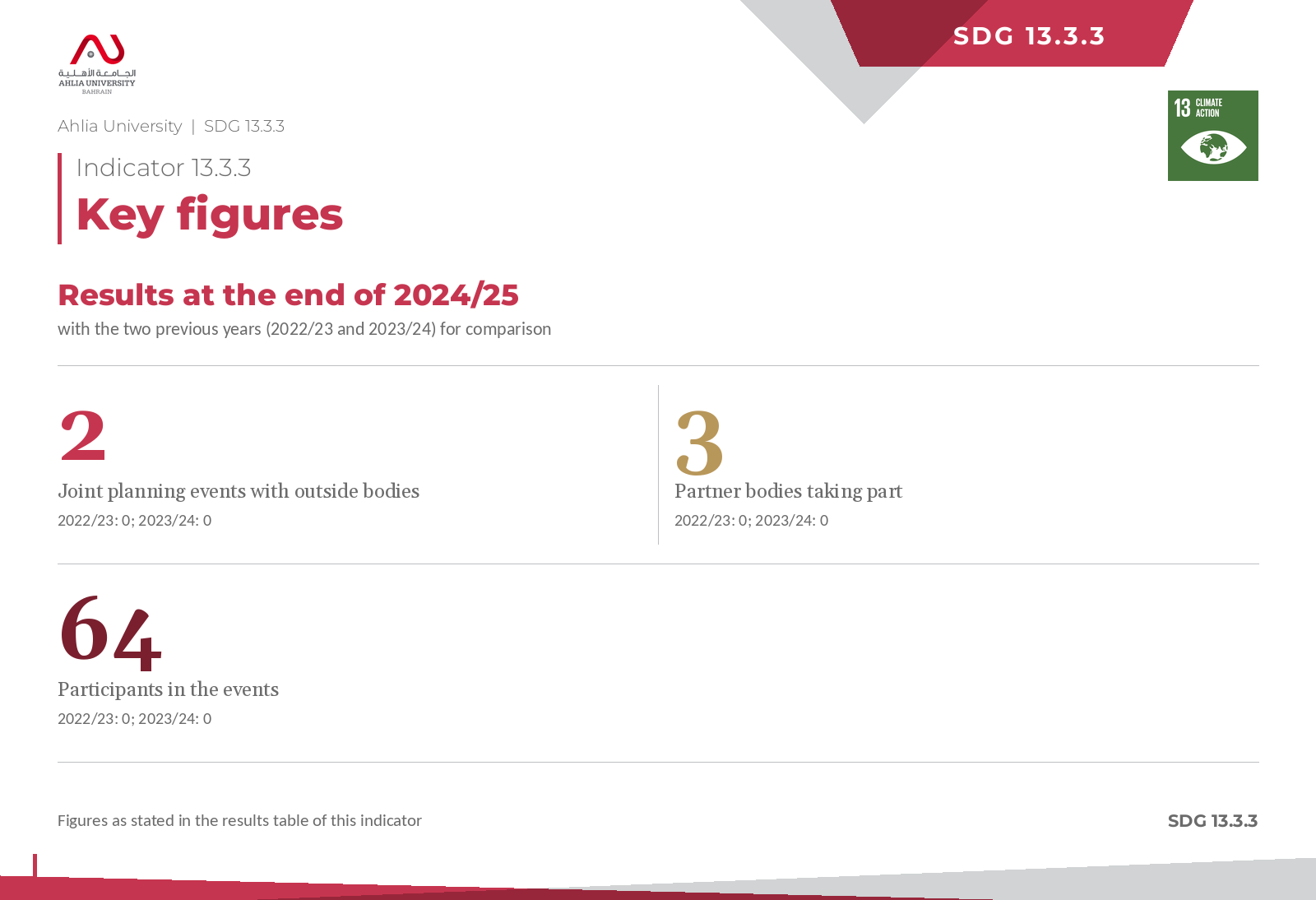
In 2024/25 the University took part in 2 co-operative planning events, 1 local and 1 regional, with 3 partner bodies, 2 other organisations at the regional workshop and 64 participants. Earlier years show 0 because the plan was first written in 2024/25. The Sustainable Development Goals are written SDGs.
At a glance
Element
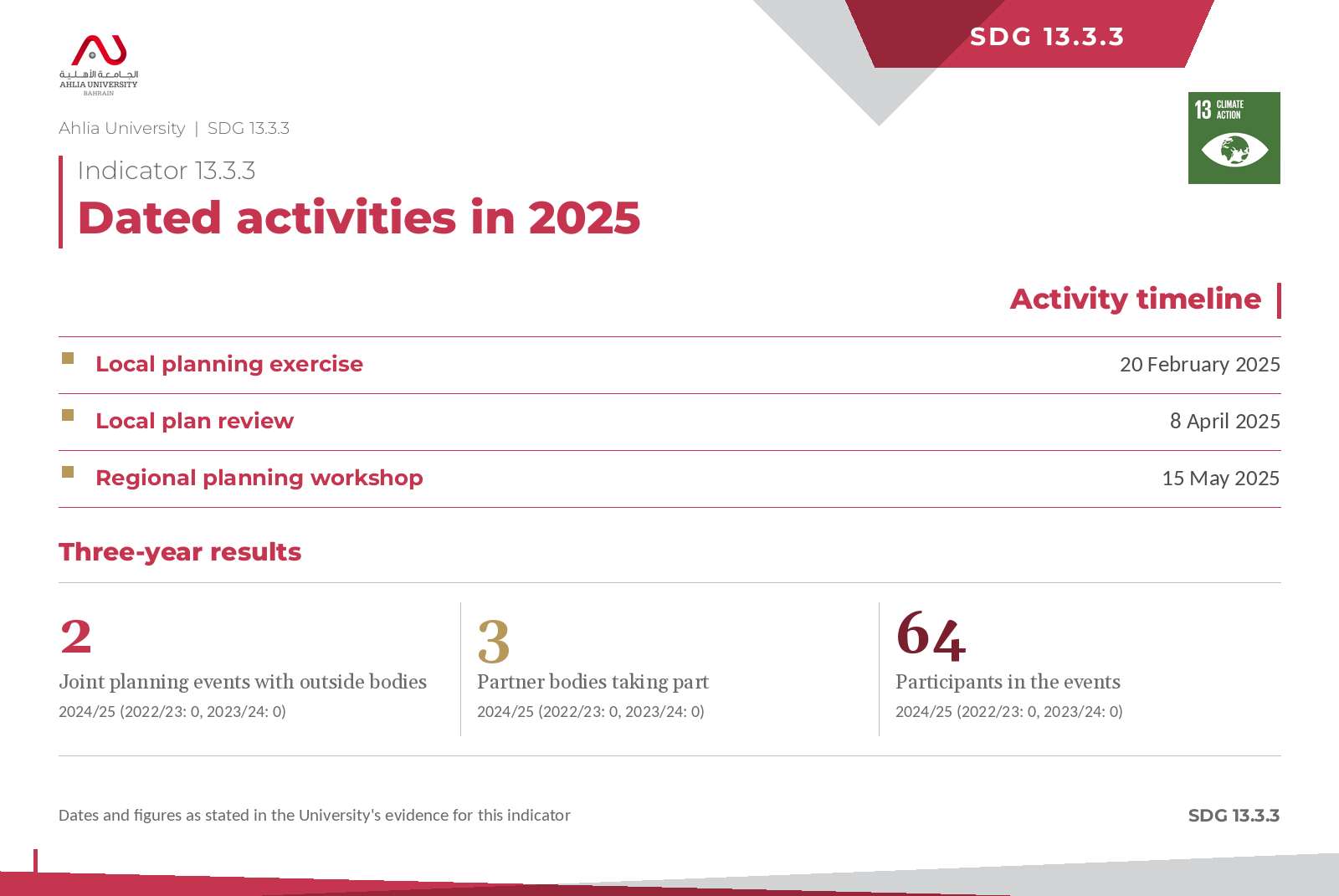
| Local planning exercise | Standing provision: Joint table-top exercise with the Capital Governorate on an extreme heat day and a storm with flooding, and exchange of contact lists Owner: Dean of Student Affairs Latest dated instance in 2025: Thursday 20 February 2025 (38 participants) Three-year figure: 1 exercise, 38 participants |
|---|---|
| Regional planning workshop | Standing provision: Workshop with the United Nations Information Centre for the Gulf Countries, Manama, and 2 other organisations of the Gulf, on early warning and shared planning Owner: SDG Unit within CAQA Latest dated instance in 2025: Thursday 15 May 2025 (26 participants) Three-year figure: 1 workshop, 26 participants |
| Local plan review | Standing provision: Review of the plan's evacuation steps with the Bahrain Association for Parents and Friends of the Disabled Owner: Dean of Student Affairs Latest dated instance in 2025: Written review, Tuesday 8 April 2025 (counted in the exercise attendance) Three-year figure: 1 review |
▪ Each row is developed below with its evidence.
1. The Campus Climate Emergency and Resilience Plan
The plan covers four risks that apply to the Gosi Complex and its neighbourhood: extreme heat, storms with flooding, dust and poor air quality, and loss of electricity or cold supply. For each risk it sets triggers, who acts, how students and staff are told, and when classes move online. It was prepared by the Facilities and Maintenance and SDG Unit team during 2024 and approved on 22 January 2025. The working group of President's Decision No. 125/2025 implements it, tests it and reviews it each year, and has members from Facilities and Maintenance, the College of Engineering, the College of Medical and Health Sciences, the Dean of Student Affairs and the SDG Unit within the Centre for Accreditation and Quality Assurance (CAQA).
The plan names the persons by office and not by name. The Dean of Student Affairs leads the response on campus, the head of Facilities and Maintenance controls the buildings and the electricity supply, the College of Medical and Health Sciences gives first-aid cover, and the Office of the President speaks to the authorities. Each office has a deputy and a printed contact card, and the cards are checked twice a year, in September and in February. The plan also sets the actions for the days before a forecast event: a message to all students and staff 24 hours before, a check of the cooling plant, and a list of students who need help to leave the building.
A one-page version is posted at every entrance and in every classroom in Arabic and English. Staff and student volunteers from the Sustainability Club are trained each October to guide others to the exits and to the upper floors.
▪ Evidence: UC/P 754/2025 and the plan [1]; decision of the working group [2].
2. Local co-operation: the Capital Governorate
On Thursday 20 February 2025 the University held a table-top exercise with representatives of the Capital Governorate, from 9:00 am to 12:30 pm. The scenario was a hot day of 47 degrees followed by a storm with flooding of the road beside the campus. The exercise tested how a governorate warning reaches the University, who closes the entrances, how students are moved to the upper floors and how the University tells parents. Thirty-eight people took part, from the University, the governorate and the Association. The exercise found 6 gaps, among them one missing contact for after-hours warnings and unclear signs for the lower-floor exit; 5 were closed by 30 April 2025 and 1 (the sign) by 30 June 2025. The Bahrain Association for Parents and Friends of the Disabled also reviewed the evacuation steps of the plan in writing on Tuesday 8 April 2025; its comments are counted in the exercise attendance and led to the change of the lower-floor exits and signs.
The governorate shared with the University the thresholds at which it issues its own heat and storm warnings. The University changed its trigger for online classes to match them, and the governorate recorded the University's entrance and exit points on its own map of the area. Both sides agreed to repeat the exercise each February with a new scenario.
▪ Evidence: exercise programme, attendance sheet and gap record [3].
3. Regional co-operation: the Gulf
The University's regional partner is the United Nations Information Centre for the Gulf Countries in Manama, with which it held a public student debate on 18 April 2024 (indicator 13.3.1). On Thursday 15 May 2025 the two held a workshop of 26 participants from the University, the Centre and two other organisations of the Gulf on early warning and shared planning. The workshop compared how heat and storm warnings are passed on in different Gulf countries and agreed a one-page list of common terms for warnings, which the University now uses in its plan. The University's page on the Sustainable Development Goals publishes the list.
The two events differ in purpose. The local exercise tests the University's actions against the actual warnings of the authority next door. The regional workshop tests whether the words used for a warning mean the same to a student from Bahrain, Kuwait or Saudi Arabia, because the University's students and visitors come from across the Gulf. Both feed one yearly review by the working group.
▪ Evidence: workshop programme, attendance sheet and the list of common terms [4]; debate page of the United Nations in Bahrain.
Policy basis
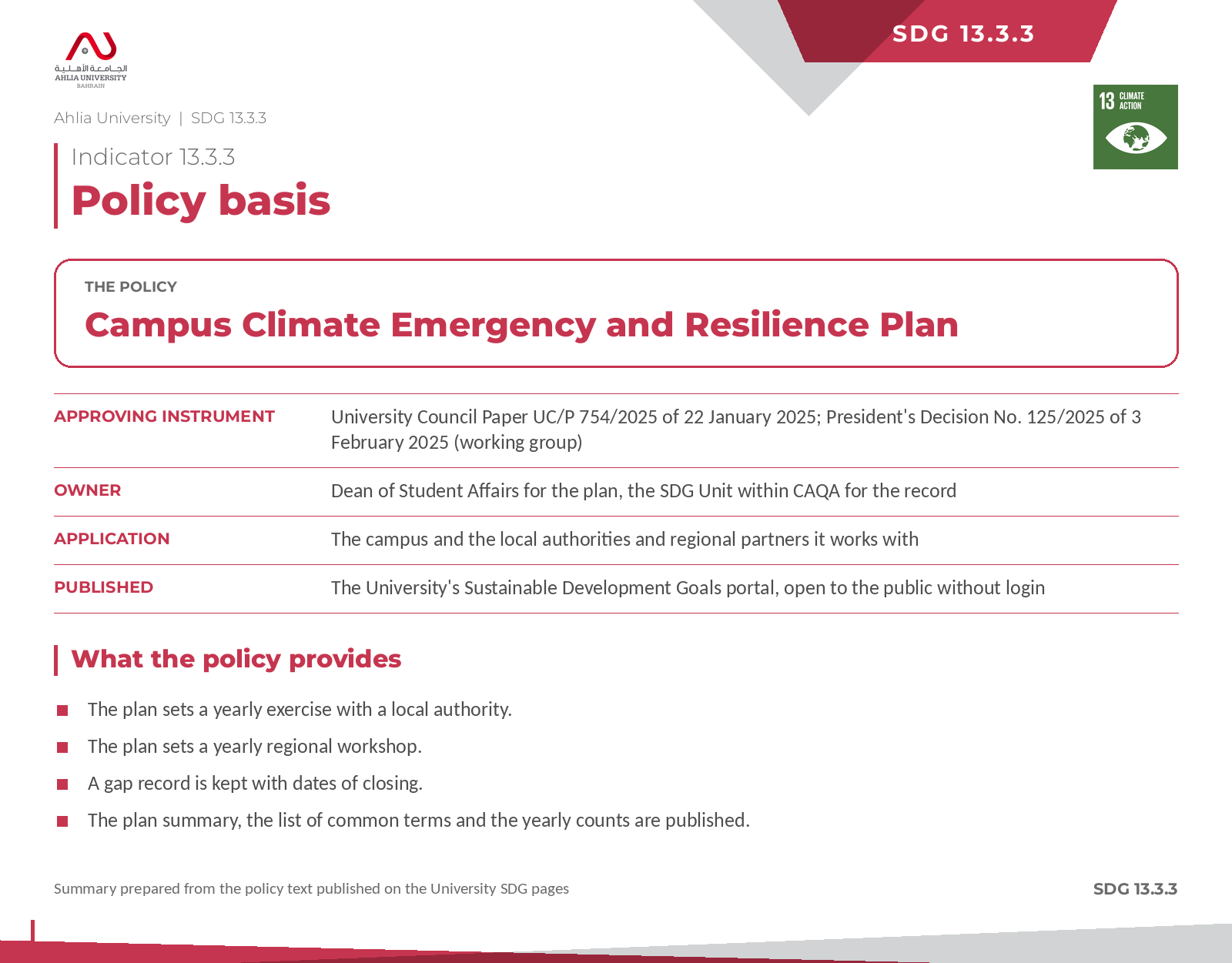
Scheme: Campus Climate Emergency and Resilience Plan, UC/P 754/2025 of 22 January 2025; President's Decision No. 125/2025 of 3 February 2025 (working group). Policies: Climate Action Plan 2025 to 2030 and Carbon Neutrality Commitment, UC/P 733/2024 of 27 November 2024; Government and Policy Engagement Protocol, UC/P 742/2024 of 25 December 2024, which sets how the University works with authorities. Owner: the Dean of Student Affairs for the plan, the SDG Unit within CAQA for the record. Application: a yearly exercise with a local authority, a yearly regional workshop, a gap record with dates of closing. Publication: the plan summary, the list of common terms and the yearly counts are published on the University's Sustainable Development Goals portal.
▪ Evidence: policy papers and decision [1] [2].
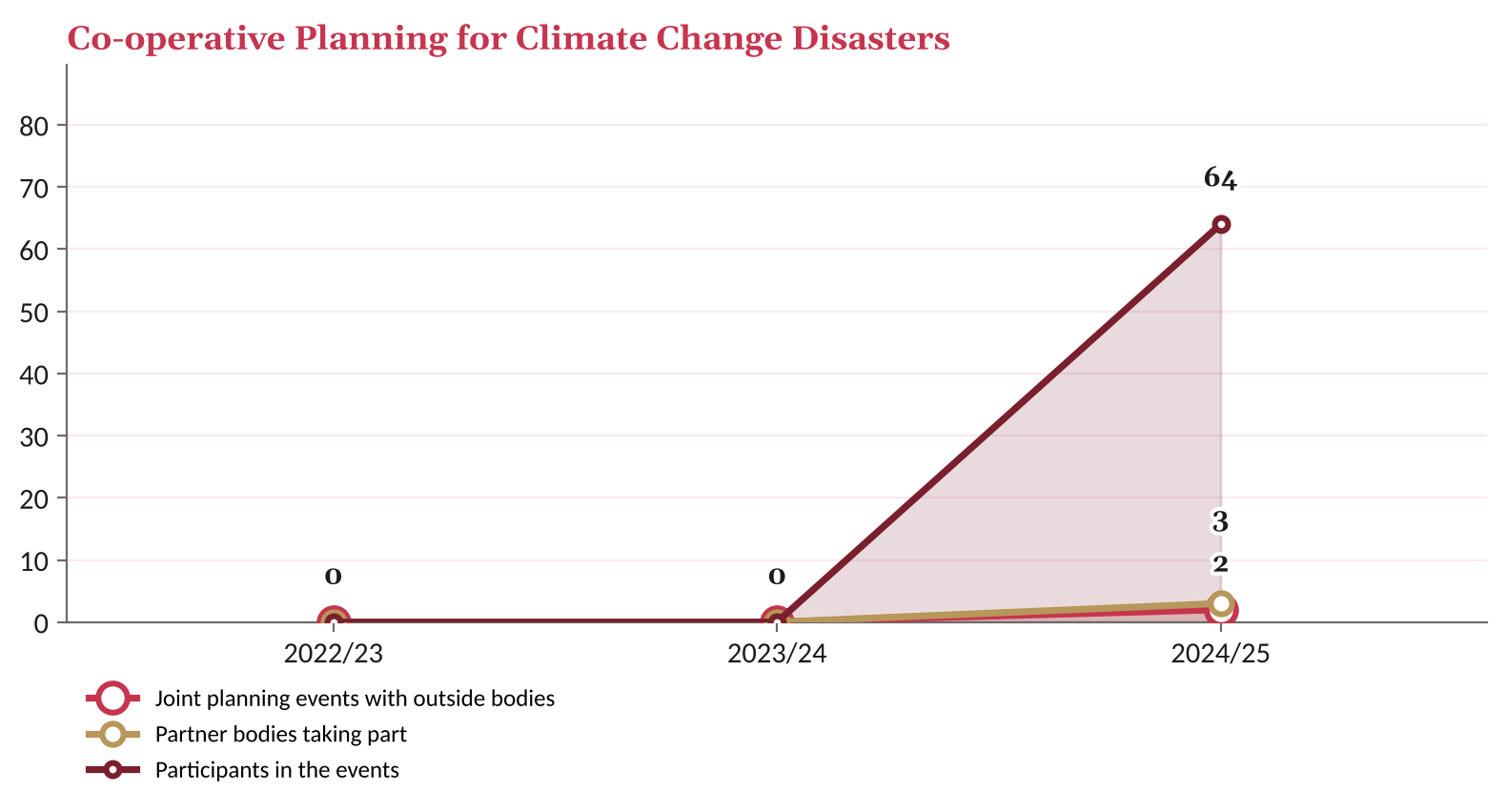
Results by academic year
Planning events are the joint exercises and workshops with outside bodies, counted in the academic year in which they were held. Partner bodies are the outside organisations that took part: the Capital Governorate, the Centre for the Gulf Countries and the Association; the two other organisations of the Gulf at the workshop are not counted as partners. Participants are the attendance of the two events. The earlier years show 0 because the plan was first written in 2024/25.
| Indicator | 2022/23 | 2023/24 | 2024/25 |
|---|---|---|---|
| Joint planning events with outside bodies | 0 | 0 | 2 |
| Partner bodies taking part | 0 | 0 | 3 |
| Participants in the events | 0 | 0 | 64 |
▪ Evidence: attendance sheets and gap record [3] [4].
Publication and verification
This document, which is the University's evidence for indicator 13.3.3 and is kept by the Dean of Student Affairs, was approved by University Council Paper UC/P 830/2026 of 14 January 2026 together with the 2025 edition of the SDG reports (University Council Paper UC/P 829/2026 of the same day, published 21 January 2026) and published on the University's Sustainable Development Goals portal on 28 January 2026, open to the public without login. The underlying registers, which are the plan, the decision, the programmes, the attendance sheets and the gap record, are held by the SDG Unit within CAQA and are quoted in the text above.
Evidence and references
- University Council Paper UC/P 754/2025 and Campus Climate Emergency and Resilience Plan
- President's Decision No. 125/2025 (working group) and UC/P 733/2024, UC/P 742/2024
- Dean of Student Affairs: programme, attendance sheet and gap record of the exercise of 20 February 2025
- SDG Unit: programme, attendance sheet and list of common terms of the workshop of 15 May 2025
- United Nations in Bahrain: student debate at Ahlia University, 18 April 2024 https://bahrain.un.org/en/266711-new-technologies-and-sdgs-discussed-student-debate-ahlia-university