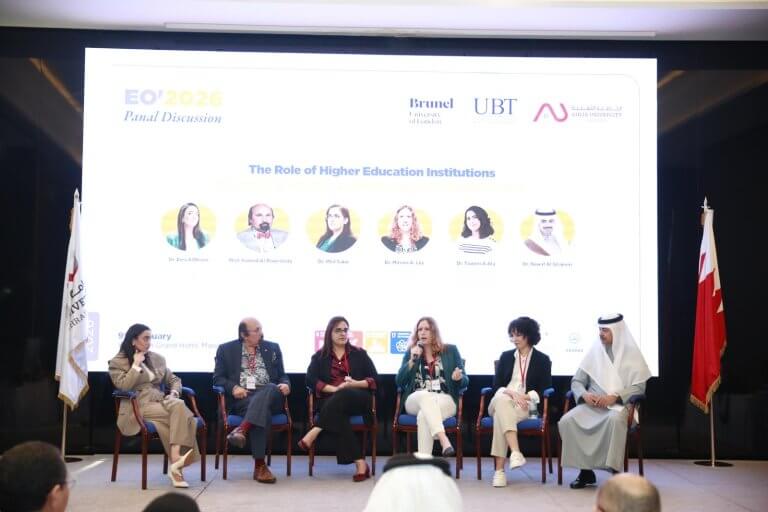
A session at the Equal Opportunities Conference, hosted by Ahlia University under the patronage of H.E. Ahmed bin Salman Al Musallam, examined how universities can prepare graduates to navigate the evolving relationship between humans and machines in the age of artificial intelligence.
The session, chaired by Dr. Esraa Al Dhaen, brought together local and international academics to discuss the growing impact of AI across education and the labour market, and the need to balance technological advancement with human-centred skills.
Dr. Al Dhaen noted that the Fifth Industrial Revolution calls for a reassessment of educational approaches, emphasising the importance of combining technical competencies with core human skills such as communication, critical thinking, and teamwork, while cautioning against excessive reliance on automation.
Professor Hamed Al-Rashidi of Brunel University London stated that artificial intelligence should be viewed as a tool to support decision-making rather than replace it, highlighting that while AI can process data efficiently, it cannot substitute human judgment or deep academic understanding.
Dr. Mariam Lili stressed the importance of promoting ethical awareness in the use of AI in research, while Dr. Tasneem Abdel-Aty pointed to the need for flexible education systems capable of adapting to rapid changes, citing the shift to hybrid learning models during the COVID-19 pandemic.
Dr. Effat Sabr highlighted the integration of Sustainable Development Goals into education through experiential learning and community engagement. Dr. Nawaf Al-Ghanem emphasised the importance of long-term strategic thinking and complex problem-solving in preparing graduates, noting that innovation depends on the ability to apply technology thoughtfully and critically.
The session also addressed the gap between universities and industry, stressing the importance of strengthening partnerships between academia, the private sector, and government to translate knowledge into tangible economic and social value.
The discussion concluded that the future of higher education lies in achieving a balanced approach that integrates technological progress with human development, ensuring graduates are equipped with the skills, competencies, and ethical responsibility needed to thrive in a knowledge-driven economy.